
Changshu Bank(601128)

Search documents
中小银行改革化险再提速 年内已有90家村镇银行退出
2 1 Shi Ji Jing Ji Bao Dao· 2025-07-15 11:31
Core Viewpoint - The reform and risk mitigation of village and town banks in China are accelerating, with multiple cases of absorption and merger occurring simultaneously across various regions, indicating a shift from pilot exploration to large-scale replication in the sector [3][4][11]. Summary by Sections Recent Developments - Recent announcements from banks in Guizhou, Xinjiang, Sichuan, and Jiangsu indicate a trend of absorption and merger of village and town banks, with Guizhou Bank merging with Tongren Fengyuan Village Bank and Xinjiang Bank planning to absorb Xinjiang Huihe Bank [1][2]. - Chengdu Rural Commercial Bank announced plans to absorb and merge six village banks in Sichuan, with regulatory approval granted shortly after [1]. Regulatory Context - The National Financial Regulatory Administration has prioritized the reform and risk mitigation of small financial institutions, with nearly 200 small financial institutions expected to merge or be dissolved by 2024 [4][11]. - As of mid-July, 90 village banks have exited the market this year, surpassing the total of 83 from the previous year, highlighting the urgency of addressing risks in weaker economic regions [4]. Merging Strategies - The absorption and merger of village banks have developed into four distinct strategies: 1. **Branch Conversion**: The most common method, where the village bank's license is canceled, and the original branches are rebranded as branches of the parent bank [6][7]. 2. **Equity Acquisition**: Involves acquiring all shares of the village bank before merging it into a wholly-owned subsidiary [7]. 3. **Survival Mergers**: Multiple village banks controlled by the same parent bank merge into one, retaining the license of the surviving entity [8]. 4. **Cash Buyouts**: The parent bank buys out the village bank's net assets and dissolves it, integrating its assets and liabilities [9]. Market Trends - The trend of bank branch closures is evident, with 2,027 branches exiting the market this year compared to 1,673 last year, driven by high costs and the rise of mobile banking [9]. - For banks still in an expansion phase, merging village banks and establishing branch networks is seen as beneficial for market penetration [10]. Future Outlook - The restructuring of village banks is expected to accelerate, with a focus on risk mitigation and enhancing service to rural revitalization and small enterprises [11]. - Regulatory support is deemed necessary for small banks to thrive, including differentiated regulatory rules and incentives for effective risk management [11].

上证基本面300指数上涨0.02%,前十大权重包含亨通光电等
Jin Rong Jie· 2025-07-14 08:24
Core Viewpoint - The Shanghai Basic 300 Index has shown a mixed performance with a slight increase of 0.02% on the latest trading day, reflecting a 2.88% rise over the past month and a 7.58% increase over the last three months, while year-to-date it has risen by 3.00% [1] Group 1: Index Performance - The Shanghai Basic 300 Index closed at 8033.05 points with a trading volume of 100.827 billion yuan [1] - The index series includes the Basic 200, 300, and 500 indices, which are based on fundamental value metrics such as revenue, cash flow, net assets, and dividends [1] - The index aims to mitigate the over-allocation of overvalued securities by breaking the link between market capitalization and weight [1] Group 2: Index Holdings - The top ten weighted stocks in the Shanghai Basic 300 Index include SMIC (1.04%), Dongwu Securities (1.02%), and Changshu Bank (0.98%) [2] - The index is fully composed of stocks listed on the Shanghai Stock Exchange [3] Group 3: Sector Allocation - The sector distribution of the index holdings is as follows: Industrial (26.97%), Materials (14.39%), Financials (10.86%), Information Technology (8.52%), Healthcare (8.34%), Consumer Discretionary (8.33%), Consumer Staples (5.08%), Energy (5.03%), Communication Services (4.55%), Real Estate (4.05%), and Utilities (3.88%) [3] - The index samples are adjusted annually, with changes implemented on the next trading day after the second Friday of June [3]




上市银行年度分红进行时 银行股投资吸引力持续凸显
Zheng Quan Ri Bao Wang· 2025-07-13 12:51
Core Viewpoint - A-share listed banks are actively distributing dividends, reflecting strong operational performance and compliance with regulatory requirements for cash dividends [1][2] Group 1: Dividend Distribution - As of July 13, 35 out of 42 A-share listed banks have completed their 2024 annual dividend distributions, including major state-owned banks and several joint-stock and city commercial banks [1] - The trend of high dividend payouts is driven by the implementation of new policies aimed at enhancing cash dividends and improving predictability in dividend distributions [1][2] Group 2: Dividend Yield - Approximately half of the A-share listed banks have a dividend yield exceeding 4%, with six banks, including China Merchants Bank and Postal Savings Bank, surpassing 7% [2] - The high dividend yield is attributed to the banks' stable long-term operations and a lower risk appetite among investors who prioritize steady returns [2] Group 3: Market Performance - The banking sector has seen a cumulative increase of 19.34% year-to-date, driven by the appeal of high dividend yields and increased cash dividend distributions [2] - Several banks are planning mid-term dividend proposals for 2025, further enhancing their investment attractiveness [2] Group 4: Future Outlook - The current market environment is expected to support a steady upward trend in bank stocks, bolstered by strong operational performance and high dividend levels [3] - The defensive nature of bank stocks, combined with favorable macroeconomic policies, suggests continued investment value despite external challenges [3]






机构密集调研银行,这些指标受关注
新华网财经· 2025-07-13 08:56
Core Viewpoint - The article highlights the increasing interest of institutional investors in listed banks, particularly focusing on loan allocation, interest margin trends, and capital replenishment strategies. Group 1: Investor Engagement - Multiple listed banks, including Jiangsu Bank, Suzhou Bank, and Ningbo Bank, have engaged in investor relations activities, discussing key issues with investors [1] - As of July 12, 2023, 26 listed banks have been surveyed by institutions, totaling 230 instances of engagement, primarily among small and medium-sized banks [1][3] - Changshu Bank received the highest number of surveys at 33, while Ningbo Bank attracted the most institutions, with 195 participating [3][4] Group 2: Interest Margin Trends - The interest margin remains a hot topic among institutions, with the net interest margin for banks reported at 1.43% in Q1 2025, a year-on-year decrease of 0.11 percentage points [4] - Jiangsu Bank aims to maintain a net interest margin that outperforms peers by enhancing asset research capabilities and managing loan interest rates [5] - Changshu Bank plans to consolidate its interest margin advantage by optimizing both asset and liability sides, focusing on high-yield assets and controlling high-cost deposits [6] Group 3: Capital Replenishment - Capital replenishment is another key focus for investors, with regulatory updates from the Financial Regulatory Bureau regarding advanced capital measurement methods [8] - Ningbo Bank is actively researching regulatory requirements and plans to issue up to 45 billion yuan in capital bonds [8] - Suzhou Bank reported a successful conversion of nearly 5 billion yuan in convertible bonds, enhancing its capital strength [9] - Su Nong Bank intends to issue up to 1 billion yuan in secondary capital bonds to support its operations [9]





名场面!上市银行6300亿“红包”只是前菜,中期分红接踵而至
2 1 Shi Ji Jing Ji Bao Dao· 2025-07-11 11:46
Core Viewpoint - The A-share listed banks are experiencing a peak in dividend distribution, with total dividends for 2024 exceeding 630 billion yuan, marking an increase of 20 billion yuan from the previous year, and setting a new historical high [1][4]. Dividend Distribution - On July 11, both China Merchants Bank and Xi'an Bank distributed cash dividends, with China Merchants Bank paying 2.000 yuan per share, totaling approximately 50.44 billion yuan, resulting in a dividend yield of about 5.7% based on a hypothetical share price of 35 yuan [2][3]. - Xi'an Bank distributed 1 yuan for every 10 shares, amounting to 444 million yuan, which represents 17.37% of its net profit [2]. - On July 10, Beijing Bank and CITIC Bank also executed dividend distributions, with Beijing Bank distributing 0.2 yuan per share, totaling 4.23 billion yuan, and CITIC Bank distributing 0.1722 yuan per share, totaling 9.582 billion yuan [3]. Overall Dividend Performance - As of July 11, 33 A-share listed banks have completed their 2024 annual dividend distributions, with five more having announced their plans [3]. - The six major state-owned banks maintained a dividend payout ratio of over 30%, with total cash dividends reaching 420.63 billion yuan, led by Industrial and Commercial Bank of China with 109.77 billion yuan [4]. Mid-term Dividend Plans - Several banks are planning mid-term dividends for 2025, with institutions like Changsha Bank and Su Nong Bank expressing intentions to enhance shareholder returns through mid-term distributions [5][6]. - The trend of increasing mid-term dividends is seen as a strategy to improve investor satisfaction and share the benefits of high-quality growth [6]. Market Outlook - Analysts predict a narrowing decline in net profit and revenue for listed banks in the first half of the year, with expectations of a 0.9% year-on-year decrease in revenue and a 0.5% decrease in net profit [7]. - The current market environment is viewed as the beginning of a long-term upward trend for bank stocks, supported by low interest rates and the revaluation of RMB assets [7].

上半年超两千次调研创纪录,机构怎么看银行股投资价值?
Di Yi Cai Jing· 2025-07-09 10:40
Core Insights - A-share listed banks, particularly city commercial banks and rural commercial banks, have become popular among institutional investors due to their strong performance and resilience in the current economic environment [1][2][3] Group 1: Institutional Research Trends - In the first half of the year, 25 banks received institutional research, totaling 2365 instances, marking a historical high [2] - City and rural commercial banks are the main focus of this research, with notable interest in Ningbo Bank and Changshu Bank, which attracted significant foreign institutional participation [2][4] - The research highlights a regional focus, with banks in the Yangtze River Delta and Chengdu-Chongqing economic circles receiving the most attention [2][4] Group 2: Key Areas of Focus - Institutional investors are particularly interested in credit allocation, asset quality, and dividend policies of banks [1][6] - Ningbo Bank reported an average net interest margin of 1.475%, outperforming state-owned banks, which averaged 1.33% [3] - The focus on dividend policies is evident, with banks like Chongqing Bank maintaining high cash dividend levels for over a decade [6] Group 3: Asset Quality and Future Outlook - Banks express confidence in maintaining stable asset quality, with expectations of better performance in net interest margins compared to the previous year [7] - Analysts predict continued interest in bank stocks due to their high dividend yields and stable earnings, despite potential downward pressure on interest margins [7]
常熟农商银行金融助力低空经济发展
Jiang Nan Shi Bao· 2025-07-07 23:16
Core Viewpoint - The third Low Altitude (Suzhou) Industry Innovation Ecological Conference and the 2025 Digital Low Altitude Conference was held in Suzhou, focusing on the theme "Digital Innovation Leads, Intelligent Benefits for the Future" [1] Group 1: Financial Support Initiatives - Changshu Rural Commercial Bank actively engaged in the low-altitude economy sector by leveraging its financial institution advantages to communicate with industry representatives, researchers, and experts [1] - The bank has implemented various measures to support the development of the low-altitude economy, including financial service innovation, industry chain collaboration, talent cultivation, and resource integration [1][2] - Financial products offered by the bank, such as "Patent Loan," "Talent Loan," and "Hui Ke Loan," are designed to meet the needs of technology-driven companies in the low-altitude economy, characterized by light assets and high R&D investment [1] Group 2: Comprehensive Service Coverage - The bank provides full-cycle services covering all stages of enterprise development, offering construction loans for newly introduced companies and working capital support for mature enterprises [2] - A "policy supermarket" has been established, integrating over a hundred policies, including tax incentives and technological transformation subsidies, to assist companies in matching applicable projects [2] - The bank actively builds platforms for government, banks, and enterprises to connect, supporting low-altitude economic activities and promoting technological cooperation and order matching among industry chain enterprises [2] Group 3: Talent Development and Future Plans - The bank has a dedicated team for scientific and technological innovation, conducting in-depth research on low-altitude economic trends and collaborating with universities to establish postdoctoral workstations [2] - As the low-altitude economy is a rapidly growing emerging industry, the bank aims to provide comprehensive and customized financial services to enterprises in this sector through multi-dimensional initiatives [2] - The bank plans to continue its efforts in financial innovation to empower the low-altitude economy and explore new development paths in collaboration with industry stakeholders [2]
净息差和不良率“倒挂”,银行盈利承压如何破局?
Di Yi Cai Jing· 2025-07-07 12:49
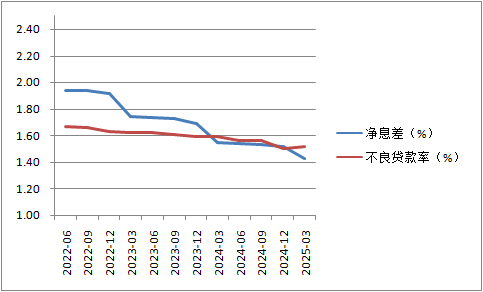
Core Viewpoint - The banking industry is facing significant pressure as net interest margins have fallen below non-performing loan ratios for the first time, indicating a critical need for banks to diversify their income sources beyond interest income [1][2][4]. Group 1: Financial Performance Indicators - In Q1, the net interest margin for Chinese commercial banks decreased to 1.43%, down 9 basis points from the previous quarter, while the non-performing loan ratio rose to 1.51%, an increase of 0.01 percentage points [2][4]. - Among the major banks, state-owned banks had the lowest non-performing loan ratios at 1.22% and 1.23%, while rural commercial banks faced the highest at 2.86% [4]. - A total of 9 out of 42 listed banks reported net interest margins lower than their non-performing loan ratios, highlighting the growing financial strain within the sector [4][5]. Group 2: Challenges and Market Dynamics - The banking sector is experiencing ongoing challenges due to declining asset quality, which is affecting profitability and the ability to cover costs associated with credit, operations, and capital [4][6]. - Analysts indicate that the pressure on net interest margins is exacerbated by weak credit demand and a shift towards lower-yielding short-term loans, leading to a decline in asset yields [6][7]. - The average net interest margin for listed banks has been on a downward trend for five consecutive years, with many banks now below the 1.8% warning line set by market pricing mechanisms [7][8]. Group 3: Strategic Responses - To address the challenges posed by low interest rates, banks are encouraged to diversify their income sources, focusing on non-interest income and other financial services [8][9]. - Recommendations include reducing deposit interest subsidies and hidden costs associated with deposits to alleviate margin pressures [8]. - Banks are advised to adopt a more resilient and balanced income structure, optimizing their liabilities and controlling costs to enhance profitability [9].

超千家机构密集调研上市银行!谁最受青睐?重点关注哪些问题?
Xin Lang Cai Jing· 2025-07-07 11:11
Core Insights - The recent surge in institutional interest in listed banks indicates a significant increase in market attention towards bank stocks, reflecting a deep re-evaluation of the banking sector's value amid a weak economic recovery [2][6] - The banking sector has shown strong performance in the first half of the year, with a total stock price increase of 13.1%, making it the second-best performing sector in the market [3][5] Institutional Interest - In the first half of the year, 19 A-share listed banks received over a thousand institutional research visits, marking a record high [1] - Regional banks, particularly those in the Yangtze River Delta, have become the primary targets for institutional investors, with Ningbo Bank, Changshu Bank, and Hangzhou Bank leading in the number of research visits [1] Dividend Policies - Most listed banks have increased their total cash dividends for 2024, with 39 out of 42 banks raising their dividend amounts by a total of 18.6 billion yuan compared to the previous year [2][6] - The average dividend yield for bank stocks stands at 5.04%, significantly higher than the 1.65% yield of 10-year government bonds, making bank stocks attractive to long-term institutional investors [2][3] Asset Quality and Net Interest Margin - Institutions are focusing on banks' asset quality, net interest margin management, and dividend policies during their research [4][5] - The banking sector's non-performing loan ratio is expected to remain low at 1.50% in 2024, although overdue rates are rising, particularly among rural commercial banks [5][6] Future Outlook - Institutions are likely to focus on whether net interest margins stabilize, the direction of loan structure adjustments towards green and technology finance, and the potential for new business growth through digital transformation and comprehensive services [7]
银行投资跟踪:国有大行推进“村改支”的启示
Tianfeng Securities· 2025-07-07 08:13
Investment Rating - The industry investment rating is "Outperform the Market" (first rating) [1] Core Insights - The reform of rural banks is a key focus for financial work this year, with significant risks identified in small and medium-sized banks, particularly in economically weaker regions [2][5] - Since 2024, the reform of rural banks has accelerated, with over 50 banks undergoing mergers and restructuring in the first half of the year [2][8] - The main reform paths for rural banks include "village to branch" (村改支), "village to division" (村改分), and equity transfer [9][11] - The acquisition of rural banks by state-owned banks is a crucial strategy for risk mitigation, with the Industrial and Commercial Bank of China (ICBC) leading the way [12][14] - Financial indicators for state-owned banks remain robust, and the impact of participating in rural bank reforms on their operations is relatively limited [16][21] Summary by Sections Section 1: Background and Policy Requirements - The economic restructuring and external uncertainties have led to deteriorating asset quality and increased credit risks in small banks, necessitating urgent risk resolution [5] - As of Q1 2025, the non-performing loan ratio of rural commercial banks is 1.35 percentage points higher than the average for commercial banks, indicating significant asset quality pressure [5] Section 2: Recent Developments in Rural Bank Reforms - The first half of 2024 saw a rapid pace of rural bank reforms, with over 50 banks merged or restructured [2][8] - The regulatory authority has issued approximately 20 approvals for mergers and dissolutions of rural banks in December 2024, a significant increase from the previous year [8] Section 3: Financial Health of State-Owned Banks - Key financial metrics for state-owned banks as of Q1 2025 show stability, with non-performing loan ratios and provision coverage ratios indicating a strong financial position [15] - The potential impact of acquiring "red zone" banks on the overall non-performing loan ratio is minimal, with estimated increases of only 4 to 8 basis points depending on the acquisition percentage [17][18] Section 4: Investment Implications - The current performance of banks is stable, presenting investment opportunities, particularly in high-yield dividend stocks [21] - The anticipated policy support and strong capital positions of state-owned banks further enhance their investment attractiveness [21]
