
INDUSTRIAL BANK(601166)

Search documents
深圳多家银行启动房贷利率调整!二套房100万贷款30年少还8万
Di Yi Cai Jing· 2025-09-12 15:39
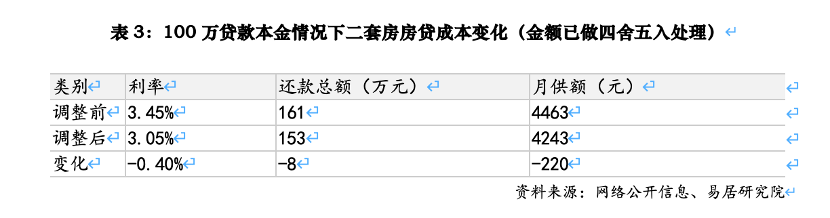
Core Viewpoint - Shenzhen has implemented new policies regarding housing loans, allowing for adjustments in interest rates for second homes, which may lead to a reduction in borrowing costs for homeowners [2][3]. Group 1: Policy Changes - As of September 12, 2023, 12 banks in Shenzhen announced that they will no longer differentiate between first and second home loans in their interest rate pricing [2][3]. - The new policy allows for the adjustment of interest rates on existing second home loans, with clients able to apply for these adjustments immediately [2][5]. Group 2: Interest Rate Adjustments - The new interest rate for second home loans may decrease by 40 basis points, resulting in significant savings for borrowers [3][4]. - For a loan of 1 million yuan over 30 years, the total repayment cost could decrease by nearly 80,000 yuan, with monthly payments reduced by approximately 220 yuan [3][4]. Group 3: Mechanism for Existing Loans - Existing loans that have interest rates higher than the average new loan rates plus 30 basis points can apply for adjustments [5][6]. - The People's Bank of China has established a mechanism for the regular adjustment of existing loan rates, allowing borrowers to negotiate changes based on market conditions [5][6]. Group 4: Application Process - Different banks have varying channels for clients to apply for interest rate adjustments, with some offering online applications through mobile banking platforms [7]. - Clients can check their eligibility for rate adjustments through designated online functions provided by their banks [7].







兴业银行哈尔滨分行积极探索“金融特派员+”服务模式提升企业获得感
Zhong Guo Jin Rong Xin Xi Wang· 2025-09-12 12:18
Group 1 - Inclusive finance is a crucial area for financial services to support the real economy and promote high-quality economic and social development [1] - Industrial Bank's Harbin branch is actively implementing the "Financial Commissioner +" service model to enhance the quality and efficiency of inclusive financial services for small and micro enterprises [1][4] - The bank's financial commissioners have identified funding gaps as a bottleneck for enterprise development during field research and discussions with local businesses [3] Group 2 - A tailored "Supply Chain + Inclusive Finance" comprehensive service plan was developed for Daqing Sanyuan Zhisheng Pharmacy Chain Co., Ltd., resulting in the efficient issuance of a special loan of 10 million yuan [3] - The bank's financial commissioners also assisted Daqing Dechuang Petrochemical Company in addressing challenges related to foreign exchange settlement and procurement costs, leading to a quick loan approval process through the "Xing Su Loan" product [3] - A three-tier service mechanism involving financial commissioners, customer managers, and expert teams was established to ensure timely response to client needs, creating a closed-loop service system that enhances enterprise satisfaction [4]

上半年多家股份行人均薪酬微降,人力资源成降本重要“阵地”
Nan Fang Du Shi Bao· 2025-09-12 12:01
Core Viewpoint - The banking industry is focusing on cost control and efficiency improvement as a consensus, with human resource optimization being a key strategy for cost management in 2025 [2][4]. Salary Analysis - Over 10 banks reported an average monthly salary exceeding 40,000 yuan, with notable figures including China Merchants Bank at 50,500 yuan and Nanjing Bank at 48,200 yuan [2]. - Salary changes varied, with some banks like China Merchants Bank and Everbright Bank experiencing slight declines compared to the previous year [4]. - State-owned banks generally reported lower average salaries, with Bank of China showing a monthly salary of 28,000 yuan, a slight increase year-on-year [4]. Cost Control Measures - Banks are implementing strict cost control measures, including reducing employee numbers and optimizing salary expenditures [2][5]. - For instance, Shanghai Pudong Development Bank reduced its employee expenses by 9.58 billion yuan, with a decrease in employee count by 673 [5]. - The overall trend shows a reduction in workforce among major state-owned banks, totaling over 20,000 employees, while some joint-stock banks increased their workforce [5]. Deposit Cost Management - Managing deposit costs has become a common strategy, with a focus on low-cost deposits as a key tool for banks [6][8]. - As of the end of Q2, the net interest margin for commercial banks was 1.42%, a slight decrease from the previous quarter [8]. - China Merchants Bank reported a significant reduction in deposit costs, with an average annual cost rate of 1.26%, down 34 basis points year-on-year [8]. Digital Transformation and Efficiency - Banks are increasingly adopting digital solutions to enhance operational efficiency and reduce costs, focusing on automating processes and minimizing manual operations [12]. - The shift towards digital banking is seen as a means to not only cut costs but also to restructure processes and improve overall efficiency [12]. - Some banks are closing inefficient branches and optimizing their real estate management to further reduce costs [11].


央行:调整后的一级交易商考评办法将从2025年启用,考评期内行为不当的一级交易商将被暂停参与公开市场操作
Sou Hu Cai Jing· 2025-09-12 10:45
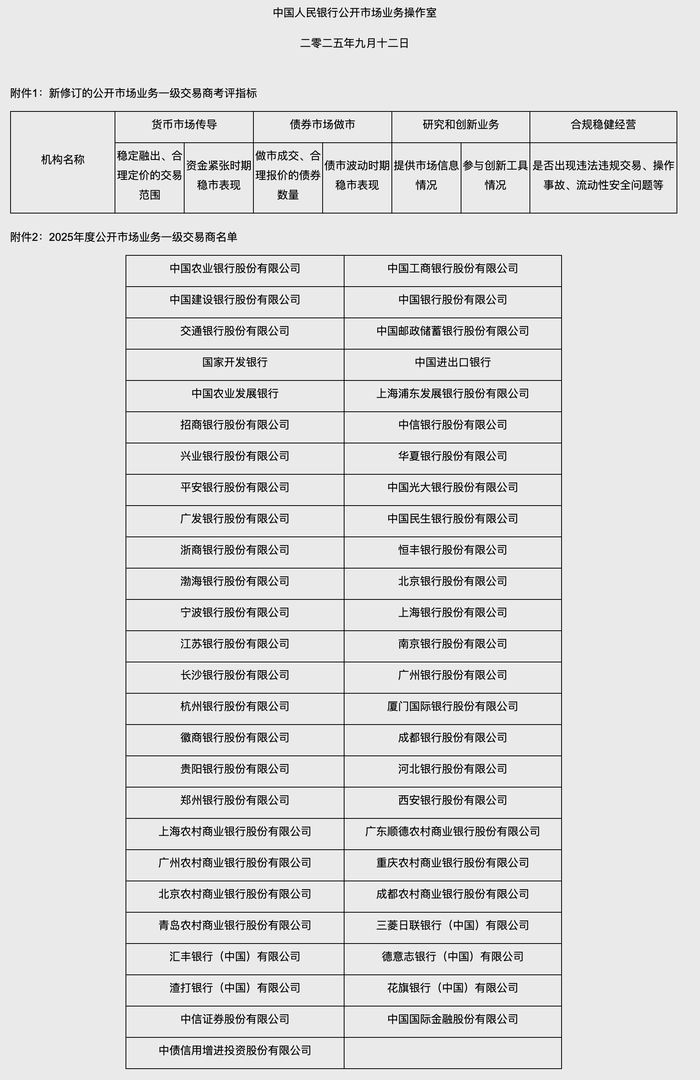
Core Viewpoint - The People's Bank of China (PBOC) has established a new evaluation mechanism for primary dealers in the open market, which will be implemented in 2025, aiming to enhance the transmission of monetary policy and adapt to the evolving financial market [1]. Group 1: Evaluation Mechanism - The PBOC's evaluation mechanism for primary dealers was first established in 2004 and adjusted in 2018 to support smooth open market operations [1]. - The new evaluation method will focus on optimizing and simplifying assessment indicators, categorizing institutions for evaluation, and strengthening the linkage with bond market makers [1]. - The list of primary dealers for the year 2025 will remain unchanged, and any dealer exhibiting inappropriate behavior during the evaluation period may be suspended from participating in open market operations [1]. Group 2: Institutions Involved - A comprehensive list of institutions that will be evaluated includes major banks such as Agricultural Bank of China, Industrial and Commercial Bank of China, China Construction Bank, and Bank of China, among others [3][4]. - The evaluation will consider factors such as stable lending, reasonable pricing, market performance during tight funding periods, and compliance with operational standards [3].




兴业银行合肥分行落地系统内首笔独家承贷境外绿地项目
Zhong Guo Jin Rong Xin Xi Wang· 2025-09-12 08:34
Group 1 - The core viewpoint of the articles highlights the successful provision of exclusive cross-border financing support by Industrial Bank's Hefei branch for a leading enterprise in Anhui Province, marking a significant step in the company's global strategy and the integration of Anhui manufacturing into international capacity cooperation [1][2] - The financing support includes an initial fund of 160 million yuan, which is the first exclusive overseas greenfield project loan within the Industrial Bank system, demonstrating the bank's commitment to the "Hui Dong Global" action plan [1] - The project faces multiple challenges such as large investment scale, long construction period, and complex cross-border coordination, necessitating a high level of professionalism and comprehensiveness in financial services [1] Group 2 - Industrial Bank's Hefei branch has developed a comprehensive cross-border financial solution tailored to the enterprise's needs, covering financing consultation, structural design, cross-border coordination, and fund disbursement [1] - The bank has established a joint special team to conduct on-site due diligence in Malaysia, assessing various risks including political, economic, and legal factors, and designing a financing structure that is both internationally compliant and practically applicable [1] - In recent years, Anhui Province has been actively promoting its enterprises to participate in global industrial division and has provided over 5 billion yuan in financing support for overseas expansion [2]
信用卡“大退潮”:半年缩水2000亿,年轻人开始告别“卡奴人生”
3 6 Ke· 2025-09-12 07:18
Core Insights - The trend of young people moving away from credit cards is increasing, with a significant decline in credit card usage and ownership among the younger generation [2][6][11] Group 1: Decline in Credit Card Usage - The number of credit cards and combined lending cards in China decreased by 52 million in the first half of 2025 compared to 2023, marking 11 consecutive quarters of decline [2] - The average number of credit cards held by individuals aged 90s has dropped from 5 to 2.3, while the 00s generation shows a 42% rate of being cardless [2][6] - As of the second quarter of 2023, the total number of credit cards in circulation was 715 million, down 0.83% from the previous quarter and over 11% from the peak of 807 million in 2022 [4] Group 2: Financial Performance of Banks - In the first half of 2025, the credit card loan balance of six major state-owned banks and eight joint-stock banks totaled 7.52 trillion yuan, a decrease of 197.57 billion yuan or 2.56% from the beginning of the year [2][3] - Among 14 listed banks, 11 reported a contraction in credit card loan balances, with China Bank experiencing the largest decline of 13.88% [3] - The total credit card transaction amount across 12 banks shrank by 1.42 trillion yuan, a year-on-year decrease of 11.05% [3] Group 3: Changing Consumer Behavior - Young consumers are increasingly favoring alternative payment methods like "Huabei" and digital bank cards, with 45% of 95s believing these options are more convenient [6][7] - The topic of "cancelling credit cards" has gained significant traction on social media, indicating a cultural shift towards "debt-free" living among younger generations [6][7] - Issues such as hidden fees, annual fees, and reduced benefits have discouraged many users from maintaining their credit cards [7] Group 4: Industry Transformation - The credit card industry is transitioning from a phase of rapid expansion to one focused on value extraction from existing customers [4][11] - Over 40 banks have received approval to terminate credit card centers, signaling a shift towards refined operations rather than aggressive growth [8] - Banks are adjusting their credit card offerings, with many reducing benefits and increasing requirements for premium cards [9][10] Group 5: Future Directions - The future of credit cards is expected to focus on meeting the diverse needs of high-end customers and providing essential payment and credit conveniences for basic customers [10][11] - The rise of mobile payment solutions is reshaping the credit landscape, prompting traditional credit card services to reevaluate their value propositions [8][11]

兴业银行跌2.01%,成交额13.68亿元,主力资金净流出8729.17万元
Xin Lang Zheng Quan· 2025-09-12 06:30
Group 1 - The core point of the news is that Industrial Bank's stock price has experienced fluctuations, with a current price of 21.40 CNY per share, down 2.01% on September 12, and a total market capitalization of 452.85 billion CNY [1] - As of June 30, 2025, Industrial Bank reported a net profit of 43.14 billion CNY, reflecting a year-on-year growth of 0.21% [2] - The bank has distributed a total of 216.10 billion CNY in dividends since its A-share listing, with 68.72 billion CNY distributed in the last three years [3] Group 2 - The stockholder count for Industrial Bank as of June 30, 2025, is 191,300, a decrease of 6.23% from the previous period [2] - The top ten circulating shareholders include Hong Kong Central Clearing Limited, which holds 747 million shares, a decrease of 4.31 million shares from the previous period [3] - The bank's stock has seen an 18.23% increase year-to-date, but has declined by 1.61% over the last five trading days and 4.12% over the last twenty days [1]
兴业银行青岛分行落地数字人民币住房公积金提取业务
Zhong Guo Jin Rong Xin Xi Wang· 2025-09-12 02:49
Core Viewpoint - The successful implementation of digital RMB for housing provident fund withdrawals by Industrial Bank's Qingdao branch enhances transaction efficiency and security while providing a convenient service for citizens [1] Group 1: Digital RMB Implementation - Industrial Bank's Qingdao branch has completed its first digital RMB housing provident fund withdrawal, allowing users to transfer funds directly to their digital RMB wallets [1] - The process features real-time fund transfer, zero transaction fees, and full traceability, improving both the efficiency of fund circulation and the security of transactions [1] Group 2: Enhanced Services for Employers - Employers can utilize Industrial Bank's online banking and "Xingye Guanjia" app for online signing and changes related to housing provident fund deductions, increasing convenience for corporate contributions [1] - The collaboration with Qingdao's housing provident fund management center showcases the bank's commitment to innovating digital RMB applications in public services [1]

银行上半年“人均月薪”有多少?招商、兴业超4.5万元
Xin Lang Cai Jing· 2025-09-12 00:55
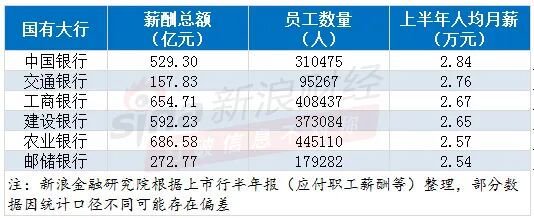
Summary of Key Points Core Viewpoint - The recent strong performance of the banking sector has drawn attention to the salary situation of listed banks, with significant differences in average salaries between state-owned banks and joint-stock banks [1][2]. Salary Data of State-Owned Banks - In the first half of 2025, the average monthly salary for employees in state-owned banks ranged from 25,400 to 28,400 yuan, with Agricultural Bank having the lowest average salary at 25,100 yuan [4][11]. - The total salary expenditure for Agricultural Bank reached 68.658 billion yuan, ranking first among state-owned banks, followed by Industrial and Commercial Bank with 65.471 billion yuan [3][4]. Salary Data of Joint-Stock Banks - Joint-stock banks generally offered higher average monthly salaries, with China Merchants Bank and Industrial Bank exceeding 45,000 yuan, specifically 50,100 yuan and 45,700 yuan respectively [6][7]. - The total salary expenditure for China Merchants Bank was 35.484 billion yuan, leading among joint-stock banks, while several others exceeded 10 billion yuan [5][6]. Employee Count Changes - Many banks reported a reduction in employee numbers, with Agricultural Bank reducing its workforce by 9,606 employees, and Industrial and Commercial Bank by over 6,700 employees [8][12]. - In contrast, China Merchants Bank was the only bank to increase its employee count, adding 867 employees [10][12]. Performance-Based Salary Mechanisms - Several banks have implemented performance-based salary mechanisms, including deferred payment and clawback provisions for high-risk positions, as seen in the practices of Minsheng Bank and Shanghai Pudong Development Bank [13][14]. - The trend of extending salary resources to county-level operations is noted, with Agricultural Bank allocating over 50% of its recruitment plan to county areas to support rural revitalization efforts [16].
私行业务跑出加速度成银行扩中收重要引擎
Zhong Guo Zheng Quan Bao· 2025-09-11 20:17
Core Insights - The private banking business has shown significant growth in both client numbers and AUM (Assets Under Management), becoming a key driver for retail banking growth amid pressure on net interest margins [1][2][3] Client Growth - Major state-owned banks lead in private banking client numbers, with Agricultural Bank of China having 279,000 clients, followed by China Construction Bank with 265,500, and Bank of China with 216,900 [1] - China Construction Bank added 34,000 private banking clients in the first half of the year, while Postal Savings Bank saw a growth of over 21% in its client base [1][2] - In the joint-stock banks, China Merchants Bank leads with 182,700 clients, followed by Ping An Bank and CITIC Bank, each exceeding 90,000 clients [2] AUM Growth - Private banking AUM growth outpaces overall retail AUM growth, with Agricultural Bank of China reporting AUM of 3.5 trillion yuan, an increase of 11.11% from the beginning of the year [2][3] - Other state-owned banks also reported significant AUM growth, with China Construction Bank at 3.18 trillion yuan, reflecting a 14.39% increase [2][3] Business Strategy and Service Development - Banks are focusing on enhancing client services, with China Construction Bank integrating personal client management and supporting private entrepreneurs [3][4] - CITIC Bank is emphasizing tiered services for ultra-high-net-worth clients, while China Everbright Bank is targeting families, women, and business owners [4] - Future developments in private banking are expected to focus on digitalization, service ecosystem integration, and global investment opportunities [4]