
INDUSTRIAL BANK(601166)

Search documents
兴业银行中层调整 多位分行干部获提任
Xin Lang Cai Jing· 2026-01-04 09:09
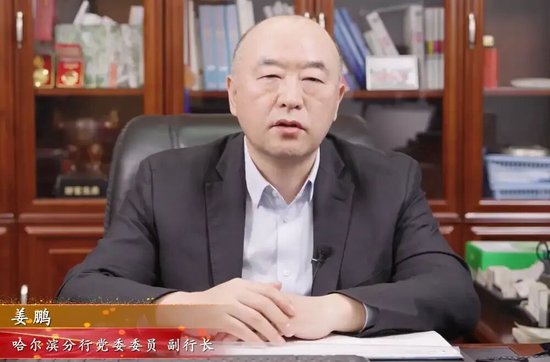
此前,2025年12月19日,兴业银行聘任孙雄鹏为首席合规官,其任职资格尚待核准。目前,华夏银行、 平安银行、民生银行等多家股份行已于2025年内先后设立首席合规官职务。 本期,主要介绍兴业银行岁末人事变动,涉及多家一级分行副行长,其中多位干部获提任。 来源:金融人事mini 近日,兴业银行公告称,修订后的公司章程已于2025年12月26日获核准并生效,自即日起,该行不再设 置监事会,由董事会审计与关联交易控制委员会行使相应职权;监事会相关制度同时废止。 审计部沈阳分部副总经理姜鹏,任审计部沈阳分部总经理;曾任兴业银行哈尔滨分行行长助理、副行 长。据悉,兴业银行审计部为总部设在福州的总行一级管理部门,在北京、上海、广州、成都、西安和 沈阳设立六个分部。 总行私人银行部资本产品处处长冯晟威,提任私人银行部总经理助理,其任职资格已于上月获准;曾任 兴业银行杭州分行投资银行部总经理。 南平分行副行长毛鸿翚,调任南昌分行副行长。 毛鸿翚,曾任兴业银行曲靖分行行长,莆田分行行长助理、副行长,2024年任南平分行副行长。南昌分 行官微最新消息显示,副行长毛鸿翚年末前往南昌支行、赣江新区支行开展年终决算慰问。 南平分行副行 ...


兴业银行厦门分行落地首笔光储充一体化项目贷款
Jin Rong Jie Zi Xun· 2026-01-04 09:02
银行频道更多独家策划、专家专栏,免费查阅>> 责任编辑:小讯 为积极响应国家"双碳"战略,推动能源结构绿色转型,兴业银行厦门分行近日成功落地分行首笔光储充 一体化项目贷款。该项目集光伏发电、储能系统与充电设施于一体,构建起多能互补、高效协同的清洁 能源体系,为厦门市新能源产业发展注入新动能。 光储充一体化项目是当前新能源领域的重要创新实践。本笔业务所支持的项目建成后,预计年发电量将 超270万千瓦时,每年可节约标准煤超1000吨,减少二氧化碳排放超2700吨,环境效益显著。同时,该 项目还为所在园区车位配套充电桩及储能设备,通过智慧能源管理系统实现电能双向互动与动态调配, 有效提升新能源消纳能力,缓解电网负荷压力,为绿色出行提供坚实保障。 下阶段,兴业银行厦门分行将进一步深化绿色金融创新,探索更多"新能源+"场景应用,以金融活水浇 灌实体经济绿色转型,为厦门高质量发展贡献更多"兴"力量。 ...
优先股隐退永续债上位!银行业资本补充进入密集冲刺期,年利息至少省3%
Xin Lang Cai Jing· 2026-01-04 05:31
Core Viewpoint - The Chinese banking industry is undergoing a significant transformation, with banks redeeming high-cost preferred shares and issuing perpetual bonds as a more cost-effective financing alternative, driven by declining social financing costs and regulatory changes [2][4][11]. Group 1: Redemption of Preferred Shares - By the end of 2025, a total of 9 banks announced the redemption of preferred shares, amounting to 111.8 billion RMB in domestic preferred shares and 5.72 billion USD in foreign preferred shares [4]. - In December 2025 alone, five banks, including Changsha Bank and Beijing Bank, redeemed a total of 45.8 billion RMB in preferred shares [3]. - The redemption of preferred shares is facilitated by their lack of maturity dates but includes redemption clauses, allowing banks to manage capital flexibly [4]. Group 2: Issuance of Perpetual Bonds - As of December 31, 2025, Chinese commercial banks issued 69 perpetual bonds, raising a total of 821.8 billion RMB, marking a historical high in both issuance quantity and scale [5]. - The interest rates for newly issued perpetual bonds generally ranged from 2.0% to 2.9%, the lowest in nearly three years, with a significant issuance peak occurring in the second half of 2025 [5][6]. - The issuance of perpetual bonds is seen as a response to the urgent need for capital replenishment, especially among small and medium-sized banks facing declining capital adequacy ratios [2][6]. Group 3: Cost Savings and Financial Efficiency - By replacing preferred shares with perpetual bonds, banks can save at least 3% annually on interest expenses, significantly reducing their financing costs [8][10]. - For instance, the interest rate on newly issued perpetual bonds is substantially lower than that of previously issued preferred shares, with examples showing potential annual savings of 12.8 million RMB for banks like Industrial Bank [10]. - The transition from preferred shares to perpetual bonds is viewed as a strategic move to optimize capital structure and reduce interest payment burdens, aligning with regulatory requirements [8][10]. Group 4: Regulatory Environment and Market Dynamics - The shift towards perpetual bonds is influenced by regulatory changes that favor capital instruments with loss absorption capabilities, making traditional preferred shares less attractive [11]. - The approval process for issuing perpetual bonds is simpler and faster compared to preferred shares, which require dual regulatory approvals, thus enhancing their appeal to banks [11]. - The current low-interest-rate environment is expected to persist, allowing banks to lock in low financing costs for the next 5 to 10 years, effectively mitigating the pressure from narrowing net interest margins [10].





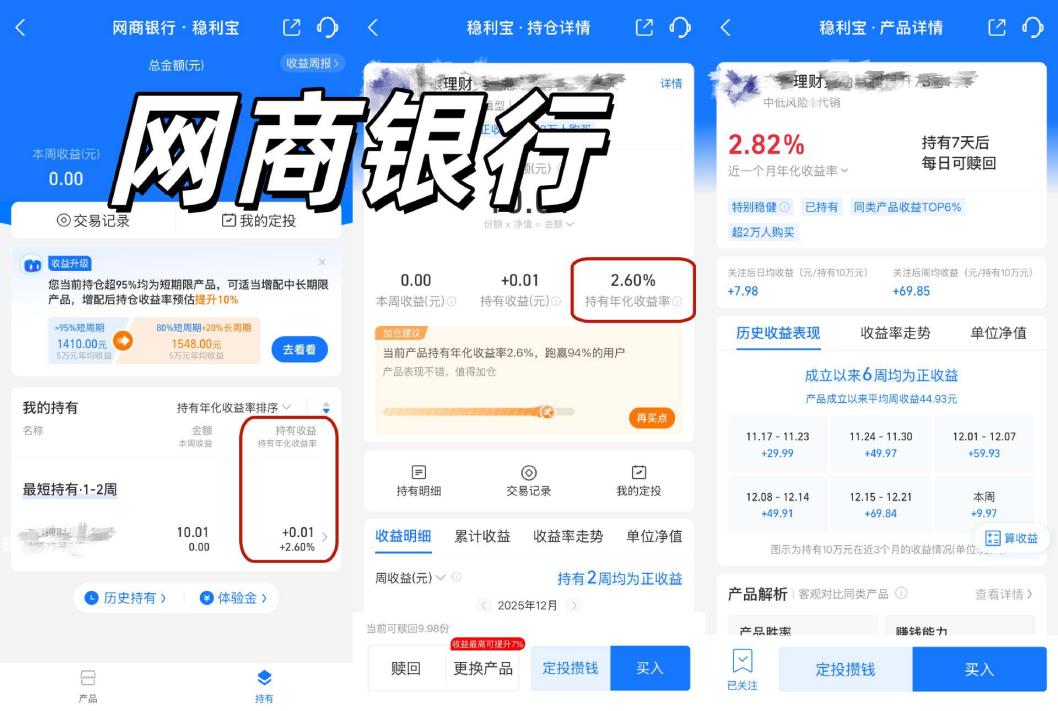
实测8家银行收益展示:多数未展示年化持仓收益率
2 1 Shi Ji Jing Ji Bao Dao· 2026-01-04 04:02
21世资管研究院研究员 杨梦雪 你知道自己购买的理财产品实际收益率,以及实际收益率与理财产品页面所展示的收益率有多少差距吗? 不少银行理财投资者向《21世纪经济报道》反映称,冲着页面展示的高达5%甚至7%的收益率数据买进去,结果发现实际获得的收益并不高,但也不知道是 怎么回事、具体差异有多少。 "当时看到页面展示的收益率还可以就买了,后面也没在意过。我大概能知道我的收益率到不了页面展示的那么高,但实际到底差多少,我不会算也就没关 注过了。"某投资者对记者表示。 《21世纪经济报道》曾多次报道银行理财行业中部分理财公司存在的"打榜"现象,即,通过估值魔法以及其他方式包装出收益数据很高的新产品用于吸引客 户和资金,待"使命"完成便沦为庸常的老产品,前期被高收益数据吸引而来的投资者实际享受不到产品所展示的诱人业绩。 该现象背后,主要成因固然是银行理财产品管理层面的把戏,但是,一些渠道在客户持仓产品业绩展示上是一本糊涂账,导致投资者很难了解到真实情况, 这某种程度上也是推手之一。 银行理财是最具普惠性的财富管理工具,其绝大部分的客户都是个人投资者,产品展示功能和客户服务尤其重要。据银行业理财登记托管中心数据,理财市 ...




银行:银行2026年展望:稳中求进
2025-12-31 16:02
Summary of the Conference Call Transcript Industry Overview - The banking sector is entering a phase of high-quality development, with a focus on absolute and relative returns from bank stocks, driven by high dividend yields and asset quality [3][4][20]. Key Points Financial Performance Projections - Expected revenue growth for listed banks in 2026 and 2027 is +2.5% and +3.6% respectively, with net profit growth of +1.9% and +2.6% [4][20]. - Revenue and profit growth are anticipated to improve due to: 1. Narrowing net interest margin pressure 2. Quality-focused credit issuance amid weak demand [4][20]. 3. Stabilization of fee income growth after several years of fee reductions [4][20]. 4. Stable or improving net non-performing loan generation rates [4][11]. 5. Accelerated supply-side reforms leading to a reduction in the number of bank licenses, improving competition and operational landscape [4][11]. Customer Demand and Market Dynamics - The low-interest-rate environment has shifted customer demand, with government and state-owned enterprises becoming significant contributors to leverage, affecting the structure of new social financing [5][10]. - Regulatory policies are influencing the development of inclusive finance, focusing on risk compensation rather than merely increasing customer numbers [5][10]. Risk Factors - Risks associated with real estate developers and retail sectors are highlighted, with potential for greater-than-expected exposure [6][11]. Profitability and Valuation Adjustments - Adjustments to profitability forecasts for 2025 and 2026 have been made, with a focus on net interest income recovery and fee income growth [20][21]. - The expected net interest margin for 2026 is projected to be approximately 1.34%, a decrease of 6 basis points from 2025 [21][22]. - Fee income is expected to grow by 3.6% and 4.9% in 2026 and 2027 respectively, indicating a positive trend in non-interest income [21][22]. Asset Quality and Credit Costs - The net non-performing loan generation rate is expected to stabilize or slightly decline, with structural characteristics of retail and corporate lending continuing [11][21]. - Credit costs are projected to remain stable at around 0.58% for 2026 and 2027, reflecting the balance between corporate and household debt servicing capabilities [21][22]. Investment Recommendations - The report suggests a continued positive outlook for bank stocks, emphasizing the importance of dividend yield and asset quality in investment decisions [3][4][20]. Additional Insights - The banking sector is undergoing a transformation towards high-quality development, with a shift in focus from scale to quality, driven by macroeconomic pressures and regulatory changes [12][20]. - The reduction in the number of banking licenses over the past five years indicates successful risk management efforts within the sector [11][12]. - The report emphasizes the need for banks to adapt their strategies to maintain competitiveness in a changing regulatory and economic environment [12][20].

银行业十五五展望系列专题(上篇):回眸十四五,监管引导和主动求变下的银行经营理念重构
Shenwan Hongyuan Securities· 2025-12-31 14:14
Investment Rating - The report indicates a positive outlook for the banking industry, suggesting a return to a price-to-book (PB) ratio of 1x during the "15th Five-Year Plan" period, focusing on stable profitability and high-quality development [3][4]. Core Insights - The banking sector is transitioning from a focus on scale to quality, with an emphasis on risk management and structural optimization. The "15th Five-Year Plan" includes the goal of building a strong financial nation, highlighting the importance of high-quality development [3][16]. - The report identifies key changes in the banking industry during the "14th Five-Year Plan," including a shift in credit structure, a focus on profitability, and the need for banks to balance risk and efficiency [2][4]. - Regulatory support is expected to stabilize net interest margins, which have reached record lows, with a projected recovery in the coming years [5][19]. Summary by Sections 1. From Quantity to Quality - The banking industry has evolved through three five-year plans, with a shift from rapid expansion to a focus on quality and risk management. The current phase emphasizes high-quality development and financial support for key sectors [2][10]. 2. Developments During the "14th Five-Year Plan" 2.1 ROE: Resilience of State-Owned Banks and Advantages of City Commercial Banks - The return on equity (ROE) for listed banks has remained around 10%, with city commercial banks showing a slight advantage due to higher leverage and better provisioning [19][20]. 2.2 Credit: Moving Away from Scale to Balance Capital and Efficiency - Banks are prioritizing structural transformation over sheer volume, focusing on supporting key sectors and optimizing credit distribution [4][12]. 2.3 Interest Margin: Recovery from Continuous Decline - The report anticipates a stabilization of net interest margins, which have been under pressure, with regulatory measures aimed at supporting banks [5][19]. 2.4 Risk: Provisioning to Support Stability - The banking sector is expected to manage risks more effectively, with a focus on maintaining adequate provisions to support profitability during challenging economic conditions [4][19]. 2.5 Financial Markets: An Alternative Revenue Stream - The report highlights the increasing importance of financial market activities as a means to smooth revenue amid declining interest income, with banks diversifying their investment strategies [4][19]. 3. Investment Analysis Opinion - The report suggests a dual strategy of focusing on leading banks and undervalued city commercial banks, anticipating a recovery in valuations for state-owned banks that have been lagging [3][4].
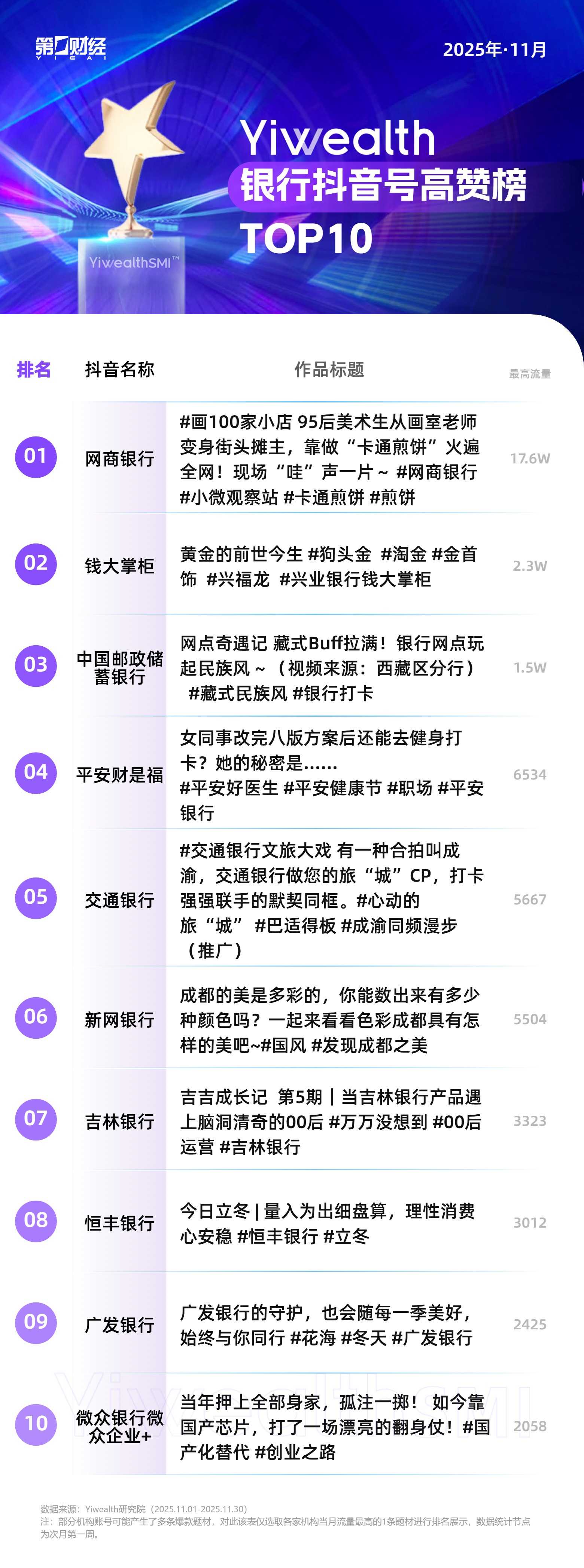
YiwealthSMI|银行广告怎么拍不招烦?来看平安银行、吉林银行
Di Yi Cai Jing· 2025-12-31 12:13
Group 1: Social Media Index Overview - The overall Bank Social Media Index (SMI) for November 2025 showed slight fluctuations, with significant reshuffling at the bottom of the rankings. Notable banks that dropped out include China CITIC Bank, Tianjin Bank, Changsha Bank, and Jiangxi Bank, while banks like Industrial Bank, Chongqing Bank, Zhejiang Commercial Bank, and Zhengzhou Bank entered the rankings [1] - Industrial Bank's ranking has experienced considerable volatility over the past three months, primarily due to the inconsistent update frequency of its Douyin account "Qian Da Zhang Gui," which affected its sub-index and overall SMI [1] Group 2: High Engagement Content - In November's high-engagement content rankings, WeBank's "Drawing 100 Small Shops" continued to dominate, while "Creative Storylines" emerged as a new trend for attracting traffic [2] - Banks like Ping An Bank and Jilin Bank produced highly rated advertisements. Ping An Bank utilized a classic "office worker" theme to highlight its app's "AI Doctor" feature, while Jilin Bank showcased the creative process behind a consumer loan product, effectively integrating product promotion with engaging storytelling [2] - "Scenario-based marketing" became a highlight, with banks transforming their branches into cultural showcases. For instance, China Postal Savings Bank's "Branch Adventure" featured its Tibet branch, breaking stereotypes about bank outlets [2] Group 3: Focus on Gold - Gold remains a key area of interest for users, with Industrial Bank's "The Past and Present of Gold" series gaining significant traction, averaging over 16,000 likes per video across three episodes [3]
银行业“十五五”展望系列专题(上篇):回眸“十四五”,监管引导和主动求变下的银行经营理念重构
Shenwan Hongyuan Securities· 2025-12-31 11:51
Investment Rating - The report maintains a positive outlook on the banking industry, indicating a "buy" rating for the sector during the "15th Five-Year Plan" period [1]. Core Insights - The banking sector is transitioning from a focus on quantity to quality, emphasizing risk management and efficiency in capital utilization. This shift is driven by the need to support the real economy while managing risks effectively [2][3]. - The report highlights that the return on equity (ROE) for listed banks has remained resilient, averaging around 10%, with city commercial banks leading at 11%-12% ROE, while state-owned banks maintain about 10% [2][3]. - Key changes observed during the "14th Five-Year Plan" include a shift away from scale-driven growth towards a balanced approach between capital and efficiency, a stabilization of net interest margins, and an increased focus on capital markets as a revenue source [2][3]. Summary by Sections 1. From Quantity to Quality - The banking industry has evolved through three five-year plans, with a core transformation focusing on risk and efficiency rather than mere volume [2][3]. 2. High-Quality Development During the "14th Five-Year Plan" 2.1 ROE: Resilience of State-Owned and City Commercial Banks - Listed banks' ROE has slightly declined but remains around 10%, reflecting operational pressures while showcasing resilience [23]. 2.2 Credit: Balancing Capital and Efficiency - The focus has shifted from merely increasing credit volume to optimizing the structure of credit distribution, with significant changes in loan allocation towards technology and green sectors [16][19]. 2.3 Net Interest Margin: Stabilization Efforts - Regulatory support is expected to stabilize net interest margins, which have reached record lows, with proactive measures to prevent further declines [2][3]. 2.4 Risk Management: Provisioning for Stability - The banking sector has moved past peak risk levels, with provisions supporting ROE stability, while new economic challenges require ongoing risk management [2][3]. 2.5 Capital Markets: A New Revenue Stream - Capital market activities have become increasingly important, with banks leveraging these for revenue amidst pressure on interest income [2][3]. 3. Investment Analysis Opinion - The report suggests a focus on stable, high-quality development, with an expectation for bank valuations to return to 1x price-to-book (PB) ratios. It emphasizes a dual strategy of investing in leading banks and quality city commercial banks [3][4].



2025年中国创投:重拾向上动能,奔赴投资新程
Zheng Quan Shi Bao Wang· 2025-12-31 11:43
Group 1: Industry Recovery and Trends - In 2025, China's venture capital industry emerged from a two-year downturn, showing signs of recovery across the entire investment chain, driven by a combination of funding and project highlights, as well as supportive policies [1] - The year-end activities of venture capitalists indicate a strong return to the industry, fueled by a new wave of technological changes and ongoing policy benefits [1] Group 2: Government Investment Fund Policies - The State Council issued a significant document aimed at promoting the high-quality development of government investment funds, focusing on stricter controls on new fund establishments and optimizing investment policies [2] - Various local governments have responded by issuing supporting policy documents, further regulating the operation of government investment funds to promote high-quality industry development [2] Group 3: Banking Sector Involvement - Since the announcement of expanded pilot programs for bank-affiliated financial asset investment companies (AICs), banks have accelerated their entry into the primary market, with several major banks successfully establishing AICs [3] - As of now, AICs from six major state-owned banks and three national joint-stock banks have been established, with total investments reaching 45.272 billion yuan, a year-on-year increase of approximately 37.7% [3] Group 4: Special Bonds for Government Guidance Funds - Several local governments have issued special bonds to support government guidance funds, breaking the previous norm that prohibited such investments [4] - A total of 52 billion yuan in special bonds have been issued by nine provinces and cities, significantly enhancing the funding pool for the venture capital industry [4] Group 5: Long-Term Government Guidance Funds - New government guidance funds established this year have extended their duration beyond the typical 10 years, with some lasting up to 20 years, providing long-term support for projects [5] - This trend of extending fund durations is expected to create a more patient investment environment, allowing for better exit strategies [5] Group 6: Mergers and Acquisitions - The introduction of policies supporting private equity funds in acquiring listed companies has led to a surge in related acquisition cases, with several venture capital firms actively pursuing stakes in public companies [6][7] - The trend of startups acquiring listed companies is also on the rise, indicating a new strategy for both startups and venture capital firms to explore exit routes [7] Group 7: Domestic PE Firms Acquiring Foreign Brands - Domestic top-tier private equity firms have increasingly acquired the Chinese operations of overseas consumer brands, highlighting a trend of local capital participating in the localization of foreign brands [8] - This trend is driven by the combination of ample funding, local operational expertise, and the stable cash flow of established foreign brands [8] Group 8: Technology Innovation Bonds - The introduction of technology innovation bonds has opened new fundraising channels for venture capital institutions, with several private firms successfully issuing bonds at competitive interest rates [9] - The issuance of these bonds has significantly boosted market confidence and marked a transition towards a more normalized support phase for private venture capital institutions [9] Group 9: Mainland VC/PE Expansion into Hong Kong - Several mainland investment institutions have established offices in Hong Kong, attracted by the region's supportive environment for technological innovation [10] - The Hong Kong government's initiatives, including the establishment of a significant innovation and technology fund, have further encouraged mainland VC/PE firms to expand into the market [10] Group 10: Return of Dollar LPs to China - Multiple venture capital firms have successfully raised dollar-denominated funds, indicating a renewed interest from international investors in the Chinese market [11][12] - The return of dollar LPs coincides with the rapid growth of China's AI industry, highlighting the potential undervaluation of Chinese assets [11][12] Group 11: National Entrepreneurship Investment Fund - The establishment of a "carrier-level" national entrepreneurship investment fund aims to support startups across key economic regions in China, with a focus on early-stage investments [13] - This fund features a long duration of 20 years and aims to provide substantial financial backing to venture capital institutions and startups, enhancing the overall investment landscape [13]



福建自贸区概念下跌0.84%,8股主力资金净流出超亿元
Zheng Quan Shi Bao Wang· 2025-12-31 09:29
截至12月31日收盘,福建自贸区概念下跌0.84%,位居概念板块跌幅榜前列,板块内,鹭燕医药、合兴 包装等跌停,平潭发展、中能电气、昇兴股份等跌幅居前,股价上涨的有41只,涨幅居前的有乾照光 电、延江股份、航天发展等,分别上涨15.75%、11.68%、10.00%。 今日涨跌幅居前的概念板块 | 概念 | 今日涨跌幅(%) | 概念 | 今日涨跌幅(%) | | --- | --- | --- | --- | | 小红书概念 | 2.88 | 硅能源 | -1.03 | | 快手概念 | 2.49 | 有机硅概念 | -0.99 | | 中船系 | 2.30 | 液冷服务器 | -0.98 | | 中韩自贸区 | 2.25 | 钠离子电池 | -0.86 | | 军工信息化 | 2.22 | 福建自贸区 | -0.84 | | 智谱AI | 2.20 | 环氧丙烷 | -0.77 | | AI语料 | 2.00 | 高压快充 | -0.77 | | 国产航母 | 1.99 | 宁德时代概念 | -0.75 | | Sora概念(文生视频) | 1.97 | PEEK材料 | -0.74 | | 卫星导航 | ...


