AGRICULTURAL BANK OF CHINA(601288)

Search documents
低价“银行直供房”激增,有房产价格低于市价25%
Di Yi Cai Jing· 2025-11-09 12:37
Core Insights - Banks are accelerating direct property sales to enhance debt recovery rates, particularly during the real estate market adjustment period [1][8] - The properties being sold directly by banks primarily originate from the disposal of non-performing loans [3][8] - The trend of "bank direct supply housing" is gaining traction, with multiple banks listing thousands of properties for sale [2][3] Group 1: Market Dynamics - Recent transactions show properties valued at approximately 2 million yuan being sold for as low as 1.5 million yuan, indicating significant discounts [1] - Major banks, including Agricultural Bank, Construction Bank, and Transportation Bank, are actively engaging in direct property sales through online platforms [2] - The scale of property listings is particularly notable among local city commercial banks and rural credit cooperatives, with some banks listing over 2,000 properties [3] Group 2: Sales Strategy - Banks are adopting a pricing strategy that often results in properties being sold below market value to expedite asset liquidation [5] - Properties are typically sold at prices lower than those of second-hand homes, with some properties experiencing multiple price reductions after failed auctions [5] - In addition to direct sales, some banks are exploring leasing options to activate assets, with clear property rights reducing transaction risks [6] Group 3: Underlying Factors - The acceleration in direct property sales is driven by the need to improve debt recovery rates, as traditional methods can take over two years [8] - The cooling of the judicial auction market has prompted banks to shift towards direct property disposal, as evidenced by declining auction success rates [9] - The overall increase in non-performing loans, particularly in personal business loans, is influencing banks to adopt a dual strategy of traditional and direct sales [8][9]



今年农业银行金市的“取胜之匙”
Tianfeng Securities· 2025-11-09 08:44
Investment Rating - Industry Rating: Outperform the market (maintained rating) [6] Core Insights - Agricultural Bank's performance in the gold market has been outstanding this year, with a year-on-year revenue growth of 2.0% in the first three quarters, leading the four major banks in net non-interest income growth at 31.7% [12][15] - The bank's financial assets have shown significant gains from fair value changes, particularly during the first quarter when the bond market faced substantial declines, achieving a floating profit of 39 billion [16][17] - The bank's strategy of maintaining a low proportion of TPL accounts (below 4%) and cautious trading strategies during market adjustments has contributed to its strong performance [18][19] Summary by Sections 1. Performance in the Gold Market - Agricultural Bank's net non-interest income growth of 31.7% in 2025 Q1-Q3 is the highest among the four major banks, with a notable increase of 45.3% in Q1 despite negative growth in other banks [15][18] - The bank achieved a floating profit of 85 billion from financial investments due to fair value changes, outperforming its peers [17][18] 2. Factors Contributing to Strong Performance - The low proportion of TPL accounts and limited incremental growth in bond assets have minimized the impact of market adjustments on the bank's earnings [19][20] - The bank's strategy to control duration in TPL account bond assets has helped mitigate risks during market volatility, although it resulted in lower floating profits in Q2 [23][24] - The timing of bond asset allocations, particularly during high interest rates in February, has allowed the bank to maintain a low cost of holdings [25][26] 3. Outlook for Future Performance - With the central bank restarting government bond trading, there is an expectation of a recovery in capital gains for the bank's gold market business in Q4, although the low trading volume and duration strategy may limit floating profit growth [29][30] - The bank's reasonable classification of I9 accounts and duration management align with current and future market conditions, providing a foundation for potential outperformance [31][32] - As the year-end approaches, there may be incentives for the bank to realize floating profits through the sale of old bonds, as indicated by an increase in investment income contribution to revenue [32][33]
多家银行行长发声
Bei Jing Wan Bao· 2025-11-09 08:00
Core Viewpoint - The eighth China International Import Expo is being held at the National Exhibition and Convention Center in Shanghai, with several bank presidents attending and delivering speeches [1] Group 1: Bank Leadership - The presidents of major banks, including Industrial and Commercial Bank of China, Agricultural Bank of China, Bank of China, and Bank of Communications, participated in the expo's thematic activities [1] - Liu Jun, Wang Zhiheng, Zhang Hui, and Zhang Baojiang represented their respective banks at the event [1]


工行、农行、中行、交行行长最新发声!
Jin Rong Shi Bao· 2025-11-09 05:00
Group 1 - The 8th China International Import Expo is being held at the National Exhibition and Convention Center in Shanghai, with leaders from major banks in attendance [1] - Liu Jun, President of ICBC, emphasized that the current technological revolution led by artificial intelligence is reshaping the global economic landscape, and that monopolies are not a key term in this era [2] - Wang Zhiheng, President of Agricultural Bank of China, highlighted the importance of open cooperation in agriculture and proposed three suggestions to enhance international agricultural trade [3] Group 2 - Zhang Hui, President of Bank of China, stated that talent is the core key to globalization, and that financial support is essential for Chinese enterprises going global [4] - Zhang Baojiang, President of Bank of Communications, discussed the role of financial services in promoting cultural tourism and its importance in stabilizing economic growth [5]
二级资本债周度数据跟踪(20251103-20251107)-20251108
Soochow Securities· 2025-11-08 12:06
Report Summary 1. Report Industry Investment Rating - Not provided in the content 2. Report's Core View - This is a weekly data tracking report on secondary capital bonds from November 3, 2025, to November 7, 2025, covering primary market issuance, secondary market trading, and valuation deviation of individual bonds [1][2][3] 3. Summary by Relevant Catalogs Primary Market Issuance - Two secondary capital bonds were newly issued in the inter - bank and exchange markets, with a total issuance scale of 15 billion yuan. The issuance term is 10 years, the issuers are subsidiaries of central enterprises and local state - owned enterprises, the issuer ratings are AAA, and the issuer regions are Guangdong and Shandong provinces [1][6] Secondary Market Trading - **Trading Volume**: The weekly trading volume of secondary capital bonds was approximately 186 billion yuan, a decrease of 13.8 billion yuan compared to the previous week. The top three bonds in terms of trading volume were 25 Agricultural Bank of China Secondary Capital Bond 03A(BC) (16.084 billion yuan), 25 Agricultural Bank of China Secondary Capital Bond 03B(BC) (10.937 billion yuan), and 25 Industrial and Commercial Bank of China Secondary Capital Bond 01BC (5.996 billion yuan). By issuer region, the top three in trading volume were Beijing (about 140.8 billion yuan), Shanghai (about 11.6 billion yuan), and Fujian (about 8.6 billion yuan) [2] - **Yield to Maturity**: As of November 7, for 5Y secondary capital bonds, the yield - to - maturity changes of ratings AAA-, AA+, and AA compared to the previous week were 4.16BP, 3.24BP, and 3.24BP respectively; for 7Y bonds, they were 1.30BP, - 0.08BP, and - 0.08BP respectively; for 10Y bonds, they were 0.64BP, 0.64BP, and 0.64BP respectively [2][11] Valuation Deviation of Top 30 Individual Bonds - **Discount Bonds**: The top three discount bonds were 21 Jiutai Rural Commercial Secondary (-48.9752%), 22 Jiangshan Rural Commercial Bank Secondary Capital Bond 01 (-0.4149%), and 24 Longwan Rural Commercial Bank Secondary Capital Bond 01 (-0.3907%). The Zhongzheng implied ratings were mainly AA+, AA-, and A+, and the regional distribution was mostly in Tianjin, Guangdong, and Shanghai [3][14] - **Premium Bonds**: The top three premium bonds were 24 Qingdao Bank Secondary Capital Bond 01 (0.5969%), 23 Chouzhou Commercial Bank Secondary Capital Bond 01 (0.5512%), and 25 Jinshang Bank Secondary Capital Bond 01 (0.4984%). The Zhongzheng implied ratings were mainly AAA-, AA+, and AA, and the regional distribution was mostly in Beijing, Shanghai, and Guangdong [3][15]
你的支付优惠用了吗?各大银行加入双十一“狂欢”,算的什么账?
Sou Hu Cai Jing· 2025-11-08 00:51
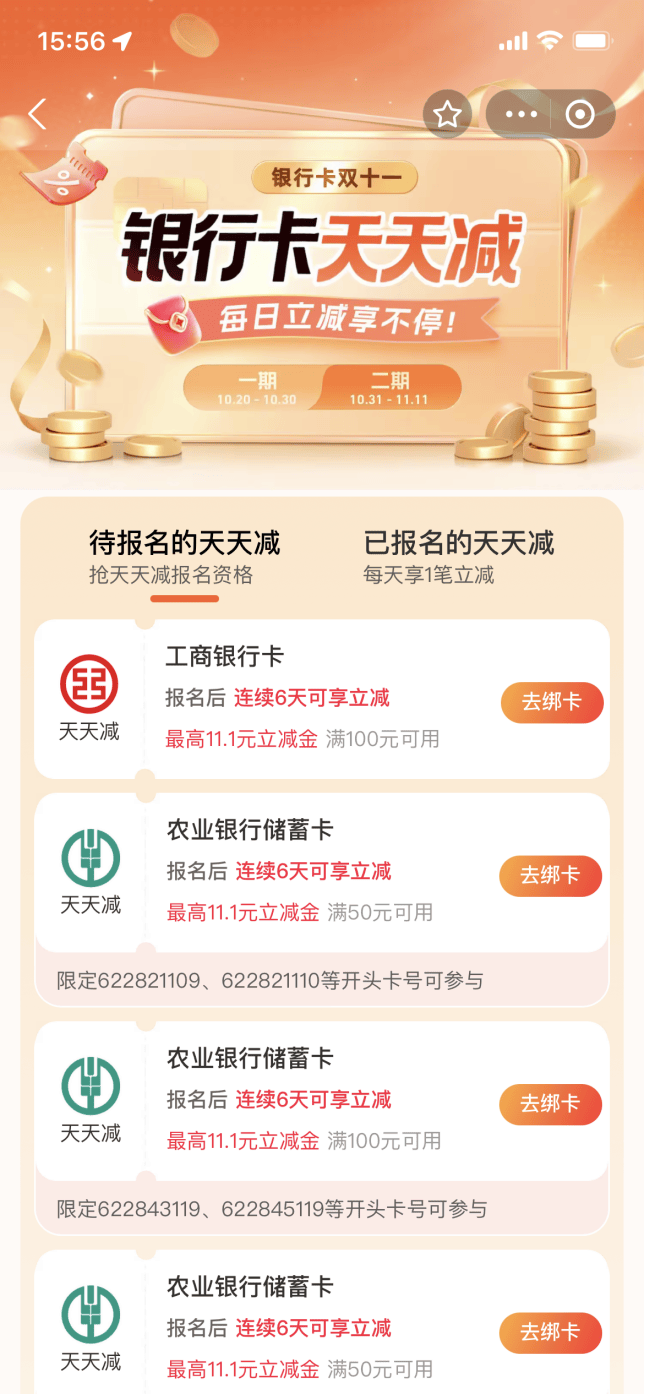
Core Viewpoint - The annual Double Eleven shopping season has officially started, with major commercial banks launching various promotional activities to stimulate consumer spending and boost business before the year-end [1][2]. Group 1: Promotional Activities by Banks - Major banks such as China Construction Bank, Bank of China, Agricultural Bank of China, and others have introduced cashback, discounts, installment benefits, and exclusive offers to attract consumers [1]. - Construction Bank offers a maximum discount of 400 yuan for credit card customers using installment payments on platforms like Alipay and Taobao, while Bank of China provides a random discount of up to 118 yuan for transactions made through Alipay [2]. - Other banks, including China Merchants Bank and Ping An Bank, have also launched various cashback and discount campaigns to engage customers during this shopping season [2]. Group 2: Strategic Insights - Experts suggest that the banks' promotional strategies represent a cost-effective method to acquire and retain customers, activating dormant accounts with low-cost random discounts [5]. - The focus on marketing during peak shopping seasons aims to enhance the usage of bank cards over third-party payment channels, thereby driving growth in credit and debit card transactions [5]. - Recommendations for banks post-Double Eleven include offering temporary credit limit increases and integrating with government consumption voucher programs to enhance customer experience and engagement [5].



【财经分析】上市银行2025年三季报透视:量缓增、价趋稳、险夯实
Zhong Guo Jin Rong Xin Xi Wang· 2025-11-07 14:05
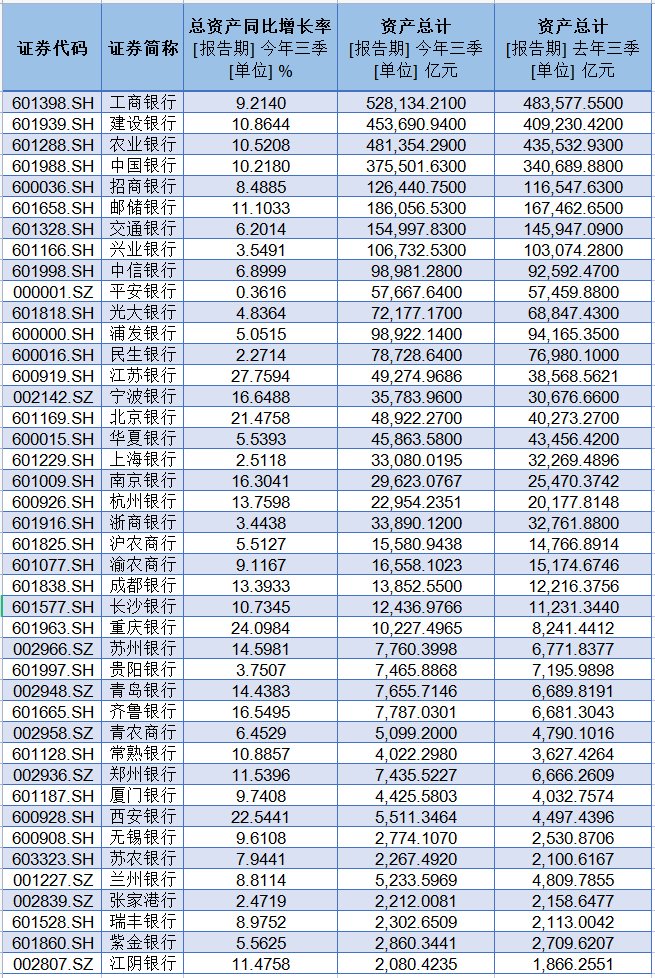
Core Insights - The total assets of 42 A-share listed banks exceeded 326 trillion yuan, with a year-on-year growth of 9.3%, indicating a steady but slightly declining growth rate [1][2] - Net interest margins show signs of stabilization, supported by improved liability costs, which provide a key support for profitability [1][4] - Asset quality remains solid, with non-performing loan ratios stable, although there is a divergence in asset quality between retail and corporate sectors [1][11] Asset Growth - The asset growth rate of listed banks has slowed compared to previous years, with a year-on-year increase of 9.3% as of Q3 2025, a decrease of 0.3 percentage points from the first half of the year [2][4] - The overall expansion of assets remains robust, with specific banks like Jiangsu Bank and Ningbo Bank showing significant growth rates of 27.76% and 16.65% respectively [3] Profitability and Revenue - The total operating income of listed banks exceeded 4.3 trillion yuan in the first three quarters, reflecting a year-on-year increase of 0.9%, with over 60% of banks reporting positive revenue growth [4] - The net profit attributable to shareholders surpassed 1.6 trillion yuan, marking a year-on-year growth of 1.5% [4] - Analysts indicate that stable net interest margins and reduced provisions are the main drivers of profit growth, while other non-interest income has weakened [5] Net Interest Margin - The net interest margin for listed banks increased by 0.3 basis points to 1.37% in Q3 2025, with asset yield decreasing by 7 basis points and liability cost decreasing by 8 basis points [6][8] - The performance of net interest margins varies among different types of banks, with joint-stock banks and city commercial banks showing better-than-expected rebounds [8][10] Asset Quality - The overall asset quality of listed banks remains stable, with non-performing loan ratios holding steady, although retail risks are showing volatility while corporate non-performing loans continue to improve [11][13] - The average provision coverage ratio for the 42 banks is 283.2%, with city commercial banks and rural commercial banks maintaining coverage ratios above 300% [13]
金融行业双周报:央行重启购债操作,有望缓解银行负债压力-20251107
Dongguan Securities· 2025-11-07 09:27
Investment Ratings - Banking: Overweight (Maintain) [1] - Securities: Market Weight (Maintain) [1] - Insurance: Overweight (Maintain) [1] Core Insights - The central bank's resumption of bond purchases aims to alleviate liquidity pressure on banks and enhance their lending capacity [1][4] - The securities industry has shown strong performance in the first three quarters of 2025, with a net profit of CNY 1,837.82 billion, a year-on-year increase of 61.25% [3][50] - The insurance sector is experiencing a strategic adjustment period due to changes in interest rates, with significant profit growth reported by major insurers [4] Summary by Sections Market Review - As of November 6, 2025, the banking, securities, and insurance indices have changed by +0.25%, +0.62%, and -0.67% respectively, while the CSI 300 index increased by +1.89% [12][19] - Among the sub-sectors, Chongqing Bank (+8.44%), Northeast Securities (+10.09%), and China Ping An (+1.90%) performed the best [12][19] Valuation Situation - As of November 6, 2025, the banking sector's price-to-book (PB) ratio is 0.78, with state-owned banks at 0.84 and joint-stock banks at 0.62 [21][22] - The securities sector's PB ratio is 1.54, indicating potential for valuation recovery [25] Recent Market Indicators - The one-year Medium-term Lending Facility (MLF) rate is 2.0%, with the one-year and five-year Loan Prime Rates (LPR) at 3.0% and 3.50% respectively [32][33] - The average daily trading volume of A-shares is CNY 19,673.61 billion, reflecting a decrease of 14.41% [38][40] Industry News - The insurance industry is adapting to new regulatory frameworks and interest rate changes, with a focus on optimizing product structures and enhancing profitability [43][44] - The central bank's actions are expected to provide a more stable liquidity environment for banks, especially as year-end liquidity fluctuations increase [48] Company Announcements - Major banks and insurers have reported varying earnings growth, with significant increases in net profits for companies like China Life and Xinhua Insurance [46][47]




农行内蒙古分行:引普惠金融活水 精准滴灌实体经济
Zhong Guo Jin Rong Xin Xi Wang· 2025-11-07 09:20
Core Insights - The Agricultural Bank of China Inner Mongolia Branch is committed to the development of inclusive finance, aligning with national policies and enhancing service systems to meet financial needs, achieving significant results in supporting the real economy [1] Group 1: Inclusive Finance Development - As of the end of September, the inclusive loan balance of the Agricultural Bank of China Inner Mongolia Branch reached 40.819 billion yuan, an increase of 10.017 billion yuan from the beginning of the year, marking a continuous increase of over 10 billion yuan for two consecutive years [1] - The financing coordination mechanism has supported 57,100 small and micro enterprises with a total loan amount of 31.835 billion yuan [1] Group 2: Focus on Agriculture and Rural Development - The bank has developed specialized products such as "Grain Farmer Loan," "Facility Loan," and "Intelligent Animal Husbandry Loan," targeting key segments of the agricultural industry chain in the region [1] - As of the end of September, the rural industry loan balance was 107.874 billion yuan, an increase of 20.672 billion yuan from the beginning of the year, with the grain industry loan balance reaching 38.916 billion yuan, up by 10.386 billion yuan [1] Group 3: Product Innovation and Financing Solutions - The bank has introduced innovative financing solutions to address the diverse needs of small and micro enterprises, including a "Inclusive + Green" model that integrates green energy consumption data into credit assessments [3] - A total of 342 small and micro enterprises have been supported under the "Silver-Guarantee" cooperation model, with loans amounting to 1.418 billion yuan [4] Group 4: Digital Transformation and Efficiency - The bank is leveraging digital transformation to enhance the efficiency of inclusive finance services, reducing the loan approval response time to 48 hours and enabling full online operations for suppliers [6] - The "Agricultural Bank Smart Chain" platform has provided loans totaling 11.42 billion yuan to 1,252 small and micro enterprises in the dairy and steel industries, facilitating seamless financing along the supply chain [6]
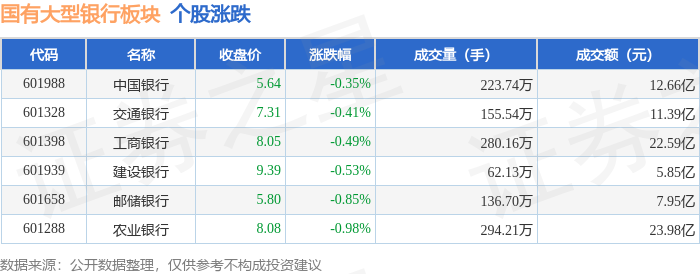
国有大型银行板块11月7日跌0.68%,农业银行领跌,主力资金净流出2.55亿元
Zheng Xing Xing Ye Ri Bao· 2025-11-07 08:37
Core Insights - The state-owned large bank sector experienced a decline of 0.68% on November 7, with Agricultural Bank leading the drop [1] - The Shanghai Composite Index closed at 3997.56, down 0.25%, while the Shenzhen Component Index closed at 13404.06, down 0.36% [1] Market Performance - The closing prices and changes for major state-owned banks are as follows: - Bank of China: 5.64, down 0.35% - Bank of Communications: 7.31, down 0.41% - Industrial and Commercial Bank of China: 8.05, down 0.49% - China Construction Bank: 9.39, down 0.53% - Postal Savings Bank: 5.80, down 0.85% - Agricultural Bank: 8.08, down 0.98% [1] Capital Flow - The state-owned large bank sector saw a net outflow of 255 million yuan from main funds, while retail investors contributed a net inflow of 251 million yuan [1] - The detailed capital flow for individual banks is as follows: - Bank of Communications: Main funds net inflow of 52.52 million yuan, retail net inflow of 34.41 million yuan - Industrial and Commercial Bank: Main funds net outflow of 22.51 million yuan, retail net inflow of 72.97 million yuan - Bank of China: Main funds net outflow of 36.09 million yuan, retail net inflow of 46.71 million yuan - China Construction Bank: Main funds net outflow of 44.38 million yuan, retail net inflow of 16.83 million yuan - Postal Savings Bank: Main funds net outflow of 53.25 million yuan, retail net inflow of 31.40 million yuan - Agricultural Bank: Main funds net outflow of 15.17 million yuan, retail net inflow of 48.80 million yuan [2]