PING AN OF CHINA(601318)

Search documents
中国平安盛瑞生分享平安的估值新叙事
Cai Jing Wang· 2025-12-22 04:26
Core Insights - The core message of the presentation by Sheng Ruisheng, Secretary of the Board and Brand Director of Ping An, is to highlight how the company is leveraging technology as a core driver to reshape its development strategy through a dual-driven approach of "comprehensive finance + healthcare and elderly care" to tap into trillion-level market opportunities [1][2]. Group 1: Strategic Focus - Ping An aims to shift market perception from short-term performance to its long-term strategic positioning and core competitiveness, emphasizing the importance of understanding its foundational strategies amidst a recovering valuation post-pandemic [2][3]. - The company has established a dual-driven development strategy focusing on "comprehensive finance + healthcare and elderly care," which addresses the diverse wealth allocation needs of consumers and the unmet demands arising from societal changes due to deep reforms and aging population [2][4]. Group 2: Business Model and Competitive Advantage - Ping An is one of the few comprehensive financial service groups in China, with insurance as its core business while also covering banking, asset management, and other diversified services. The company emphasizes a customer-centric approach, providing integrated financial solutions that enhance customer retention and reduce risks associated with single business cycles [3][6]. - The healthcare and elderly care sectors represent a significant market opportunity, with Ping An innovatively adopting a Chinese version of the HMO model, integrating high-quality resources without heavy asset investments, and offering a cost-effective service model [4][6]. Group 3: Technological Integration - Technology is identified as the core driver for the diversified strategy of Ping An, with advancements in AI enhancing service efficiency and customer experience. The company has implemented a global operational management center and integrated technology into its service processes, achieving significant improvements in claims processing and customer service [5][6]. - The company has achieved a high level of digitalization, with 80% of service scenarios being handled through AI, significantly improving operational efficiency [5][6]. Group 4: Customer Service and Future Outlook - As of now, Ping An has served 250 million customers, providing a full lifecycle of services from basic financial products to comprehensive health management and elderly care solutions [7]. - Looking ahead to 2026, Ping An plans to enhance AI applications with three major innovative services: a universal service entry point, AI family doctors with high accuracy rates, and a unified global emergency rescue service [8].

长三角A股市值首超30万亿
第一财经· 2025-12-22 04:01
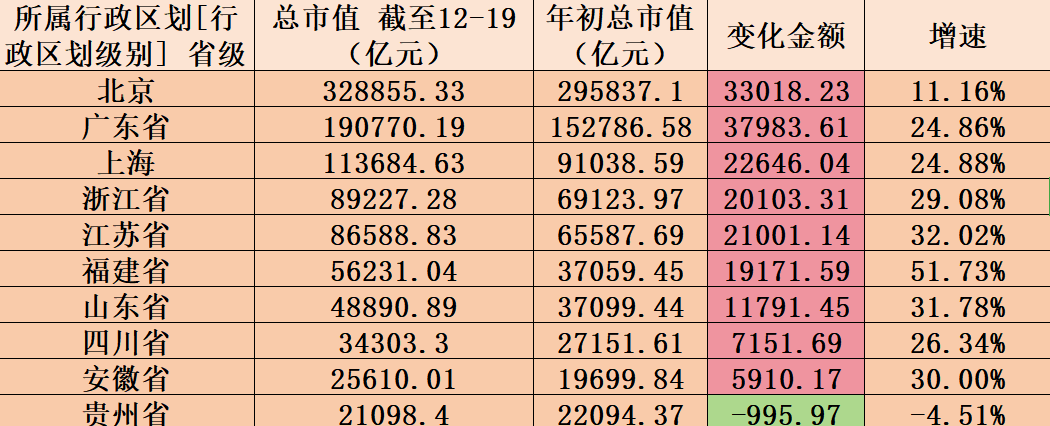
Core Viewpoint - The article highlights the significant shift in market capitalization within the Sichuan province, where the electronic industry, particularly led by the optical module leader Xinyi Sheng (300502.SZ), has overtaken traditional giants like Wuliangye (000858.SZ) to become the top company by market value in the region. This change reflects broader trends in the A-share market driven by advancements in AI and technology [3][4]. Market Capitalization Growth - As of December 19, 2025, the total market capitalization of A-shares reached 120.31 trillion yuan, marking a 22.2% increase from the beginning of the year. The top five provinces contribute significantly to this growth, with Beijing, Guangdong, Shanghai, Zhejiang, and Jiangsu leading the way [6][7]. - The market capitalization of Beijing stands at 32.88 trillion yuan, with a growth of 11.16% from the start of the year, largely supported by state-owned enterprises and tech companies [8][16]. - Guangdong's market capitalization increased by 24.86% to 19.08 trillion yuan, driven by sectors such as electronics and automotive [13][16]. - Shanghai's market capitalization grew by 24.88% to 11.37 trillion yuan, with significant contributions from semiconductor and AI hardware sectors [12][16]. Regional Performance - The Yangtze River Delta region's total market capitalization reached 31.51 trillion yuan, accounting for 26.2% of the national total, with notable growth in cities like Suzhou and Hangzhou [12][14]. - The Anhui province saw the highest growth rate of 30%, increasing its market capitalization from 1.97 trillion yuan to 2.56 trillion yuan [12]. - The Sichuan province's market capitalization rose by 26.34% to 3.43 trillion yuan, reflecting a strong performance in the electronic sector [10][14]. City Rankings and Dynamics - The top ten cities by market capitalization include Beijing, Shenzhen, Shanghai, Hangzhou, and Suzhou, with significant competition among mid-tier cities [14][15]. - Shenzhen's market capitalization reached 12.23 trillion yuan, growing by 23.1% due to the presence of major companies in technology and finance [16]. - Suzhou's market capitalization increased by 8839 billion yuan, driven by advancements in electronics and manufacturing, with several companies surpassing the 100 billion yuan mark [17]. Key Companies and Contributions - Notable contributors to market capitalization growth include Ningde Times (300750.SZ) and Zijin Mining (601899.SH) in Fujian, which saw substantial increases in their stock prices [10]. - In the semiconductor sector, companies like Zhongxin International (688981.SH) and Huahong Semiconductor (688347.SH) have significantly boosted Shanghai's market value [8][12]. - The article emphasizes the role of emerging companies in driving regional economic growth and attracting capital investment [4][11].







资负管理要求将深化,多维度匹配督促行业行稳致远:保险行业重大事项点评
Huachuang Securities· 2025-12-22 03:46
Investment Rating - The report maintains a "Recommendation" rating for the insurance industry, indicating an expectation that the industry index will outperform the benchmark index by more than 5% in the next 3-6 months [28]. Core Insights - The new asset-liability management regulations aim to deepen the alignment between asset and liability management, enhancing the industry's long-term stability and operational capabilities [16]. - The report highlights that the recent decline in long-term interest rates has put pressure on net investment returns, posing potential "spread loss" challenges for the industry [8]. - The report notes that the head-listed insurance companies are expected to manage their liability costs better than smaller firms, which may face greater pressure due to cost management issues [16]. Summary by Sections Regulatory Changes - The new regulations clarify asset-liability management goals, principles, governance structures, policies, procedures, and establish regulatory and monitoring indicators [3]. - Key changes include institutional integration, improved organizational structures, and optimized calculation standards for regulatory indicators [3]. Monitoring Indicators - Regulatory indicators for property insurance companies focus on cost-benefit matching, duration matching, and liquidity matching, with specific minimum standards set for various metrics [4][5][6]. - Life insurance companies have indicators such as effective duration gap and comprehensive investment income coverage ratio, with strict monitoring requirements [4]. Investment Performance - As of H1 2025, the average net investment return for listed insurance companies is approximately 3.5%, with significant variations among companies [8]. - The report indicates a notable decline in new business costs for life insurance companies, driven by adjustments in preset interest rates and unified pricing strategies [12][15]. Strategic Implications - The report suggests that the new regulations may lead to a trend of controlling the scale of whole life insurance business sales and increasing allocations to long-duration bonds [16]. - It is anticipated that the pricing of new insurance products will become more cautious as companies focus on cost-benefit matching [16].


沪深300ETF中金(510320)涨0.98%,半日成交额125.08万元
Xin Lang Cai Jing· 2025-12-22 03:41
Core Viewpoint - The performance of the CSI 300 ETF managed by CICC shows a slight increase, with notable movements in its constituent stocks, indicating mixed market sentiment and sector performance [1] Group 1: ETF Performance - As of the midday close on December 22, the CSI 300 ETF (510320) rose by 0.98%, priced at 1.240 yuan, with a trading volume of 1.2508 million yuan [1] - The performance benchmark for the CSI 300 ETF is the return rate of the CSI 300 Index, with a return of 22.91% since its inception on April 16, 2025, and a recent one-month return of -0.30% [1] Group 2: Constituent Stocks Performance - Notable movements among the top holdings include: - Contemporary Amperex Technology Co., Ltd. (宁德时代) decreased by 0.91% - Kweichow Moutai Co., Ltd. (贵州茅台) increased by 0.09% - Ping An Insurance (中国平安) fell by 0.45% - China Merchants Bank (招商银行) declined by 0.17% - Zijin Mining Group Co., Ltd. (紫金矿业) rose by 4.24% - NewEase Technology (新易盛) increased by 6.19% - Zhongji Xuchuang (中际旭创) grew by 5.60% - Midea Group (美的集团) decreased by 0.31% - East Money Information Co., Ltd. (东方财富) rose by 0.39% - Yangtze Power Co., Ltd. (长江电力) fell by 1.18% [1]

嘉兴监管分局同意中国平安浙江分公司嘉兴中心支公司海盐县营销服务部变更营业场所
Jin Tou Wang· 2025-12-22 03:41
一、同意中国平安人寿保险股份有限公司浙江分公司嘉兴中心支公司海盐县营销服务部将营业场所变更 为:浙江省嘉兴市海盐县武原街道昭君弄一号恒隆广场A幢1208-1、1209室。 2025年12月18日,国家金融监督管理总局嘉兴监管分局发布批复称,《中国平安(601318)人寿保险股 份有限公司浙江分公司关于变更中国平安人寿保险股份有限公司嘉兴中心支公司海盐县营销服务部营业 场所的请示》(平保寿浙分发〔2025〕404号)收悉。经审核,批复如下: 二、中国平安人寿保险股份有限公司浙江分公司应按照有关规定及时办理变更及许可证换领事宜。 ...
AI巨浪“掀桌”,A股市值版图重塑,长三角市值首超30万亿|回望2025
Di Yi Cai Jing· 2025-12-22 03:25
Group 1 - The core point of the article highlights the shift in market capitalization leadership in Sichuan Province from Wuliangye to the optical module leader, Xinyi Sheng, reflecting the explosive growth in the electronics industry [2][3] - The AI wave has significantly impacted the electronic and communication industries, leading to a surge in technology stocks across various sectors and driving profound changes in the market landscape [3][4] - The total market capitalization of A-shares has increased from 48.6 trillion yuan at the beginning of the year to 56.5 trillion yuan by year-end, marking a growth of nearly 8 trillion yuan [4] Group 2 - As of December 19, 2025, the total market capitalization of A-shares reached 120.31 trillion yuan, representing a year-to-date increase of 22.2% [5][6] - The top five provinces in terms of market capitalization are Beijing, Guangdong, Shanghai, Zhejiang, and Jiangsu, with a highly concentrated "pyramid" structure in market value distribution [5][6] - Fujian Province saw a remarkable market capitalization growth of 51.73%, driven by the strong performance of major companies like CATL and Zijin Mining, moving from seventh to sixth place in rankings [9] Group 3 - The Yangtze River Delta region leads with a total market capitalization of 31.51 trillion yuan, accounting for 26.2% of the A-share market, with significant contributions from semiconductor and AI hardware companies [10][11] - The market capitalization of Jiangsu and Zhejiang provinces grew by over 29%, showcasing their robust private economy and industrial upgrade momentum [11][12] - The total market capitalization of the Pearl River Delta reached 18.3 trillion yuan, benefiting from the development of electronics, automotive, and biomedicine industries [12] Group 4 - Major cities like Beijing, Shenzhen, and Shanghai continue to dominate A-share market capitalization, with Beijing's market value at 32.88 trillion yuan, supported by state-owned enterprises and tech companies [15] - Shenzhen's market capitalization increased by 23.1% to 12.23 trillion yuan, driven by key players in technology, finance, and new energy sectors [15] - The city of Suzhou experienced a significant market capitalization increase of 8839 billion yuan, with strong performances in advanced manufacturing sectors [16]




险企资产负债管理系统性升级
GOLDEN SUN SECURITIES· 2025-12-22 03:24
Investment Rating - The report maintains an "Accumulate" rating for the non-bank financial sector [6]. Core Insights - The insurance industry is expected to benefit from the trend of bank deposits moving to insurance products, with a positive outlook for the liability side performance in 2026 due to successful short-term sales initiatives. The introduction of a tiered product pricing structure is anticipated to significantly alleviate the risk of interest spread losses. The "reporting and operation integration" is expected to promote industry consolidation and enhance the concentration of leading companies [4][31]. - The securities sector is experiencing a rise in market risk appetite and sustained high trading activity, benefiting from both valuation and performance attributes [4][31]. - Key companies to watch include China Ping An, China Life, China Pacific Insurance, Guotai Junan, and Huatai Securities [4][31]. Summary by Sections 1. Industry Dynamics - The insurance sector is undergoing a systematic upgrade in asset-liability management, with new regulations requiring comprehensive coverage, reasonable matching, and robust supervision. The new rules include three mandatory indicators for property insurance companies, all of which must not fall below 100% [1][2]. - The report highlights the performance of listed insurance companies, with New China Life reporting a cumulative premium income of 188.85 billion yuan, a year-on-year increase of 16% [14]. 2. Securities - The public fund performance benchmark reform has been initiated, focusing on the transformation of existing products and ensuring a smooth transition without drastic changes to holdings. The reform aims to enhance the attractiveness of the capital market [18]. - The average daily trading volume of stock funds was 22,219 billion yuan, a decrease of 7.20% week-on-week [22]. 3. Multi-Financial - Nanhua Futures has set the final price for its H-share issuance at 12 HKD per share, with plans to list on the Hong Kong Stock Exchange [30].



融资余额增至2.49万亿,电子行业获14亿净买入
Sou Hu Cai Jing· 2025-12-22 03:17
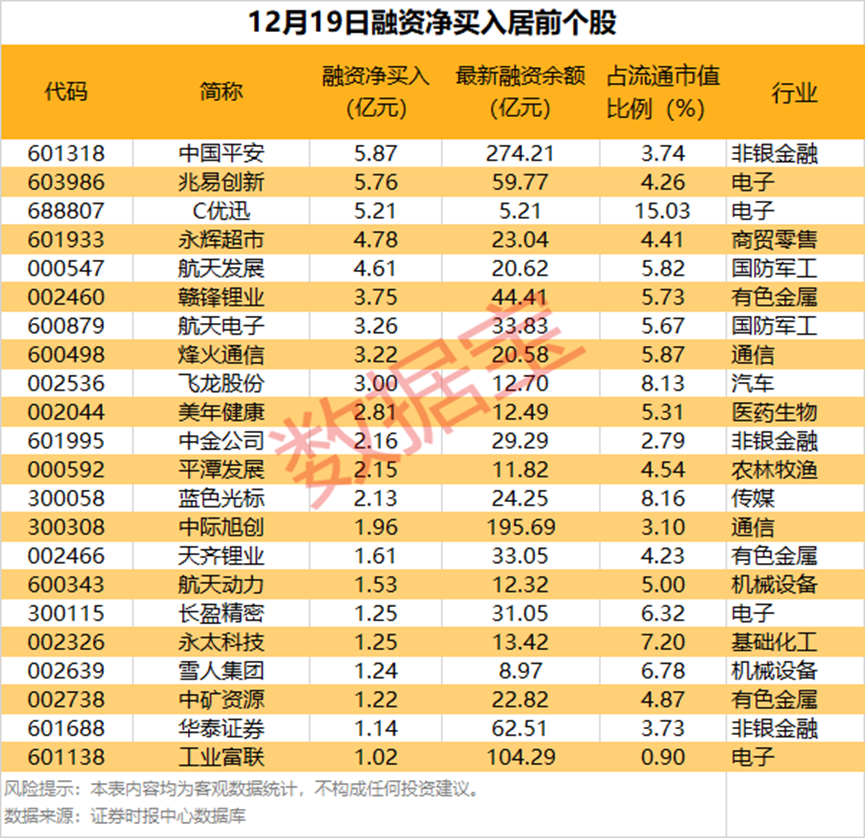
Group 1 - The overall market financing balance increased to 2.49 trillion yuan as of December 19, with a rise of 4.577 billion yuan compared to the previous trading day [1] - A total of 15 Shenwan first-level industries experienced net inflows of financing funds, with the electronics industry leading at a net purchase amount of 1.409 billion yuan [3] - Notable individual stocks with significant net financing purchases include China Ping An at 587 million yuan, followed by companies like Zhaoyi Innovation, Yonghui Superstores, and others [3] Group 2 - A total of 1,726 individual stocks received net financing purchases on the same day, with 22 stocks exceeding 100 million yuan in net purchases [3] - The top ten stocks by net financing purchase amounts included China Ping An, Zhaoyi Innovation, and others, indicating strong market interest in these companies [3]



22股杠杆资金净买入超亿元,中国平安最受青睐
Zheng Quan Shi Bao Wang· 2025-12-22 02:26
Core Insights - As of December 19, the total market financing balance reached 2.49 trillion yuan, an increase of 4.577 billion yuan compared to the previous trading day [1] Group 1: Financing Activities - A total of 22 stocks had a net financing inflow exceeding 100 million yuan [1] - China Ping An (601318) topped the list with a net financing inflow of 587 million yuan [2] - Other notable stocks with significant net financing inflows include: - Zhaoyi Innovation (603986) with 576 million yuan - C Yujing with 521 million yuan - Yonghui Supermarket (601933) with 478 million yuan - Aerospace Development (000547) with 461 million yuan - Ganfeng Lithium (002460) with 375 million yuan [2] Group 2: Sector Performance - The financing balance for China Ping An (601318) was 27.421 billion yuan, accounting for 3.74% of its market capitalization [2] - Zhaoyi Innovation (603986) had a financing balance of 5.977 billion yuan, representing 4.26% of its market capitalization [2] - C Yujing's financing balance was 521 million yuan, which is 15.03% of its market capitalization [2] - Yonghui Supermarket (601933) had a financing balance of 2.304 billion yuan, making up 4.41% of its market capitalization [2] - Aerospace Development (000547) had a financing balance of 2.062 billion yuan, representing 5.82% of its market capitalization [2] - Ganfeng Lithium (002460) had a financing balance of 4.441 billion yuan, accounting for 5.73% of its market capitalization [2]
上证180ETF指数基金(530280)涨近1%,机构建议关注三条主线
Xin Lang Cai Jing· 2025-12-22 02:26
Core Viewpoint - The recent adjustments in the market have provided investors with opportunities to strategically position themselves for the upcoming "cross-year" market trends, particularly focusing on growth and dividend styles [2]. Group 1: Market Performance - As of December 22, 2025, the Shanghai 180 Index (000010) increased by 0.65%, with notable gains from stocks such as Tuojing Technology (688072) up by 6.39%, China Duty Free Group (601888) up by 6.27%, and Zijin Mining (601899) up by 4.95% [1]. - The Shanghai 180 ETF Index Fund (530280) rose by 0.58%, with the latest price reported at 1.21 yuan [1]. Group 2: Investment Recommendations - The report from China International Capital Corporation (CICC) suggests focusing on three main investment themes: 1. **Growth in AI Technology**: The AI sector is expected to transition into industrial applications, with opportunities in computing power, optical modules, and cloud computing infrastructure, particularly favoring domestic companies. Applications to watch include robotics, consumer electronics, smart driving, and software [2]. 2. **External Demand**: Companies with overseas expansion strategies are seen as reliable growth opportunities, particularly in sectors like home appliances, engineering machinery, commercial buses, power grid equipment, gaming, and non-ferrous metals [2]. 3. **Cyclical Reversal**: Attention is recommended on sectors nearing improvement in supply-demand dynamics or benefiting from policy support, such as chemicals, aquaculture, and new energy [2]. Group 3: Seasonal Trends and Market Catalysts - According to Huatai Securities, the upcoming spring market is anticipated to show positive momentum, driven by potential catalysts such as foreign capital position adjustments post-Christmas, the dense disclosure period for annual reports starting mid-January, and possible reserve requirement ratio cuts in January [3]. - The Shanghai 180 ETF closely tracks the Shanghai 180 Index, which comprises 180 large-cap, liquid stocks from the Shanghai market, reflecting the overall performance of core listed companies [3].