PING AN OF CHINA(601318)

Search documents
资本热话 | 国际大行继续“超配中国”,这些A股行业龙头最受青睐
Sou Hu Cai Jing· 2025-10-22 10:29
Group 1 - UBS maintains an overweight rating on China within emerging markets, citing faster revenue and earnings growth compared to India, and improving capital return rates in the MSCI China index [1] - A-shares have experienced a style shift from "growth" to "value dividend" since October, influenced by US-China trade tensions and profit-taking in the tech sector, but the medium-term outlook for A-shares remains positive [1][3] - Foreign investors are closely monitoring China's 14th Five-Year Plan, particularly aspects related to "anti-involution," consumption promotion, high-quality growth, and the development of new productive forces [1][11] Group 2 - A-shares are showing structural differentiation, with major indices fluctuating, but foreign investors believe there is still high allocation value in the market despite recent tariff impacts [3][4] - The market's sensitivity to US-China trade tensions has decreased, and there is an expectation of policy measures to stabilize the market if significant volatility occurs [4] - Foreign investors favor industry leaders, with significant holdings in companies like Kweichow Moutai, Ping An, and Wuliangye, indicating a preference for stable, high-quality stocks [6][7] Group 3 - Foreign investors are increasing their positions in leading stocks, with notable increases in holdings for companies like Siyi Electric and Hai Da Group during the third quarter [8][6] - UBS expresses a preference for A-shares over H-shares due to their defensive nature against geopolitical tensions, maintaining a focus on growth styles as the main investment theme [10] - The upcoming policies in the 14th Five-Year Plan are expected to create potential opportunities in "anti-involution" and service consumption, which could drive cyclical improvements in various industries [12]





黄金巨震,险企如何看后市?平安产险内部人士:已配置黄金额度的50%
Xin Lang Cai Jing· 2025-10-22 10:23
智通财经记者 | 冯丽君 在金价不断攀升、黄金热度接连走高的2025年,保险公司获批入市黄金,部分积极投资黄金的险企如今 大概率已赚得"盆满钵满"。 今年以来,COMEX黄金期货今年累计上涨约50%;上海黄金交易所SGE黄金9999今年累计上涨约 54%,但近期黄金市场剧烈波动。 10月21日晚间,现货黄金跌破每盎司4200美元关口,创下近四年来最大跌幅,10月22日盘中一度逼近 4000美元关口。而就在两天前,COMEX黄金期货创下近4400美元/盎司的历史高价,达到4398美元/盎 司。 面对黄金巨震,险资作为中长期资金有什么态度? 试点险企积极投资黄金 今年2月7日,国家金融监管总局发布《关于开展保险资金投资黄金业务试点的通知》(下称《通 知》),规定自发布之日起,10家试点保险公司可以中长期资产配置为目的,开展投资黄金业务试点。 在短期快速下调之后,3月25日至今,COMEX黄金期货涨幅仍超过30%。而2024年,五大上市险企(中 国人寿、中国平安、中国太保、中国人保、新华保险)总投资收益率均不足6%。 在2025年半年报中,中国平安提到上半年积极增加优质另类资产布局,并试点黄金投资业务,多元化拓 展 ...

平安产险泉州中心支公司:银发天团萌力出圈 解锁晚年新姿态
Zhong Jin Zai Xian· 2025-10-22 10:20
Core Viewpoint - The event organized by Ping An Property & Casualty Insurance in Quanzhou aims to celebrate the elderly during the Double Ninth Festival by providing a creative photography session, helping seniors embrace their beauty and self-worth regardless of age [1][9]. Group 1: Event Overview - Volunteers from Ping An Property & Casualty Insurance engaged with seniors at the Cizhonghong Elderly Care Center, creating personalized fashion photo shoots to deliver unique blessings for the Double Ninth Festival [1]. - The initiative seeks to challenge the perception that aging diminishes beauty, encouraging seniors to express themselves and enjoy the moment [1]. Group 2: Volunteer Engagement - Volunteers demonstrated patience and care, assisting seniors with their appearance and encouraging them to relax and smile, which helped to create a lively atmosphere [4]. - The interaction included personalized attention, such as promising to arrange future photo sessions for seniors who expressed regret about not having their medals during the shoot [4]. Group 3: Photography Experience - A total of 25 seniors participated, with volunteers capturing their unique moments and expressions, fostering a sense of comfort and joy among the participants [7]. - Each photograph serves as a reflection of the seniors' lives and a means of intergenerational connection, with plans to deliver framed photos to the seniors afterward [7]. Group 4: Philosophical Perspective - The volunteers view their role as "time restorers," aiming to help each elder feel like the protagonist of their own life story, reinforcing the idea that age should not limit one's sense of beauty [9]. - The event embodies the spirit of "enjoying life in old age" and promotes respect for the elderly, with hopes that this warmth will spread across communities [9].



服务乡村振兴 平安产险医疗健康下乡百村巡回活动落地莆田仙游
Zhong Jin Zai Xian· 2025-10-22 10:20
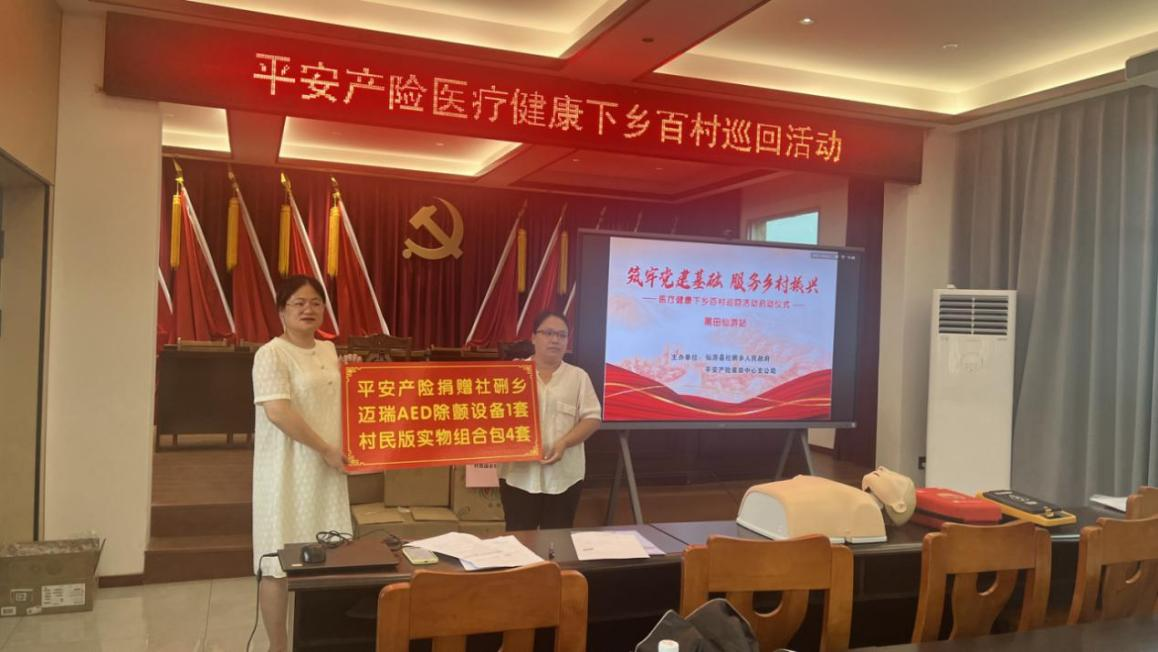
Group 1 - The core initiative is to implement the Party's leadership in rural revitalization, focusing on enhancing public welfare through practical measures in rural development [1] - Ping An Property & Casualty Insurance donated an AED defibrillator and four sets of emergency medical kits to Shexing Township, providing essential hardware support for rural medical emergencies [3] - Professional trainers conducted emergency knowledge and skills training for villagers, teaching basic first aid methods such as CPR and AED usage, which received enthusiastic participation from the community [3] Group 2 - The event included a financial literacy segment where volunteers distributed brochures and explained practical tips to prevent financial fraud, basic insurance knowledge, and public welfare policies to villagers [6] - Shexing Township is the fourth stop of Ping An's rural health outreach initiative in Putian, following previous locations, demonstrating the company's commitment to community health [8] - The company aims to continue implementing the spirit of the Central Financial Work Conference, focusing on the "five major articles" of finance, leveraging its dual advantages of "comprehensive finance + healthcare" to meet rural needs [8]
从技术先行到价值转化 AI如何穿越“达尔文海”
Nan Fang Du Shi Bao· 2025-10-22 10:15
Core Insights - The rise of AI deepfake scams poses significant threats to both individual finances and the security of the financial system, with direct economic losses exceeding 1.8 billion yuan as reported by the China Internet Finance Association [1] - Hong Kong's financial sector is exploring the use of AI to combat AI-generated fraud, exemplified by the inclusion of PAObank's anti-fraud strategy platform in the Hong Kong Monetary Authority's GenA.I. sandbox [1] - The disconnect between AI technology and actual business needs has created a "value divide," necessitating a reevaluation of how AI is integrated into financial services [3][4] Group 1: Value Divide and AI Integration - The phenomenon of "value divide" arises from the prevalent "technology-first" approach in AI projects, leading to isolated implementations that do not align with real business scenarios [3][4] - McKinsey's research indicates that while 80% of companies claim to use next-generation AI, 80% of these companies have not seen significant value enhancement from their AI initiatives [3] Group 2: AI as a Business Partner - AI should not be viewed as a standalone solution but rather as a business partner that integrates deeply into financial operations, enhancing risk control, marketing, customer service, and overall operational efficiency [4][6] - The collaboration between PAObank and Financial One Account to create an anti-fraud platform demonstrates a successful application of AI technology in the banking sector, with significant operational metrics such as over 90 million calls and 20,000 intercepted attacks [6] Group 3: Empowering Core Business - The successful realization of AI's value is marked by its ability to address public pain points and enhance enterprise-level applications, as emphasized by Ping An Group's approach to integrating AI into its financial services [5][9] - AI applications in areas such as auto insurance have led to measurable improvements, including a 0.3 percentage point increase in risk control capabilities, translating to billions in value due to the scale of operations [9][10] Group 4: Long-term Value Creation - The focus on practical applications of AI rather than mere technological advancements is crucial for creating sustainable value in the financial sector, as illustrated by Ping An's strategy of leveraging extensive data and operational experience [10]
从技术先行到价值转化,AI如何穿越“达尔文海”
Nan Fang Du Shi Bao· 2025-10-22 10:02
Core Insights - The rise of AI deepfake scams poses significant threats to both individual finances and the security of the financial system, with direct economic losses exceeding 1.8 billion yuan as reported by the China Internet Finance Association [1] - Hong Kong's financial sector is exploring the use of AI to combat AI-generated fraud, as evidenced by the inclusion of PAObank's anti-fraud strategy platform in the Hong Kong Monetary Authority's GenA.I. sandbox [1][3] - The disconnect between AI technology and actual business needs has created a "value gap," necessitating a reevaluation of how AI is integrated into financial services [3][4] Group 1: Value Disconnection - The narrative surrounding AI is expanding globally, with many financial institutions adopting "AI First" strategies, yet a significant number of these initiatives fail to deliver tangible value [3] - McKinsey's research indicates that while 80% of companies are utilizing next-generation AI, 80% of these companies report no significant value enhancement from their AI projects [3][4] - The phenomenon of "crossing the Darwinian sea" highlights the challenges faced by tech innovation firms in transitioning from R&D to successful commercialization, particularly in the AI sector [4] Group 2: Addressing Public Pain Points - The successful realization of AI's value in the financial sector is marked by its ability to address public pain points and generate social value [4][5] - PAObank's collaboration with Financial One Account to create an anti-fraud platform exemplifies the application of AI technology in banking, with over 90 million calls made to the technology and over 20,000 black market attacks intercepted [5] - The integration of AI into business processes is emphasized, with AI being viewed as a business partner rather than a standalone tool [5][6] Group 3: Empowering Core Business - The transformation of AI into a valuable asset for core business operations is crucial, with a focus on ensuring that every AI project has a clear value proposition [7] - In the auto insurance sector, AI-driven pricing models have improved risk control capabilities by 0.3 percentage points, translating to significant financial benefits given the scale of claims [7][8] - AI applications have led to substantial cost optimizations across various functions, including marketing, service, and risk management, with notable savings reported [8]

保险板块10月22日涨0.03%,新华保险领涨,主力资金净流出2.59亿元
Zheng Xing Xing Ye Ri Bao· 2025-10-22 08:19
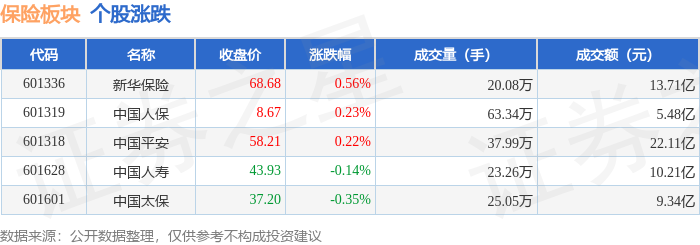
Core Insights - The insurance sector experienced a slight increase of 0.03% on October 22, with Xinhua Insurance leading the gains [1] - The Shanghai Composite Index closed at 3913.76, down 0.07%, while the Shenzhen Component Index closed at 12996.61, down 0.62% [1] Insurance Sector Performance - Xinhua Insurance (601336) closed at 68.68, up 0.56% with a trading volume of 200,800 shares and a transaction value of 1.371 billion [1] - China Pacific Insurance (601601) closed at 37.20, down 0.35% with a trading volume of 250,500 shares and a transaction value of 934.7 million [1] - China Life Insurance (601628) closed at 43.93, down 0.14% with a trading volume of 232,600 shares and a transaction value of 1.021 billion [1] - China Ping An (601318) closed at 58.21, up 0.22% with a trading volume of 379,900 shares and a transaction value of 2.211 billion [1] - China Reinsurance (601319) closed at 8.67, up 0.23% with a trading volume of 633,400 shares and a transaction value of 548 million [1] Capital Flow Analysis - The insurance sector saw a net outflow of 259 million from institutional investors, while retail investors contributed a net inflow of 253 million [1] - Xinhua Insurance had a net inflow of 75.31 million from institutional investors, but a net outflow of 73.70 million from retail investors [2] - China Ping An experienced a significant net outflow of 168 million from institutional investors, while retail investors contributed a net inflow of 172 million [2] - China Life Insurance and China Pacific Insurance also saw net outflows from institutional investors, with retail investors offsetting some of these losses [2]



保险代理人队伍:规模企稳 角色重塑
Jin Rong Shi Bao· 2025-10-22 06:19
Core Insights - The insurance agent workforce is transitioning from quantity expansion to quality enhancement, marking a significant shift towards high-quality growth in the insurance industry [1] Group 1: Stability in Agent Workforce - The insurance agent workforce is showing signs of stabilization, with a slight decrease of 4.0% to approximately 1.33 million agents among five A-share listed insurance companies by mid-2025 [2] - The number of insurance marketing agents is projected to be 2.64 million by the end of 2024, down over 70% from the peak of 9.12 million in 2019, but the decline has significantly narrowed compared to 2.81 million at the end of 2023 [2] - The stabilization is attributed to the completion of the "clearing" process and the implementation of "quality over quantity" strategies by insurance companies, focusing on attracting and nurturing high-quality talent [2] Group 2: Reduction in Branch Offices - Insurance companies are also undergoing a "streamlining" process, with the number of branch offices closed from 2020 to 2024 being 980, 2,196, 3,020, 2,065, and 2,012 respectively [3] - Since 2025, over 2,400 branch offices have exited the market, with a total of more than 12,000 institutions closed in the past five years [3] Group 3: Transformation of Agent Roles - The role of insurance agents is evolving from mere sales to comprehensive advisory roles, with companies like Ping An Life introducing "insurance health consultants" that combine multiple identities [4] - Major insurance firms are enhancing professional training to meet refined customer needs, reflecting a shift from quantity-driven expansion to quality-driven capability enhancement [4][5] - Regulatory frameworks are supporting this transformation, with directives aimed at accelerating marketing system reforms and encouraging the professionalization of insurance sales personnel [4] Group 4: Rising Professional Standards - The educational qualifications of insurance marketing agents are improving, with 72.34% holding a college degree or higher, an increase of 5.5 percentage points from the previous year [5] - The proportion of new agents with a bachelor's degree or higher has risen from under 30% five years ago to nearly 70% [5] Group 5: Performance Growth Linked to Quality - The quality enhancement is translating into performance growth, with China Life's individual insurance channel new business value reaching 24.34 billion yuan, a year-on-year increase of 9.5% [6] - Ping An Life's agent channel new business value grew by 17.0%, with per capita new business value increasing by 21.6% [6] - New business value for Xinhua Insurance's individual insurance channel reached 3.11 billion yuan, up 11.7% year-on-year, with per capita productivity increasing by 74% [6] Group 6: Future Trends and Challenges - As customer insurance awareness grows, the demand for comprehensive services is increasing, necessitating agents to transition from sales experts to planning consultants with knowledge across multiple fields [7] - The introduction of roles like "financial planners" and "risk managers" is attracting more professionals into the insurance sector, with expectations for the agent workforce to stabilize and potentially grow [7] - However, the industry will continue to experience a dynamic process of selection, with increasing complexity in product sales requiring higher professional capabilities from agents [8]
保险业全力护航 黄淮海秋粮抢收攻坚战
Jin Rong Shi Bao· 2025-10-22 06:15
Core Insights - The article highlights the severe impact of continuous heavy rainfall on the autumn harvest in the Huanghuaihai region and other provinces, posing significant challenges to agricultural production and food security [1][7] - The government has allocated 484 million yuan in disaster relief funds to support affected provinces in agricultural recovery efforts [1] - Insurance companies are actively implementing emergency response plans to expedite disaster claims and support farmers [2][3][4] Government Response - The Ministry of Finance and the Ministry of Agriculture and Rural Affairs have jointly issued 484 million yuan for disaster relief to seven provinces [1] - The funds are aimed at facilitating rapid harvesting, drying of crops, drainage of fields, and wet sowing of winter wheat [1] - A meeting was held to emphasize the importance of timely insurance claims processing for affected farmers [1] Insurance Industry Actions - Multiple insurance companies have activated emergency plans to establish a disaster claims system, ensuring the protection of farmers' interests [2] - China Life Insurance and other firms are utilizing technology such as drones and satellite imagery to enhance damage assessment and claims processing efficiency [4][6] - Insurance companies have reported significant payouts, with 1.41 billion yuan already disbursed for various crop losses as of October 13 [1][3] Local Initiatives - Local insurance branches are collaborating with agricultural experts to conduct on-site assessments and provide timely advice to farmers [5][6] - In regions like Shandong and Anhui, insurance companies are actively involved in coordinating harvesting and drying efforts to minimize crop losses [4][5] - The use of technology and data analysis is being emphasized to monitor crop conditions and guide farmers in disaster prevention [6] Overall Impact - The efficiency of agricultural insurance claims is crucial for ensuring farmers' financial recovery and maintaining national food security [7] - The insurance sector is committed to providing rapid responses and effective measures to support the autumn harvest and mitigate losses [7]
险资再度增持银行股 热情或将持续
Jin Rong Shi Bao· 2025-10-22 06:04
Core Viewpoint - Insurance capital is actively increasing its holdings in bank stocks, driven by high dividend yields and stable returns, particularly in a low-interest-rate environment [1][3][4]. Group 1: Recent Activities of Insurance Capital - On October 10, Ping An Life increased its holdings in China Merchants Bank H-shares by 2.989 million shares, raising its total to 781 million shares, which accounts for 17% of the bank's H-shares [1]. - On the same day, Ping An purchased 6.416 million shares of Postal Savings Bank, bringing its total holdings to 17.01% [1]. - As of September 30, Ping An Life had acquired 39.634 million shares of Agricultural Bank H-shares, increasing its stake to 17.03%, with total holdings across its subsidiaries exceeding 19% [2]. Group 2: Reasons for Increased Investment in Bank Stocks - The high dividend yields and stable returns of bank stocks make them an ideal choice for insurance capital, especially in a declining interest rate environment [3]. - Regulatory encouragement for insurance capital to enter the market and new accounting standards promoting high-dividend asset allocation are also driving this trend [3]. - Current valuations of bank stocks are at historical lows, providing a favorable investment opportunity with cyclical resilience and policy support [3]. Group 3: Growth in Equity Allocation by Insurance Capital - A joint initiative by six departments aims to guide long-term funds, including insurance capital, to increase their market participation [4]. - As of the second quarter of 2025, the total investment balance of insurance companies exceeded 36 trillion yuan, with stock investments rising by 26.38% year-on-year [4]. - The five major listed insurance companies reported a total stock investment balance of 1.8 trillion yuan by mid-2025, reflecting an increase of over 400 billion yuan from the previous year [4]. Group 4: Market Outlook and Challenges - Insurance capital is expected to benefit from equity investments, enhancing investment returns and optimizing portfolio performance [5]. - However, challenges include the inherent volatility of the stock market, necessitating improved risk management and investment proportion control [5]. - Increased instances of insurance capital acquiring stakes may lead to market discussions regarding their impact [5].