
BANK COMM(601328)

Search documents
前三季多家国有行净利增速由负转正!净利息收入降幅普遍收窄
Sou Hu Cai Jing· 2025-11-03 07:16
Core Insights - The performance of China's six major state-owned banks showed steady growth in the first three quarters, with total operating income reaching 2.72 trillion yuan, a year-on-year increase of 1.87%, and net profit attributable to shareholders reaching 1.07 trillion yuan, up 1.22% year-on-year [2][3] Financial Performance - All six major state-owned banks achieved year-on-year revenue growth in the first three quarters, with China Bank leading at a 2.69% increase, while the other five banks had growth rates between 0.82% and 2.17% [3][5] - The net profit growth rate for these banks turned positive in the third quarter, with Industrial and Commercial Bank of China (ICBC) reporting a single-quarter profit of 101.8 billion yuan, marking the first time it exceeded 100 billion yuan in a single quarter [3][4] - The net interest income for most banks declined year-on-year, but the rate of decline narrowed compared to the first half of the year, with only the Bank of Communications reporting an increase of 1.46% [6][8] Non-Interest Income - All six banks reported year-on-year growth in net fee and commission income, with Agricultural Bank of China leading at a 13.34% increase, and Postal Savings Bank of China also showing strong performance with an 11.48% increase [7][8] - The improvement in non-interest income is attributed to a recovery in capital markets and increased wealth management income [7][8] Asset Quality - Five out of six major state-owned banks reported a decrease in non-performing loan (NPL) ratios compared to the end of the previous year, indicating overall stable asset quality [9][11] - Postal Savings Bank was the only bank to see an increase in its NPL ratio, which rose to 0.94%, still the lowest among the six banks [9][11] Provision Coverage - The provision coverage ratio, a key indicator of risk resilience, showed that only China Bank fell below 200%, with a ratio of 196.60%, while Agricultural Bank had the highest at 295.08% [10][11] Inclusive Finance Initiatives - The banks reported significant growth in inclusive finance loans, with notable increases in loans for small and micro enterprises and pension management [12][13] - The banks are also advancing in technology and green finance, with substantial growth in technology loans and green loan balances [12][13]








从IT负责人到交行副行长,他退休5年后被查
Nan Fang Du Shi Bao· 2025-11-03 07:12
Core Points - The former Vice President of Bank of Communications, Hou Weidong, is under investigation for serious violations of discipline and law, five years after his retirement [1][2] - Hou Weidong was the first Chief Information Officer (CIO) in China's banking industry and held significant positions in both technology and business operations during his tenure [2][3] Group 1: Background and Career - Hou Weidong worked at the Industrial and Commercial Bank of China before joining Bank of Communications, where he held various roles, including Vice President and CIO [2] - He served as Vice President of Bank of Communications for over nine years and was also the CIO for six years during that time [2][3] - His career highlights include leading the launch of major technological systems that transformed banking operations from distributed to centralized processing [3] Group 2: Institutional Response - Following the announcement of Hou Weidong's investigation, the Bank of Communications' Party Committee held a meeting to express support for the central government's decision and to cooperate fully with the investigation [4] - The committee emphasized the importance of ongoing discipline and warning education to mitigate the negative impact of Hou's case and to strengthen anti-corruption efforts [4] - Leadership within the bank is urged to maintain strict adherence to political discipline and regulations, promoting a healthy political environment [4]
经络:香港10月现楼按揭达6662宗 环比增加8%
智通财经网· 2025-11-03 07:11
Core Insights - In October 2025, the number of existing property mortgage applications in Hong Kong increased to 6,662, up by 491 applications (8%) from September, while the number of pre-sale mortgage applications dropped to 599, a decrease of 599 applications (44%) from the previous month [1] - Year-on-year comparison shows that existing property mortgage applications rose by 2,729 applications (69.4%) compared to October 2024, while pre-sale mortgage applications increased by 51 applications (9.3%) [1] - For the first ten months of 2025, existing property mortgage applications totaled 54,228, an increase of 10,988 applications (25.4%) from the same period in 2024, and pre-sale mortgage applications reached 6,041, up by 2,435 applications (67.5%) [1] Market Share Analysis - In the existing property mortgage market, Bank of China (Hong Kong) leads with a market share of 32.2%, followed by HSBC at 19.3%, Hang Seng Bank at 15.8%, Standard Chartered Bank at 7%, and Bank of East Asia at 6.2% [2] - For pre-sale mortgages, HSBC ranks first with a market share of 23.9%, followed by Bank of China (Hong Kong) at 20.2%, Hang Seng Bank at 14.4%, and China Communications Bank at 10.5% [2] - The market share of the four major banks in existing property mortgages slightly decreased from 74.7% to 74.3% in October 2025 [2]





浙商证券:25Q3银行营收利润增速韧性强 Q4有望深蹲起跳
智通财经网· 2025-11-03 06:19
Core Viewpoint - The performance of listed banks in Q1-Q3 2025 slightly exceeded expectations, with revenue growth remaining stable and profit growth showing a slight increase [1][2] Performance Overview - Listed banks' revenue growth year-on-year is stable at 0.9%, while profit growth has increased to 1.6%. The weighted revenue and net profit attributable to shareholders increased by 0.9% and 1.6% respectively, with a slight slowdown in growth compared to H1 2025 [2][3] - Large banks showed a comprehensive performance turnaround, while the performance of small and medium-sized banks was mixed. Agricultural Bank, Bank of Communications, China Bank, and Industrial Bank performed better than expected, while China Construction Bank experienced a significant decline in quarterly interest margin [2][3] Driving Factors - Asset scale growth for listed banks in Q1-Q3 2025 was 9.3%, a slowdown of 0.3 percentage points compared to H1 2025. Loan growth decreased while financial investment growth increased [3] - The interest margin stabilized in Q3 2025, with a slight increase of 0.3 basis points to 1.37%. The asset yield decreased by 7 basis points to 2.81%, while the cost of liabilities decreased by 8 basis points to 1.56% [4] Non-Interest Income - Non-interest income for listed banks grew by 5.0% year-on-year, but the growth rate decreased by 2.0 percentage points compared to the previous quarter. Fee and commission income increased by 4.6% year-on-year, indicating some recovery in related business [5][6] - Bond trading income decreased by 0.6% year-on-year, with small and medium-sized banks experiencing a larger decline compared to state-owned banks [5][6] Asset Quality - The average non-performing loan (NPL) ratio remained stable at 1.23%, while the average attention rate increased by 2 basis points to 1.69%. The retail sector continues to face pressure, particularly in small and micro loans [7][8] - The number of banks announcing mid-term dividends has increased, with some banks raising their mid-term dividend rates compared to the previous year [9] Recommended Stocks - Recommended stocks include Shanghai Pudong Development Bank, Nanjing Bank, Shanghai Bank, Jiangsu Bank, Agricultural Bank, and Bank of Communications, with a focus on Qilu Bank and H-share large banks [9]





“国家队”资金,最新持仓曝光
Zhong Guo Zheng Quan Bao· 2025-11-03 05:35
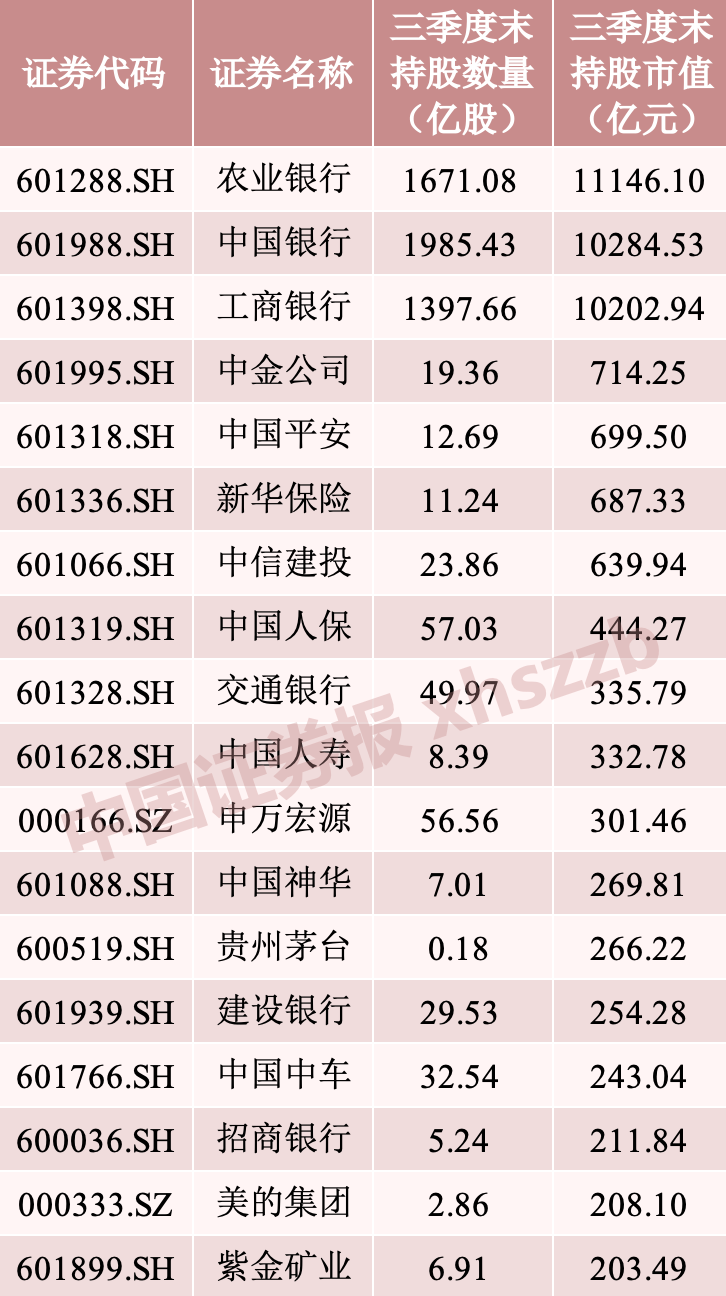
Group 1 - "National Team" funds increased holdings in insurance, resource, consumer, electronics, and communication sectors, with some stocks doubling in price during Q3 [1][8] - Over 800 A-share listed companies had "National Team" funds among their top ten shareholders by the end of Q3, with a total market value exceeding 100 billion yuan for 33 companies [2][5] - Major holdings by "National Team" funds included Agricultural Bank of China, Bank of China, and Industrial and Commercial Bank of China, with market values of 1.11 trillion yuan, 1.03 trillion yuan, and 1.02 trillion yuan respectively [2][6] Group 2 - "National Team" funds also held significant stakes in companies with market values between 300 billion yuan to 500 billion yuan, including China Life Insurance and China Pacific Insurance [3] - New entries into the top ten shareholders list included nearly 180 companies, with notable holdings in Mindray Medical and Giant Network, each exceeding 1 billion yuan [7] - The overall adjustment by "National Team" funds indicated a shift towards cyclical stocks, with increased investments in financials, resources, and consumer goods [8][9]



寻找绩优股:2026年银行业年度策略
GUOTAI HAITONG SECURITIES· 2025-11-03 05:20
Investment Rating - The report indicates a cautious outlook on the credit growth rate, suggesting a shift towards quality improvement, with expectations for a recovery in corporate loan increments by 2026 [5][9]. Core Insights - Credit growth is expected to slow significantly starting in 2024, but the decline in growth rate is anticipated to moderate by 2026, with corporate loans likely to see a year-on-year increase [7][9]. - The relationship between credit growth and economic growth is weakening, emphasizing the need to optimize credit structure and reduce idle financial resources [9]. - The report highlights that the banking sector's total asset growth will outpace loan growth in 2025, driven by government bond supply and fiscal policies [9]. Summary by Sections Credit Growth Forecast - New RMB loans are projected at 21.3 trillion, 23.6 trillion, and 18.9 trillion yuan for 2022, 2023, and 2024 respectively, with a further estimate of 14.7 trillion yuan for the first three quarters of 2025 [9]. - For 2026, new loans are expected to be between 17.2 trillion and 17.7 trillion yuan, corresponding to a growth rate of 6.3% to 6.5% [9]. Loan Composition - In 2023, the total RMB loans are expected to reach 237.59 trillion yuan, with a year-on-year growth rate of 10.6% [8]. - Retail loans are projected to grow from 80.10 trillion yuan in 2023 to 82.84 trillion yuan in 2024, reflecting a growth rate decline from 5.7% to 3.4% [8]. - Corporate loans are anticipated to increase from 157.07 trillion yuan in 2023 to 171.01 trillion yuan in 2024, with a growth rate of 12.7% [8]. Regional Performance - Regions such as Jiangsu, Zhejiang, Sichuan, and Shandong are expected to continue outperforming the national average in loan growth due to strong economic performance and support from new policy financial tools [12]. Banking Sector Dynamics - The report notes that state-owned banks are expected to maintain a competitive edge due to lower funding costs and capital injections from the Ministry of Finance [12]. - The net interest margin is in a downward trend, but the rate of decline is expected to slow starting in 2025, with some smaller banks potentially stabilizing their margins by 2026 [13][17]. Asset Quality - As of Q2 2025, the non-performing loan (NPL) ratio for listed banks is reported at 1.25%, indicating a stable asset quality despite pressures on retail credit [37]. - The report emphasizes that while retail loan NPLs have increased since 2021, corporate loan clearances have improved significantly, providing a buffer against retail risks [37].


交通银行前三季度营收、净利润均实现同比增长
Zheng Quan Ri Bao Zhi Sheng· 2025-11-03 04:09
Core Insights - The core viewpoint of the news is that Bank of Communications has demonstrated steady operational development in the first three quarters of 2025, with key financial indicators showing positive growth compared to the previous year [1][2]. Financial Performance - The bank achieved operating income of 199.645 billion yuan, representing a year-on-year increase of 1.80% [1]. - Net interest income and net fee and commission income both experienced positive growth, increasing by 1.46% and 0.15% respectively [1]. - The net profit attributable to shareholders reached 69.994 billion yuan, up by 1.90% year-on-year [1]. - Total assets amounted to 15.50 trillion yuan, reflecting a growth of 4.02% compared to the end of the previous year [1]. Loan and Financial Services - The customer loan balance stood at 9.07 trillion yuan, marking a 6.04% increase from the end of the previous year, with an additional 31.2 billion yuan year-on-year [1]. - The bank has focused on enhancing financial services for the real economy, with significant growth in technology finance, digital finance, pension finance, and manufacturing loans, all exceeding the average growth rate of corporate loans [1]. Strategic Initiatives - As a state-owned bank headquartered in Shanghai, Bank of Communications is deeply integrated into the strategic tasks assigned to Shanghai, enhancing its capabilities in technology finance and expanding its market leadership in financial services [2]. - The bank has established cooperation with 65 major municipal projects and 191 district-level projects in Shanghai during the reporting period [2]. - The bank facilitated "Bond Connect" transactions totaling 650.1 billion yuan and "Swap Connect" transactions of 634.4 billion yuan [2]. Risk Management - The bank maintains a prudent management philosophy, focusing on refined risk management and enhancing control over key risk areas [2]. - The non-performing loan ratio is reported at 1.26%, a decrease of 0.05 percentage points from the end of the previous year [2]. - The provision coverage ratio stands at 209.97%, an increase of 8.03 percentage points compared to the end of the previous year [2].
国有大行三季报全部出炉,营收和净利润均实现正增长
Jin Tou Wang· 2025-11-03 03:25
Core Insights - The six major state-owned banks in China reported steady profit growth for the first three quarters of 2025, with a combined net profit exceeding 1 trillion yuan [1] - Total assets of the Industrial and Commercial Bank of China (ICBC) approached 53 trillion yuan, while Agricultural Bank and China Construction Bank followed with 48.14 trillion yuan and 45.37 trillion yuan respectively, both showing asset growth rates exceeding 10% [1] Revenue Summary - In terms of revenue, ICBC led with 640.03 billion yuan, followed by China Construction Bank at 573.70 billion yuan and Agricultural Bank at 550.88 billion yuan [1] - China Bank reported the highest revenue growth rate at 2.69%, while ICBC also showed significant growth above 2% [1][2] - Other banks like Agricultural Bank, Postal Savings Bank, and Traffic Bank had revenue growth rates between 1% and 2%, while China Construction Bank experienced a slight increase of 0.82% [1] Net Interest Income and Margin - Net interest income continued to decline across most banks, with only Traffic Bank showing positive growth [2] - Postal Savings Bank had the highest net interest margin at 1.68%, despite the largest decline, while Traffic Bank's margin was 1.20%, down by 8 basis points [2] - The remaining four banks experienced a similar decline of around 15 basis points in net interest margin [2] Net Profit Analysis - ICBC reported the highest net profit at 269.91 billion yuan, followed by China Construction Bank at 257.36 billion yuan and Agricultural Bank at 220.86 billion yuan, with Agricultural Bank showing the highest year-on-year growth of 3.03% [2] - Traffic Bank had the lowest net profit at 69.99 billion yuan [2] Asset Quality - As of September, Postal Savings Bank maintained the best asset quality with a non-performing loan (NPL) ratio of 0.94%, despite a slight increase from the previous year [2] - Traffic Bank's NPL ratio was 1.26%, showing the largest decline of 0.05 percentage points, while Agricultural Bank and China Construction Bank also reported slight decreases in their NPL ratios [3] Provision Coverage - Agricultural Bank led in provision coverage ratio at 295.08%, while Traffic Bank, ICBC, and China Construction Bank also saw improvements in their coverage ratios compared to the previous year [3]
本周有逾十只近3月年化超10%固收+理财可申购
2 1 Shi Ji Jing Ji Bao Dao· 2025-11-03 03:07
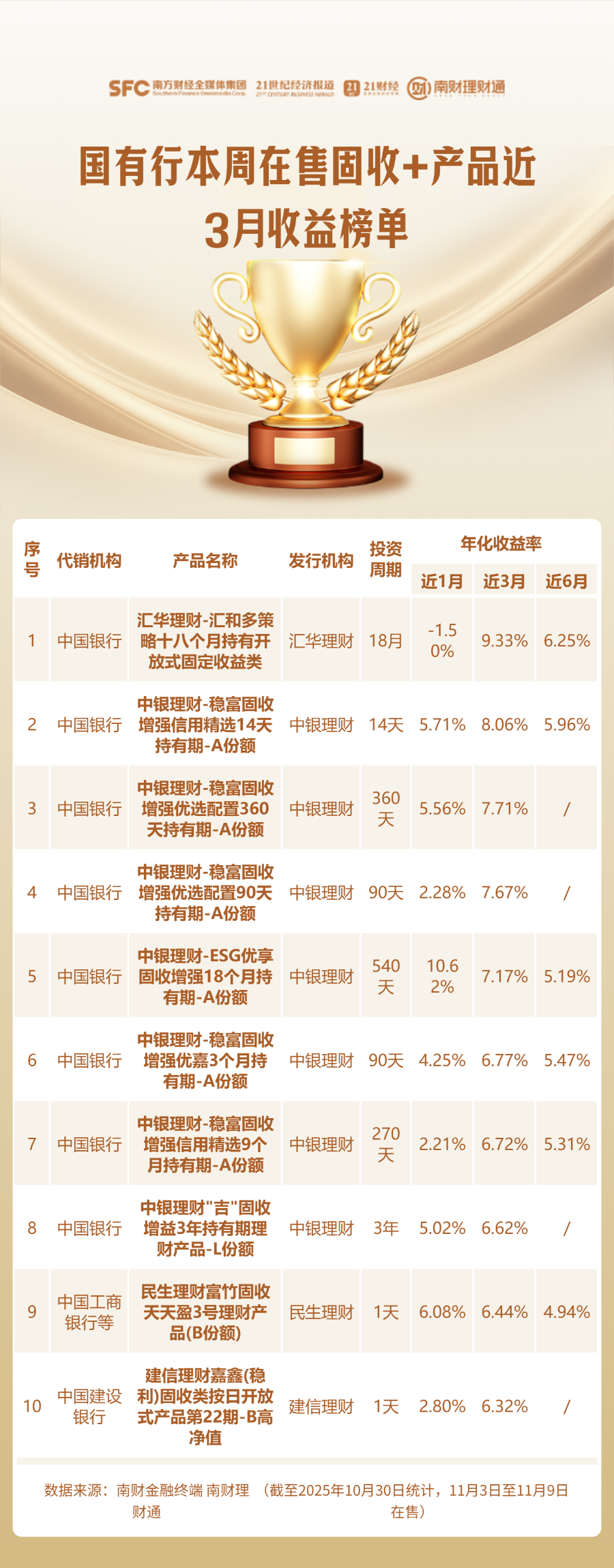
Core Viewpoint - The article emphasizes the importance of selecting suitable wealth management products, particularly "fixed income+" products, from various banks, highlighting the performance of these products over different time frames to aid investors in making informed decisions [1][2]. Summary by Category Product Performance - The article presents a performance ranking of wealth management products based on their annualized returns over the past month, three months, and six months, with a focus on the three-month annualized yield for recent market fluctuations [1]. - Notable products include: - "幸福99添益(稳健 严选FOF)" from 杭银理财 with a three-month yield of 13.32% [7]. - "贵竹固收揭强未在" from 中国民生银行 with a three-month yield of 11.5% [8]. - "宁享固定收益类甄选日开理财1号" from 微众银行 with a three-month yield of 7.90% [14]. Distribution Channels - The article lists 28 distribution institutions, including major banks such as 工商银行, 中国银行, and 招商银行, which are involved in selling these wealth management products [1]. - It highlights the variability in product availability due to factors like sales limits and differing product displays across banks, advising investors to refer to the actual offerings on bank apps [1]. Data Source - The performance data is sourced from 南财金融终端, with statistics as of October 30, 2025, and the ranking is based on products available for sale from November 3 to November 9, 2025 [1][14].
交通银行 深度融入上海“五个中心”建设
Jin Rong Shi Bao· 2025-11-03 02:33
Core Insights - The core viewpoint of the report is that Bank of Communications has shown steady growth in its financial performance for the first three quarters of 2025, with a focus on enhancing its role in Shanghai's economic development and improving its financial services capabilities [1] Financial Performance - As of the end of the reporting period, Bank of Communications had total assets of 15,499.783 billion yuan, an increase of 599.066 billion yuan, representing a growth of 4.02% compared to the end of the previous year [1] - For the first three quarters of this year, the bank achieved operating income of 199.645 billion yuan, a year-on-year increase of 1.80% [1] - The net profit attributable to shareholders reached 69.994 billion yuan, reflecting a year-on-year growth of 1.90% [1] Strategic Initiatives - The bank is deeply integrated into Shanghai's "Five Centers" construction, focusing on enhancing its technological financial capabilities and maintaining its leading position in financial market operations [1] - It has established cooperation with 65 major municipal projects and 191 district-level projects in Shanghai during the reporting period [1] - The bank has completed "Bond Connect" transactions amounting to 650.1 billion yuan and "Swap Connect" transactions totaling 634.4 billion yuan [1] Risk Management - As of the end of the reporting period, the non-performing loan ratio was 1.26%, a decrease of 0.05 percentage points from the end of the previous year [1] - The provision coverage ratio stood at 209.97%, an increase of 8.03 percentage points compared to the end of the previous year [1] - The bank disposed of non-performing loans amounting to 55.737 billion yuan, which is a year-on-year increase of 28.12% [1]