
BANK COMM(601328)

Search documents
11 家大行去年理财代销增超万亿
Jing Ji Guan Cha Wang· 2026-01-30 02:45
Core Viewpoint - The report highlights a decline in the scale of bank wealth management sales in December 2025, with a total of 13.46 trillion yuan, a decrease of 1.05% from November, but an increase of 10% from the beginning of the year. The growth is attributed to a "deposit migration" logic, indicating a shift in customer preferences towards wealth management products [2][6]. Group 1: Bank Performance - Postal Savings Bank showed a remarkable growth rate of 27.2%, leading among the 11 national banks, while China Merchants Bank followed with a 12.2% increase [2][4]. - In absolute terms, China Merchants Bank led with a wealth management sales scale of 4.41 trillion yuan, followed by CITIC Bank and Industrial Bank, each exceeding 1 trillion yuan [2][4]. - The ranking of the 11 banks remained relatively stable, with Postal Savings Bank rising from 7th to 4th place by the end of the year [2][4]. Group 2: Market Dynamics - The overall wealth management sales scale of the 11 banks increased by 1.22 trillion yuan, reflecting a 10% growth from the beginning of the year, with three banks (Postal Savings, China Merchants, and Huaxia) achieving growth rates above 10% [5][6]. - The average yield of wealth management products fell below 2% for the first time, at 1.98%, yet the number of investors increased by 14.37%, indicating a strong demand for stable-return products [8][9]. - The "deposit migration" narrative remains a key driver for the growth of wealth management, as banks focus on deeper market penetration and optimizing customer service [9][10]. Group 3: Future Outlook - Predictions suggest that by the end of 2026, the wealth management scale could reach approximately 38 trillion yuan, with a growth rate of around 12% [11]. - The average risk index is expected to gradually rise, and the proportion of long-term products is anticipated to increase, while T+0 products will decrease [11].





去银行办社保业务,东城区“社银合作”服务网点增至7家
Bei Jing Ri Bao Ke Hu Duan· 2026-01-30 02:42
Core Viewpoint - The "Social Security and Banking Cooperation" initiative in Dongcheng District has shown significant progress, with new partnerships established and high satisfaction rates among the public [1][3]. Group 1: Initiative Overview - The "Social Security and Banking Cooperation" initiative has been operational for over 9 months, resulting in 126,100 service visits and a public satisfaction rate of 98.02% [3]. - The initiative aims to provide convenient social security services to the public while enhancing efficiency for social security and promoting development for banks [3]. Group 2: New Partnerships - Postal Savings Bank and Bank of China have recently joined the "Social Security and Banking Cooperation" network, increasing the total number of service points to 7 [1][6]. - The existing network includes Industrial and Commercial Bank of China, China Construction Bank, Bank of Communications, Beijing Bank, and Beijing Rural Commercial Bank, serving a total of 35,000 insured units and over 1.67 million insured individuals [6]. Group 3: Service Areas - The service network covers key areas along the central axis, including Zhongguancun Dongcheng Park, "Hangkongyuan" Technology Park, Dongzhimen, Wangfujing-Longfusi, Tiantan, and Yongdingmenwai [6]. - This strategic placement aims to provide high-frequency and low-risk social security services to the local population [6].

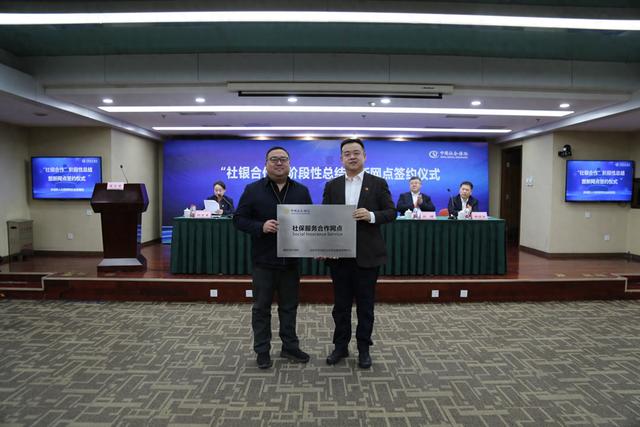
国有大行“村改支”提速推进,农行系村镇银行全部退出!其他大行进展几何?
Xin Lang Cai Jing· 2026-01-30 00:54
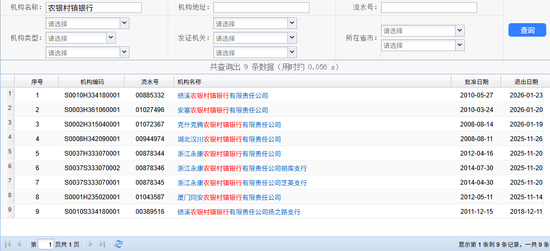
短短三个月时间内,中国农业银行旗下6家村镇银行便悉数完成收编。 近日,安徽金融监管局发布批复,正式宣布解散位于宣城市的绩溪农银村镇银行,该行全部 资产、负债及相关业务由中国农业银行承继。在此之前,农行旗下另外5家村镇银行已陆续 完成市场退出流程,这也标志着农行系村镇银行的全面改革工作圆满收尾。 自去年6月工商银行收购重庆璧山工银村镇银行,率先打响国有大行参与"村改支"的第一枪 后,国有大行推进村镇银行改革的序幕正式拉开。据统计,截至目前,国有大行通过"村改 支"模式完成整合的村镇银行共计10家,其中工商银行1家、农业银行6家、交通银行3家,改 革进程稳步推进。 三个月内收编6家 农行系村镇银行全部退出 近日,安徽金融监管局发布批复称,同意解散绩溪农银村镇银行,该行全部资产、负债、业 务、网点、员工及其他一切权利义务由中国农业银行承继。 批复明确要求,该行应立即停止一切经营活动,于15个工作日内向国家金融监督管理总局宣 城监管分局缴回许可证,并按照有关法律法规要求办理相关手续。 金融研究院查询金融监管总局官网披露的金融许可证信息发现,绩溪农银村镇银行已于2026 年1月23日正式退出。 | (图源:金融监管总 ...

你的“年终奖”到账了吗?银行打响理财市场“抢收”大战
Xin Lang Cai Jing· 2026-01-30 00:54
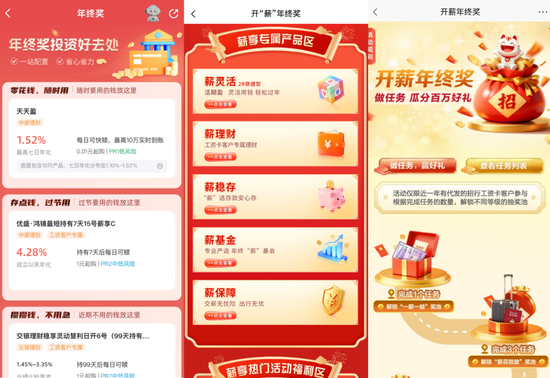
Core Viewpoint - Multiple banks are targeting the year-end bonuses of workers by launching exclusive financial products and promotional activities to attract customers [2][5][10]. Group 1: Year-End Bonus Financial Products - Several banks, including Postal Savings Bank, Bank of Communications, and China Merchants Bank, have introduced dedicated sections in their mobile banking apps for year-end bonus financial products [5][6][7]. - For example, Postal Savings Bank offers products like "Daily Earnings" with a maximum annualized rate of 1.52% and a low-risk product with an annualized rate of 4.28% [6]. - China Merchants Bank has a "Year-End Bonus" section that includes tasks for customers to unlock rewards, specifically targeting customers with salary accounts [7]. Group 2: Asset Allocation Strategies - Some banks are providing asset allocation strategies for year-end bonuses, suggesting a breakdown of funds into categories such as daily expenses, safety nets, stable investments, and growth investments [8]. - For instance, the Guangdong branch of China Construction Bank recommends allocating 10%-20% for daily expenses, 5%-10% for safety, 40%-60% for stable investments, and 10%-20% for growth [8]. Group 3: Market Trends and Data - As of the end of 2025, the total scale of the bank wealth management market reached 33.29 trillion yuan, an increase of 11.15% from the beginning of the year, with the number of investors growing by 14.37% [12][13]. - The report indicates that low-risk and medium-low-risk products dominate the market, with 95.73% of the total wealth management products falling into these categories [14]. - In 2025, wealth management products generated a total return of 730.3 billion yuan for investors, with an average yield of 1.98% [14].

“科技+数据+生态”深度融合,交通银行四川省分行数字化经营再上新台阶
Mei Ri Jing Ji Xin Wen· 2026-01-29 12:50
在数字经济浪潮席卷全球、金融科技深刻重塑行业格局的今天,中国银行业正经历一场以数字化为核心 的深刻变革。 交通银行四川省分行(以下简称"交行四川省分行"或"分行")主动顺应时代趋势,积极践行总行战略, 以"科技+数据+生态"的深度融合为引擎,推动全行数字化经营迈上新台阶,不仅实现了自身服务能力 与运营效率的提升,更在服务四川地方经济发展、践行金融为民使命中展现了国有大行的担当与智慧。 当前,交行四川省分行数字化转型已从前期布局投入阶段,全面进入成效加速显现、价值持续释放的新 时期。数据显示,截至2025年末,该行个人手机银行月活跃用户(MAU)数量超过110万,创下该行自 推出移动金融服务以来的最高纪录。更为可喜的是,其年月均活跃用户数量已逼近102万,与上年同期 相比实现净增长超过12万,增长表现亮眼。 这一成绩的取得,不仅是该行线上渠道建设与用户体验优化成效的直观反映,更标志着其数字化服务已 深度融入广大客户的日常生活,成为获取金融服务的主要入口,为分行后续深化数字营销、拓展场景生 态、提升客户价值奠定了坚实的用户基础。 答好安全必答题 守护数字时代发展根基 为此,分行将网络安全与系统稳定性提升至前所未有 ...
21独家|去年银行理财代销大增 邮储劲增27%超越交行等
2 1 Shi Ji Jing Ji Bao Dao· 2026-01-29 09:49
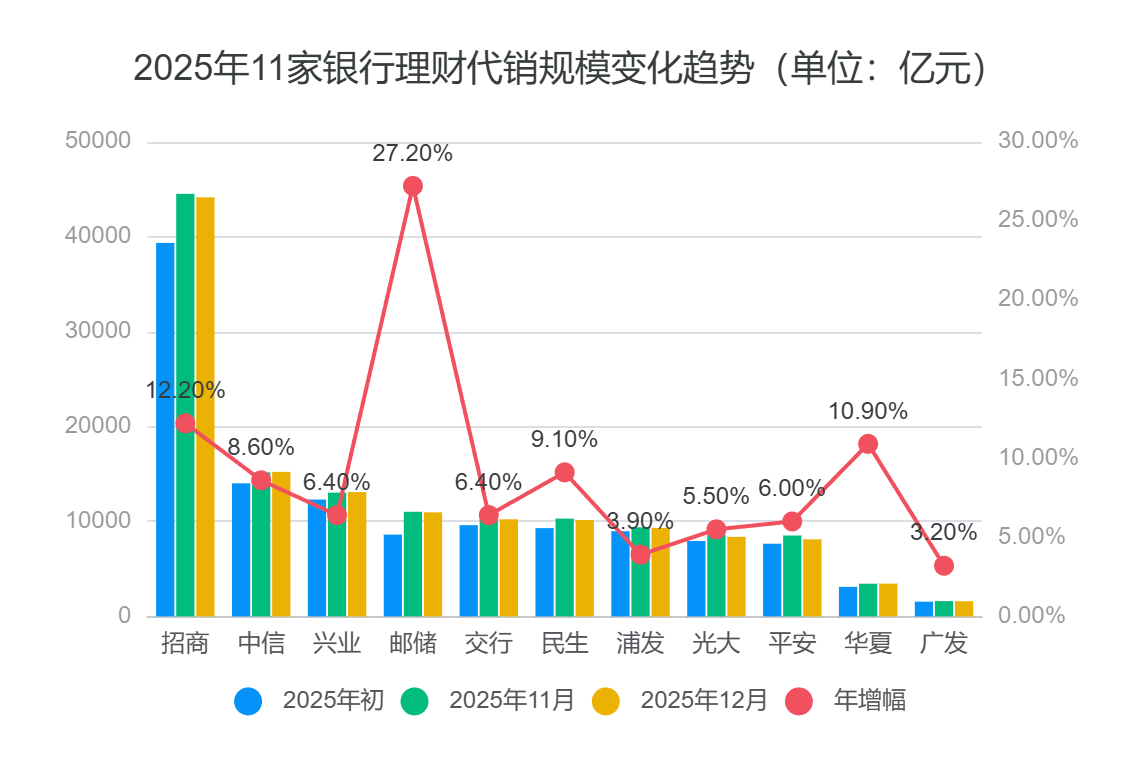
Core Insights - The report highlights a decline in the scale of bank wealth management sales, with a total of 13.46 trillion yuan by December 2025, down 1.05% from November but up 10% from the beginning of the year [1][7] - Postal Savings Bank showed remarkable growth, leading with a 27.2% increase, while China Merchants Bank followed with a 12.2% increase [1][5] - The overall growth in wealth management sales is attributed to a "deposit migration" trend, where customers are shifting their funds into wealth management products [7][10] Group 1: Bank Performance - By December 2025, China Merchants Bank led with a wealth management sales scale of 4.41 trillion yuan, followed by CITIC Bank and Industrial Bank, both exceeding 1 trillion yuan [1][2] - Postal Savings Bank's rise in ranking from 7th to 4th among the 11 banks indicates a significant shift in market dynamics [2][4] - The total growth in wealth management sales among the 11 banks amounted to 1.22 trillion yuan, with a year-on-year increase of 10% [7][6] Group 2: Factors Driving Growth - The growth of Postal Savings Bank's wealth management sales is linked to strategic reforms and an expansion of distribution channels, with approximately 40,000 outlets enhancing customer reach [5][6] - The shift in focus from "product sales" to "product configuration" aims to cater to high-net-worth clients, which is seen as a crucial strategy for growth [5][10] - The demand for stable, low-volatility wealth management products remains strong, particularly in a low-interest-rate environment, driving customer interest [9][10] Group 3: Market Trends - The report notes a seasonal pattern in bank wealth management, characterized by "quarter-end contraction" and "quarter-beginning recovery," influenced by regulatory requirements [8][10] - Despite a slight contraction in December, the overall wealth management scale showed resilience, indicating strong underlying demand [8][9] - Predictions suggest that the wealth management scale could reach approximately 38 trillion yuan by the end of 2026, with a projected growth rate of around 12% [12]

又有多家银行宣布:获批终止营业
Jin Rong Shi Bao· 2026-01-29 09:44
2026年以来,又有多家银行信用卡分中心关停。不同于以往国有大行主导的收缩态势,城商行等中小银 行也纷纷加入"瘦身"阵营,成为本轮调整的新亮点。 作为开年以来首家启动信用卡分中心关停的城商行,广州银行的动作尤为迅猛。开年不足一个月,该行 已接连获批关停7家信用卡分中心,涵盖珠三角核心城市——1月21日,珠海金融监管分局发布批复,同 意广州银行股份有限公司信用卡中心珠海分中心终止营业;在此之前,江门、中山、惠州、佛山、深 圳、东莞6家分中心已先后完成停业批复流程。 国有大行的关停步伐也未曾停歇,延续了此前的转型节奏。1月4日,四川金融监管局发布批复,明确同 意交通银行(601328)太平洋信用卡中心成都分中心终止营业,并要求该分中心在停业后及时拆除原址 标识标牌,不得再开展任何金融业务。 记者注意到,交通银行信用卡分中心的持续收缩,实则是其业务模式战略转型的具体落地。早在2024年 度业绩发布会上,该行管理层就明确表态,为了更好地适应信用卡业务发展到新阶段的要求,该行将信 用卡的业务模式由过去集中直接经营改为分行属地经营,将信用卡业务纳入属地零售业务中进行统一经 营。这一转型方向在2025年半年报中进一步明确, ...
国有大行2026年工作会议聚焦三大主线
2 1 Shi Ji Jing Ji Bao Dao· 2026-01-29 09:35
Core Viewpoint - The major state-owned commercial banks in China have outlined their development roadmap for 2026, focusing on political leadership, responsibility, and enhancing financial services to support high-quality economic development [1] Group 1: Focus on Main Responsibilities and National Strategy - State-owned banks are prioritizing credit resources and financial services towards national strategic areas and weak links in economic and social development, aiming for precise financial support [2] - Industrial and Commercial Bank of China (ICBC) aims to align with national policies, support the modernization of the industrial system, and enhance loan and bond investments [3] - Agricultural Bank of China emphasizes supporting rural revitalization and urban-rural integration, focusing on key areas like food supply chains and rural development [5] - Bank of China plans to accurately position itself within the national agenda, enhancing core functions and competitiveness while focusing on five key financial areas: technology, green finance, inclusive finance, pension finance, and digital finance [8][9] Group 2: Strengthening Risk Control and Compliance - Banks are prioritizing the prevention of systemic financial risks while balancing development and safety [10] - ICBC is enhancing its risk control through intelligent platforms, while Agricultural Bank is focused on managing risks in local government debt and real estate [11] - Compliance is being positioned as a core competitive advantage, with banks emphasizing strict auditing and risk management practices [15] Group 3: Deepening Reform and Innovation - Banks are committed to deepening reforms and driving digital transformation to improve service efficiency and customer experience [16] - ICBC is focused on enhancing its digital capabilities, while Agricultural Bank is advancing smart banking initiatives [17] - In the context of narrowing interest margins, banks are emphasizing cost reduction and efficiency improvements through optimized operations [19]

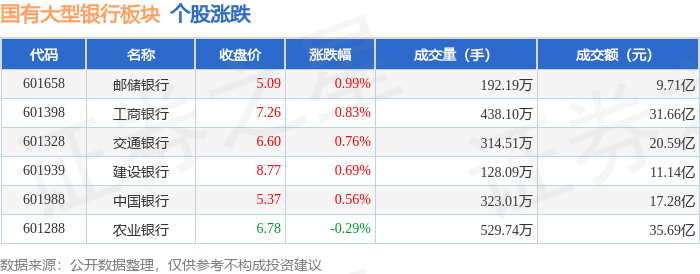
国有大型银行板块1月29日涨0.37%,邮储银行领涨,主力资金净流入6.02亿元
Zheng Xing Xing Ye Ri Bao· 2026-01-29 09:03
Group 1 - The core viewpoint of the news is that the state-owned large bank sector experienced a slight increase of 0.37% on January 29, with Postal Savings Bank leading the gains [1] - The Shanghai Composite Index closed at 4157.98, up 0.16%, while the Shenzhen Component Index closed at 14300.08, down 0.3% [1] - The trading performance of individual stocks in the state-owned large bank sector showed varied results, with Postal Savings Bank closing at 5.09, up 0.99%, and Agricultural Bank of China closing at 6.78, down 0.29% [1] Group 2 - The net inflow of main funds into the state-owned large bank sector was 602 million yuan, while retail investors saw a net outflow of 309 million yuan [1] - The detailed fund flow for individual banks indicated that Industrial and Commercial Bank of China had a main fund net inflow of 1.55 billion yuan, but also experienced net outflows from both retail and speculative funds [2] - The overall trend showed that while some banks like Postal Savings Bank had a positive net inflow from main funds, they still faced outflows from retail investors, indicating mixed investor sentiment [2]

合规问题凸显,交通银行两个省级分行被罚没686万元
Zhong Guo Jing Ji Wang· 2026-01-29 08:29
前一天,国家金融监督管理总局上海监管局开出"罚单",交通银行上海市分行因多项违规被罚没款合计 611.86951万元。其违法违规事实包括向关系人发放信用贷款、违规对个别贷款品种部分免息、置换类 个人经营贷款管理严重违反审慎经营规则等多项内容。同时,上海金山支行副行长富宇等8名相关责任 人分别被警告或警告并罚款。 据不完全统计,2026年开年以来,交通银行各地分支行已收到至少5张罚单。1月5日,交通银行太仓分 行同样因流动资金贷款"三查"不到位,被罚款35万元,时任副行长高晓静被警告并处罚款7万元;1月6 日,交通银行陕西省分行也因发放固定资产贷款不审慎等问题,被陕西监管局罚款253万元,多名责任 人受到警告等处罚;1月9日,交通银行重庆璧山支行因贷款"三查"不到位、信贷资金被挪用,被罚款30 万元,时任行长助理、副行长谭欣被警告。 而此前的2025年年底,交通银行还曾收到中国人民银行开出的总额6700余万元的"天价罚单",涉及账户 管理、反洗钱、财政资金管理等众多核心领域。 一系列分支行被罚背后,折射出交通银行在合规管理中存在系统性薄弱问题环节。有业内人士认为,近 年来的监管政策强烈释放出严监管常态化、精准化 ...