
NCI(601336)

Search documents
市值创历史新高!新华保险的2025年答卷:站上新台阶
券商中国· 2025-12-31 02:12
Core Viewpoint - In 2025, Xinhua Insurance achieved record-breaking performance amidst a complex environment characterized by low interest rates, evolving customer demands, and technological disruptions, marking a significant milestone as it approaches its 30th anniversary [2][4]. Group 1: Comprehensive Strength - By the end of Q3 2025, Xinhua Insurance's total assets exceeded 1.83 trillion yuan, an increase of 8.3% from the beginning of the year, reaching a historical high [3]. - The company's embedded value approached 280 billion yuan, reflecting an 8.1% growth year-to-date, also a historical peak [3]. - Core solvency ratio and comprehensive solvency ratio stood at 154.27% and 234.15%, respectively, indicating strong capital adequacy [3]. Group 2: Development Efficiency - In the first three quarters of 2025, Xinhua Insurance reported a net profit of 32.857 billion yuan, a year-on-year increase of 58.9%, setting a new historical record [4]. - Total premium income reached 172.7 billion yuan, up 19% year-on-year, maintaining industry-leading growth [4]. - The first-year premium income for long-term insurance was 34.9 billion yuan, reflecting a 41% increase [4]. - New business value surged to 6.18 billion yuan in the first half, a significant year-on-year increase of 58%, with a continued growth of 50.8% in the first three quarters [4]. Group 3: Strategic Development Model - Xinhua Insurance is committed to a development vision of becoming a leading financial service group centered on insurance, providing comprehensive risk protection and wealth planning services [5][6]. - The company has adopted a collaborative model of "Insurance + Service + Investment," focusing on enhancing customer-centric strategies and building a robust service ecosystem [6][7]. - Investment performance remains strong, with an annualized total investment return of 8.6% and a comprehensive investment return of 6.7%, leading the industry [7]. Group 4: Contribution to National Strategy - Xinhua Insurance emphasizes its political mission and social responsibility, aligning its operations with national strategies in areas such as technology finance, green finance, inclusive finance, pension finance, and digital finance [8][9]. - The company has invested over 60.5 billion yuan in supporting technology-driven enterprises, with a year-on-year growth of 29.3% [9]. - In green finance, investments exceeded 31.6 billion yuan, marking a 28.8% increase, while providing insurance services to over 6,300 green enterprises [9][10].



险企密集“去监事会” 保险业公司治理变革深化
Jin Rong Shi Bao· 2025-12-31 01:52
Core Viewpoint - The insurance industry is undergoing a significant transformation with the "exit of the supervisory board," as many companies are abolishing this governance structure to enhance efficiency and adapt to new regulatory requirements [2][4]. Group 1: Changes in Governance Structure - As of December 25, 2023, 13 insurance companies, including China Life and China Pacific Insurance, have announced the abolition of their supervisory boards, marking a profound change in the long-standing "three meetings and one layer" governance framework [2][3]. - The trend began with Japan's insurance company in April 2023, which was the first to announce the removal of the supervisory board, followed by state-owned insurance groups [2][3]. - By December 2023, major companies like China Life and New China Life had completed the necessary regulatory approvals to officially abolish their supervisory boards [3][4]. Group 2: Policy and Regulatory Drivers - The reform is driven by the new Company Law effective July 2024, allowing state-owned companies to replace supervisory boards with audit committees, which can enhance governance efficiency [4]. - The China Banking and Insurance Regulatory Commission issued a notice in December 2024, clarifying that financial institutions can establish audit committees to perform the functions of supervisory boards [4]. Group 3: Motivations Behind the Reform - The primary motivations for abolishing supervisory boards include the need to reduce costs, improve efficiency, and address issues of overlapping functions and formalized supervision [4]. - The transition is not seen as a reduction in oversight but rather a restructuring of the supervisory system, with audit committees taking over the responsibilities of the supervisory boards [4]. - The industry anticipates that this reform will enhance compliance and risk management capabilities, contributing to the high-quality development of the insurance sector [4].



年度行情收官 10家券商金股组合收益率亮眼超过50%
Zheng Quan Shi Bao· 2025-12-31 01:28
Core Insights - The report highlights the performance of stock recommendations from various brokerages, with 10 brokerages achieving over 50% returns in 2025, showcasing their ability to identify and recommend stocks early in the market cycle [2][3]. Group 1: Brokerage Performance - The highest cumulative return was achieved by Guoyuan Securities at 83.73%, followed by Northeast Securities and Kaiyuan Securities with returns of 67.47% and 67% respectively [2]. - Other brokerages such as Dongxing Securities, Huaxin Securities, and China Merchants Securities also reported returns exceeding 60%, while Everbright Securities, Dongguan Securities, Guotai Junan, and Changcheng Securities had returns above 50% [2]. Group 2: Stock Selection Strategy - The success of these brokerages is attributed to their strategy of identifying stocks at low points and consistently recommending them, which has led to significant gains [4][5]. - For instance, Kaiyuan Securities recommended Xinyisheng for four consecutive months, resulting in a total increase of 440% from May to August [6]. Group 3: Popular Stocks - Tencent Holdings emerged as the most recommended stock, being favored by around seven brokerages each month, making it the most popular stock of the year [7]. - The report indicates that the most popular stocks varied throughout the year, with technology stocks dominating in the first quarter, consumer stocks in the second, financial stocks in the third, and a return to technology stocks in the fourth quarter [7].





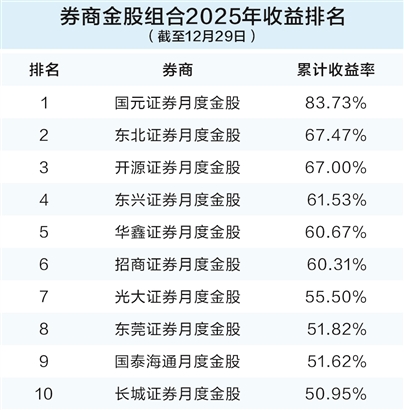
年度行情今日收官 十家券商金股组合收益率超百分之五十
Zheng Quan Shi Bao· 2025-12-30 18:19
Core Insights - The article highlights the performance of brokerage firms' recommended stocks, known as "golden stocks," which have achieved over 50% returns in 2025, with some firms excelling by identifying and recommending stocks early in their upward trends [1][3]. Group 1: Performance of Golden Stocks - As of December 29, 2025, 10 brokerage firms' golden stock portfolios recorded returns exceeding 50%, with the highest being 83.73% from Guoyuan Securities [3]. - Other notable performers include Northeast Securities and Kaiyuan Securities, with returns of 67.47% and 67%, respectively [3]. - The golden stock strategy has become a mature business for many brokerage firms, showcasing their research capabilities and market insights [3]. Group 2: Strategies for Success - Early identification of stocks at low prices and consistent recommendations have been key strategies for achieving high returns [4]. - For instance, Kaiyuan Securities recommended Xinyisheng for four consecutive months, resulting in a total increase of 440% from May to August [5]. - Guoyuan Securities focused on sectors like media, pharmaceuticals, and machinery, with significant monthly gains from stocks like Giant Network and JiBit [4]. Group 3: Popularity of Tencent - Tencent Holdings emerged as the most recommended stock, being favored by around seven brokerage firms monthly, making it the top "golden stock" of the year [2][6]. - The popularity of stocks varies by quarter, with technology stocks dominating in the first quarter, consumer stocks in the second, financial stocks in the third, and a return to technology stocks in the fourth quarter [6]. Group 4: Market Trends and Recommendations - The article notes that not all popular stocks achieve high success rates, with less than 40% of the most recommended A-share stocks showing gains in the same month they were recommended [7].


中国分红险发展的前世今生:低利率时代的重逢
Soochow Securities· 2025-12-30 10:06
Investment Rating - The report maintains an "Accumulate" rating for the insurance sector [1]. Core Insights - The report discusses the evolution of participating insurance in China, highlighting its significance in a low-interest-rate environment and the shift towards floating yield products, which are gaining traction among domestic investors [2][6]. Summary by Sections 1. What is Participating Insurance? - Participating insurance is a type of insurance that combines protection and investment, allowing policyholders to share in the insurer's surplus [12]. - The operational mechanism involves sharing profits derived from better-than-expected performance, with a minimum of 70% of the surplus distributed to policyholders [6][15]. 2. Historical Development of Participating Insurance in Mainland China - The development of participating insurance has seen significant fluctuations influenced by policy and market factors, with its market share peaking at 75% in 2010 before declining due to market reforms [6][45]. - Since 2024, regulatory policies have encouraged the development of floating yield products, marking a consensus in the industry towards transitioning to participating insurance [6][45]. 3. Current Transition of Participating Insurance - The report anticipates that the proportion of participating insurance will continue to rise, with over 50% of new policies in the first half of 2025 being participating insurance [6][45]. - The transition is expected to alleviate pressure from interest rate losses and enhance the reliability of the insurance sector's embedded value (EV) [6][45]. 4. International Experience - In mature markets, floating yield products dominate, with Hong Kong's participating insurance being a core component, accounting for 85% of new premiums in 2024 [2][6]. - The report suggests that the characteristics of participating insurance in Hong Kong, such as multi-currency support and a design of low guarantees with high floating returns, could serve as a model for the mainland market [2][6]. 5. Key Metrics for Evaluating Participating Insurance - The report outlines four key indicators for assessing the performance of participating insurance: 1. **Guaranteed Rate**: Currently set at 1.75%, which is lower than traditional insurance [23]. 2. **Demonstration Rate**: Reflects expected returns, with current rates around 3.5% to 4% [24]. 3. **Actual Yield**: The industry average is capped at 3.2%, with some companies exceeding this limit [27]. 4. **Dividend Realization Rate**: Increased by 11 percentage points to 62% in 2024, indicating improved management and expectation guidance [29].



《保险公司资产负债管理办法(征求意见稿)》点评:资负管理的战略定位进一步提级
Shenwan Hongyuan Securities· 2025-12-30 09:33
Investment Rating - The report maintains an "Overweight" rating for the insurance industry, indicating a positive outlook for the sector's performance relative to the overall market [3]. Core Insights - The strategic positioning of asset-liability management for insurance companies has been elevated, with the introduction of the "Insurance Company Asset-Liability Management Measures (Draft for Comments)" by the Financial Supervisory Authority [2]. - The draft emphasizes three main goals for asset-liability management: matching the term structure, cost-benefit matching, and liquidity matching, with insurance companies bearing primary responsibility and the authority overseeing compliance [2]. - The governance structure requires clear delineation of responsibilities for the board of directors and senior management, establishing an asset-liability management committee and department within insurance companies [2]. - The report highlights the importance of asset-liability management in mitigating interest spread risks, especially in a declining interest rate environment, and aims to enhance the risk warning mechanism for insurance operations [2]. Summary by Sections Regulatory and Monitoring Indicators - For property and casualty insurance companies, there are three regulatory indicators focusing on income-cost coverage and liquidity, all of which must not fall below 100% [5]. - For life insurance companies, four regulatory indicators are established, including effective duration gap and comprehensive investment income coverage, also requiring a minimum of 100% [5]. Valuation of Key Companies - The report provides a valuation table for key non-bank financial companies, including China Life, Ping An, and China Pacific Insurance, with metrics such as market capitalization and price-to-earnings ratios [6]. - For instance, China Life has a market capitalization of 115.02 billion RMB and a PE ratio of 7.66, while Ping An has a market capitalization of 119.24 billion RMB and a PE ratio of 9.02 [6]. Investment Recommendations - The report continues to recommend several major insurance companies, including China Life (H), Ping An (A/H), China Pacific Insurance, China People’s Insurance, New China Life, and China Property Insurance, while suggesting to pay attention to China Taiping [3].
2025保险业做实理性经营 体量、效益、股价同创新高
Zheng Quan Shi Bao· 2025-12-29 19:13
Core Insights - The insurance industry in China has achieved record high asset levels and profitability in 2025, driven by practical reforms and a focus on rational management [1][2]. Group 1: Industry Growth and Performance - By the end of October 2025, China's insurance industry total assets reached 40.59 trillion yuan, an increase of 4.68 trillion yuan from the beginning of the year, marking a growth rate of 13.03% [2]. - The total assets of the insurance industry have seen double-digit growth since 2023, primarily due to increased premium income, cost optimization, enhanced capital replenishment, and improved asset allocation [2]. - The combined market capitalization of five listed insurance companies in A-shares exceeded 3.3 trillion yuan, with a growth of over 700 billion yuan, reflecting a nearly 30% increase [3]. Group 2: Profitability and Financial Health - In the first three quarters of 2025, the five listed insurance companies achieved a total net profit of 426 billion yuan, a year-on-year increase of 33.5%, setting a historical high [4]. - The insurance sector's balance sheet has entered a phase of healthy expansion, benefiting from low interest rates and strong sales of main products like dividend insurance [4]. Group 3: Regulatory and Structural Reforms - The dynamic adjustment mechanism for insurance product preset rates was officially launched in 2025, with preset rates decreasing from 2.34% at the beginning of the year to 1.90% by the end of the year [10][11]. - The introduction of the fourth life table in October 2025 will impact insurance product pricing, reflecting changes in population structure and mortality rates [15][16]. Group 4: Market Strategies and Innovations - The insurance industry is increasingly focusing on dividend insurance products, which now account for nearly half of new life insurance products launched after September 2025 [13]. - The commercial health insurance innovation drug directory was released in December 2025, marking a significant step in clarifying the boundaries between basic medical insurance and commercial health insurance [17][18]. Group 5: Investment Trends - Insurance capital has accelerated its entry into the market, with equity asset allocation reaching historical highs, and the stock and fund allocation balance reaching 5.59 trillion yuan, a 35.92% increase from the previous year [8][9]. - The "long money, long investment" strategy has gained traction, with regulatory changes encouraging insurance funds to focus on long-term investments [7].

上市潮未歇,AI成保险科技叙事新逻辑
Xin Lang Cai Jing· 2025-12-29 13:45
Core Insights - The insurance technology sector is experiencing a significant transformation, moving from a "traffic-driven" narrative to an "AI-driven" approach, reflecting a fundamental shift in growth paths and capital market valuations [3][24][30] Group 1: Market Developments - On December 23, 2025, Easy Health was listed and saw a first-day surge of 158%, reaching a market capitalization of over HKD 12 billion, marking it as a standout in the Hong Kong insurance technology sector [23] - White Dove Online has also passed the Hong Kong Stock Exchange's listing hearing, aiming to become the "first AI stock in the domestic insurance industry" [3][24] - The insurance technology industry is witnessing a new wave of listings, with various companies like Yuanbao and iCloud Insurance entering the market, indicating a robust trend towards public offerings [3][24][25] Group 2: AI Integration and Investment - In 2025, the Chinese insurance industry is projected to invest over CNY 67 billion in technology, with a focus on big data, cloud computing, and artificial intelligence [25] - McKinsey's research indicates that leading insurance companies utilizing AI have seen shareholder returns 6.1 times greater than those lagging behind, highlighting AI as a core competitive advantage [25] - Major insurance firms are evolving their strategies from "ALL in AI" to "AI in ALL," integrating AI across the entire value chain, including product design and risk management [25][26] Group 3: Competitive Landscape - Traditional insurance companies are enhancing their internal capabilities while new tech-driven firms are rapidly exploring boundaries, validating AI's value creation potential [26][28] - Companies like Easy Health and White Dove Online are leveraging AI technologies to transform traditional processes, focusing on areas such as health data structuring and scenario adaptation [26][28] - The competition is intensifying, with a clear divide in market valuations based on the effectiveness of AI implementation among different firms [4][25] Group 4: Narrative Reconstruction - The narrative surrounding insurance technology is shifting from acquiring large user bases to emphasizing AI technology barriers and digital solutions [30][31] - This transition is driven by market saturation, regulatory pressures, and changing consumer expectations for more precise and transparent services [32][33] - The new narrative emphasizes the importance of technology-driven value creation, moving away from the previous reliance on external traffic growth [34][39] Group 5: Challenges and Risks - The rise of AI in insurance also brings challenges related to data security and algorithm fairness, as companies must navigate the complexities of handling sensitive personal information [36][37] - There are significant risks associated with the interpretability of AI models, which can lead to unfair treatment of certain demographic groups if historical biases are present in training data [36][37] - Companies are urged to build resilience in technology and governance to address these challenges and ensure compliance with regulatory standards [36][38]

杨玉成连任新华保险董事长
Jin Rong Jie· 2025-12-29 06:10
关键词阅读:新华保险 杨玉成 董事长 责任编辑:栎树 新华保险发布公告称,公司第九届董事会第一次会议于2025年12月24日在北京召开。经与会董事审议和 现场表决,同意选举杨玉成担任公司第九届董事会董事长。公开信息显示,杨玉成,1971年生,曾任宏 源证券党委委员、纪委书记、副总经理、监事长,申万宏源集团监事长,申万宏源集团和申万宏源证券 党委副书记,申万宏源证券执行董事、总经理等职。2023年8月至2023年10月,任新华保险党委书记。 2023年12月起,获批任新华保险党委书记、董事长。 ...
邢台金融监管分局同意新华保险河北分公司平乡营销服务部营业场所变更
Jin Tou Wang· 2025-12-29 05:24
二、新华人寿保险股份有限公司河北分公司应按照有关规定及时办理变更及许可证换领事宜。 一、同意新华人寿保险股份有限公司河北分公司平乡营销服务部营业场所变更为:河北省邢台市平乡县 城建设街南段东侧(泰和苑商业B区104+204号)房间。 2025年12月25日,邢台金融监管分局发布批复称,《新华人寿保险股份有限公司河北分公司关于平乡营 销服务部变更营业场所的请示》(新保冀字〔2025〕145号)收悉。经审核,现批复如下: ...