
ICBC(601398)

Search documents
六大行集体公告
Sou Hu Cai Jing· 2026-01-22 11:25
Group 1 - The core viewpoint of the news is that major Chinese banks have announced the implementation of an optimized personal consumption loan subsidy policy, extending its benefits and expanding its scope [1][2][3] Group 2 - The implementation period for the personal consumption loan subsidy policy has been extended to December 31, 2026 [1] - The support scope has been expanded to include credit card bill installment services [1] - The subsidy field has been broadened by removing the restriction on single transactions of 50,000 yuan and above [2] - The subsidy standards have been improved by eliminating the 500 yuan cap on single transaction subsidies and the 1,000 yuan cumulative subsidy limit for borrowers at a single institution [2] - Existing loan agreements signed under the previous subsidy policy will automatically apply the new subsidy terms for transactions occurring after January 1, 2026, without the need for re-signing [2]


落实个人消费贷款最新财政贴息政策,六大行集体公告
第一财经· 2026-01-22 11:10
Core Viewpoint - Major Chinese banks have announced the implementation of an optimized personal consumption loan subsidy policy, extending its benefits and expanding its scope to support consumer spending [1] Summary by Relevant Sections Policy Implementation - The personal consumption loan subsidy policy will be extended until December 31, 2026 [1] - The scope of support has been expanded to include credit card bill installment services [1] Subsidy Expansion - The subsidy field has been broadened by removing the restriction on single transactions of 50,000 yuan and above [1] - The subsidy standard has been improved by eliminating the previous cap of 500 yuan on single transaction subsidies and the cumulative limit of 1,000 yuan for each borrower at a single institution for transactions below 50,000 yuan [1] Existing Agreements - For loans that have already signed the "Personal Consumption Loan Subsidy Service Agreement," any consumption occurring after January 1, 2026, will automatically apply the latest subsidy policy without the need for re-signing the agreement [1]





落实个人消费贷款最新财政贴息政策,六大行集体公告
Feng Huang Wang· 2026-01-22 11:01
Core Viewpoint - Major Chinese banks have announced the implementation of an optimized personal consumption loan subsidy policy, extending its duration and expanding its scope to support consumer spending [1] Group 1: Policy Implementation - The implementation period for the personal consumption loan subsidy policy has been extended to December 31, 2026 [1] - The scope of support has been expanded to include credit card installment payment services [1] Group 2: Subsidy Expansion - The subsidy field has been broadened by removing the restriction on single transactions of 50,000 yuan and above [1] - The subsidy standard has been improved by eliminating the cap of 500 yuan on single transaction subsidies and the previous limit of 1,000 yuan for cumulative subsidies under 50,000 yuan per borrower at a single institution [1] Group 3: Existing Agreements - For loans that have already signed the personal consumption loan subsidy service agreement, any consumption occurring after January 1, 2026, will automatically apply the latest subsidy policy without the need to re-sign the agreement [1]
工商银行:已提交200亿美元全球中期票据计划上市申请
Xin Lang Cai Jing· 2026-01-22 10:08
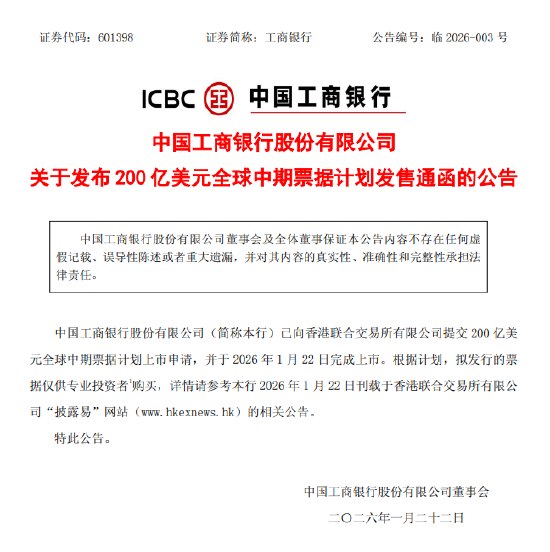
1月22日金融一线消息,工商银行公告称,该行已向香港联合交易所有限公司提交200 亿美元全球中期 票据计划上市申请,并于 2026 年 1 月 22 日完成上市。根据计划,拟发行的票据仅供专业投资者购买。 责任编辑:李琳琳 1月22日金融一线消息,工商银行公告称,该行已向香港联合交易所有限公司提交200 亿美元全球中期 票据计划上市申请,并于 2026 年 1 月 22 日完成上市。根据计划,拟发行的票据仅供专业投资者购买。 证券代码:601398 证券简称:工商银行 中国工商银行股份有限公司(简称本行)已向香港联合交易所有限公司提交 200 亿美 元全球中期票据计划上市申请,并于2026年1月22日完成上市。根据计划,拟发行的票 据仅供专业投资者 购买,详情请参考本行 2026年1月22日刊载于香港联合交易所有限公 司"披露易"网站(www.hkexnews.hk)的相关公告。 特此公告。 中国工商银行股份有限公司董事会 二〇二六年一月二十二日 责任编辑:李琳琳 公告编号:临 2026-003 号 ICBC 国 中国工商银行 中国工商银行股份有限公司 关于发布 200 亿美元全球中期票据计划发售通函的公告 ...
工商银行(601398) - 工商银行关于发布200亿美元全球中期票据计划发售通函的公告
2026-01-22 10:00
证券代码:601398 证券简称:工商银行 公告编号:临 2026-003 号 中国工商银行股份有限公司 关于发布 200 亿美元全球中期票据计划发售通函的公告 中国工商银行股份有限公司董事会及全体董事保证本公告内容不存在任何虚 假记载、误导性陈述或者重大遗漏,并对其内容的真实性、准确性和完整性承担法 律责任。 中国工商银行股份有限公司(简称本行)已向香港联合交易所有限公司提交 200 亿美 元全球中期票据计划上市申请,并于 2026 年 1 月 22 日完成上市。根据计划,拟发行的票 据仅供专业投资者 1购买,详情请参考本行 2026 年 1 月 22 日刊载于香港联合交易所有限公 司"披露易"网站(www.hkexnews.hk)的相关公告。 特此公告。 中国工商银行股份有限公司董事会 二〇二六年一月二十二日 1 根据香港联合交易所有限公司证券上市规则第 37 章定义,专业投资者指(a)如属香港人士,按《证券及期货 条例》附表 1 第 1 部所界定的专业投资者(包括按该条例第 397 条所制定的规则所指的人士);或(b)如属非香 港人士,根据有关司法权区对公开发售的相关豁免可向其出售证券的人士。 ...
多家银行发文明确信用卡账单分期贴息细节,开启补申请通道
Bei Jing Shang Bao· 2026-01-22 09:37
Core Viewpoint - The Chinese government has introduced a new personal consumption loan interest subsidy policy, which aims to enhance consumer spending and stimulate the economy by providing financial incentives through interest subsidies on personal loans and credit card installments [1][3]. Group 1: Policy Implementation - The new subsidy policy will be effective from September 1, 2025, to December 31, 2026, for personal consumption loans, while the credit card installment subsidy period will be from January 1, 2026, to December 31, 2026 [3]. - The policy expands the support scope by including credit card installment payments for the first time, with a subsidy rate of 1% per annum, and removes previous restrictions on consumption areas [3][4]. Group 2: Bank Responses - Major banks such as ICBC, ABC, BOC, CCB, and others have quickly responded by issuing operational guidelines and clarifications regarding the implementation of the subsidy policy [2][3]. - Banks have confirmed that customers who have already signed consumption loan subsidy agreements will automatically benefit from the new policy without needing to re-sign agreements [4][5]. Group 3: Customer Guidance - Customers are required to sign a supplementary agreement for credit card installment subsidies, with each card needing a separate agreement to benefit from the subsidy during the policy period [5][6]. - Banks are advised to streamline the process for customers to access the subsidy, including online application portals and clear communication of interest rates and subsidy limits [6][7]. Group 4: Market Impact - The minimum execution interest rate for consumption loans remains at 3%, but with the subsidy, the effective interest rate for eligible borrowers could potentially drop to the "2% range" [7].


国有大型银行板块1月22日跌1.3%,农业银行领跌,主力资金净流出2.09亿元
Zheng Xing Xing Ye Ri Bao· 2026-01-22 09:01
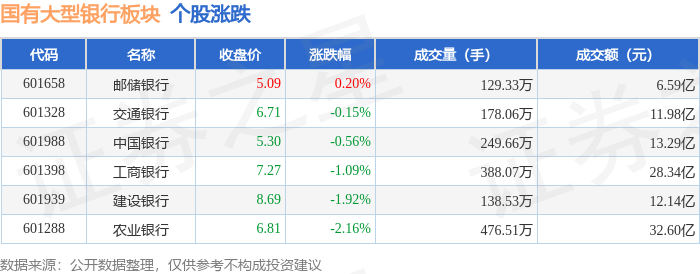
Group 1 - The core viewpoint of the article indicates that the state-owned large bank sector experienced a decline of 1.3% on January 22, with Agricultural Bank leading the drop [1] - The Shanghai Composite Index closed at 4122.58, up 0.14%, while the Shenzhen Component Index closed at 14327.05, up 0.5% [1] - The trading volume and turnover for major state-owned banks are detailed, showing varying performance among individual banks [1] Group 2 - Agricultural Bank's stock price fell by 2.16% to 6.81, with a trading volume of 476.51 million shares and a turnover of 32.60 billion [1] - The net outflow of main funds from the state-owned large bank sector was 209 million, while retail investors saw a net inflow of 38.81 million [1] - The table shows the net inflow and outflow of funds for individual banks, highlighting the performance of each bank in terms of main, retail, and speculative funds [2]
数字人民币2.0:从M0到M1的质变
GF SECURITIES· 2026-01-22 05:07
Investment Rating - The report provides a "Buy" rating for all major banks analyzed, indicating a positive outlook for the banking sector [7]. Core Insights - The digital renminbi has entered its 2.0 era, transitioning from a central bank liability (M0) to a commercial bank liability (M1), allowing it to earn interest and be included in deposit insurance and reserve requirements [6][14]. - This transformation positions China as the first economy to offer interest on its central bank digital currency (CBDC), fundamentally altering its monetary attributes and creating a new financial paradigm in the digital economy [27]. - The digital renminbi's interest-bearing feature enhances user motivation to hold it, shifting its perception from a mere payment tool to a viable store of value, thus promoting its integration into everyday financial activities [27][28]. Summary by Sections 1. Digital Renminbi 2.0 Era - The digital renminbi (e-CNY) is now classified as a digital deposit currency, which can earn interest and is managed under a new regulatory framework [14]. - Major state-owned banks have begun offering interest on digital renminbi wallet balances, marking a significant shift in its utility and appeal [14][27]. 2. Development Progress and Application Status - The development of the digital renminbi began in 2014, with significant milestones including pilot tests in various cities and the establishment of a comprehensive operational framework by 2025 [32][33]. - As of November 2025, the digital renminbi has processed 34.8 billion transactions amounting to 16.7 trillion yuan, with extensive coverage across multiple provinces and cities [37]. 3. Global CBDC Development Trends - The report identifies three main trends in global CBDC development: active retail CBDC initiatives, innovation in payment systems, and cautious approaches in some countries like the U.S. [6]. - China's proactive stance in developing its CBDC positions it favorably in the global digital economy landscape, particularly in cross-border trade applications [30].


工商银行(01398) - 中国工商银行股份有限公司20,000,000,000美元全球中期票据计划...
2026-01-22 04:01
香港交易及結算所有限公司及香港聯合交易所有限公司對本公告之內容概不負責,對其準確性或完整性亦不發表 任何聲明,並明確表示,概不對因本公告全部或任何部分內容而產生或因倚賴該等內容而引致之任何損失承擔任 何責任。 本公告僅供參考之用,並不構成收購、購買或認購任何證券的邀請或要約。本公告不構成或形成任何要約購買在 美國銷售的證券的一部分。除非另有規定,任何根據計劃(定義見下文)將予發行的票據將不會根據經不時修訂之 1933年美國聯邦證券法(「證券法」)進行登記,而且不得在未登記或獲豁免遵守證券法的登記規定的情況下於美國 境內或向任何美國人士(定義見證券法)或出於美國人士的利益進行發售或出售。將不會在美國進行證券的公開發 售。 於香港聯合交易所有限公司 上市之通告 20,000,000,000美元全球中期票據計劃 安排行和交易商 中國工商銀行股份有限公司 INDUSTRIAL AND COMMERCIAL BANK OF CHINA LIMITED (於中華人民共和國註冊成立的股份有限公司) 股份代號:1398 * 由中國工商銀行股份有限公司通過其相關持牌附屬機構執行。 中國工商銀行* 中國工商銀行股份有限公司已向香 ...
工商银行(01398) - 发行通函发佈 - 中国工商银行股份有限公司20,000,000,000美...
2026-01-22 04:00
本公告不構成或形成任何要約購買在美國銷售的證券的一部分。除非另有規定,任何根據計劃(定義見下文)將予 發行的票據(「票據」)將不會根據經不時修訂之1933年美國聯邦證券法(「證券法」)進行登記,而且不得在未登記或 獲豁免遵守證券法的登記規定的情況下於美國境內或向任何美國人士(定義見證券法)或出於美國人士的利益進行 發售或出售。將不會在美國進行證券的公開發售。 香港投資者謹請注意:本行確認票據擬僅供專業投資者(定義見上市規則第37章)(「專業投資者」)購買,計劃已按 該基準於香港聯合交易所有限公司上市,並且將於香港聯合交易所有限公司上市的票據亦將按該基準於香港聯合 交易所有限公司上市。據此,本行確認票據不適合作為香港零售投資者之投資。投資者應審慎考慮所涉及的風險。 香港交易及結算所有限公司及香港聯合交易所有限公司對本公告之內容概不負責,對其準確性或完整性亦不發表 任何聲明,並明確表示,概不對因本公告全部或任何部分內容而產生或因倚賴該等內容而引致之任何損失承擔任 何責任。 本公告及隨附的上市文件乃按香港聯合交易所有限公司證券上市規則(「上市規則」)規定刊發僅供參考之用,並不 構成收購、購買或認購任何證券的邀請或要 ...