CHALCO(601600)

Search documents
港股午评 恒生指数早盘跌0.97% 中国铝业逆市上涨超5%
Jin Rong Jie· 2025-12-03 05:04
Group 1 - The Hang Seng Index fell by 0.97%, down 252 points, closing at 25,842 points, while the Hang Seng Tech Index dropped by 1.3% [1] - China Aluminum (02600) rose by 5.66% as it plans to acquire stakes in three subsidiaries, enhancing its control [1] - CGN Mining (01164) increased by over 3% due to two major uranium suppliers lowering their 2026 production guidance, tightening supply and supporting uranium prices [1] - Longpan Technology (02465) surged over 10% after its subsidiary signed a nearly 5 billion yuan long-term contract with Sunwoda [1] - Yunji (02670) rose over 5%, reaching a new high since its listing, up 70% from its IPO price, leading in the smart hotel robot application competition [1] - Yijun Group Holdings (02442) resumed trading and skyrocketed by 66% after a change in controlling stake, receiving a buyout offer at over 80% discount [1] Group 2 - Lemo Technology (02539) debuted with a 68% increase, recognized as a leader in shared massage equipment [2] - Jinyan Gaoling New Materials (02693) also debuted, rising by 3%, being the largest producer of precision casting mullite materials in China [2] - Yidu International Holdings (00259) increased by over 7%, with its subsidiary, Canfeng Information, being a core client and shareholder of the domestic AI chip star company, Muxi, which will start its Sci-Tech Innovation Board subscription on December 5 [2] Group 3 - Capital界金控 (00204) plummeted over 50%, with mid-term losses expanding 3.73 times to 50.13 million HKD [3] Group 4 - XPeng Motors-W (09868) fell over 4%, with November sales declining by 12% month-on-month, failing to meet the target of 40,000 units [4]


恒生指数早盘跌0.97% 中国铝业逆市上涨超5%
Zhi Tong Cai Jing· 2025-12-03 04:10
Group 1 - The Hang Seng Index fell by 0.97%, down 252 points, closing at 25,842 points, while the Hang Seng Tech Index dropped by 1.3% [1] - China Aluminum (601600) (02600) rose by 5.66% as it plans to acquire stakes in three subsidiaries, enhancing its control [1] - CGN Mining (01164) increased by over 3% due to two major uranium suppliers lowering their 2026 production guidance, tightening supply and supporting uranium prices [1] - Longpan Technology (603906) (02465) surged over 10% after its subsidiary signed a nearly 5 billion yuan long-term contract with Sunwoda [1] - Yunji (02670) rose over 5%, reaching a new high since its listing, up 70% from its IPO price, leading in the smart hotel robot application competition [1] - Yijun Group Holdings (02442) resumed trading and skyrocketed by 66% after a change in controlling stake, receiving a buyout offer at over 80% discount [1] - LeMo Technology (02539) debuted with a 68% increase, recognized as a leader in shared massage equipment [1] - Jinyan Gaoling New Materials (02693) also debuted, rising by 3%, being the largest producer of precision casting mullite materials in China [1] - Yidu International Holdings (00259) increased by over 7% as Muxi Co., Ltd. plans to initiate its Sci-Tech Innovation Board application on December 5 [1] - Capital Market Financial Holdings (00204) plummeted over 50%, with mid-term losses expanding 3.73 times to 50.13 million HKD [1] Group 2 - XPeng Motors-W (09868) fell over 4% as November sales declined by 12% month-on-month, failing to meet the target of 40,000 units [2]

港股午评|恒生指数早盘跌0.97% 中国铝业逆市上涨超5%
智通财经网· 2025-12-03 04:07
Group 1 - The Hang Seng Index fell by 0.97%, down 252 points, closing at 25,842 points, while the Hang Seng Tech Index dropped by 1.3% [1] - China Aluminum (02600) rose by 5.66% as it plans to acquire stakes in three subsidiaries, enhancing its control [1] - CGN Mining (01164) increased by over 3% due to two major uranium suppliers lowering their 2026 production guidance, tightening supply and supporting uranium prices [1] - Longpan Technology (02465) surged over 10% after its subsidiary signed a nearly 5 billion yuan long-term contract with Sunwoda [1] - Yunji (02670) rose over 5%, reaching a new high since its listing, now 70% above its IPO price, leading in the smart hotel robot application competition [1] Group 2 - Yijun Group Holdings (02442) resumed trading and skyrocketed by 66% after a change in controlling interest, receiving a buyout offer at over 80% discount [2] Group 3 - Lemo Technology (02539) debuted with a 68% increase, recognized as a leader in shared massage equipment [3] - Jinyan High-Alumina New Materials (02693) also debuted, rising by 3%, being the largest producer of precision casting mullite materials in China [3] - Yidu International Holdings (00259) increased by over 7%, with its subsidiary, Sanfeng Information, being a core client and shareholder of domestic AI chip star company Muxi, which will start its Sci-Tech Innovation Board subscription on December 5 [3] Group 4 - Capital界金控 (00204) plummeted over 50%, with mid-term losses expanding 3.73 times to 50.13 million HKD [4] Group 5 - XPeng Motors-W (09868) fell over 4% as November sales decreased by 12% month-on-month, failing to meet the target of 40,000 units [5]
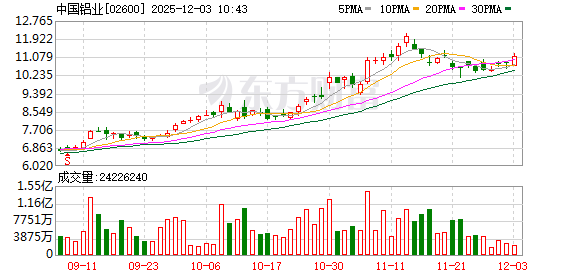
港股异动 中国铝业(02600)早盘涨超4% 拟收购云铝涌鑫等三家子公司股权 有助强化控制权
Jin Rong Jie· 2025-12-03 03:20
汇丰发布研报称,展望明年中国铝行业基本面转强,下游需求持续增长,潜在供应短缺会成为市场关注 重点,预期中国产能维持4,500万吨上限,全球新增产能则依然有限,在电动车行业发展及电网投资的 支持下,中国需求维持稳固,来自建筑行业的拖累预期减弱,预料2026年铝价将按年增长6%,并存在 上行风险,继续列铝业股为中国材料板块的首选。 本文源自:智通财经网 消息面上,中国铝业近日宣布,云铝股份拟向云南冶金收购云铝涌鑫、云铝润鑫及云铝泓鑫股权。这三 家公司均为云铝股份的控股子公司。本次收购完成后,云南冶金不再持有三家公司股权,有利于云铝股 份优化所属企业股权结构,实现铝资产专业化归集,提高权益电解铝产能,符合云铝股份做优做强核心 主业的战略目标。 智通财经获悉,中国铝业(02600)早盘涨超4%,截至发稿,涨3.34%,报11.13港元,成交额2.25亿港 元。 ...
中国铝业(02600.HK)早盘涨超3%
Mei Ri Jing Ji Xin Wen· 2025-12-03 02:42
每经AI快讯,中国铝业(02600.HK)早盘涨超3%,截至发稿,涨3.34%,报11.13港元,成交额2.25亿港 元。 (文章来源:每日经济新闻) ...

港股异动 | 中国铝业(02600)早盘涨超4% 拟收购云铝涌鑫等三家子公司股权 有助强化控制权
智通财经网· 2025-12-03 02:29
消息面上,中国铝业近日宣布,云铝股份拟向云南冶金收购云铝涌鑫、云铝润鑫及云铝泓鑫股权。这三 家公司均为云铝股份的控股子公司。本次收购完成后,云南冶金不再持有三家公司股权,有利于云铝股 份优化所属企业股权结构,实现铝资产专业化归集,提高权益电解铝产能,符合云铝股份做优做强核心 主业的战略目标。 汇丰发布研报称,展望明年中国铝行业基本面转强,下游需求持续增长,潜在供应短缺会成为市场关注 重点,预期中国产能维持4,500万吨上限,全球新增产能则依然有限,在电动车行业发展及电网投资的 支持下,中国需求维持稳固,来自建筑行业的拖累预期减弱,预料2026年铝价将按年增长6%,并存在 上行风险,继续列铝业股为中国材料板块的首选。 智通财经APP获悉,中国铝业(02600)早盘涨超4%,截至发稿,涨3.34%,报11.13港元,成交额2.25亿港 元。 ...
中国铝业早盘涨超4% 拟收购云铝涌鑫等三家子公司股权 有助强化控制权
Zhi Tong Cai Jing· 2025-12-03 02:28
中国铝业(601600)(02600)早盘涨超4%,截至发稿,涨3.34%,报11.13港元,成交额2.25亿港元。 汇丰发布研报称,展望明年中国铝行业基本面转强,下游需求持续增长,潜在供应短缺会成为市场关注 重点,预期中国产能维持4,500万吨上限,全球新增产能则依然有限,在电动车行业发展及电网投资的 支持下,中国需求维持稳固,来自建筑行业的拖累预期减弱,预料2026年铝价将按年增长6%,并存在 上行风险,继续列铝业股为中国材料板块的首选。 消息面上,中国铝业近日宣布,云铝股份(000807)拟向云南冶金收购云铝涌鑫、云铝润鑫及云铝泓鑫 股权。这三家公司均为云铝股份的控股子公司。本次收购完成后,云南冶金不再持有三家公司股权,有 利于云铝股份优化所属企业股权结构,实现铝资产专业化归集,提高权益电解铝产能,符合云铝股份做 优做强核心主业的战略目标。 ...

2025年中国工业金属行业政策、产业链、产量、重点企业经营情况及趋势研判:新兴产业需求强劲,驱动工业金属创新升级[图]
Chan Ye Xin Xi Wang· 2025-12-03 01:17
Core Insights - The industrial metals sector is crucial for modern industrial systems, reflecting the economic operation status of a nation. The sector is characterized by high strength, corrosion resistance, and excellent processing performance, supporting key industries such as construction, machinery, automotive, electricity, and aerospace [1][13]. Industry Overview - Industrial metals, a subset of non-ferrous metals, include copper, aluminum, lead, and zinc, which are widely used in various industrial applications. The sector has a complete industrial chain in China, from mining to processing, with production and consumption at the global forefront [4][6][13]. - The demand structure is shifting, with traditional construction growth slowing, while emerging industries like new energy, high-end equipment, and electronic semiconductors are driving demand for high-precision, lightweight, and specialty alloys [1][13]. Industry Policies - Recent policies aim to enhance the resilience and security of the industrial metals supply chain. For instance, the "Copper Industry High-Quality Development Implementation Plan (2025-2027)" targets a 5%-10% increase in domestic copper resources by 2027 and aims for a 5% annual growth in the value added of the non-ferrous metals industry from 2025 to 2026 [9][13]. Industry Chain - The industrial metals industry chain consists of upstream mining exploration and selection, midstream smelting and purification, and downstream applications in construction, automotive, shipbuilding, machinery, electrical, and aerospace sectors [9][10][13]. Market Trends - The industrial metals sector is transitioning towards high-performance, lightweight, and green manufacturing, with a focus on new alloy materials and resource recycling. The "dual carbon" goals are expected to accelerate the development of energy-saving technologies and the recycled metals industry [1][13]. - The market for copper alloy materials is projected to exceed 3000 billion yuan by 2028, driven by the growth of new energy vehicles and advanced manufacturing sectors [18]. Key Companies - Major players in the industrial metals sector include Jiangxi Copper, Zijin Mining, and China Aluminum, which dominate the market due to their scale and resource advantages. Private companies like Nanshan Aluminum and Yunnan Aluminum are also gaining market share through innovation [2][18][19]. Production Statistics - China's copper production is expected to grow significantly, with the copper alloy materials market reaching 2367 billion yuan in 2024. The production of aluminum alloys is projected to increase from 629.4 million tons in 2015 to 1614.1 million tons in 2024, reflecting a compound annual growth rate of 11.03% [14][17][18].



中铝集团投资的西芒杜项目首船铁矿石成功发运
Zheng Quan Shi Bao Wang· 2025-12-03 00:24
人民财讯12月3日电,当地时间12月2日下午5:30(北京时间12月3日凌晨1:30),几内亚马瑞巴亚港, 随着满载20万吨高品位铁矿石的远洋货轮拔锚,缓缓驶离港口,朝着中国方向启航,西芒杜项目首船铁 矿石成功发运,标志着这座沉睡近30年的世界级铁矿正式打通"矿山—铁路—港口—海运"全产业链通 道。西芒杜铁矿位于几内亚东南部贝拉省,属于世界级大型优质露天赤铁矿,资源量超40亿吨,平均全 铁品位达65%以上。 ...
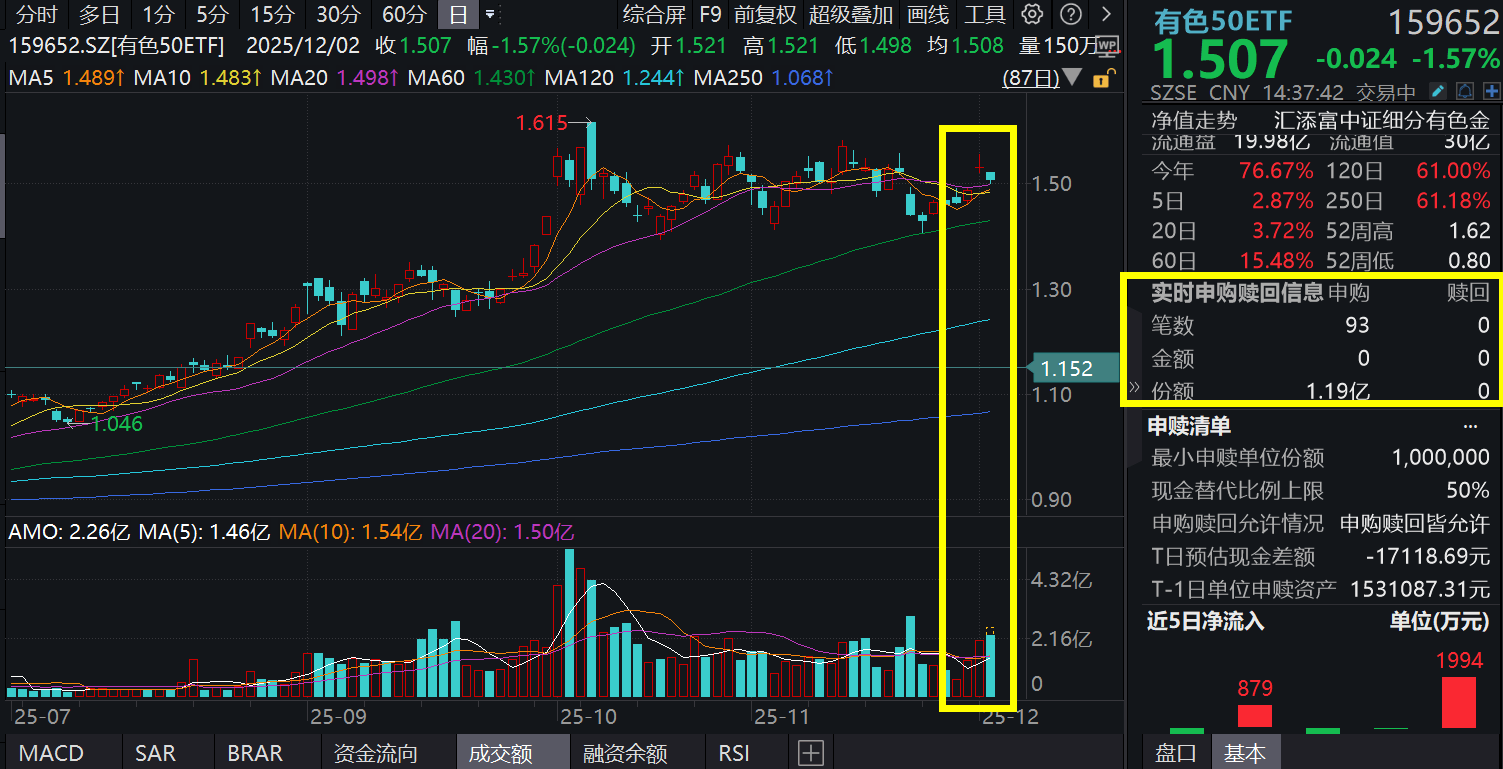
美就业警报拉响!降息大局已定?有色回调,有色50ETF(159652)一度跌超2%,资金实时逢跌涌入超1亿元!全球铜矿紧缺,铜价后市怎么看?
Sou Hu Cai Jing· 2025-12-02 07:07
Core Viewpoint - The A-share market experienced a decline, with the Shanghai Composite Index falling below 3900 points, while the Nonferrous 50 ETF (159652) saw a drop of 1.57%, with significant buying interest emerging during the dip [1][3]. Market Performance - The Nonferrous 50 ETF (159652) index components mostly retreated, with Tianqi Lithium and other stocks dropping over 3%, while Northern Rare Earth and Huayou Cobalt fell more than 2% [3]. - Key stocks in the Nonferrous 50 ETF include Zijin Mining (-1.50%), Northern Rare Earth (-2.75%), and Tianqi Lithium (-3.39%), among others, indicating a general downturn in the sector [4]. Economic Indicators - The U.S. manufacturing sector continues to decline, with the ISM reporting a contraction for the ninth consecutive month, which may influence global market sentiment [5]. - Bank of America forecasts a 25 basis point rate cut by the Federal Reserve in December, with further cuts expected in mid-2026, potentially impacting investment flows into commodities [5]. Precious Metals Market - Silver prices have surged, with a year-to-date increase of over 94%, driven by supply shortages and rising industrial demand, particularly in photovoltaics and electric vehicles [5][6]. - The market anticipates continued support for precious metals due to expectations of Fed rate cuts and liquidity easing, which could further elevate gold and silver prices [7]. Industrial Metals Outlook - The copper market faces production disruptions due to frequent accidents at major mines, leading to a downward revision of global copper output forecasts [8]. - Codelco's significant price increase for refined copper contracts highlights the tightening supply situation, with potential implications for copper prices moving forward [8]. Investment Opportunities - The Nonferrous 50 ETF (159652) is positioned to benefit from a super cycle in metals, with a diversified exposure to gold, copper, aluminum, lithium, and rare earths [9]. - The ETF's composition shows a leading "gold-copper content" of 46%, indicating a strong strategic positioning within the sector [11]. - The ETF has demonstrated superior performance with a cumulative return leading its peers since 2022, driven by earnings rather than valuation expansion [12][13].