CPIC(601601)

Search documents
科技赋能,太保e检惠农利农——太保白云区“数字渔医”服务站投入运营
Nan Fang Nong Cun Bao· 2025-11-12 10:04
Core Viewpoint - The establishment of the "Digital Fish Medicine" service station by China Pacific Insurance in Baiyun District aims to enhance the health and productivity of the aquaculture industry through technological support and innovative insurance services [1][4][6]. Group 1: Industry Challenges - Frequent animal diseases in aquaculture have led to significant economic losses and hindered the healthy development of the industry due to a lack of professional knowledge and detection capabilities among farmers [2][3]. - The difficulty in disease prevention and control has increased, prompting a need for innovative solutions in agricultural insurance services for the aquaculture sector [4][5]. Group 2: Service Station Features - The "Digital Fish Medicine" service station integrates local expertise and advanced testing equipment from partner companies to create a comprehensive risk warning platform for aquaculture in Baiyun District [13][15]. - Equipped with advanced tools such as automatic ion detectors and PCR testing devices, the service station provides essential testing services for water quality, parasites, and fish viruses [16][17][18]. Group 3: Professional Support - The service station is staffed by qualified aquatic veterinarians with extensive field experience, offering pre-disaster warnings, damage reduction during disasters, and post-disaster recovery services [21][22][23]. - By providing scientific data for targeted interventions, the service station aims to reduce the misuse of medications, ensuring food safety and helping farmers increase their yields [24][25][26].



保险板块11月12日涨2.26%,中国人保领涨,主力资金净流入4.95亿元
Zheng Xing Xing Ye Ri Bao· 2025-11-12 08:49
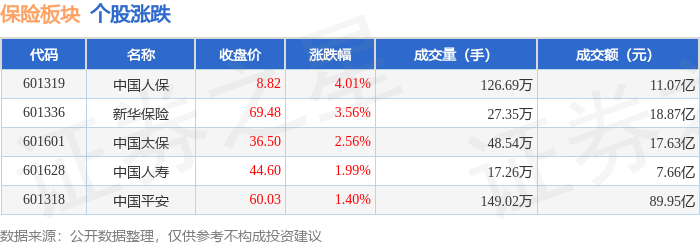
Core Insights - The insurance sector experienced a rise of 2.26% on November 12, with China Life Insurance leading the gains [1] - The Shanghai Composite Index closed at 4000.14, down 0.07%, while the Shenzhen Component Index closed at 13240.62, down 0.36% [1] Insurance Sector Performance - China Pacific Insurance (601318) closed at 60.03, up 1.40%, with a trading volume of 1.49 million shares and a transaction value of 8.99517 billion [1] - China Life Insurance (601628) closed at 44.60, up 1.99%, with a trading volume of 172,600 shares and a transaction value of 766 million [1] - China Property & Casualty Insurance (601601) closed at 36.50, up 2.56%, with a trading volume of 485,400 shares and a transaction value of 1.763 billion [1] - New China Life Insurance (601336) closed at 69.48, up 3.56%, with a trading volume of 273,500 shares and a transaction value of 1.887 billion [1] - China Reinsurance (601319) closed at 8.82, up 4.01%, with a trading volume of 1.2669 million shares and a transaction value of 1.107 billion [1] Capital Flow Analysis - The insurance sector saw a net inflow of 495 million from institutional investors, while retail investors experienced a net outflow of 669 million [1] - China Life Insurance (601318) had a net inflow of 27.3 million from institutional investors, while retail investors had a net outflow of 357 million [2] - New China Life Insurance (601336) had a net inflow of 13.1 million from institutional investors, with a net outflow of 15 million from retail investors [2] - China Property & Casualty Insurance (601601) experienced a net outflow of 7.24 million from institutional investors and a net outflow of 1.46 million from retail investors [2] - China Reinsurance (601319) had a net inflow of 7.018 million from institutional investors, but retail investors had a significant net outflow of 64.42 million [2]




决定险资投向的关键---FVOCI是什么?
Hua Er Jie Jian Wen· 2025-11-12 07:37
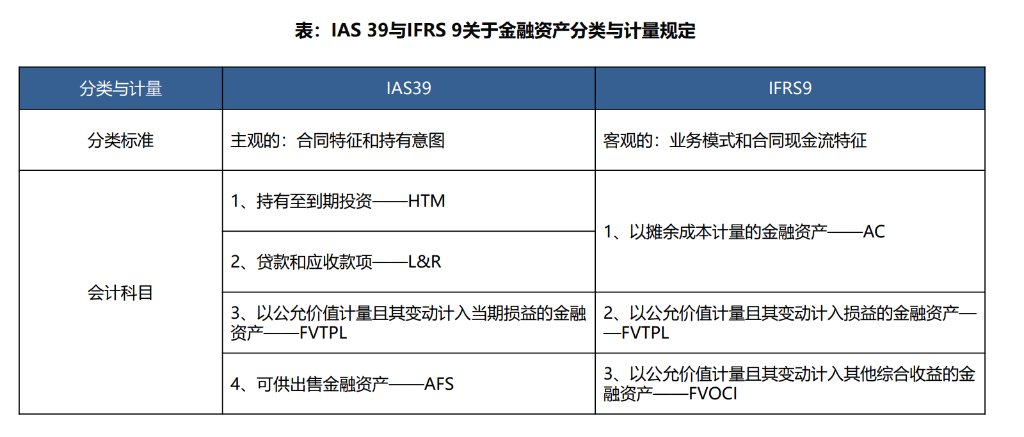
Core Viewpoint - The implementation of the new accounting standards in the insurance industry, particularly the FVOCI category, is significantly impacting the asset allocation strategies of insurance companies [1][2][4]. Group 1: Accounting Standards and Implementation - The FVOCI (Fair Value Through Other Comprehensive Income) category will be fully implemented by January 1, 2026, replacing the previous four-category model with a three-category system [2][4]. - The new classification system includes FVOCI, FVTPL (Fair Value Through Profit or Loss), and AC (Amortized Cost) [2][4]. - Non-listed insurance companies must implement the new standards by the specified date, while some companies like China Ping An have already adopted them since 2018 [4]. Group 2: Impact on Profitability - Investment income is crucial for insurance companies, with total investment income contributing significantly to net profit for major players like China Life and China Ping An, with ratios reaching 192% and 194% respectively in the first half of 2025 [8]. - The choice between FVOCI and FVTPL for equity assets can greatly influence profit volatility, with FVOCI potentially offering a more stable profit profile for companies with long-term liabilities [11]. Group 3: Asset Allocation Trends - As of mid-2025, the proportion of equity assets classified under FVOCI has increased for major insurance companies, with China Life's FVOCI equity assets rising by 10.6 percentage points to 22.6% [12]. - The increase in FVOCI equity allocation is attributed to a low-interest-rate environment and a shortage of alternative investments, making FVOCI stocks a short-term substitute for bonds [15]. - In the bond category, the FVOCI proportion has also seen increases, with China Life's bond assets under FVOCI rising by 1.8 percentage points to 87.3% [16]. Group 4: Strategic Considerations - Different insurance companies have varying requirements regarding profit volatility, leading some to prefer a higher allocation to FVOCI assets while others may favor FVTPL for potential higher returns [17]. - The classification of assets is not standardized across the industry, allowing companies to tailor their strategies based on their specific operational needs and investment capabilities [17].
大病保险织密民生保障网
Jin Rong Shi Bao· 2025-11-12 03:15
Core Viewpoint - The article highlights the significant impact of the comprehensive medical insurance policies implemented by China Pacific Insurance (CPIC) in Gansu province, particularly in the impoverished areas of Linxia Prefecture, showcasing how these policies have improved access to healthcare and financial security for residents [1][3]. Group 1: Service Improvement - CPIC has established a robust service network to enhance public understanding of insurance policies, particularly in areas with low awareness and communication barriers [2][4]. - The company has formed bilingual teams to effectively communicate insurance policies to local residents, ensuring that the information is accessible and understandable [3][4]. - Over the past eight years, CPIC has created eight bilingual promotional teams that have reached 106 towns and 1,149 administrative villages, distributing over 160,000 informational materials [3][4]. Group 2: Efficiency Enhancement - The claims processing time has significantly decreased, with patients now able to complete insurance claims in under two minutes at the time of discharge, compared to the previous 10 to 15 days [5][6]. - CPIC has implemented a one-stop instant settlement system in collaboration with local medical institutions, allowing for real-time data uploads and efficient claims processing [6]. - The number of service windows has increased from 7 to 53, ensuring that residents have easy access to claims services [6]. Group 3: Community Support - CPIC has established a special claims service mechanism for impoverished individuals, providing personalized support and a green channel for claims [7]. - The company has actively engaged in community support initiatives, including emergency response efforts and funding for local health facilities, demonstrating a commitment to improving residents' health conditions [7]. - CPIC aims to further strengthen the social safety net in Linxia Prefecture, focusing on addressing the challenges of poverty caused by illness [7].

中国太保涨2.02%,成交额5.35亿元,主力资金净流入4847.01万元
Xin Lang Cai Jing· 2025-11-12 02:48
Core Viewpoint - China Pacific Insurance (Group) Co., Ltd. has shown a positive stock performance with a year-to-date increase of 10.03% and a recent rise of 2.02% in stock price, indicating investor confidence and market interest [1][2]. Financial Performance - For the period from January to September 2025, the company reported a net profit attributable to shareholders of 45.7 billion yuan, representing a year-on-year growth of 19.29% [2]. - The company has cumulatively distributed dividends amounting to 119.28 billion yuan since its A-share listing, with 30.01 billion yuan distributed over the last three years [3]. Stock Market Activity - As of November 12, the stock price was 36.31 yuan per share, with a trading volume of 535 million yuan and a turnover rate of 0.22%, leading to a total market capitalization of 349.31 billion yuan [1]. - The net inflow of main funds was 48.47 million yuan, with significant buying activity from large orders, indicating strong institutional interest [1]. Business Structure - The company operates primarily through its subsidiaries, China Pacific Life Insurance Co., Ltd. and China Pacific Property Insurance Co., Ltd., focusing on comprehensive life and property insurance products [2]. - The revenue composition includes 51.25% from property insurance, 46.78% from life and health insurance, and 0.97% from asset management [2]. Shareholder Information - As of September 30, 2025, the number of shareholders increased by 16.49% to 102,000, while the average circulating shares per person decreased by 14.76% to 69,643 shares [2]. - Major shareholders include China Securities Finance Corporation and Hong Kong Central Clearing Limited, with the latter reducing its holdings by approximately 57.95 million shares [3].
八届进博会“全勤生” 中国太保保险保障服务全面升级
Ren Min Ri Bao· 2025-11-11 22:31
Core Insights - China Pacific Insurance (Group) Co., Ltd. has participated in the China International Import Expo (CIIE) for eight consecutive years, providing comprehensive insurance solutions and risk management services [1][9] - The company has enhanced its insurance coverage to over 1.28 trillion yuan for this year's expo, showcasing its commitment to supporting the event [1][9] Group 1: Insurance Solutions - China Pacific Insurance offers a one-stop insurance product called "Jinbo Bao," which includes 15 basic coverage products and 4 special coverage products tailored for global exhibitors, logistics providers, and service providers [2][3] - The insurance services cover all aspects of the expo, including pre-event, during the event, and post-event phases, ensuring comprehensive risk protection for participants [3] Group 2: Strategic Forums and Initiatives - The company hosted several high-level forums during the expo, focusing on national strategies and social issues, such as aging finance and the development of the new energy vehicle industry [4][5] - A forum on aging finance gathered experts to discuss the integration of insurance and health services, emphasizing the need for a multi-layered pension insurance system [4] Group 3: Collaborative Efforts - China Pacific Insurance actively collaborates with various partners to enhance the expo experience, including launching a joint initiative with multiple organizations to promote the expo [7] - The company has also introduced a carbon footprint tracking initiative, encouraging participants to engage in carbon neutrality efforts [8] Group 4: Future Strategies - In 2025, China Pacific Insurance plans to implement three major strategies: "Big Health and Care," "Internationalization," and "Artificial Intelligence+" to enhance its market competitiveness [8] - The company aims to transform technological advancements into smarter and more convenient service experiences for its clients [8]
非车险报行合一落地 定价能力或成竞争焦点
Zhong Guo Zheng Quan Bao· 2025-11-11 20:09
Core Viewpoint - The implementation of the unified reporting and pricing system for non-auto insurance starting November 1 aims to standardize the market, curb vicious competition, and improve underwriting profitability [1][2]. Group 1: Implementation of Unified Reporting and Pricing - The unified reporting and pricing system requires insurance companies to align their actual insurance terms and rates with the materials submitted to regulatory authorities [1]. - Non-auto insurance has seen rapid growth, with premium income reaching 687.8 billion yuan in the first nine months of the year, accounting for a significant portion of property insurance premiums [1]. - The previous competitive model based on pricing has led to underwriting losses for many companies, necessitating a shift towards improved pricing capabilities [1][2]. Group 2: Regulatory Guidance and Industry Response - The Financial Regulatory Authority has issued guidelines to enhance the management of non-auto insurance, focusing on optimizing assessment mechanisms and strengthening rate management [2]. - Insurance companies have established special task forces to review existing products and upgrade systems to comply with new regulations [2][3]. - Different non-auto insurance products have specific re-filing deadlines, with commercial property insurance needing to be re-filed by December 1, 2025, and other products by the end of 2026 [2]. Group 3: Changes in Business Operations - The requirement for "fee upon issuance" means that property insurance companies must collect premiums before issuing policies, altering traditional business practices [3]. - Companies are currently informing clients about these changes and coordinating with relevant departments for system upgrades [3]. Group 4: Future Market Dynamics - The competition in the non-auto insurance market is expected to shift from price competition to a focus on pricing capability, risk identification, and service quality [3][4]. - Smaller specialized insurance companies can leverage their strengths by focusing on niche markets and offering customized products and differentiated services [4]. - Companies are encouraged to enhance their cost accounting systems and invest in technology to improve risk pricing and underwriting capabilities [4].
进博会保险“扩圈”!头部险企联合多领域巨头构建产业链新生态
Hua Xia Shi Bao· 2025-11-11 13:49
Core Viewpoint - The eighth China International Import Expo (CIIE) has become a significant platform for domestic insurance companies to expand their ecosystems and seek new business growth opportunities, particularly in the fields of elderly finance, insurance technology, and health management [2][3]. Group 1: Industry Trends - The insurance sector is actively seeking collaboration opportunities at CIIE, marking a shift from being a supporting role to a more prominent position in the event [3]. - The focus on elderly finance has become a key area of interest, with companies aiming to build an ecosystem that integrates insurance protection, health services, and wealth management [3][4]. - The integration of insurance with the health and wellness industry is seen as essential for meeting diverse elderly care needs [3]. Group 2: Company Initiatives - China Pacific Insurance (China Taiping) is upgrading its "big health" strategy to "big health and wellness," leveraging international experiences to enhance its service offerings [2]. - Ping An's subsidiary, Ping An Good Doctor, has announced a deep collaboration with Medtronic to innovate in digital healthcare and traditional medical services [4]. - The insurance industry is exploring its role in the new energy vehicle sector, with a focus on providing comprehensive risk management and financial services for companies expanding overseas [5]. Group 3: Technological Advancements - The insurance industry is increasingly adopting artificial intelligence (AI) technologies to enhance decision-making processes and operational efficiency [6][7]. - AI is transforming traditional actuarial models, enabling better handling of complex data and improving product innovation [8]. - The shift towards dynamic risk assessment, particularly in the context of "insurance for those with pre-existing conditions," is being supported by AI-driven predictive analytics [9].
保险板块11月11日跌1.23%,新华保险领跌,主力资金净流出3213.39万元
Zheng Xing Xing Ye Ri Bao· 2025-11-11 08:46
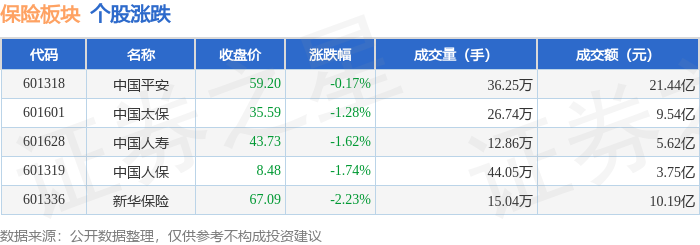
Core Insights - The insurance sector experienced a decline of 1.23% on November 11, with New China Life Insurance leading the drop [1] - The Shanghai Composite Index closed at 4002.76, down 0.39%, while the Shenzhen Component Index closed at 13289.0, down 1.03% [1] Company Performance - China Ping An (601318) closed at 59.20, down 0.17%, with a trading volume of 362,500 shares and a transaction value of 2.144 billion [1] - China Pacific Insurance (601601) closed at 35.59, down 1.28%, with a trading volume of 267,400 shares and a transaction value of 954 million [1] - China Life Insurance (601628) closed at 43.73, down 1.62%, with a trading volume of 128,600 shares and a transaction value of 562 million [1] - China Property & Casualty Insurance (601336) closed at 8.48, down 1.74%, with a trading volume of 440,500 shares and a transaction value of 375.1 million [1] - New China Life Insurance (601336) closed at 67.09, down 2.23%, with a trading volume of 150,400 shares and a transaction value of 1.019 billion [1] Fund Flow Analysis - The insurance sector saw a net outflow of 32.134 million from institutional investors, while retail investors experienced a net outflow of 84.0465 million [1] - The net inflow from speculative funds was 116 million [1] Individual Stock Fund Flow - New China Life Insurance had a net inflow of 25.5731 million from institutional investors, while retail investors had a net outflow of 76.2197 million [2] - China Life Insurance experienced a net outflow of 0.5293 million from institutional investors and a net inflow of 33.4407 million from speculative funds [2] - China Pacific Insurance had a net outflow of 8.7693 million from institutional investors and a net inflow of 45.3669 million from speculative funds [2] - China Property & Casualty Insurance had a net outflow of 17.9751 million from institutional investors and a net inflow of 26.2701 million from speculative funds [2] - China Ping An had a net outflow of 30.4332 million from institutional investors, with retail investors showing a net inflow of 69.9772 million [2]
中金:25Q3险企NBV延续高增速 向后看负债端对股价影响或增强
Zhi Tong Cai Jing· 2025-11-11 07:50
Group 1 - The core viewpoint is that the new business value (NBV) of Chinese life insurance companies continues to show high growth, with optimistic outlooks for the liability side [2][1] - In 9M25, the NBV growth rates for major life insurance companies are as follows: China Life +76.6%, Ping An +46.2%, China Life +41.8%, and Taiping +31.2% [2][1] - The first-year premium value rates for Ping An and Taiping increased by 7.6 percentage points and 1.7 percentage points to 25.2% and 18.0%, respectively [2][1] Group 2 - The comprehensive cost ratio (CoR) for property insurance companies is improving, with the following year-on-year changes: China Property -2.1 percentage points to 96.1%, Ping An Property -0.8 percentage points to 97.0%, and Taiping Property -1.1 percentage points to 97.6% [3][1] - Regulatory measures have led to improvements in the quality and efficiency of auto insurance, and the current focus on non-auto insurance governance is expected to enhance profitability for leading property insurance companies [3][1] Group 3 - Net profits are experiencing significant growth, driven by strong stock market performance, with annualized total investment returns for China Life and Xinhua increasing by 1.0 and 1.8 percentage points to 6.4% and 8.6%, respectively [4][1] - Taiping and China Property's non-annualized total investment returns increased by 0.5 and 0.8 percentage points to 5.2% and 5.4%, while Ping An's non-annualized comprehensive investment return rose by 1.0 percentage point to 5.4% [4][1] Group 4 - The impact of the liability side on stock prices may increase, as the high investment return-driven market may be nearing its end, leading to a higher probability of weakened asset-side elasticity [5][1] - The focus should be on optimizing liability product structures, reducing costs, and highlighting growth trends in quality life insurance [5][1] - The industry ranking remains as follows: Ping An (601318.SH), China Taiping (00966), China Taiping (601601.SH), China Life (02628), and China Property (601319) [5][1]