CPIC(601601)

Search documents
中国太保(601601):三季度业绩主要由投资驱动 个险渠道逐季加速
Ge Long Hui· 2025-11-09 21:23
Core Viewpoint - China Pacific Insurance (CPIC) reported a strong performance for Q3 2025, with revenue and net profit attributable to shareholders increasing by 24.6% and 35.2% year-on-year, reaching 144.4 billion and 17.8 billion yuan respectively, contributing to a cumulative revenue and net profit growth of 11.1% and 19.3% for the first three quarters of 2025 [1] Financial Indicators - Q3 2025 profit was primarily driven by investments, with total profit increasing by 85.7% year-on-year to 27.9 billion yuan, where insurance service performance and investment performance grew by 54% and 79% to 7.7 billion and 23.4 billion yuan respectively [1] - The income tax rate for Q3 2025 rose significantly from 9.4% to 34.2%, attributed to higher capital market gains exceeding tax-exempt limits and a greater contribution from the property insurance sector [1] - As of the end of September, the net asset attributable to shareholders decreased by 2.5% to 284.2 billion yuan, underperforming compared to peers, mainly due to the disparity in interest rates applied to assets and liabilities [1] Life Insurance Business - The individual insurance channel showed a quarterly improvement in new policy premiums, with Q3 2025 new premiums increasing by 13.5% year-on-year to 10.6 billion yuan, driven by competitive product offerings and market timing [1] - The cumulative new business value (NBV) growth for life insurance was 31.2%, maintaining stability close to the mid-year figure of 32.3%, benefiting from an increased proportion of new premiums from agents [1] - The core solvency ratio for life insurance decreased from 136% at the end of Q2 2025 to 124% at the end of Q3 2025, with forecasts indicating a further decline to 117% in the next quarter [1] Profit Forecast and Valuation - The company is expected to achieve net profits attributable to shareholders of 52.9 billion, 64.7 billion, and 75.1 billion yuan for 2025-2027, with year-on-year growth rates of 17.7%, 22.2%, and 16.1% respectively [2] - The estimated embedded value per share for 2025-2027 is projected to be 66.5, 74.4, and 83.3 yuan, with current price-to-embedded value (PEV) ratios of 0.54, 0.48, and 0.43 [2]

华源晨会精粹20251109-20251109
Hua Yuan Zheng Quan· 2025-11-09 13:12
Group 1: North Exchange Market Insights - The North Exchange 50 Index and the specialized new index will undergo adjustments on December 15, 2025, with potential additions of three companies: Kai Fa Technology, Ge Bi Jia, and Wan Tong Hydraulic [2][7] - The North Exchange 50 Index has seen a decline of over 3% this week, with average daily trading volume dropping to 23.1 billion yuan, indicating a need to monitor market sentiment and trading volume changes [2][8] - The overall outlook for the North Exchange remains optimistic, with a focus on companies with solid fundamentals and reasonable valuations, particularly those that may enter the index [8] Group 2: New Consumption Sector Developments - The introduction of new tax policies for gold trading is expected to drive market share towards compliant leading brands, while non-compliant businesses may face significant impacts [11][12] - Domestic beauty brands are increasingly leveraging video platforms like WeChat to enhance sales, with a notable growth in social e-commerce, indicating a shift in consumer engagement strategies [12][13] - The new consumption landscape reflects changing consumer attitudes, with a focus on innovative and high-quality domestic brands in sectors like beauty and jewelry [13] Group 3: Non-Banking Sector Analysis - China Pacific Insurance reported a 24.6% year-on-year increase in revenue and a 35.2% increase in net profit for Q3 2025, driven primarily by investment performance [3][16] - The company's new business value (NBV) in life insurance grew by 31.2% year-on-year, indicating a stable growth trajectory in individual insurance channels [17] - The overall performance aligns with market expectations, with a forecasted net profit growth of 17.7% to 751 billion yuan by 2027 [18] Group 4: Fast Food Industry Performance - Yum China achieved a revenue of $3.21 billion in Q3 2025, reflecting a 4% year-on-year growth, although net profit declined by 5% [20][21] - The company’s core brands, KFC and Pizza Hut, demonstrated resilience with improved operating profit margins, despite challenges in average transaction values [21][22] - Yum China is on track to meet its goal of 20,000 stores by the end of 2026, with a strong opening pace and strategic franchise expansion [22]
非银周报:保险非车险报行合一细则落地,利好大型险企盈利能力与市占率提升-20251109
SINOLINK SECURITIES· 2025-11-09 12:28
Investment Rating - The report suggests a focus on two main lines: (1) Listed securities firms with better-than-expected Q3 performance and (2) multi-financial companies with impressive growth rates, particularly recommending Hong Kong Exchanges and Clearing [2] Core Insights - The average daily trading volume of A-shares in 2025 from January to October reached 2.02 trillion yuan, a year-on-year increase of 92% [1] - The margin trading balance continues to grow, with financing and securities lending balances as of November 6 being 248.05 billion yuan and 183 billion yuan, respectively, marking increases of 33.8% and 75.3% compared to the end of last year [1] - The insurance sector saw a cumulative original premium income of 5.21 trillion yuan in the first nine months of 2025, reflecting a year-on-year growth of 8.8% [36] Summary by Sections Securities Sector - The average daily margin trading balance in 2025 is projected to be 1.999 trillion yuan, a year-on-year increase of 32% [1] - New account openings in October decreased significantly, with 2.31 million new accounts opened, a 66% drop compared to October last year [35] Insurance Sector - The introduction of unified reporting guidelines for non-auto insurance is expected to enhance the profitability and market share of large insurance companies [3] - The report anticipates a double-digit growth in new premium income for the insurance sector in 2026, driven by strong investment performance in 2025 [4] - The insurance asset management sector has seen a 25.1% year-on-year increase in the registration scale of asset-backed securities (ABS) in the first three quarters of 2025 [40]




护航新能源车“出海”,保险业发声!
券商中国· 2025-11-09 10:40
Core Viewpoint - The Chinese new energy vehicle (NEV) industry is rapidly advancing towards intelligence and internationalization, with the insurance sector playing a crucial role in supporting the overseas expansion of NEV companies [1][2]. Group 1: Market Growth and Export Dynamics - The global NEV market has experienced significant growth, with sales increasing from less than 3 million units to over 17 million units in the past five years, achieving a penetration rate of 22.5% [4]. - China's NEV sales in the first three quarters of this year grew by 35% year-on-year, while exports surged by nearly 90% [4]. - The penetration rate of NEVs in China's automotive exports exceeded 30% by the third quarter of this year, marking a structural leap from product export to industrial output [4]. Group 2: Challenges in Globalization - Chinese automotive companies face challenges in entering new markets, including cost control, time pressure, and compliance with international regulations and standards [4][5]. - The General Data Protection Regulation (GDPR) and upcoming regulations on artificial intelligence and data governance pose significant challenges for data acquisition and understanding local customers [5]. Group 3: Insurance Solutions for NEV Export - Insurance companies are exploring various models to support NEV companies in their overseas ventures, providing tailored insurance solutions based on the development stage of the companies [6]. - The first phase involves product export, where traditional marine risks and specific risks related to lithium batteries are covered through cargo insurance [7]. - The second phase focuses on localized operations, requiring comprehensive risk coverage, including political violence and export credit insurance [7]. - The third phase, termed "ecological export," involves exporting technology and management solutions, presenting new challenges such as overseas insurance difficulties and battery anxiety [7][8]. Group 4: Cross-Industry Collaboration - The development of the NEV industry requires collaboration across multiple sectors, including automotive, technology, and insurance [11]. - Insurance companies and automotive manufacturers are working together to enhance repair and claims efficiency through data interconnectivity [11]. - A memorandum of cooperation was signed by various industry associations to promote high-quality development in the NEV sector through technical standards and repair system optimization [12]. Group 5: Internationalization Strategies - China Pacific Insurance has identified internationalization as a key strategy in its 14th Five-Year Plan, aiming to expand its overseas operations and partnerships [9]. - The company has provided risk coverage of up to 49 billion yuan for overseas projects in countries like India, Thailand, and Indonesia [8]. - The establishment of a comprehensive support system for overseas expansion is deemed essential, including market research, localization strategies, and compliance consulting [12].


中国太保寿险成功举办国际银行保险高峰论坛
Guo Ji Jin Rong Bao· 2025-11-09 10:11
Core Viewpoint - The forum organized by China Pacific Insurance (CPIC) emphasizes the importance of collaboration between banking and insurance sectors to achieve high-quality development and contribute to the construction of a strong financial nation and the well-being of the people [1][3][14] Group 1: Forum Highlights - The forum was attended by nearly 150 representatives from major state-owned banks, joint-stock banks, and rural commercial banks, focusing on the integration of banking and insurance, value transformation, and technological empowerment [1] - CPIC Chairman Fu Fan highlighted the significant contribution of the banking-insurance channel, with personal insurance premiums in China surpassing 4 trillion yuan, advocating for a "coexistence" strategy to leverage unique advantages in serving national strategies and meeting public needs [3][14] Group 2: Strategic Initiatives - CPIC General Manager Li Jinsong stated that the collaboration between banking and insurance is evolving from "channel cooperation" to "ecosystem integration," aiming for broader development opportunities [5] - CPIC launched the "China Pacific Insurance Banking Service System," which includes the "Nanshan Residence" high-quality home care service brand and the "Health Enjoyment" service that combines insurance with comprehensive medical and elderly care services [8] Group 3: Technological Empowerment - The forum introduced the "Intelligent Customer Experience Solution" aimed at enhancing efficiency and optimizing experiences in banking-insurance operations through customer-centric insights and personalized service offerings [8] - Executives from international insurance firms shared insights on European banking-insurance market trends, cooperation models, and successful experiences, contributing to a multi-faceted discussion on industry development [9]

我国城市老年人脑健康风险呈“社会经济梯度”分布
Zhong Guo Xin Wen Wang· 2025-11-09 09:29
Core Insights - The report highlights significant structural characteristics in the brain health risk distribution among urban elderly populations in China, with risks closely linked to age, education level, income, and the presence of chronic diseases [1][2] Group 1: Brain Health Risks - The brain health risks among urban elderly are highly correlated with age, low education levels, low income, and the coexistence of chronic diseases, creating a clear "socioeconomic gradient" [1] - There are significant differences in high-risk proportions across different cities from coastal to inland areas, forming a "continuous risk spectrum" [1] - The structural risks are attributed to a combination of environmental factors (pollution, noise, social isolation, and psychological stress) and systemic issues within the healthcare framework [1] Group 2: Proposed Solutions - The report proposes a system solution centered on "service and payment dual-drive," aiming to create an innovative framework covering prevention, diagnosis, rehabilitation, and long-term care [2] - It emphasizes a data-driven approach to establish a brain health data interconnection platform to break down information barriers between departments and industries [2] - The solution includes payment innovation to promote the integration of "insurance + health management," directing resources to high-risk areas [2] - It advocates for proactive measures by improving early screening and diagnosis networks, shifting from passive treatment to active intervention [2] - The framework also aims to enhance home rehabilitation and long-term care systems, reinforcing the integration of medical and elderly care [2] - Finally, it calls for a top-level design to establish standardized evaluation and policy support systems as a safeguard [2]
中国太保(601601):三季度业绩主要由投资驱动,个险渠道逐季加速
Hua Yuan Zheng Quan· 2025-11-09 09:10
Investment Rating - The investment rating for China Pacific Insurance (601601.SH) is "Buy" (maintained) [3] Core Views - The third-quarter performance of China Pacific Insurance was primarily driven by investments, with individual insurance channels accelerating quarter by quarter [3] - The group's single-quarter revenue and net profit attributable to shareholders increased by 24.6% and 35.2% year-on-year, reaching 144.4 billion and 17.8 billion yuan respectively [3] - The cumulative net profit attributable to shareholders for the first three quarters grew by 19.3% year-on-year, indicating a stable performance that aligns with market expectations [3] Financial Metrics Summary - As of the end of Q3 2025, the cumulative net asset value decreased by 2.5% to 284.2 billion yuan compared to the beginning of the year [6] - The cumulative new business value (NBV) for life insurance showed a year-on-year growth of 31.2% [9] - The comprehensive cost ratio for property insurance improved by 1 percentage point to 97.6% [3] Business Segment Analysis - The new single premium growth rate for the life insurance agent channel showed a quarterly improvement, with Q3 single-quarter new premium increasing by 13.5% to 10.6 billion yuan [5] - Investment performance was a major driver of profit, with Q3 total profit increasing by 85.7% to 27.9 billion yuan, driven by a 79% increase in investment performance [6][17] - The core solvency adequacy ratio for life insurance decreased from 136% at the end of Q2 to 124% at the end of Q3, with a forecasted decline to 117% for the next quarter [9] Profit Forecast and Valuation - The forecasted net profit attributable to shareholders for 2025-2027 is 52.9 billion, 64.7 billion, and 75.1 billion yuan, with year-on-year growth rates of 17.7%, 22.2%, and 16.1% respectively [7] - The current stock price corresponds to a price-to-embedded value (PEV) ratio of 0.54, 0.48, and 0.43 for the years 2025-2027 [7]
中国太保董事长:新能源车出海仍面临保障短板,需构建全链条的服务网络
Xin Lang Cai Jing· 2025-11-09 07:41
Core Insights - The chairman of China Pacific Insurance, Fu Fan, stated that the sales of new energy vehicles (NEVs) in China are projected to reach 12.87 million units in 2024, with the market size of the entire industry chain approaching 2.8 trillion yuan [1] Group 1: Industry Outlook - In 2024, the sales volume of new energy vehicles in China is expected to be 12.87 million units, indicating significant growth in the sector [1] - The overall market size for the new energy vehicle industry chain is anticipated to be nearly 2.8 trillion yuan, reflecting the expanding economic impact of this sector [1] Group 2: Technological Challenges - Fu Fan highlighted that the technological transformation in the new energy vehicle sector brings forth increasing risk management challenges, particularly in areas such as intelligent driving and battery safety [1] - Collaboration among automotive, technology, and insurance sectors is essential to explore these new challenges and ensure that technology can be safely implemented [1] Group 3: Export and Global Strategy - The export volume of new energy vehicles from China is projected to exceed 70% in 2024, indicating a strong international presence [1] - To support the global expansion of the industry, it is crucial to establish a comprehensive service network that addresses shortcomings in overseas insurance, service guarantees, and financial support [1]
上海国际金融中心一周要闻回顾(11月3日—11月9日)
Guo Ji Jin Rong Bao· 2025-11-09 04:50
Group 1 - The eighth Hongqiao International Economic Forum held multiple sub-forums focusing on financial support for global trade, supply chain stability, and cross-border trade development, highlighting the importance of financial cooperation in international markets [1][2][3] - China Bank and the Hong Kong Trade Development Council signed a strategic cooperation memorandum to assist enterprises in expanding into international markets [1] - The launch of the "Digital Trade" ecological alliance by the Bank of Communications aims to enhance cross-border trade quality [2] Group 2 - The Shanghai Futures Exchange revised its guidelines for using government bonds as margin, facilitating futures companies in managing collateral [7] - Shanghai banks are innovating in financial services, such as the launch of the "Xinyu" cross-border products by Shanghai Rural Commercial Bank to support enterprises in global markets [11] - The signing of a strategic cooperation framework agreement between Shanghai United Assets and Macau Financial Assets Exchange aims to enhance cross-border asset trading and technological collaboration [9] Group 3 - The China Export-Import Bank introduced a tailored financial service plan for the eighth China International Import Expo, focusing on providing efficient cross-border financial services [14] - The Shanghai Financial Regulatory Bureau reported a total asset balance of 28.59 trillion yuan in the banking sector as of September 2025, reflecting a year-on-year growth of 6.25% [30] - The Shanghai Stock Exchange successfully recorded the first cross-border share pledge registration, enhancing the efficiency of cross-border transactions [20]


第八届进博会热度攀升 多项金融创新成果为企业“链”接全球保驾护航
Yang Shi Wang· 2025-11-09 03:13
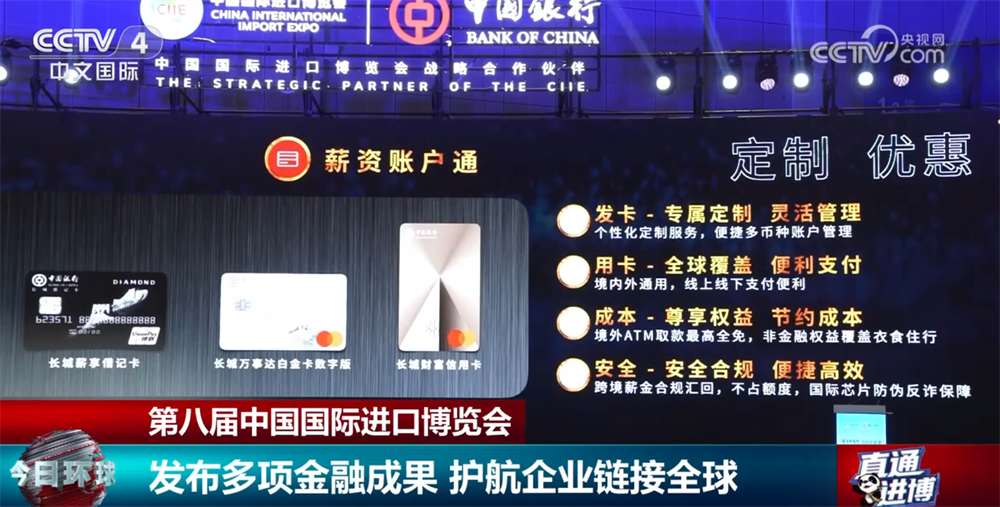
Group 1 - The eighth China International Import Expo is gaining momentum, with various financial institutions launching innovative financial products to support enterprises in global operations [1] - Bank of China introduced the "Global Payroll" product to address the complexities and inefficiencies in cross-border payroll for enterprises, providing a comprehensive service system from payroll to usage [1][3] - The product aims to reduce time and cost in cross-border payroll management, allowing enterprises to focus on core business expansion [3] Group 2 - China Pacific Insurance provided an insurance solution for the expo, with a total coverage amount of 1.28 trillion yuan, benefiting organizers, exhibitors, buyers, and supply chain service providers [5] - The company developed a "technology output + local service" solution to address challenges faced by the new energy vehicle sector in international markets [5] - Pacific Insurance aims to enhance the convenience of insurance for domestic vehicles abroad by leveraging online services and collaborating with local partners to mitigate risks [7]