
China Life(601628)

Search documents
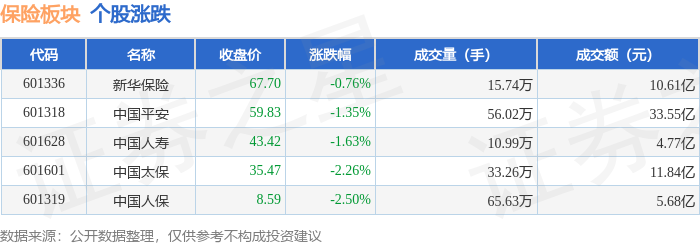
保险板块11月17日跌1.69%,中国人保领跌,主力资金净流出4.49亿元
Zheng Xing Xing Ye Ri Bao· 2025-11-17 08:49
Core Insights - The insurance sector experienced a decline of 1.69% on November 17, with China Pacific Insurance leading the drop [1] - The Shanghai Composite Index closed at 3972.03, down 0.46%, while the Shenzhen Component Index closed at 13202.0, down 0.11% [1] Insurance Sector Performance - Major insurance stocks and their performance on November 17: - New China Life Insurance: Closed at 67.70, down 0.76%, with a trading volume of 157,400 shares and a turnover of 1.061 billion [1] - Ping An Insurance: Closed at 59.83, down 1.35%, with a trading volume of 560,200 shares and a turnover of 3.355 billion [1] - China Life Insurance: Closed at 43.42, down 1.63%, with a trading volume of 109,900 shares and a turnover of 477.1 million [1] - China Pacific Insurance: Closed at 35.47, down 2.26%, with a trading volume of 332,600 shares and a turnover of 1.184 billion [1] - China Reinsurance: Closed at 65.8, down 2.50%, with a trading volume of 656,300 shares and a turnover of 568.17 million [1] Capital Flow Analysis - On the same day, the insurance sector saw a net outflow of 449 million from institutional investors, while retail investors contributed a net inflow of 381 million [1] - Detailed capital flow for major insurance stocks: - New China Life Insurance: Institutional net outflow of 48.11 million, retail net inflow of 80.23 million [2] - China Reinsurance: Institutional net outflow of 59.35 million, retail net inflow of 36.53 million [2] - China Pacific Insurance: Institutional net outflow of 60.37 million, retail net inflow of 73.01 million [2] - China Life Insurance: Institutional net outflow of 66.36 million, retail net inflow of 48.20 million [2] - Ping An Insurance: Institutional net outflow of 215 million, retail net inflow of 143 million [2]






2025年三季度保险公司资金运用点评:资产配置股升债降,主动管理将更为重要
GUOTAI HAITONG SECURITIES· 2025-11-17 06:22
Investment Rating - The report maintains an "Overweight" rating for the insurance industry [3][5]. Core Insights - As of Q3 2025, the balance of insurance funds has steadily increased, with stock assets' proportion rising while bond assets' proportion has decreased. The importance of active management in investments is expected to grow [3][5]. - The insurance industry fund utilization balance reached CNY 37.5 trillion, up 12.6% year-to-date, driven by stable growth in new and renewal premiums, with an overall premium growth of 8.8% year-on-year [5][6]. - The allocation to stock assets increased to CNY 3.62 trillion, representing 10.0% of total assets, up 2.5 percentage points year-to-date [5][6]. - The report emphasizes the need for insurance companies to shift from passive to active asset management strategies to enhance investment returns [5][6]. Summary by Sections Fund Utilization - The insurance industry's fund utilization balance as of Q3 2025 is CNY 37.5 trillion, a 12.6% increase from the beginning of the year. Life insurance accounts for CNY 33.7 trillion (up 12.6%), while property insurance accounts for CNY 2.4 trillion (up 7.5%) [5][6]. - Premium growth for the insurance industry was 8.8% year-on-year, with life insurance growing by 10.2% and property insurance by 4.9% [5][6]. Asset Allocation - Stock asset allocation reached CNY 3.62 trillion, a 1.19 trillion increase year-to-date, with a 10.0% share of total assets, up 2.5 percentage points from the start of the year [5][6]. - The proportion of bond assets is 50.3%, a slight decrease of 0.8 percentage points from the previous quarter, while bank deposits decreased to 7.9% [5][6]. - Other assets, primarily non-standard assets, decreased to 18.4% [5][6]. Investment Strategy - The report highlights the need for improved active management capabilities in the investment sector, as net investment yields are declining in a low-interest-rate environment [5][6]. - It is suggested that insurance companies should adopt more flexible asset allocation strategies to optimize returns [5][6]. Stock Recommendations - The report recommends specific stocks including New China Life, Ping An Insurance, China Pacific Insurance, China Life, and China People's Insurance Group [5][6].
中国人寿:以两乡网点“小切口”写普惠金融“大文章”
Ren Min Wang· 2025-11-17 05:32
Core Viewpoint - The article emphasizes the importance of the "Two Rural" strategy initiated by China Life Insurance to enhance rural financial services and support the national rural revitalization strategy, particularly in the context of the 14th Five-Year Plan's concluding year [1][2]. Group 1: Strategic Initiatives - China Life Insurance has launched the "Two Rural Revitalization" strategic plan to develop rural areas as independent business platforms, focusing on diversified sales, comprehensive services, and brand promotion [1]. - The "Two Rural Star Production Unit System" aims to establish a graded evaluation and construction system for all rural grassroots outlets, ensuring coordinated development and resource allocation [2]. - The "Two Rural Revitalization Model Room Construction" focuses on creating benchmark outlets that excel in development willingness, performance indicators, and innovative models, supported by special policies and funding [2]. Group 2: Infrastructure and Service Improvements - The transformation of previously outdated rural outlets has led to improved facilities and services, creating a welcoming environment for customers and enhancing the overall service experience [3]. - China Life has implemented hardware upgrades in rural outlets, including detailed regulations for design and equipment, and established "Love Stations" to provide convenient services [4]. - The integration of government and insurance services at rural outlets has streamlined processes for residents, such as health insurance payments, significantly reducing the need for travel [5]. Group 3: Product and Service Diversification - The company has recognized the growing insurance needs of rural residents and has innovated its service model by collaborating with local property insurance companies to create a blended insurance service approach [6]. - Successful examples include partnerships between life and property insurance branches, enhancing service efficiency for rural populations [6]. - The ongoing development of rural outlets is characterized by strong management practices, substantial investment, and innovative approaches, aligning with national rural revitalization goals [6]. Group 4: Community Engagement and Trust Building - The upgrades in service and infrastructure have fostered trust and satisfaction among rural residents, with tangible benefits such as accessible services and clear policy communication [7]. - The commitment to local service delivery and community integration has positioned China Life as a key player in promoting inclusive financial services in rural areas [7].
和田金融监管分局同意中国人寿财险和田地区中心支公司变更营业场所
Jin Tou Wang· 2025-11-17 05:24
Group 1 - The financial regulatory bureau of Hotan approved the request for China Life Property & Casualty Insurance Co., Ltd. to change the business location of its Hotan branch [1] - The new business address is specified as No. 25, Tunkun West Road, Hotan City, Xinjiang Uygur Autonomous Region, on the third floor [1] - The company is required to handle the change and obtain the necessary permits in accordance with relevant regulations [1]
中国人寿跌2.02%,成交额1.33亿元,主力资金净流出2147.18万元
Xin Lang Cai Jing· 2025-11-17 02:13
Core Viewpoint - China Life Insurance's stock price has experienced fluctuations, with a recent decline of 2.02%, while the company shows a year-to-date increase of 4.89% in stock price [1][2]. Group 1: Stock Performance - As of November 17, China Life's stock price is 43.25 CNY per share, with a market capitalization of 1,222.448 billion CNY [1]. - The stock has seen a 2.70% decline over the past five trading days, a 1.76% increase over the past 20 days, and a 2.78% increase over the past 60 days [1]. Group 2: Financial Performance - For the period from January to September 2025, China Life reported a net profit of 167.804 billion CNY, marking a year-on-year growth of 60.54% [2]. - The company has distributed a total of 226.344 billion CNY in dividends since its A-share listing, with 51.103 billion CNY distributed over the last three years [2]. Group 3: Shareholder Information - As of September 30, 2025, the number of shareholders has increased to 119,700, a rise of 15.32% from the previous period [2]. - The average number of circulating shares per shareholder is 214,145, which is a decrease of 16.86% compared to the previous period [2].
保险机构投资前三季度最高收益率8.6% 三大调仓路径浮现:稳固收、加权益、拓另类
Zhong Guo Jing Ji Wang· 2025-11-17 02:09
Core Viewpoint - The insurance sector has shown impressive investment performance in the first three quarters of 2025, driven by a favorable stock market and increased bond yield volatility, leading to higher investment returns for insurance companies [1][2]. Investment Performance - Five listed insurance companies reported significant investment returns, with New China Life achieving an annualized return of 8.6%, while China Pacific Insurance and China Life reported non-annualized returns of 5.2% and 6.42%, respectively [1][2]. - China Life's total investment income reached RMB 368.55 billion, marking a 41.0% year-on-year increase [3]. - China Reinsurance's total investment income was RMB 862.50 billion, reflecting a 35.3% year-on-year growth [3]. Investment Strategies - Insurance companies are actively responding to the demand for long-term capital entry into the market, leveraging their patient capital advantage to steadily increase equity holdings [1][2]. - China Reinsurance has increased its long-duration bond allocation and focused on long-term growth potential in equity investments [3]. - China Pacific Insurance has maintained a disciplined asset allocation strategy, actively managing equity investments with a focus on undervalued and high-dividend stocks [3]. Alternative Investments - Alternative investments are becoming a key focus for insurance companies as part of their diversification strategies and business transformation efforts [4]. - China Reinsurance is actively promoting business transformation by investing in asset-backed plans and public/private REITs [5]. - China Ping An is also increasing its allocation to quality alternative assets to diversify and enhance its revenue sources [6]. Product Performance - A total of 1,483 insurance asset management products achieved positive returns this year, with a 93.8% success rate, and four products exceeded 100% returns [8].
三明监管分局同意撤销中国人寿大田县支公司第三营销服务部
Jin Tou Wang· 2025-11-17 01:08
Core Points - The National Financial Supervision Administration approved the request to revoke the third marketing service department of China Life Insurance Co., Ltd. in Datian County [1] - Following the approval, the department must cease all business activities immediately and return its license within 15 working days [1] - The company is required to comply with relevant laws and regulations during the process of handling the revocation [1]
杭州“六小龙”强势崛起 谁在耐心陪跑?
Zheng Quan Ri Bao· 2025-11-16 16:44
Core Viewpoint - The article highlights the significant role of insurance capital in supporting technological innovation and the development of the "Six Little Dragons" in Hangzhou, showcasing a shift from traditional investment to a more integrated approach that combines capital with services [1][5][9]. Group 1: Investment Landscape - The "Six Little Dragons" of Hangzhou include several innovative tech companies that have attracted attention from capital markets, with plans for some to go public [2][3]. - Major insurance companies like China Life and Pacific Insurance are using indirect investment methods, becoming financial backers through a multi-layered investment structure involving private equity funds [2][3]. - Insurance capital has invested over 600 billion yuan in technology enterprises, reflecting a growing commitment to supporting the entire lifecycle of tech companies [5][6]. Group 2: Investment Models - Insurance funds primarily participate as limited partners in private equity funds, often collaborating with government or state-owned funds to invest in technology firms [4][5]. - The investment approach of insurance capital has evolved to include a mix of indirect equity investments and direct funding, aiming to balance safety and strategic value [4][8]. - The establishment of funds like the National SME Development Fund illustrates how insurance capital is leveraging government-led initiatives to invest in technology [3][4]. Group 3: Challenges and Solutions - Insurance capital faces challenges in aligning its traditional investment strategies with the high-risk, high-reward nature of technology innovation [7][8]. - To address these challenges, insurance asset management companies are innovating their investment models, such as using S-funds to better match long-term insurance capital with the needs of tech innovation [7][8]. - The shift towards a more proactive role as "active capital" reflects a broader trend of insurance funds becoming integral partners in the technology sector, moving beyond mere financial investors [9].
险企App迎“花式升级” 场景突围正当时
Bei Jing Shang Bao· 2025-11-16 15:40
Core Insights - Insurance companies are transforming their apps from mere claims processing tools into comprehensive "health partners" and "lifestyle managers" that provide continuous service interactions beyond just insurance transactions [1][2][6] Group 1: Service Innovations - Insurance apps are increasingly offering diverse services, such as mental health assessments through the "Emotional Support Station" on the China People's Insurance app, allowing users to evaluate their psychological state [2][4] - China Life's app has introduced a "Pension Zone," providing users with easy access to information about various pension facilities and enabling online appointment scheduling [3][4] - The integration of medical services is exemplified by Ping An Life's app, which offers "domestic second opinions" from top hospital experts, addressing the shortage of medical resources in lower-tier facilities [4][6] Group 2: Strategic Shift - The evolution of insurance apps reflects a strategic shift from "post-incident compensation" to "full-cycle health management," enhancing user engagement and trust through regular service interactions [4][6] - The focus has shifted from merely selling policies to managing user relationships throughout their life cycles, incorporating health, retirement, and wealth management services [6][7] - Regulatory guidance is pushing insurance companies to integrate health management with insurance services, emphasizing risk reduction as a key business logic [6][7] Group 3: Market Dynamics - The user engagement metrics indicate a successful transition, with China People's Insurance app's monthly active users increasing from 3.35 million to nearly 4 million within a year [5][6] - The competitive landscape is evolving, with large insurers leveraging their resources to create comprehensive service platforms, while smaller firms focus on niche markets and partnerships to enhance their offerings [7][8]
非银行业周报:前三季度险资股票规模增加1.2万亿,非银板块估值具备性价比-20251116
SINOLINK SECURITIES· 2025-11-16 13:02
Investment Rating - The report suggests a focus on the brokerage sector, indicating that the sector has a price-to-book (PB) ratio of 1.41x, which is considered undervalued compared to its performance [1] Core Views - The report emphasizes the resilience and stability of the capital market, highlighting the need for a more inclusive and attractive regulatory framework, improved quality and value of listed companies, and effective regulatory enforcement [1][41] - The brokerage sector has underperformed the market by 13 percentage points year-to-date, despite a projected high profit growth for the year [1] - The insurance sector shows a significant increase in asset allocation, with total funds reaching 37.46 trillion yuan, a 12.6% increase year-on-year [3][37] Summary by Sections Brokerage Sector - The brokerage sector has seen a 4% increase year-to-date, lagging behind the broader market [1] - The current PB ratio is 1.41x, indicating a potential for price appreciation given the expected high profit growth [1] - Recommendations include focusing on brokerage firms with strong quarterly performance that are still undervalued [2] Insurance Sector - As of Q3 2025, the total asset size of the insurance industry reached 40.4 trillion yuan, reflecting a 12.5% increase from the beginning of the year [37] - The allocation of insurance funds has shifted, with a notable increase in equity investments, which now account for 10% of total investments [3] - The report anticipates a double-digit growth in new insurance premiums for 2026, driven by strong investment performance in 2025 [4] Market Dynamics - The report notes that the average daily trading volume of A-shares was 20,123 billion yuan, a decrease of 13.5% week-on-week [15] - The report highlights the significant growth in new equity fund issuance, which totaled 4,820 million units from January to October 2025, a year-on-year increase of 175.9% [15] - The insurance sector's premium income showed mixed results, with some companies experiencing growth while others faced declines in specific months [36]
