
PSBC(601658)

Search documents
瑞丰银行、郑州银行等多家银行撤销监事会获监管核准
2 1 Shi Ji Jing Ji Bao Dao· 2025-11-14 10:33
Core Viewpoint - The recent approval by regulatory authorities for banks to abolish their supervisory boards and transfer their functions to the audit committee of the board is a significant shift in corporate governance within the banking sector in China [1][2][3] Group 1: Regulatory Changes - Over ten banks have announced the approval to abolish their supervisory boards, including prominent banks such as Wuxi Rural Commercial Bank, Changshu Bank, Zhengzhou Bank, and Shanghai Bank [1] - The new Company Law, effective from July 1, 2024, allows joint-stock companies to establish an audit committee composed of directors to perform the functions of the supervisory board, eliminating the need for a supervisory board [2] - The National Financial Supervision Administration's notification in December 2025 further clarifies that financial institutions can set up an audit committee in accordance with their articles of association, thereby not requiring a supervisory board [2] Group 2: Historical Context and Implications - The supervisory board system was introduced in the 1990s in China's banking sector, modeled after the German system, to establish an independent supervisory layer [3] - The original intent of the supervisory board was to act as a supervisor in corporate governance, ensuring compliance and asset safety, but it has often struggled to fulfill this role effectively [3] - The transition to an audit committee, typically composed of directors with financial and risk management backgrounds, is expected to enhance governance efficiency by integrating supervisory functions into the decision-making core of the board [3]




银行行业资金流入榜:平安银行等10股净流入资金超5000万元
Zheng Quan Shi Bao Wang· 2025-11-14 09:29
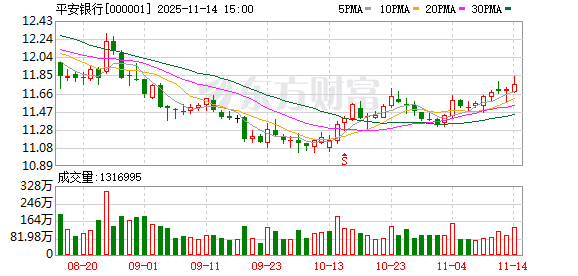
Market Overview - The Shanghai Composite Index fell by 0.97% on November 14, with only four sectors rising, led by the comprehensive and real estate sectors, which increased by 1.58% and 0.39% respectively [2] - The banking sector ranked third in terms of gains for the day [2] - A total of 26 sectors experienced net outflows of capital, with the electronics sector seeing the largest outflow of 21.65 billion yuan [2] Capital Flow Analysis - The banking sector saw a slight increase of 0.26% with a net inflow of 297 million yuan, comprising 42 stocks, of which 22 rose and 15 fell [3] - Among the banking stocks, 19 experienced net inflows, with 10 stocks receiving over 50 million yuan, led by Ping An Bank with an inflow of 163 million yuan [3] - Major banks with significant net inflows included Industrial and Commercial Bank of China and Postal Savings Bank, with inflows of 147 million yuan and 108 million yuan respectively [3] Individual Bank Performance - The top-performing banks in terms of capital flow included: - Ping An Bank: +0.43%, 68% turnover, 163.16 million yuan inflow [4] - Industrial and Commercial Bank of China: +0.49%, 11% turnover, 146.70 million yuan inflow [4] - Postal Savings Bank: +0.34%, 29% turnover, 108.33 million yuan inflow [4] - Conversely, banks with significant net outflows included Agricultural Bank of China, with a net outflow of 3.30 billion yuan, and Shanghai Pudong Development Bank, with a net outflow of 1.05 billion yuan [4]




国有大型银行板块11月14日涨0.17%,中国银行领涨,主力资金净流入3699.4万元
Zheng Xing Xing Ye Ri Bao· 2025-11-14 08:58
Core Insights - The state-owned large bank sector saw a slight increase of 0.17% on November 14, with China Bank leading the gains [1] - The Shanghai Composite Index closed at 3990.49, down 0.97%, while the Shenzhen Component Index closed at 13216.03, down 1.93% [1] Bank Performance - China Bank (601988) closed at 5.82, up 1.39% with a trading volume of 3.83 million shares [1] - Bank of Communications (601328) closed at 7.52, up 0.94% with a trading volume of 2.07 million shares [1] - Industrial and Commercial Bank of China (601398) closed at 8.25, up 0.49% with a trading volume of 3.06 million shares [1] - Postal Savings Bank of China (601658) closed at 5.83, up 0.34% with a trading volume of 1.94 million shares [1] - China Construction Bank (601939) closed at 9.56, up 0.21% with a trading volume of 0.72 million shares [1] - Agricultural Bank of China (601288) closed at 8.50, down 0.70% with a trading volume of 3.55 million shares [1] Capital Flow Analysis - The state-owned large bank sector experienced a net inflow of 36.99 million yuan from institutional investors, while retail investors saw a net inflow of 91.47 million yuan [1] - Speculative funds had a net outflow of 128 million yuan [1] Individual Bank Capital Flow - Industrial and Commercial Bank of China (601398) had a net inflow of 14.5 million yuan from institutional investors, but a net outflow of 77.71 million yuan from speculative funds [2] - Bank of Communications (601328) had a net inflow of 83.88 million yuan from institutional investors, with a net outflow of 70.13 million yuan from speculative funds [2] - Postal Savings Bank of China (601658) had a net inflow of 83.25 million yuan from institutional investors, with a net outflow of 67.32 million yuan from speculative funds [2] - China Bank (601988) had a net inflow of 73.29 million yuan from institutional investors, with a net outflow of 13.32 million yuan from speculative funds [2] - Agricultural Bank of China (601288) had a significant net outflow of 37.1 million yuan from institutional investors, but a net inflow of 120 million yuan from speculative funds [2]



2025年10月金融数据点评:社融信贷均偏弱,存款搬家继续演绎
Yin He Zheng Quan· 2025-11-14 07:21
Investment Rating - The report maintains a "Recommended" rating for the banking industry [1]. Core Viewpoints - The growth of social financing (社融) has slowed down, with October's new social financing amounting to 814.9 billion yuan, a year-on-year decrease of 597.1 billion yuan. The total social financing stock increased by 8.49% year-on-year, with a slight month-on-month decline of 0.18 percentage points [3]. - Demand for loans remains weak, with a notable decrease in both household and corporate financing needs. In October, the balance of RMB loans grew by 6.5% year-on-year, a decrease of 0.1 percentage points from the previous month [3]. - The phenomenon of "deposit migration" continues, as M1 and M2 growth rates have declined. In October, M1 and M2 increased by 6.2% and 8.2% year-on-year, respectively, with month-on-month declines of 1 percentage point and 0.2 percentage points [3]. Summary by Sections Social Financing - In October, the new social financing was 814.9 billion yuan, down 597.1 billion yuan year-on-year. The government bond issuance has weakened its support for social financing [3]. - RMB loans decreased by 20.1 billion yuan in October, a year-on-year reduction of 316.6 billion yuan. The issuance of new government bonds was 489.3 billion yuan, down 560.2 billion yuan year-on-year [3]. Loan Demand - The demand for loans from the real economy remains weak, with household loans decreasing by 360.4 billion yuan in October, a year-on-year drop of 520.4 billion yuan. Corporate loans increased by 350 billion yuan, primarily driven by a significant rise in bill financing [3]. Deposit Trends - The total RMB deposits in financial institutions increased by 610 billion yuan in October, a year-on-year increase of 100 billion yuan. However, household deposits decreased by 1.34 trillion yuan, indicating ongoing deposit migration [3]. - Non-bank deposits increased by 1.85 trillion yuan year-on-year, reflecting a shift in capital towards more active markets [3]. Investment Recommendations - The report suggests that the weakening support from government bonds for social financing and the ongoing weak loan demand necessitate attention to the effectiveness of new policy financial tools. The banking sector's transformation driven by the 14th Five-Year Plan is expected to provide opportunities for fundamental recovery [3]. - Specific stock recommendations include Industrial and Commercial Bank of China (601398), Agricultural Bank of China (601288), Postal Savings Bank of China (601658), Jiangsu Bank (600919), Hangzhou Bank (600926), and China Merchants Bank (600036) [3].




邮储银行台州市分行:“党建+科创金融”助推科创企业“加速跑”
Zhong Guo Jin Rong Xin Xi Wang· 2025-11-14 06:48
Core Insights - The article highlights the successful collaboration between Yuhuan Weisi Electric Co., Ltd. and Postal Savings Bank of China Taizhou Branch, showcasing how tailored financial solutions can address the challenges faced by innovative enterprises in expanding their operations and investing in technology [1][4]. Group 1: Company Overview - Yuhuan Weisi Electric is a high-tech enterprise specializing in power electronic components, holding 13 practical invention patents [3]. - The company’s main product, electric vehicle charging stations, has gained traction in local communities, contributing to green transportation and smart community development [3]. Group 2: Financial Support and Impact - Postal Savings Bank of China Taizhou Branch provided a customized mortgage loan of 38 million yuan to Yuhuan Weisi Electric, facilitating the company's urgent need for capacity expansion and technological investment [1][4]. - The bank's "Party Building + Sci-tech Finance" model effectively addresses financing difficulties for local innovative enterprises, enhancing their growth potential [1][5]. Group 3: Financial Strategy and Results - The bank's service team conducted thorough due diligence, recognizing the company's core technology and patent value, which led to a streamlined loan approval process [4]. - Following the loan disbursement, Yuhuan Weisi Electric rapidly increased production capacity and invested in the development of next-generation charging stations, improving both production efficiency and product quality [4][5]. Group 4: Broader Financial Initiatives - The bank has been actively developing financial products tailored for innovative enterprises, such as Sci-tech Credit Loans and green project financing, to alleviate traditional collateral constraints [5]. - By 2025, the bank aims to provide comprehensive financial services to 1,063 technology enterprises, with a total loan issuance of 7.156 billion yuan, representing 46.86% of the bank's small enterprise loan portfolio [5]. Group 5: Future Directions - The bank plans to continue enhancing its financial support for green industries and innovative enterprises, aiming to introduce more flexible financing solutions and efficient services [6].

银行股集体上涨,中证A500红利低波ETF(561680)红盘向上
Xin Lang Cai Jing· 2025-11-14 03:07
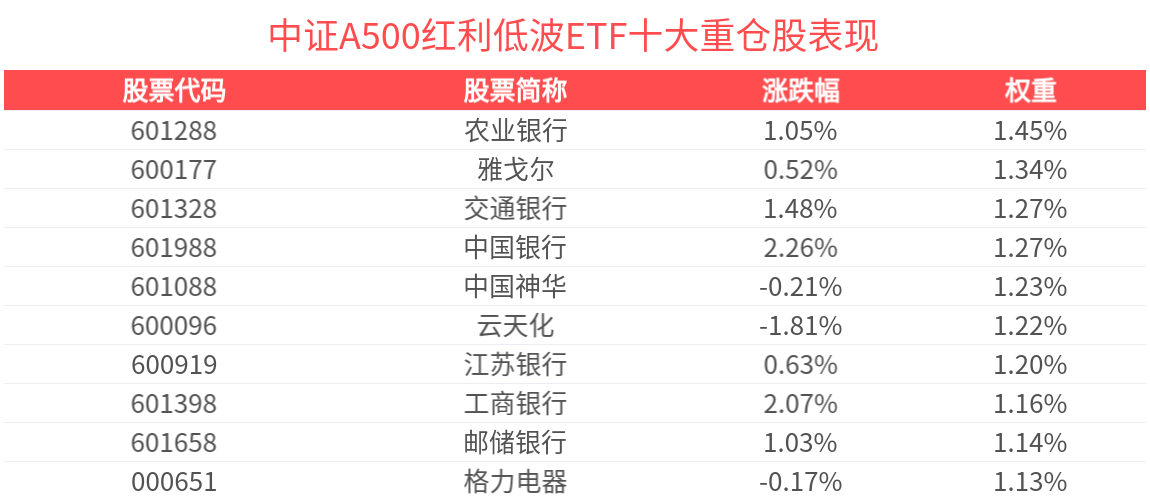
Core Insights - The China A500 Dividend Low Volatility Index (932422) has shown a slight increase of 0.14% as of November 14, 2025, with notable gains in major banks such as Bank of China (601988) up by 2.26% and Industrial and Commercial Bank of China (601398) up by 2.07% [1] Investment Environment - The National Bureau of Statistics emphasizes the need to focus on high-quality development, optimize investment structure, and enhance the investment environment to stimulate private investment and promote healthy investment growth [1] - According to Zhongtai Securities, the investment logic for bank stocks is shifting from "pro-cyclical" to "weak-cyclical," making high-dividend bank stocks more attractive during economic stagnation [1] - With the M1 growth rate declining, major financial data has entered a downward cycle, attributed to weaker fiscal expansion and the fading of low base effects [1] ETF Performance - The China A500 Dividend Low Volatility ETF (561680) has a turnover rate of 1.8% and a transaction volume of 3.36 million yuan as of November 14, 2025 [2] - Since its inception, the ETF has recorded a maximum monthly return of 3.37% and an average monthly return rate of 3.37%, with a monthly profit probability of 78.57% [2] - The maximum drawdown since inception is 3.42%, with a recovery period of 30 days [2] Index Composition - As of October 31, 2025, the top ten weighted stocks in the China A500 Dividend Low Volatility Index account for 31.82% of the index, including Agricultural Bank of China (601288) and China Shenhua Energy (601088) [3] - The top ten stocks include major banks and companies, indicating a strong representation of the financial sector within the index [3][5]


银行研思录25:银行股息率排名与中期分红进度梳理-20251114
CMS· 2025-11-14 03:02
Investment Rating - The report does not explicitly state an investment rating for the banking sector, but it provides detailed insights into dividend yields and distribution processes, which can inform investment decisions. Core Insights - The report outlines the latest dividend yields and mid-term dividend processes for A and H shares of listed banks, emphasizing the importance of accurately calculating dynamic dividend yields to avoid discrepancies across periods [1][2]. - It details the two processes for mid-term dividends following the 2023 revision of the regulatory guidelines, highlighting the conventional and simplified processes for implementing mid-term dividends [2]. - The report provides a comprehensive overview of key dates related to dividend distribution for both A and H shares, including the importance of purchasing shares before the ex-dividend date to qualify for dividends [3][4]. Summary by Sections Dynamic Dividend Yield Calculation - A simplified yet accurate method for calculating dynamic dividend yield is introduced, defined as "rolling 12-month EPS * cash dividend rate / share price," which helps avoid issues related to overlapping or missing annual and mid-term dividends [1]. - The report calculates the cash dividend rate using a standardized approach across different banks, resulting in a clear comparison of dividend yields as of November 13, 2025 [1]. Mid-Term Dividend Processes - The report explains the two processes for mid-term dividends: the conventional process requiring shareholder approval and a simplified process allowing for quicker implementation [2]. - The simplified process is designed to enhance flexibility for companies in distributing mid-term dividends, thereby improving shareholder returns [2]. Dividend Distribution Key Dates - For A shares, investors must purchase shares before the ex-dividend date to receive dividends on the same day, while H shares typically see a delay of about one month for dividend payments [3][4]. - The report outlines the differences in the dividend distribution timeline between A and H shares, emphasizing the need for investors to be aware of these timelines to maximize their returns [3][4]. Mid-Term Dividend Progress - As of November 13, 2025, 31 A-share banks have confirmed mid-term dividends, while 11 H-share banks have also confirmed their dividend distributions [9][11]. - The report categorizes banks based on their dividend status, detailing those that have implemented dividends, those that are pending, and those that have opted not to distribute dividends [9][10][11]. - It highlights that the end of 2025 and early 2026 is expected to be a peak period for mid-term dividend distributions, suggesting potential investment opportunities for dividend-seeking investors [11].






让“梨城”名片更闪亮
Jin Rong Shi Bao· 2025-11-14 02:07
Core Viewpoint - The financial support from Postal Savings Bank of China (邮储银行) has significantly boosted the production and distribution of Kuerle fragrant pears in Xinjiang, enhancing the local agricultural economy and improving farmers' income through innovative loan products and services [1][2][3] Group 1: Financial Support and Loan Products - Postal Savings Bank of China's Xinjiang branch has launched a series of credit products, including "Planting Loan," "Acquisition Loan," and "Storage Loan," to support the fragrant pear industry [2] - The bank has issued over 200 million yuan in loans to the fragrant pear industry, facilitating the movement of pears from farms to consumers [1][2] - The bank's "Express Loan" provided 3.5 million yuan to a cold storage company within three days, addressing urgent funding needs for pear acquisition [1] Group 2: Agricultural Production and Economic Impact - Kuerle fragrant pear's planting area has reached 412,000 acres, with an expected production of over 300,000 tons this year [2] - Farmers like Heng Zhen, who cultivate 200 acres of fragrant pears, anticipate earnings exceeding 1 million yuan due to high yield and quality [2] - The brand value of Kuerle fragrant pears has ranked first in China for six consecutive years, indicating strong market recognition and demand [2] Group 3: Industry Transformation and Future Outlook - The Kuerle city is transforming its pear industry towards standardized planting, brand marketing, and deep processing, supported by a model of "government support + financial backing + enterprise leadership" [3] - The bank is committed to enhancing its services in deep processing and cold chain logistics, aiming to further strengthen the local economy and support rural revitalization [3] - The integration of financial services with agricultural training and market analysis is expected to improve the overall quality and efficiency of the pear industry [3]
华宝纳斯达克精选股票型 发起式证券投资基金(QDII)调整大额申购(含定投)金额上限的公告
Zhong Guo Zheng Quan Bao - Zhong Zheng Wang· 2025-11-13 23:18
Announcement Details - The Hua Bao Nasdaq Select Stock Fund (QDII) will adjust the daily single account subscription limit to 50 yuan starting from November 17, 2025, for sales agents, while the limit remains at 100,000 yuan for direct sales [1] - If a single account's subscription exceeds the limit, the fund manager will confirm the subscription up to the limit, and any excess will be deemed unsuccessful [1] - During the suspension of large subscriptions, other fund operations will continue normally, and a future announcement will be made regarding the resumption of large subscriptions [1] New Sales Agents - Hua Bao Fund Management Company has added China Postal Savings Bank as a sales agent for certain funds effective November 14, 2025, following a sales agency agreement [4] - Investors can conduct account opening, subscription, and redemption through the "You Ni Tong Ying" platform of Postal Savings Bank [5] Additional Sales Agent - Hua Bao Fund Management Company has also added Great Wall Securities as a sales agent for certain funds effective November 14, 2025, following a sales agency agreement [8] - Investors can perform account opening, subscription, and redemption through Great Wall Securities [9]

关于景顺长城基金管理有限公司旗下部分基金新增中国邮政储蓄银行为销售机构的公告
Zhong Guo Zheng Quan Bao - Zhong Zheng Wang· 2025-11-13 23:18
Core Viewpoint - In order to better meet the financial needs of investors, Invesco Great Wall Fund Management Co., Ltd. has signed a sales agreement with China Postal Savings Bank to add it as a sales institution for certain funds starting from November 14, 2025 [1] Group 1: Fund Sales Information - The sales institution added is China Postal Savings Bank, with its registered and office address located at Financial Street, Xicheng District, Beijing [1] - Investors can inquire about details through the customer service of Invesco Great Wall Fund Management Co., Ltd. or China Postal Savings Bank [4][12] Group 2: Fund Subscription and Redemption - Subscription and redemption services are only applicable during normal subscription periods and specific open days and times for the funds [2][11] - A "regular investment plan" allows investors to set up automatic deductions for fund purchases, with specific rules and procedures to be followed as per the sales institution's regulations [2][11] Group 3: Fund Conversion and Fee Discounts - If the sales institution opens conversion services for the funds, investors must ensure that the funds being converted out are redeemable and those being converted in are available for subscription [2][11] - The sales institution may offer fee discounts for one-time subscriptions or regular investment plans, with specific rules determined by the institution [2][12] Group 4: Fund Investment Limitations - Starting from November 17, 2025, there will be a limit of 5 million yuan on the total amount of subscriptions and conversions for the fund per day per account [5] - If a conversion request exceeds this limit, the fund management has the right to partially or fully reject the application [5] Group 5: Market Risk and Trading Information - The Invesco Great Wall Nasdaq Technology Index ETF has experienced significant price premiums in the secondary market, prompting a warning to investors about potential risks [7] - The fund will be suspended from trading on November 14, 2025, until 10:30 AM to protect investor interests [7]
