
PSBC(601658)

Search documents
银行直接下场抛售超7万套房产 部分单价比市场价低50%
Sou Hu Cai Jing· 2025-11-11 00:55
Core Viewpoint - The banking system is increasingly engaging in "direct property sales," offering properties at prices significantly lower than market rates, which is attracting attention and may impact the second-hand housing market [1][10]. Group 1: Direct Property Sales by Banks - Major banks, including Agricultural Bank, Construction Bank, and others, are actively selling properties online, with a noticeable increase in the speed of asset disposal [3][4]. - As of 2024, the number of properties listed for direct sale by banks has exceeded 70,000, with significant contributions from various regional banks [9][10]. - The properties being sold are primarily non-performing assets, with banks aiming to enhance debt recovery rates through direct sales [10][11]. Group 2: Pricing and Market Impact - "Bank direct supply properties" are often priced 50% lower than market rates, making them attractive to buyers, although some properties still fail to sell despite significant price reductions [14][15]. - The introduction of bank direct sales may exert downward pressure on second-hand housing prices in specific regions, potentially delaying the recovery of the real estate market [18]. - The pricing strategy of banks involves lowering prices after failed sales attempts, which can lead to a competitive pricing environment within communities [14][18]. Group 3: Market Dynamics and Trends - The current trend of banks selling properties directly is partly driven by a cooling legal auction market, prompting banks to seek alternative methods for asset liquidation [12][13]. - The rise in non-performing loans among major banks has led to an increase in the sale of properties as a means to manage financial stability [11][12]. - The overall impact of bank direct sales on the real estate market is expected to be limited in scope, affecting only certain areas rather than the national market as a whole [18].







年内商业银行金融债发行规模达2.95万亿元
Zheng Quan Ri Bao· 2025-11-10 16:11
Core Insights - The issuance of bonds by commercial banks in China has surged, reaching a total of 2.95 trillion yuan in 2023, marking a year-on-year increase of 14.79% [1] - The primary types of bonds issued are subordinated debt and perpetual bonds, which together account for approximately 1.38 trillion yuan [1][2] - Major banks like Industrial and Commercial Bank of China and China Construction Bank have announced their bond issuance plans for 2026, with ICBC planning to issue up to 488 billion yuan and CCB setting a cap of 700 billion yuan for various capital instruments [1] Group 1 - The increase in bond issuance is driven by three main factors: optimizing capital structure through instruments like perpetual bonds, raising long-term funds to improve liability structure, and favorable market conditions for expanding issuance [2] - The trend of increasing bond issuance is expected to continue into 2026, positively impacting bank operations, financial markets, and the real economy [2][3] - The issuance of bonds enhances banks' capital adequacy ratios and risk resilience, while also providing quality investment options for institutional investors [2] Group 2 - The favorable monetary and macroeconomic policies are expected to support the continued growth of bond issuance by banks [3] - The demand for bonds is also driven by banks' operational needs and their mission to serve the real economy [3]

真金白银!年内十余家上市银行获股东、高管增持,银行“防御性板块”角色要变?
Xin Lang Cai Jing· 2025-11-10 12:57
Core Viewpoint - The recent surge in share buybacks by various banks, including Qilu Bank and Qingdao Bank, reflects strong confidence in the long-term value of the banking sector, with over 10 listed banks participating in this trend [1][9][10]. Group 1: Share Buybacks - Qilu Bank announced that its directors, supervisors, and senior executives have collectively increased their holdings by 3.15 million yuan, accounting for 90% of the planned buyback amount [1]. - Qingdao Bank's major shareholder, Qingdao Guoxin Financial Holdings, increased its holdings by 957 million yuan, raising its stake to 15.42%, making it the largest shareholder [4]. - Xiamen Bank's executives completed a buyback plan exceeding the minimum target, with total contributions reaching 1.6857 million yuan [5]. Group 2: Market Sentiment - The buyback activities are interpreted as a recognition of the banking sector's valuation, with a current price-to-book ratio of 0.72 and a dividend yield of 3.99%, attracting long-term capital [10][12]. - The banking sector has seen a collective "self-purchase" phenomenon, with various regional banks also engaging in buybacks, indicating a broader trend across the industry [6][8]. Group 3: Performance and Valuation - Despite a slight decline in revenue and net profit for 42 A-share listed banks in the first quarter, 24 banks reported growth in both metrics, particularly city and rural commercial banks [10]. - The net interest margin for listed banks is projected to stabilize, with a simulated net interest margin of 1.32% for Q3 2025, marking a potential turning point after four years of decline [12]. - Long-term capital, particularly from insurance funds, has been increasingly allocated to the banking sector, with a reported increase of 8.36 billion shares held by insurance funds in Q3 2025 [12][13].




邮储银行中层调整涉及多家省分行行长
Xin Lang Cai Jing· 2025-11-10 09:08
Core Insights - Postal Savings Bank of China reported total assets of 18.61 trillion yuan as of September 30, 2025, representing an 8.9% increase from the end of the previous year [1] - The bank achieved a revenue of 265.08 billion yuan in the first three quarters of this year, reflecting a year-on-year growth of 1.82%, while net profit reached 76.794 billion yuan, showing a similar upward trend [1] - The bank is undergoing significant personnel changes, including the resignation of non-executive director Han Wenbo and various leadership adjustments across its branches [2][4] Financial Performance - For the first three quarters, the net interest margin narrowed to 1.68%, yet remains the highest among the six major state-owned banks [6] - Interest income for the period was 210.505 billion yuan, a decrease of 2.07% year-on-year, although the decline rate has slowed compared to the mid-year figures [6] - Non-interest income has increased as the bank focuses on diversifying its revenue streams and enhancing its retail business while expanding corporate and funding operations [6] Cost Management - Business and management expenses for the first three quarters totaled 152.167 billion yuan, down by 4.165 billion yuan or 2.66% year-on-year [6] - The cost-to-income ratio improved to 57.40%, a reduction of 2.65 percentage points compared to the same period last year [6] Asset Quality - As of September 30, 2025, the bank's non-performing loan balance stood at 91.009 billion yuan, an increase of 10.690 billion yuan from the end of the previous year [6] - The non-performing loan ratio was 0.94%, still the lowest among the six major banks, although it increased by 0.04 percentage points from the previous year [6] - The provision coverage ratio was reported at 240.21% [6] Organizational Changes - The bank is implementing reforms focusing on organizational structure, network operations, market service systems, incentive mechanisms, digital transformation, risk management, and operational management [5] - The bank aims to strengthen its first-level branches' operational capabilities and optimize personnel allocation as part of its "one branch, one sub-branch" reform pilot [5]
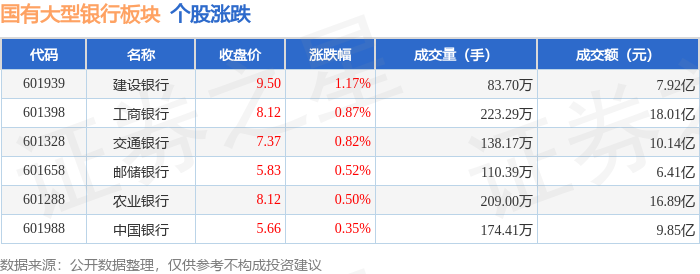
国有大型银行板块11月10日涨0.61%,建设银行领涨,主力资金净流入3.85亿元
Zheng Xing Xing Ye Ri Bao· 2025-11-10 08:48
Core Insights - The state-owned large bank sector saw an increase of 0.61% on November 10, with China Construction Bank leading the gains [1] - The Shanghai Composite Index closed at 4018.6, up 0.53%, while the Shenzhen Component Index closed at 13427.61, up 0.18% [1] Bank Performance Summary - China Construction Bank (CCB) closed at 9.50, up 1.17% with a trading volume of 837,000 shares and a transaction value of 79.267 million [1] - Industrial and Commercial Bank of China (ICBC) closed at 8.12, up 0.87% with a trading volume of 2.2329 million shares and a transaction value of 1.801 billion [1] - Bank of Communications closed at 7.37, up 0.82% with a trading volume of 1.3817 million shares and a transaction value of 1.014 billion [1] - Postal Savings Bank closed at 5.83, up 0.52% with a trading volume of 1.1039 million shares and a transaction value of 641 million [1] - Agricultural Bank of China closed at 8.12, up 0.50% with a trading volume of 2.09 million shares and a transaction value of 1.689 billion [1] - Bank of China closed at 5.66, up 0.35% with a trading volume of 1.7441 million shares and a transaction value of 985 million [1] Fund Flow Analysis - The state-owned large bank sector experienced a net inflow of 385 million from institutional investors, while retail investors saw a net outflow of 107 million [1] - The detailed fund flow for individual banks shows that ICBC had a net inflow of 172 million from institutional investors, while it faced a net outflow of 67.16 million from retail investors [2] - Bank of Communications had a net inflow of 133 million from institutional investors, with a net outflow of 34.23 million from retail investors [2] - CCB had a net inflow of 57.239 million from institutional investors, but also faced a net outflow of 53.9629 million from retail investors [2] - Agricultural Bank of China had a net inflow of 10.959 million from institutional investors, while retail investors contributed a net inflow of 60.3273 million [2] - Bank of China experienced a net outflow of 20.5749 million from institutional investors, but had a net inflow of 12.2374 million from retail investors [2]
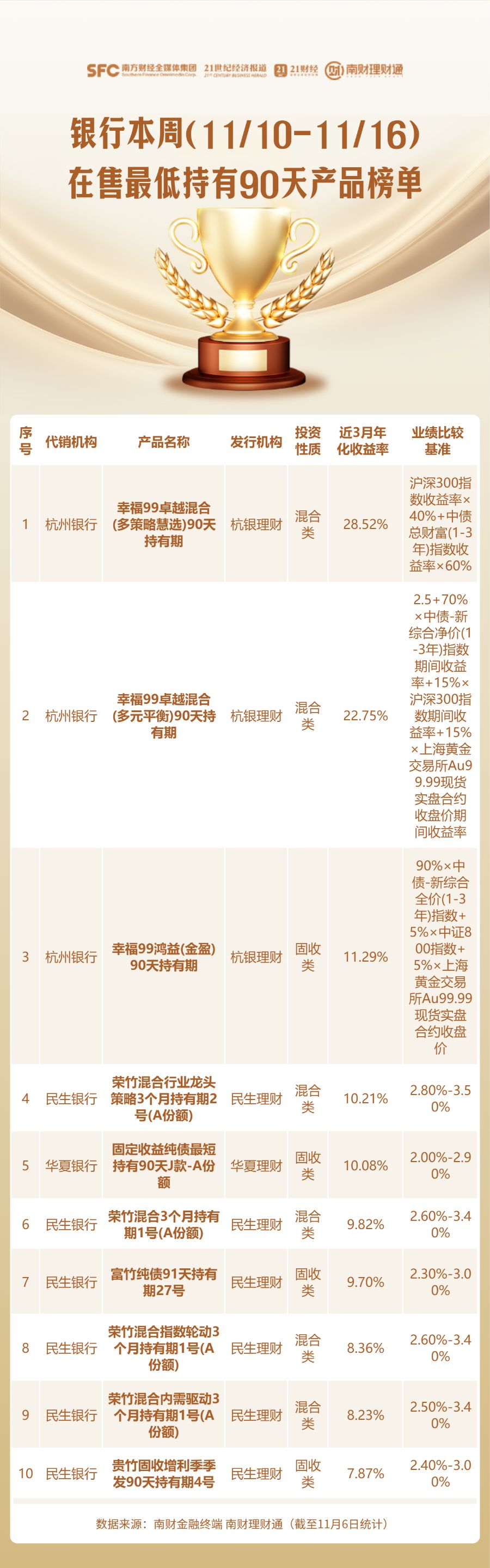
本周在售最低持有期产品哪家强?
2 1 Shi Ji Jing Ji Bao Dao· 2025-11-10 08:44
Core Insights - The article emphasizes the importance of distinguishing between various bank wealth management products, which often have similar names and vague characteristics, to help investors make informed choices [1] - The South Finance Wealth Management team compiles a weekly performance ranking of wealth management products available through different distribution channels, focusing on those with the best performance [1] Product Performance Summary - The report categorizes products based on minimum holding periods of 90 days, 180 days, and 365 days, calculating annualized returns for each category [1] - A total of 28 distribution institutions are involved in the ranking, including major banks such as Industrial and Commercial Bank of China, Bank of China, and Agricultural Bank of China [1] - The ranking is based on the assumption of the product's "on-sale" status, but actual availability may vary due to factors like sold-out quotas or differences in product listings for different customers [1] 90-Day Holding Period Products - The top-performing product for a 90-day holding period is from Hangzhou Bank, with an annualized return of 22.75% [4] - Other notable products include those from Minsheng Bank and Huaxia Bank, with returns of 10.21% and 10.08%, respectively [5] 180-Day Holding Period Products - For the 180-day holding period, Hangzhou Bank's product leads with a return of 14.04% [7] - Minsheng Bank also features prominently with products yielding 12.26% and 10.26% [7] 365-Day Holding Period Products - The report indicates that products with a 365-day holding period are also being evaluated, with specific performance data yet to be detailed in the provided excerpts [9]



从增量扩面到提质控险 银行业普惠金融迈向差异化精准服务
2 1 Shi Ji Jing Ji Bao Dao· 2025-11-10 04:21
Core Insights - The report highlights the significant growth and development of inclusive finance in China, particularly focusing on small and micro enterprises and rural areas, with a notable annual growth rate of over 20% in inclusive micro loans during the 14th Five-Year Plan period [1][2] - As of June 2025, the balance of inclusive micro loans reached 36 trillion yuan, which is 2.3 times that of the end of the 13th Five-Year Plan, with a decrease in interest rates by 2 percentage points [1][2] - The average interest rate for newly issued inclusive micro loans was 3.48% as of June 2025, reflecting a decrease of 66 basis points year-on-year [1][2] Group 1: Digital Empowerment - Digital technology has been a key driver for the development of inclusive finance, with banks utilizing big data and AI to enhance loan approval efficiency and reduce financing costs [2][7] - The market structure among banks is changing, with large commercial banks holding a 45.11% share of inclusive micro loans, while rural financial institutions have seen a decline in their market share [2][3] - The average growth rate of inclusive micro loans has been slowing down, with a decrease from 30.9% in 2020 to 12.3% by mid-2025 [2][3] Group 2: Performance of Listed Banks - Among listed banks, Agricultural Bank of China, Industrial and Commercial Bank of China, and Beijing Bank reported the highest growth rates in inclusive micro loans at 18.50%, 17.30%, and 17.27% respectively [3][4] - In contrast, some banks, including Shanghai Bank and Zhengzhou Bank, experienced negative growth rates of -3.97% and -2.06% [3][4] - The performance of different banks varies significantly, with state-owned banks generally showing stronger growth in inclusive micro loans compared to smaller banks [3][4] Group 3: Interest Rates and Risk Management - The interest rates for newly issued inclusive micro loans have decreased across various banks, with the highest rate at 4.20% and the lowest at 2.94% [7][8] - The gap in interest rates between large and small banks is narrowing, with some large banks' rates aligning closely with those of smaller banks [8][9] - The report emphasizes the importance of risk management in the inclusive finance sector, with several banks focusing on improving asset quality and managing non-performing loans [9][10]


低价“银行直供房”激增
Di Yi Cai Jing· 2025-11-10 01:59
Core Insights - Banks are accelerating direct property sales to enhance debt recovery rates, particularly during the real estate market adjustment period [1][8] - The phenomenon of "bank direct supply housing" is primarily driven by the disposal of non-performing loans, where banks acquire full ownership of properties through debt stripping and then sell or lease them directly [1][3] Group 1: Market Activity - Multiple banks, including Agricultural Bank, Construction Bank, and Transportation Bank, are actively listing properties for direct sale on online platforms, with some banks offering over a thousand properties [1][2] - Local city commercial banks and rural credit cooperatives are significantly contributing to the scale of direct listings, with banks like Lanzhou Bank and Jilin Bank leading in the number of properties available [3] Group 2: Pricing and Sales Strategy - "Bank direct supply housing" typically offers significant price advantages compared to regular second-hand and judicial auction properties, often sold below market value to expedite asset liquidation [5] - For instance, a property auctioned by Lanzhou Rural Commercial Bank sold for 151 million yuan, while similar properties were listed between 180 million and 220 million yuan [5] Group 3: Asset Management Approaches - In addition to direct sales, some banks are exploring leasing options to activate assets, with examples including China Bank auctioning residential lease rights [6] - The properties sold directly by banks often originate from judicial auctions that failed to sell, or through proactive judicial processes where banks acquire properties after legal proceedings [6][7] Group 4: Market Conditions and Trends - The increase in direct property sales is influenced by the cooling of the judicial auction market, prompting banks to seek alternative methods for asset disposal [9] - Traditional methods of handling non-performing loans can take over two years, while direct sales can significantly shorten this timeline, thus improving overall debt recovery rates [8]
交通银行VS邮储银行:交行正在被全面超越
数说者· 2025-11-09 23:31
Core Viewpoint - The article provides a comparative analysis of Bank of Communications and Postal Savings Bank of China, highlighting their historical backgrounds, shareholder structures, operational scales, financial performance, and asset quality, ultimately indicating that Postal Savings Bank has surpassed Bank of Communications in several key metrics. Historical Background - Bank of Communications was established in 1908 and has undergone several transformations, including being designated as a national bank and later restructured as a joint-stock bank in 1986 [3]. - Postal Savings Bank can trace its origins back to 1919, with its formal establishment as a limited liability company occurring in 2007, and it transitioned to a joint-stock company in 2012 [5]. Shareholder Structure - As of September 2024, the top shareholders of Bank of Communications include the Ministry of Finance (35.01%) and HSBC (16.00%) [4]. - Postal Savings Bank's major shareholders include China Post Group (51.87%) and the Ministry of Finance (15.77%) [6]. Operational Scale - By the end of 2024, Bank of Communications had 14,750 operating institutions, while Postal Savings Bank had 7,899, but with a total of approximately 40,000 outlets when including its parent company's network [7][8]. Financial Performance - In 2024, Bank of Communications had total assets of 14.90 trillion yuan, while Postal Savings Bank had 17.08 trillion yuan, indicating that Postal Savings Bank has a higher asset scale [14]. - For the first three quarters of 2025, Postal Savings Bank's net profit reached 765.62 billion yuan, surpassing Bank of Communications' 699.94 billion yuan [14]. Asset Quality - Postal Savings Bank has consistently maintained a lower non-performing loan ratio compared to Bank of Communications, with figures below 1% for the past decade [35][43]. - The provision coverage ratio for Postal Savings Bank has been higher than that of Bank of Communications, although it has seen a decline in recent years [36][39]. Net Interest Margin - Postal Savings Bank's net interest margin has been higher than that of Bank of Communications, attributed to its deposit structure, which relies heavily on stable personal deposits [32][34]. Cost-to-Income Ratio - As of the end of 2024, Postal Savings Bank's cost-to-income ratio was significantly higher at 64.23%, compared to Bank of Communications' 29.90% [44]. Employee Structure - By the end of 2024, Postal Savings Bank employed 197,600 people, significantly more than Bank of Communications' 95,700 employees [12][47]. Overall Assessment - Postal Savings Bank has shown rapid growth in total assets and operating income, surpassing Bank of Communications to become the fifth-largest commercial bank in China, although it still trails in net profit [49].
金融债成资管产品配置“压舱石” 年内“二永债”已发1.37万亿元
Zheng Quan Shi Bao Wang· 2025-11-09 23:27
Core Viewpoint - Major Chinese banks, including Industrial and Commercial Bank of China (ICBC) and China Construction Bank (CCB), have announced their bond issuance plans for 2026, indicating a strong focus on raising capital through various debt instruments [1] Group 1: Bond Issuance Plans - ICBC plans to issue financial bonds not exceeding 488 billion yuan [1] - CCB intends to issue capital instruments and non-capital debt instruments totaling no more than 700 billion yuan [1] - Other state-owned banks, such as Agricultural Bank of China and Postal Savings Bank of China, are also reviewing their future financial bond and capital tool issuance limits [1] Group 2: Market Trends - As of November 9, the total bond issuance by commercial banks for the year has reached 2.88 trillion yuan [1] - The combined issuance of Tier 2 capital bonds and perpetual bonds (referred to as "two perpetual bonds") is approximately 1.37 trillion yuan, showing little change compared to the same period last year [1] - Financial bonds, including bank "two perpetual bonds" and TLAC (Total Loss-Absorbing Capacity) bonds, are becoming core assets for asset management institutions [1]