
PSBC(601658)

Search documents
银行长期限存款“退场”背后
Bei Jing Shang Bao· 2025-11-09 13:49
Core Viewpoint - The long-term deposit products, once considered a "stabilizing force" for investors, are gradually disappearing from the shelves of some banks, indicating a profound restructuring of the banking industry's profit logic in response to deepening interest rate marketization and a low-interest environment [1][4][8]. Group 1: Disappearance of Long-term Deposits - As of November 9, major state-owned banks and some joint-stock banks have removed 5-year large certificates of deposit (CDs) from their offerings, with banks like ICBC, ABC, and BOC no longer listing these products [2][3]. - The interest rates for commonly available 3-year large CDs are now between 1.5% and 1.75%, with some banks facing a "one order hard to find" situation due to limited availability [2][3]. - Regional banks are also tightening their long-term CD offerings, with many now focusing on shorter terms such as 1 month, 3 months, and 1 year [3][5]. Group 2: Strategic Shift in Banking - The current low net interest margin has prompted banks to lower their liability costs to maintain stable profit levels, leading to the reduction or cancellation of high-interest long-term CDs [4][7]. - Smaller banks, particularly village banks, are also halting long-term deposit products, reflecting a broader industry trend towards optimizing balance sheets in response to regulatory pressures and changing market conditions [5][7]. - The traditional banking model of high-interest deposits and low-interest loans is facing unprecedented challenges, with net interest margins dropping to historical lows [8][9]. Group 3: Future Directions - The banking sector is expected to increasingly favor short-term adjustments and flexible combinations of various financial products to enhance customer loyalty and stabilize relationships [9]. - Banks are likely to optimize their liability structures by offering more medium- and short-term deposit products, reducing the proportion of high-cost deposits, and improving overall profitability through wealth management services [9].






你的支付优惠用了吗?各大银行加入双十一“狂欢”,算的什么账?
Sou Hu Cai Jing· 2025-11-08 00:51
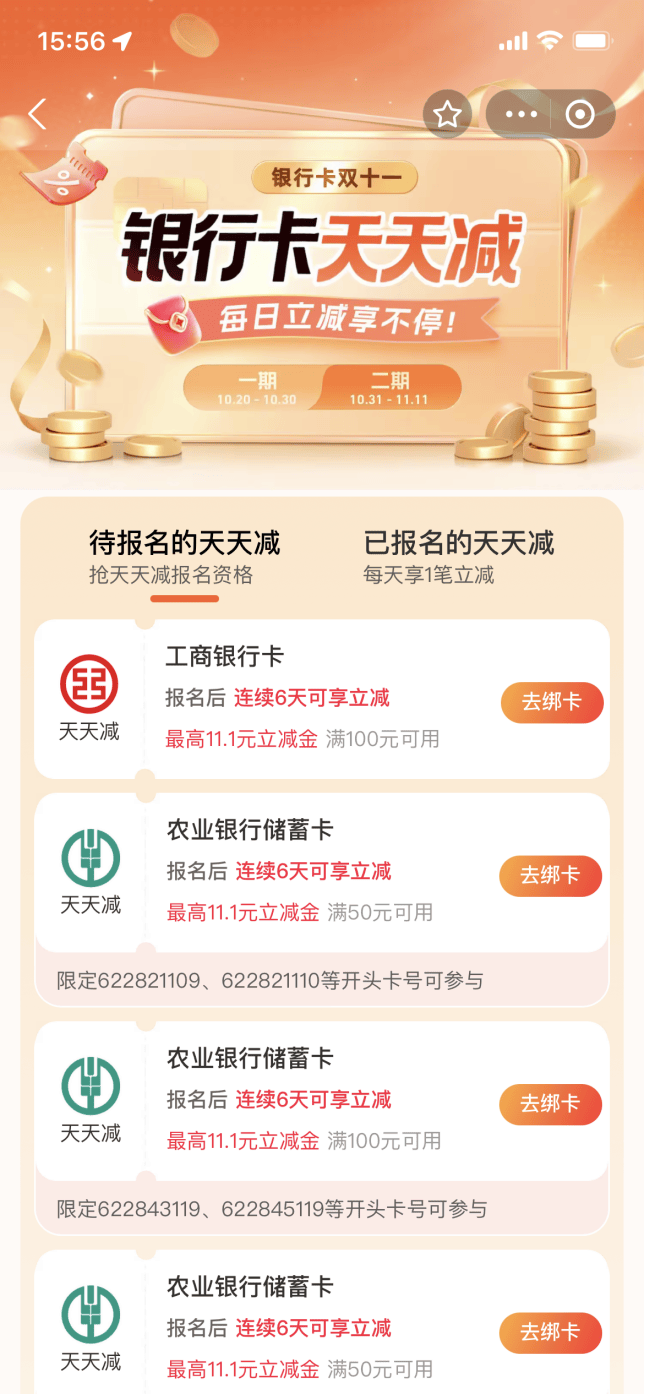
Core Viewpoint - The annual Double Eleven shopping season has officially started, with major commercial banks launching various promotional activities to stimulate consumer spending and boost business before the year-end [1][2]. Group 1: Promotional Activities by Banks - Major banks such as China Construction Bank, Bank of China, Agricultural Bank of China, and others have introduced cashback, discounts, installment benefits, and exclusive offers to attract consumers [1]. - Construction Bank offers a maximum discount of 400 yuan for credit card customers using installment payments on platforms like Alipay and Taobao, while Bank of China provides a random discount of up to 118 yuan for transactions made through Alipay [2]. - Other banks, including China Merchants Bank and Ping An Bank, have also launched various cashback and discount campaigns to engage customers during this shopping season [2]. Group 2: Strategic Insights - Experts suggest that the banks' promotional strategies represent a cost-effective method to acquire and retain customers, activating dormant accounts with low-cost random discounts [5]. - The focus on marketing during peak shopping seasons aims to enhance the usage of bank cards over third-party payment channels, thereby driving growth in credit and debit card transactions [5]. - Recommendations for banks post-Double Eleven include offering temporary credit limit increases and integrating with government consumption voucher programs to enhance customer experience and engagement [5].



国有大型银行板块11月7日跌0.68%,农业银行领跌,主力资金净流出2.55亿元
Zheng Xing Xing Ye Ri Bao· 2025-11-07 08:37
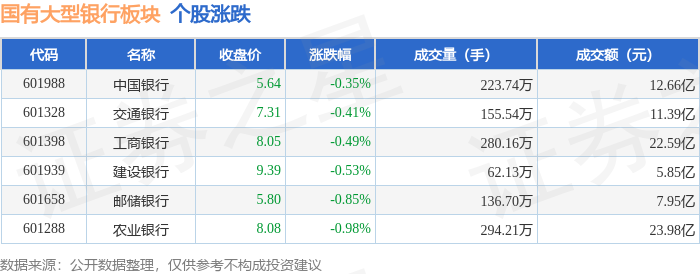
Core Insights - The state-owned large bank sector experienced a decline of 0.68% on November 7, with Agricultural Bank leading the drop [1] - The Shanghai Composite Index closed at 3997.56, down 0.25%, while the Shenzhen Component Index closed at 13404.06, down 0.36% [1] Market Performance - The closing prices and changes for major state-owned banks are as follows: - Bank of China: 5.64, down 0.35% - Bank of Communications: 7.31, down 0.41% - Industrial and Commercial Bank of China: 8.05, down 0.49% - China Construction Bank: 9.39, down 0.53% - Postal Savings Bank: 5.80, down 0.85% - Agricultural Bank: 8.08, down 0.98% [1] Capital Flow - The state-owned large bank sector saw a net outflow of 255 million yuan from main funds, while retail investors contributed a net inflow of 251 million yuan [1] - The detailed capital flow for individual banks is as follows: - Bank of Communications: Main funds net inflow of 52.52 million yuan, retail net inflow of 34.41 million yuan - Industrial and Commercial Bank: Main funds net outflow of 22.51 million yuan, retail net inflow of 72.97 million yuan - Bank of China: Main funds net outflow of 36.09 million yuan, retail net inflow of 46.71 million yuan - China Construction Bank: Main funds net outflow of 44.38 million yuan, retail net inflow of 16.83 million yuan - Postal Savings Bank: Main funds net outflow of 53.25 million yuan, retail net inflow of 31.40 million yuan - Agricultural Bank: Main funds net outflow of 15.17 million yuan, retail net inflow of 48.80 million yuan [2]

上市银行大类资产配置跟踪:信贷投放稳健,债券配置灵活性提升
Ping An Securities· 2025-11-07 08:10
Industry Investment Rating - The investment rating for the banking sector is "Outperform" [1] Core Insights - The proportion of corporate loans has increased, while retail demand recovery is being monitored. As of mid-2025, the proportion of corporate loans among listed banks rose by 1.65 percentage points from the end of 2024 to 60.2%. The manufacturing sector's loans accounted for 18.5% of corporate loans, reflecting a recovery in the operations of manufacturing enterprises [3][12] - The flexibility in bond allocation has increased, with bond trading helping to stabilize market fluctuations. In the first half of 2025, listed banks saw a significant decline in other comprehensive income and fair value changes due to interest rate fluctuations. Some banks, primarily state-owned, increased bond trading to enhance investment returns and stabilize net profit growth [3][6] - Asset quality pressure is manageable, with a focus on risks in the retail sector. The overall asset quality remains stable, with the non-performing loan (NPL) ratio for A-share listed banks holding steady at 1.15% as of Q3 2025. However, the average NPL ratio for retail loans increased by 15 basis points to 1.58% compared to the end of 2024 [3][6] Summary by Sections Corporate Loan Structure - The overall asset structure of listed banks shows an increase in loan allocation, with the loan proportion rising by 0.1 percentage points from the end of 2024. State-owned banks increased interbank asset allocation, while small and medium-sized banks focused more on loan issuance [12][19] - Corporate loans remain the primary focus of credit allocation, with corporate loans accounting for 91.1% of all new loans in the first nine months of 2025. Short-term corporate loans made up 33.7% of new corporate loans [17][18] Bond Investment Preferences - The preference for flexible bond allocation has increased, with banks primarily investing in government bonds and central bank bills. The proportion of OCI accounts has risen, indicating a shift towards more flexible investment strategies [6][3] Asset Quality and Risk Monitoring - The asset quality of the banking sector is stable, with a non-performing loan ratio of 1.15% as of Q3 2025. The retail loan sector has shown slight increases in NPL ratios, necessitating ongoing monitoring of risks in this area [3][6]


邮储银行跌0.85%,成交额7.95亿元,近5日主力净流入-4860.25万
Xin Lang Cai Jing· 2025-11-07 08:05
Core Viewpoint - Postal Savings Bank of China (PSBC) has shown a decline in stock price and trading volume, indicating potential investor caution amid recent market movements [1][3]. Financial Performance - For the first nine months of 2025, PSBC reported a net profit of 765.62 billion yuan, reflecting a year-on-year growth of 0.98% [7]. - The bank's cumulative cash dividends since its A-share listing amount to 1,377.96 billion yuan, with 773.95 billion yuan distributed over the past three years [8]. Dividend Yield - PSBC's dividend yields over the past three years were 5.58%, 6.00%, and 4.61%, indicating a consistent return to shareholders [2]. Shareholder Structure - As of September 30, 2025, the number of shareholders decreased by 13.09% to 142,600, while the average circulating shares per person increased by 15.29% to 478,570 shares [7]. Market Activity - The stock experienced a net outflow of 66.32 million yuan today, with a continuous reduction in main capital over the past two days [3][4]. - The average trading cost of PSBC shares is 5.14 yuan, with the stock price approaching a resistance level of 5.86 yuan, suggesting potential for a price correction if this level is not surpassed [5]. Company Overview - PSBC, established on March 6, 2007, and listed on December 10, 2019, primarily offers banking and financial services in China, with personal banking contributing 65.15% to its revenue, corporate banking 22.71%, and funding operations 12.10% [6].

邮银协同推进物流金融行动 畅通产业循环助力实体经济高质量发展
Ren Min Wang· 2025-11-07 07:47
Core Viewpoint - The collaboration between China Postal Savings Bank and China Post is enhancing the "finance + logistics" service model, injecting new momentum into the real economy and supporting industrial circulation [1] Group 1: Logistics Financial Services in Shandong - Shandong's postal and banking collaboration is breaking traditional boundaries, transitioning from single services to comprehensive solutions [2] - The "1+1+1" management model pairs each customer with a postal and banking manager to create tailored solutions, effectively integrating resources [2] - The "Jinchai Loan" product was developed to address the financial pressures faced by automotive dealers, with comprehensive logistics support from China Post [2][3] - China Postal Savings Bank has granted credit of 8.9 billion yuan to nine subsidiaries of China National Heavy Duty Truck Group, with 392 dealers utilizing the "Jinchai Loan" [3] Group 2: Innovative Services in Chongqing - In Chongqing, the postal and banking collaboration has introduced a "medical factoring + logistics" service model, gaining positive customer feedback [4] - The partnership with a major pharmaceutical company has led to extensive logistics support, enhancing service depth and trust [4][5] - A layered management mechanism has been established to coordinate service resources effectively [5] Group 3: Logistics Financial Development in Hebei - Hebei's postal and banking collaboration focuses on the automotive industry, addressing the urgent need for integrated logistics and financial services [7] - Customized logistics financial solutions are being developed for major automotive manufacturers, enhancing service quality [8] - The "In-Factory Pass," "Store Pass," "Outbound Easy," and "Production and Sales Pass" projects have been successfully implemented, creating a multi-layered logistics financial service system [8]
邮储银行11月6日获融资买入9845.89万元,融资余额8.43亿元
Xin Lang Cai Jing· 2025-11-07 03:51
Core Viewpoint - Postal Savings Bank of China (PSBC) experienced a decline in stock price and trading volume, indicating potential investor caution and market volatility [1] Financing Summary - On November 6, PSBC had a financing buy-in amount of 98.45 million yuan and a financing repayment of 109 million yuan, resulting in a net financing outflow of 10.52 million yuan [1] - The total financing and securities balance for PSBC reached 848 million yuan, with the current financing balance at 843 million yuan, accounting for 0.21% of the circulating market value, which is below the 20th percentile level over the past year [1] Securities Lending Summary - On November 6, PSBC repaid 170,600 shares in securities lending and sold 26,100 shares, with a selling amount of 152,700 yuan based on the closing price [1] - The remaining securities lending volume was 774,200 shares, with a balance of 4.53 million yuan, exceeding the 70th percentile level over the past year, indicating a relatively high position [1] Company Overview - PSBC, established on March 6, 2007, and listed on December 10, 2019, provides banking and related financial services in China, focusing on personal banking, corporate banking, and fund operations [2] - The revenue composition of PSBC includes 65.15% from personal banking, 22.71% from corporate banking, and 12.10% from fund operations, with other businesses contributing 0.04% [2] Financial Performance - As of September 30, PSBC reported a net profit attributable to shareholders of 76.562 billion yuan, reflecting a year-on-year growth of 0.98% [2] - The total cash dividends distributed by PSBC since its A-share listing amount to 137.796 billion yuan, with 77.395 billion yuan distributed over the past three years [3] Shareholder Information - As of September 30, 2025, the number of PSBC shareholders decreased by 13.09% to 142,600, while the average circulating shares per person increased by 15.29% to 478,570 shares [2] - Major shareholders include Hong Kong Central Clearing Limited and various ETFs, with notable reductions in their holdings compared to previous periods [3]
中国银行业(HA 股)_ 2025 年第三季度表现分化,上行空间有限但下行支撑稳固-Banks - China (H_A)_ 3Q25 mixed, upside limited but good for downside support
2025-11-07 01:28
Summary of Key Points from the Conference Call Industry Overview - **Industry**: Chinese Banking Sector (H-share banks) - **Period**: 3Q25 results and 9M25 performance Earnings Review - **Net Profit Growth**: Increased from +0.4% YoY in 1H25 to +0.5% in 9M25, with all big six state banks reporting positive YoY growth [1][11] - **Core Earnings Growth**: Slowed from +1.6% YoY in 1H to +0.8% by 9M25 [1] - **Performance Comparison**: H-share bank sector rose 19.9% YTD, underperforming MSCI China and HSI by 16ppt and 9ppt, respectively [1][11] - **Dividend Yield**: Sector's dividend yield at 5.3% is considered unattractive [1][11] - **Stock Recommendations**: Downgraded CCB-H/ABC-H from Buy to Neutral; upgraded BoComm-H from Underperform to Neutral; ICBC is the top pick among large banks [1][11] Loan Growth and Deposit Trends - **Loan Growth**: Average loan growth decelerated from 6.8%/6.9% YoY in FY24/1H25 to 6.3% in 9M25; big six state banks led with 7.5-10.0% YoY growth [2] - **Small Banks**: Experienced loan size contraction of 0.3-1.4% QoQ, raising concerns [2] - **Deposit Growth**: Seasonally low at 0.2% QoQ in 3Q, but YoY growth at 6.8% exceeded loan growth [2] Net Interest Margin (NIM) - **NIM Trends**: Average NIM edged down 1bp QoQ to 1.42% in 3Q; some banks reported NIM increases due to reduced funding costs [3] - **Future Outlook**: Potential stabilization of margins expected if no further policy rate cuts occur [3] Non-Interest Income - **Fee Income Growth**: Improved from +3.3% YoY in 1H to +4.8% in 9M25, attributed to a lower base and strong capital markets [4] - **Trading Gains**: Weakened from 29% YoY in 1H25 to 16% in 9M25, with some banks experiencing significant QoQ drops [4] Credit Quality and Provisions - **NPL Ratio**: Stable at 1.22% QoQ/YTD; average credit cost fell 5bp YoY to 67bp in 9M25 [5] - **Provisions**: Total provisions rose by +0.5% YoY in 9M, down from +3.5% in 1H [5] - **Coverage Ratios**: NPL and loan reserve coverage edged down QoQ to 232% and 2.75%, respectively [5] Valuation and Market Performance - **Valuation Metrics**: H-share banks currently trade at 0.55x P/B, 3.5x P/PPOP, and 6.0x P/E; dividend yield has declined from nearly 10% in Jan-2024 to 5.3% [11][21][23] - **Market Performance**: H-share banks underperformed the MSCI China index YTD; A-H share premium narrowed from 34% to 21% [31][11] Conclusion - The Chinese banking sector is showing mixed signals with modest profit growth and declining loan growth. While larger banks provide some stability, the overall market performance and valuation metrics suggest caution for investors. The focus remains on key players like ICBC, with recommendations adjusted based on recent performance.
8100亿元!年内A股定增大涨
Shen Zhen Shang Bao· 2025-11-06 13:53
Core Viewpoint - The fundraising amount through private placements in the A-share market has significantly increased this year, with financial stocks leading the way in terms of capital raised [2]. Group 1: Fundraising Statistics - As of November 3, 2023, 140 companies have raised a total of 812.37 billion yuan through private placements, marking a 23% increase in the number of companies and a 5.4 times increase in the amount raised compared to the previous year [2]. - Among the top 10 companies by fundraising amount, 6 are financial institutions, highlighting the dominance of this sector in the private placement market [2]. - Four major state-owned banks, including China Bank, Postal Savings Bank, and others, have raised over 100 billion yuan each through private placements, contributing significantly to the overall market size [2]. Group 2: Specific Company Fundraising - China Bank raised 165 billion yuan, Postal Savings Bank 130 billion yuan, Traffic Bank 120 billion yuan, and Construction Bank 105 billion yuan through private placements [2]. - The successful completion of fundraising by these banks indicates a substantial breakthrough in their plans to supplement core Tier 1 capital through the capital market [2]. Group 3: Use of Funds - Companies are utilizing the funds raised through private placements for various purposes, including asset acquisitions and operational funding [3]. - For instance, AVIC Chengfei raised 17.439 billion yuan for acquiring 100% equity of AVIC Chengfei, while Sairisi raised 8.164 billion yuan for a new factory and operational funds [3]. - Guolian Securities raised 29.492 billion yuan to acquire 99.26% of Minsheng Securities [3]. Group 4: Policy Support and Market Dynamics - The revival of the private placement market is supported by policy initiatives, including the China Securities Regulatory Commission's new merger and acquisition guidelines [3]. - Local governments have also introduced measures to support corporate mergers and acquisitions, further stimulating the market [3]. Group 5: Notable Cases and Challenges - Some companies have seen significant participation from major shareholders in their private placements, such as Nanfang Electric, which plans to raise up to 2 billion yuan with substantial backing from its controlling shareholder [3]. - However, not all private placements have been successful; for example, GCL-Poly announced the termination of its nearly three-year fundraising plan, originally aimed at raising 4.842 billion yuan, due to market adjustments in the photovoltaic industry [4].


零售风险专题:风险缓释,资产质量局部趋稳
Western Securities· 2025-11-06 11:45
Investment Rating - The industry rating is "Overweight" and has been maintained from the previous rating [5]. Core Viewpoints - The retail loan quality is under pressure, with growth slowing down, and the overall retail loan bad debt ratio has been on the rise since 2022, reaching 1.29% in Q2 2025, an increase of 13 basis points from Q4 2024 [2][12]. - Retail loan growth is weak, with a year-on-year increase of only 3.5% in Q2 2025, which is a further slowdown compared to 2024 [20]. - Banks are increasing efforts to dispose of retail bad debts, which is expected to mitigate the impact of retail loan risk exposure on overall asset quality [3][33]. Summary by Sections 1. Retail Loan Asset Quality Under Pressure, Growth Slowing - As of Q2 2025, the total retail loan amount of listed banks reached 63.3 trillion yuan, accounting for 34.3% of total loans [2][11]. - The retail loan bad debt ratio has continued to rise, with the overall bad debt ratio for listed banks at 1.23% [12][19]. - The increase in retail bad debts is attributed to weak consumer demand and a decline in repayment capacity, with the retail bad loan balance growing by 28.7% year-on-year [20][21]. 2. Retail Loan Risk Exposure Easing, Credit Cost Pressure Marginally Reduced - The bad debt generation rate for retail loans in H1 2025 was 1.18%, slightly up from 2024, but the increase is less pronounced compared to previous years [34][35]. - The marginal easing of credit cost pressure is reflected in the credit cost for retail loans, which increased by only 1 basis point to 1.02% in H1 2025 [35][41]. - The overall retail loan risk exposure is expected to remain manageable due to banks' proactive measures in bad debt disposal [33]. 3. Retail Asset Quality Outlook: Policy Support, Risks Expected to Continue Easing - The overall credit risk of retail loans is expected to continue easing under supportive policies, particularly in consumer credit [4]. - The asset quality of consumer credit, including housing loans, is anticipated to stabilize marginally, while the asset quality in the small and micro-enterprise sector may continue to face pressure [4].