PSBC(601658)

Search documents
国有大行部署2026年经营工作,重点聚焦何处?
Xin Lang Cai Jing· 2026-02-03 01:29
近日,工商银行、农业银行、中国银行、建设银行、交通银行、邮储银行召开2026年党建暨 经营(管理)工作会议。 回顾2025年,多家银行将"高质量发展"总结为年度关键词。例如,农业银行在会上提及"各 项目标任务顺利完成,高质量发展迈出新的步伐";中国银行表示"扎实推进高质量发展,经 营业绩稳中有进";交通银行提及"高质量发展进一步推进,稳中有进、稳中提质发展态势得 到有力巩固"。展望2026年,多家银行要求做好金融"五篇大文章",同时抓好信贷投放以及 有效防范化解重点领域风险等工作重点。 事实上,国有大行基于历史定位与资源禀赋,形成了各具特色的服务重心。其中,农业银行 强调,要始终把服务"三农"作为重中之重;中国银行明确巩固和扩大全球化优势;建设银行 提出推动商投行一体化、公私一体化、本外币一体化、集团一体化。 国有大行聚焦主责主业, 不断提升服务实体经济质效 从近期召开的2026年党建暨经营工作会议看,国有大行均将党建工作置于首位。 工商银行会议强调,全面加强党的领导和党的建设,以更高标准、更实举措推进全面从严治 党从严治行。坚持不懈用党的创新理论凝心铸魂,提高政治能力,坚定拥护"两个确立"、坚 决做到"两个 ...



2026年经营部署如何“划重点”?六大行全扫描
Xin Lang Cai Jing· 2026-02-03 00:48
智通财经记者 | 安震 2026年1月末,六大行相继召开党建和经营工作会议,总结2025年全年工作,并对2026年重点工作进行 部署。 对比2025年工作重点,银行的重点工作有差异也有延续——今年是"十五五"的开局之年,各大金融机构 将工作重心从"十四五"收官转移到"十五五"的开局破局,各金融机构工作重心依然为服务实体经济、防 范金融风险,结合自身发展扬长补短。 从"圆满收官"到"开局破局" 2025年,金融机构将完成十四五规划作为重点任务之一,重点在稳收尾,防风险。如工行"打好巡视整 改、防化风险、转型变革三场攻坚战",农行"牢牢把握'防风险、促高质量发展'工作主线",均以"十四 五"圆满收官为目标。 而2026年,多家银行转向"十五五"的谋篇布局。工行"制定实施好全行'十五五'规划打造一流银行、领军 银行",交行"科学编制交行'十五五'规划"。 交行提出"聚焦上海'五个中心'建设,做强上海主场,辐射带动全行创新发展"。 建行在会议中明确,扬长补短,加强协同联动,推动商投行一体化、公私一体化、本外币一体化、集团 一体化,提升金融服务适配性。 细化风险防范,"数字化"驱动效率革命 面对复杂的经济金融环境,多家 ...

房地产融资协调“白名单”机制两周年:主办银行制成核心
Feng Huang Wang· 2026-02-03 00:41
Group 1 - The core viewpoint of the article highlights the establishment and implementation of a coordinated financing mechanism for urban real estate, which aims to streamline financing processes and ensure that reasonable financing demands are met by banks [1][3] - The "white list" mechanism has been in place for two years, with the main bank system being recognized as a key component for real estate project financing, ensuring that information sharing among banks is improved and reducing the risk of over-lending [2][3] - Recent data indicates that while the financing support for "white list" projects has been significant, the growth rate of new loans has slowed down considerably compared to the initial year of implementation [4][5] Group 2 - As of the end of last year, banks in Beijing had provided loans totaling 215.6 billion yuan for 219 "white list" projects, while Hunan province reported 1,830.9 billion yuan in loans for 1,386 projects, demonstrating the effectiveness of the financing coordination mechanism [4][5] - The overall loan amount for "white list" projects exceeded 7 trillion yuan, supporting nearly 20 million housing units, but the growth in loan amounts has significantly decreased, with only 1.4 trillion yuan added in the last six months of the previous year [4][5] - The recent adjustments to the "white list" financing mechanism include allowing for a five-year extension on loans for qualifying projects, which aims to alleviate short-term repayment pressures for real estate companies while maintaining cautious lending practices for new projects [6][7]
最新!黄金与白银价格新高后剧烈波动 多家银行紧急调整!
Sou Hu Cai Jing· 2026-02-03 00:05
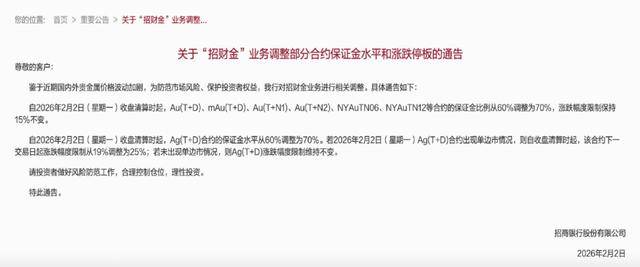
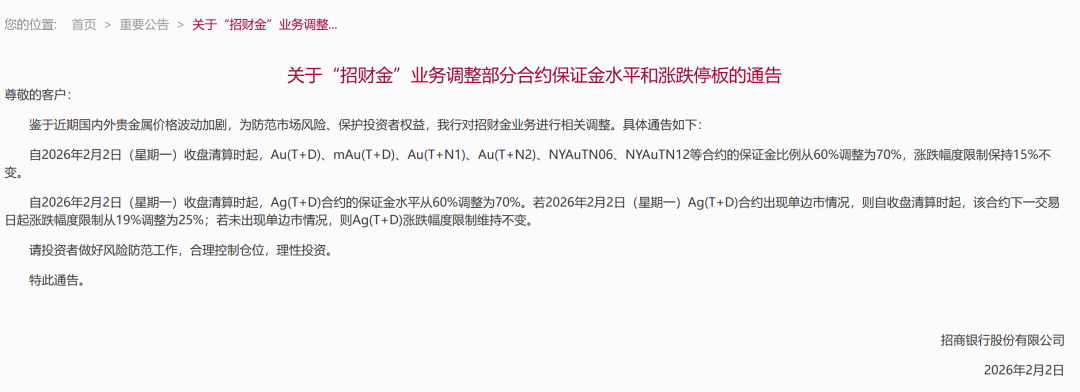
Core Viewpoint - Recent fluctuations in international gold and silver prices have prompted banks to adjust their operations and issue risk warnings to protect investors amid significant market volatility [1][2][4][5][6][7] Group 1: Market Fluctuations - On February 2, gold futures dropped below $4,500 per ounce, with silver prices experiencing a cumulative decline of approximately 40% from the peak on January 29, while gold prices fell by about 20% [1] - The recent volatility in precious metals is attributed to macroeconomic expectations, technical overbought conditions, and profit-taking by some investors, indicating a high volatility phase in the market [7] Group 2: Bank Responses - China Merchants Bank announced an increase in margin requirements for various gold and silver contracts from 60% to 70% to mitigate market risks [1] - The bank also suspended new account openings and new positions in its "Zhaocai Gold" business due to the changing market conditions [2] - Other banks, including Postal Savings Bank of China and Agricultural Bank of China, have issued similar warnings and adjusted their business practices to enhance risk management and protect client interests [2][4][5] Group 3: Risk Management Strategies - Banks are implementing a multi-layered approach to risk management, including increasing entry barriers, limiting leverage, and guiding rational investment behaviors [7] - The adjustments made by banks reflect a proactive stance in managing risks associated with precious metals trading, aiming to maintain market stability and protect investor interests [7]



金融活水“贷”来及时雨,邮储银行“产业贷”让临沂味道香飘全球
Qi Lu Wan Bao· 2026-02-02 23:33
比比赞(山东)食品有限公司的快速崛起,离不开精准的发展定位,更离不开邮储银行临沂分行的金 融"及时雨"。"我们的渠道布局很广,既给品牌供应饼干原料,也做代工,还做出口和自有礼盒销售, 订单一直很饱满,但扩大生产、新建厂房都需要大量资金,关键时刻是邮储银行拉了我们一把。"岳键 介绍道。 早在企业筹备阶段,邮储银行沂水县支行的客户经理韩汶泽就通过走访了解到其转型升级的需求,主动 对接、全程跟进。考虑到企业成立初期资金周转紧张,且春节前亟需资金囤购原材料,该行精准匹配线 上"食品集群e贷"产品,仅用一周时间就为企业发放200万元贷款,解了企业的燃眉之急。"线上产品审 批快、额度足,正好贴合我们当时的急需,工作人员全程上门服务,省去了我们不少麻烦。"岳键对该 行的高效服务赞不绝口。 齐鲁晚报·齐鲁壹点 主余凤 通讯员 李洁 "临近过年,车间里四条生产线24小时连轴转,门口的货运大车排着队等货,这忙碌劲儿,要是没有邮 储银行(601658)的支持,想都不敢想!"近日,比比赞(山东)食品有限公司的厂房里,负责人岳键 指着轰鸣的生产线,对前来走访的邮储银行临沂分行工作人员感慨道。车间内,酥性饼干、夹心饼干的 香气扑面而来, ...
国有六大行密集强化黄金投资业务风险管控
Zheng Quan Ri Bao· 2026-02-02 16:43
Core Viewpoint - The recent volatility in gold prices has prompted major state-owned banks in China to adjust their gold-related business practices, enhancing risk management and guiding investors towards rational participation in the market [1][2][4]. Group 1: Adjustments by State-Owned Banks - Major state-owned banks, including ICBC, ABC, BOC, CCB, and others, have implemented changes to their gold-related business, including increasing entry thresholds, transaction limits, and risk assessment requirements [2][4]. - ICBC announced on February 1 that due to significant fluctuations in domestic and international precious metal prices, investors should maintain a rational investment mindset and avoid impulsive trading [2]. - CCB raised the minimum amount for personal gold accumulation to 1,500 yuan starting February 2, citing increased market risks [3]. Group 2: Market Analysis and Long-Term Value - Despite short-term price fluctuations, experts believe that gold and other precious metals still hold long-term investment value due to global risk aversion and changes in asset allocation logic [1][5]. - The precious metals market has shown an upward trend since 2026, with gold and silver performing particularly well, although recent price volatility has raised concerns about future market behavior [5]. - Analysts suggest that while short-term pressures may exist, long-term factors such as declining real interest rates and persistent inflation will continue to support gold prices [5][6]. Group 3: Investor Guidance - Investors are advised to focus on risk management, including understanding market volatility, monetary policy changes, and liquidity risks associated with investment products [6]. - It is emphasized that investors should assess their risk tolerance and avoid excessive leverage, choosing investment tools that align with their financial situations [6].
金银价格巨震,多家银行出手
Zhong Guo Zheng Quan Bao - Zhong Zheng Wang· 2026-02-02 15:20
Core Viewpoint - Recent adjustments by major banks in China, including China Agricultural Bank, China Merchants Bank, and Bank of China, are aimed at mitigating risks associated with significant fluctuations in precious metal prices, emphasizing the need for investors to manage their positions and invest rationally [1][2][5]. Group 1: Bank Adjustments - China Merchants Bank announced an increase in margin requirements for various gold contracts from 60% to 70% due to heightened volatility in precious metal prices, while maintaining a 15% limit on price fluctuations [1]. - Bank of China adjusted the margin for silver deferred contracts from 50.80% to 66.04% and increased the fluctuation limit from 19% to 25% if a unilateral market condition occurs [5]. - Agricultural Bank of China also indicated adjustments to the fluctuation limits for silver contracts, aligning with the Shanghai Gold Exchange's risk management guidelines [7]. Group 2: Market Implications - Industry experts suggest that these measures are intended to tighten risk controls, reduce trading leverage, and increase capital costs for investors, thereby curbing speculative behavior in the market [2][7]. - The adjustments are expected to enhance liquidity during extreme market conditions and reduce the probability of defaults, with other banks likely to follow suit in implementing similar risk management strategies [7]. - Banks are advising investors to carefully assess their risk tolerance and financial situation, urging a rational investment approach and close monitoring of market conditions to mitigate potential losses from price volatility [9][10].
最新!多家银行,紧急调整!
券商中国· 2026-02-02 14:43
Core Viewpoint - Recent fluctuations in international gold and silver prices have led to significant adjustments in banking operations and risk management strategies to protect investors amid heightened market volatility [1][9]. Group 1: Market Fluctuations - On February 2, gold futures dropped below $4,500 per ounce, with silver prices experiencing a cumulative decline of approximately 40% from the peak on January 29, while gold prices fell by about 20% [1]. - The current market environment reflects a high volatility phase influenced by macroeconomic expectations, technical overbought conditions, and profit-taking by investors [9]. Group 2: Banking Responses - China Merchants Bank announced adjustments to its "Zhaocai Gold" business, increasing margin requirements for various gold and silver contracts from 60% to 70% to mitigate market risks [2]. - The Agricultural Bank of China implemented a risk assessment requirement for clients engaging in gold accumulation services, mandating a cautious risk tolerance rating [7]. - The Bank of China adjusted margin requirements for silver contracts, increasing the margin from 50.80% to 66.04% in case of a one-sided market [7]. Group 3: Investor Guidance - Banks are advising investors to enhance their risk awareness, control their positions, and avoid impulsive trading behaviors in light of the current market uncertainties [3][8]. - Financial institutions are promoting a strategy of maintaining a rational investment mindset, suggesting that investors should consider long-term perspectives and diversify their asset allocations [9].

事关黄金,工行、农行、邮储、招行最新提示
Di Yi Cai Jing Zi Xun· 2026-02-02 14:32
邮储银行也于当日发布公告称,近期国内外贵金属市场价格波动剧烈,不确定因素显著增多。为保护黄 金积存、实物贵金属业务客户利益,该行特别提示相关客户,请客户加强风险防范意识,在审慎评估自 身财务状况及风险承受能力的基础上,理性投资、合理配置、避免追涨杀跌,密切关注贵金属行情变 化,控制持仓规模,防范贵金属价格波动带来的资金损失。 除了风险提示,多家银行依据上海黄金交易所最新通知,宣布调整黄金、白银延期合约涨跌幅限制,上 调相关合约保证金比例。 2026.02.02 本文字数:1710,阅读时长大约3分钟 作者 |第一财经 亓宁 面对黄金价格从历史性暴涨到历史性暴跌,银行的风险提示和风控手段调整频率明显提高。 2月2日,黄金白银延续跌势,国际黄金现货价格一度跌至4403.64美元/盎司,日内最大跌幅超过9%;国 际白银现货价格最低触及71.33美元/盎司,日内最大跌幅接近15%。 同日,工商银行再度发布《关于加强防范贵金属市场价格波动风险的提示》称,近期国际贵金属市场波 动率显著增加,引发价格快速变化,风险进—步显现,提醒客户在审慎评估自身风险承受能力的基础 上,保持理性投资心态,避免盲目追涨杀跌。"建议从中长期视 ...


事关黄金,工行、农行、邮储、招行最新提示
第一财经· 2026-02-02 14:24
Core Viewpoint - The article discusses the significant volatility in the gold and silver markets, leading banks to increase risk warnings and adjust their risk management measures in response to the sharp price fluctuations [2][3]. Group 1: Market Volatility - On February 2, international gold prices fell to $4,403.64 per ounce, with a maximum daily drop exceeding 9%, while silver prices hit a low of $71.33 per ounce, with a drop close to 15% [2]. - Banks, including Industrial and Agricultural Banks, issued warnings about the increased volatility in the precious metals market, urging clients to assess their risk tolerance and maintain a rational investment approach [2][3]. Group 2: Risk Management Adjustments - Several banks announced adjustments to the margin requirements for gold and silver futures contracts in response to the volatility. For instance, Industrial Bank raised the margin for silver contracts from 60% to 66% on February 2 [4]. - Prior to this, on January 28, Industrial Bank had already increased the margin for various gold contracts from 43% to 60% and for silver contracts from 47% to 60% [4]. - Agricultural Bank also adjusted the price fluctuation limits for silver contracts, increasing the limit from 19% to 25% if a one-sided market condition occurs [5]. Group 3: Client Advisory - Banks emphasized the importance of clients maintaining awareness of market changes and controlling their positions to mitigate risks associated with price fluctuations in precious metals [3][5]. - Postal Savings Bank similarly advised clients to strengthen their risk awareness and rationally allocate investments based on their financial situations and risk tolerance [3].