
PSBC(601658)

Search documents
直销银行,溃败无声
3 6 Ke· 2025-09-24 11:27
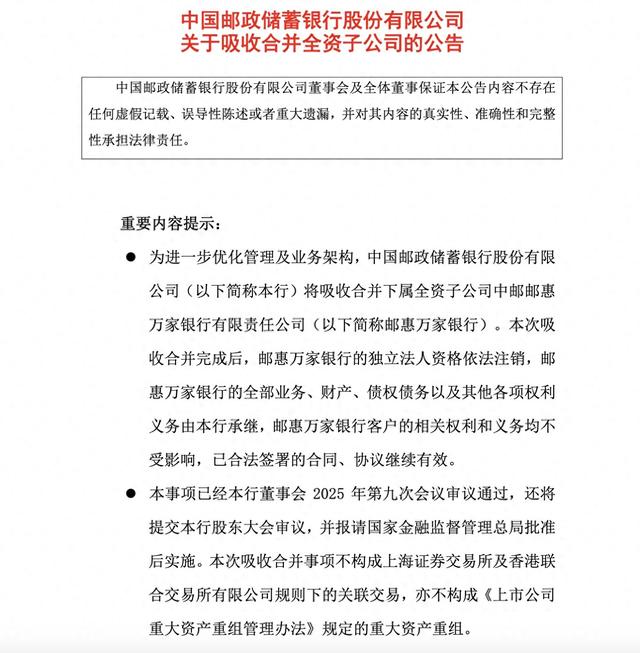
Core Viewpoint - Postal Savings Bank of China announced the absorption and merger of its wholly-owned subsidiary, Postal Bank of China Huinong Bank, marking the exit of the second independent legal direct bank in China within a short span of three years since its establishment [1][3]. Group 1: Background and Development - The establishment of Postal Bank of China Huinong Bank was part of Postal Savings Bank's digital transformation strategy, intended to serve as a "testbed" for innovation [3][4]. - The bank was officially approved to commence operations in June 2022, but it has struggled to gain a significant presence in the market, with total assets of only 12 billion yuan and around 20 million registered users by June 2025 [3][6]. Group 2: Performance and Financials - The performance of Postal Bank of China Huinong Bank has been disappointing, with a net loss of 4.15 billion yuan in 2024, and cumulative losses exceeding 840 million yuan since its inception [6][7]. - The bank's non-performing loan ratio surged from 2.28% in 2023 to 6.66% in 2024, indicating severe credit quality issues [6][7]. Group 3: Regulatory and Compliance Issues - In July 2025, the bank faced a fine of 4.25 million yuan for violating clearing management regulations, adding to its compliance challenges [9][10]. - The high turnover in the bank's executive team, including the chairman and senior management, has contributed to operational instability [10]. Group 4: Industry Context - The direct banking model in China has faced significant challenges, with many independent legal direct banks struggling to establish themselves in a competitive environment dominated by traditional banks and fintech [12][13]. - As of July 2025, only about ten independent direct banking apps remain operational, a stark decline from their peak, indicating a consolidation trend in the industry [15].


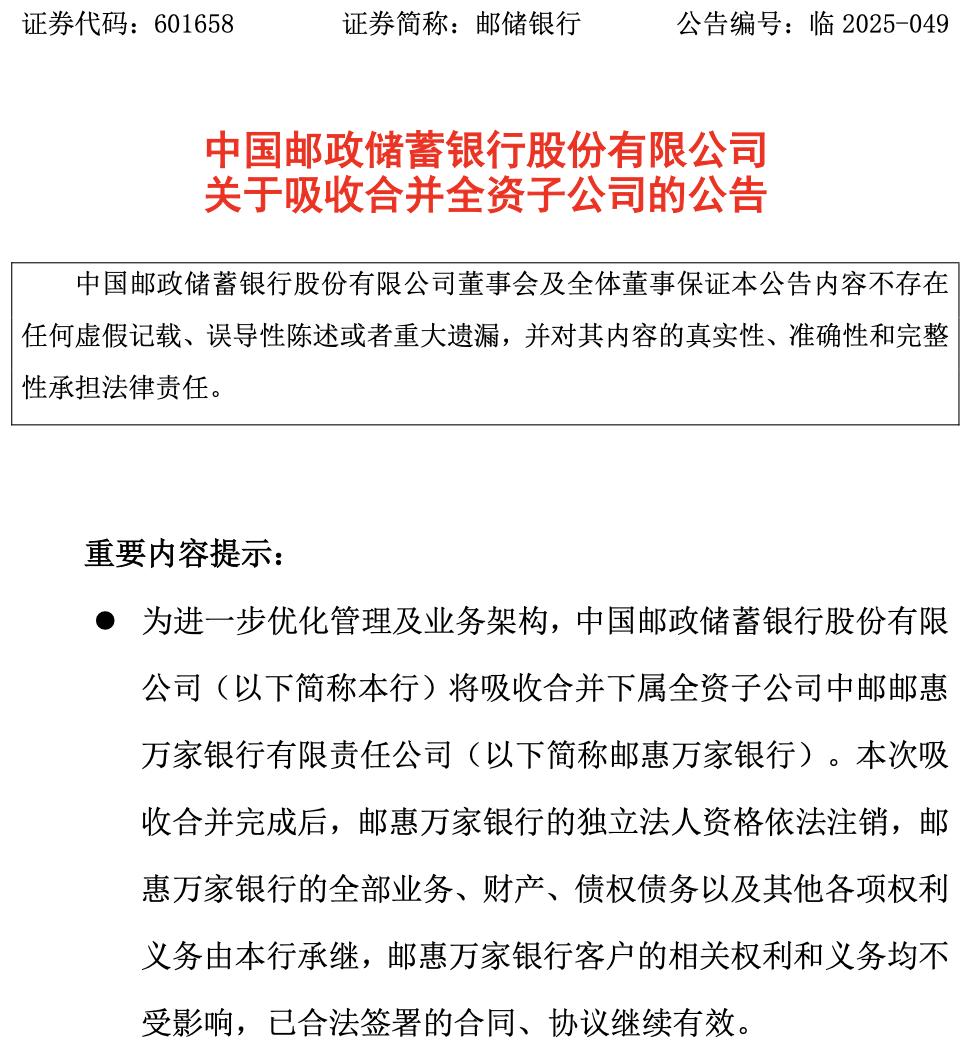
邮惠万家银行退场!独立法人直销银行为何仅剩“独苗”?
Guo Ji Jin Rong Bao· 2025-09-24 11:16
Core Viewpoint - Postal Savings Bank of China (PSBC) is set to absorb and merge its wholly-owned subsidiary, Postal Huinong Bank, to optimize management and business structure, leaving only Citic Baixin Bank as the sole independent direct bank in China [1][2][4] Group 1: Merger Details - The merger will result in the legal cancellation of Postal Huinong Bank's independent status, aimed at effectively utilizing resources and reducing operational costs for PSBC [2] - The integration of Postal Huinong Bank's online operational experience into PSBC is expected to enhance its online service capabilities and reduce management costs [2][3] - Postal Huinong Bank, established in January 2022 with a registered capital of 5 billion yuan, reported net profits of -162 million yuan, -263 million yuan, and -415 million yuan from 2022 to 2024, with a revenue of 150 million yuan and a net loss of -118 million yuan in the first half of 2025 [2][3] Group 2: Industry Context - The overlap in business scope between Postal Huinong Bank and PSBC includes public deposit acceptance, loan issuance, and financial bond issuance, indicating a high degree of redundancy [3] - The trend of direct banks is declining, with only a few remaining operational, as many banks are reducing their online channels and focusing on specific customer segments [4][5] - The current banking strategy emphasizes differentiation and the development of specific business segments rather than independent legal structures, with a shift towards integrated financial platforms and embedded service models [5]

邮储银行昭通市分行联合人民银行昭通市分行开展“贵金属和宝石行业反洗钱知识宣传”专项活动
Sou Hu Cai Jing· 2025-09-24 09:51
Core Viewpoint - The increasing prosperity of the precious metals and gemstones market has led to their use as a new means for money laundering by criminals, prompting a need for enhanced anti-money laundering (AML) measures in the industry [1] Group 1: Event Overview - On September 11, 2025, the Postal Savings Bank of China in Zhaotong, in collaboration with the local Economic Crime Investigation Team, conducted a special event focused on AML knowledge in the precious metals and gemstones sector [1][3] - The event was guided by the People's Bank of China and aimed to educate local businesses on the complexities and risks associated with money laundering in this industry [1][3] Group 2: Training Content - The training centered around the "Management Measures for Anti-Money Laundering and Anti-Terrorist Financing in Precious Metals and Gemstone Industry Institutions," effective from August 1, 2025 [3] - Participants were educated on the hidden nature and dangers of money laundering in the precious metals and gemstones sector through case studies and educational videos [3] - Key characteristics of gold, such as its high value, ease of liquidation, and difficulty in tracking, were discussed to highlight its potential misuse for laundering [3] Group 3: Participation and Impact - The event covered 21 local stores and 7 brands, with over 320 participants and more than 1,600 informational brochures distributed, achieving nearly 100% coverage in the Zhaotong area [6] - The training significantly enhanced the awareness of AML practices among local precious metals institutions, laying a solid foundation for a safe and regulated trading environment [6] - The Postal Savings Bank plans to continue its efforts in promoting AML awareness in key sectors to strengthen the financial security framework in Zhaotong [6]
对公贷款成银行增长“胜负手” 行业无还本续贷规模达9.4万亿
2 1 Shi Ji Jing Ji Bao Dao· 2025-09-24 09:12
Group 1 - The financing environment for small and micro enterprises is improving, with banks actively seeking to provide loans, a shift from previous years where enterprises sought loans from banks [1][2] - In the first half of the year, at least 20 banks reported an increase in corporate loans, particularly for small and micro enterprises, indicating a competitive lending landscape [1][4] - The financial regulatory authority has established mechanisms to support small and micro enterprise financing, resulting in the issuance of loans totaling 22 trillion yuan, alleviating funding pressures for small businesses [1][4] Group 2 - Guangdong Huihua Plastic Technology Co., Ltd. has increased its production capacity due to rising orders, securing loans of 10 million yuan and 20 million yuan in June and July to purchase raw materials [2] - Banks are adapting their lending strategies, moving away from traditional collateral-based loans to more flexible credit solutions, such as domestic letters of credit, to meet the needs of businesses with insufficient collateral [2][3] - The competition among banks has intensified, with banks not only lowering interest rates but also enhancing service quality to attract clients, as evidenced by significant reductions in loan interest rates compared to two years ago [3][4] Group 3 - Postal Savings Bank reported a 14.83% year-on-year increase in corporate loans, amounting to 541.1 billion yuan in the first half of the year, while retail loans showed stable growth [4][5] - China Bank's corporate loan balance reached 13.52 trillion yuan, with notable growth in green loans, private enterprise loans, and manufacturing loans, reflecting a robust lending environment [4] - Citic Bank achieved a record high in corporate loan growth, with an increase of 296.8 billion yuan in the first half of the year, maintaining a low non-performing loan ratio of 1.01% [4][5]

穿越周期 邮储银行锻造韧性经营内生力量
Zheng Quan Ri Bao Zhi Sheng· 2025-09-24 09:05
Core Viewpoint - Postal Savings Bank of China (PSBC) demonstrated resilience and steady growth in the first half of 2025, achieving a revenue of 179.446 billion yuan and a net profit of 49.415 billion yuan, both showing positive year-on-year growth despite industry challenges [4][10]. Financial Performance - PSBC's total assets and financial indicators reflect its unique operational resilience, with a net interest margin of 1.70%, maintaining industry leadership [4][5]. - As of June 2025, total customer loans reached 9.54 trillion yuan, a year-on-year increase of 6.99%, while deposits exceeded 16 trillion yuan, growing by 5.37% [5][6]. Asset and Liability Management - The bank's balanced asset-liability structure is attributed to long-term proactive management, with company loans increasing by 14.83% to 4.190 trillion yuan [6][7]. - PSBC has strengthened its core competitiveness in stable, low-cost, and diversified deposits, with corporate deposits rising by 13.86% [5][6]. Business Development Strategy - PSBC is focusing on balanced development across retail, corporate, and asset management sectors, moving away from reliance solely on retail banking [6][8]. - The bank's corporate finance segment has become a highlight, with significant growth in both loans and deposits [6][7]. Risk Management and Technology - PSBC emphasizes risk management and technology investment, enhancing its operational resilience through a comprehensive risk management system and digital transformation [7][8]. - The bank has improved its intelligent risk control capabilities and established a robust data asset foundation to support various business innovations [8][9]. Alignment with National Strategy - PSBC is actively promoting financial services that align with national strategies, focusing on serving agriculture, rural areas, and small enterprises, thereby enhancing its competitive edge [9][10]. - The bank has developed a multi-layered technology finance institution system to support high-growth enterprises [9]. Capital Strengthening - In the first half of 2025, PSBC completed a significant A-share private placement of 130 billion yuan, enhancing its capital adequacy ratios to 14.57% and 10.52% for total and core tier-one capital, respectively [10]. - The capital increase not only alleviates short-term pressures but also activates long-term potential for credit expansion and risk management [10].

银行业数字化转型加速,邮储银行宣布吸收合并全资直销银行子公司
Guan Cha Zhe Wang· 2025-09-24 08:57
Core Viewpoint - China Postal Savings Bank announced a strategic merger with its wholly-owned subsidiary, Postal Savings Bank of China Huinong Bank, marking a significant shift from decentralized pilot projects to centralized integration in its digital transformation process [1][5] Group 1: Strategic Goals - The merger aims to achieve strategic integration, optimize resource allocation, and reduce management costs [1][4] - The independent operation of the direct bank subsidiary has led to overlapping business functions with the parent company, necessitating improved resource allocation efficiency [1][4] Group 2: Financial Performance - As of June 2025, Postal Savings Bank of China Huinong Bank had a net asset of 4.042 billion and a deposit scale of 7.2 billion, indicating that its asset scale is relatively small compared to the overall size of Postal Savings Bank [2] - Despite serving over 20 million customers, the marginal benefits of the independent operation model are diminishing from an asset return and cost-effectiveness perspective [2] Group 3: Industry Trends - The merger reflects a broader trend in the banking industry towards digital transformation, moving from independent direct banks to integrated digital operations within parent companies [5][6] - The number of independent legal direct banks is decreasing, with only a few remaining operational, indicating a shift in the strategic value of such models [6] Group 4: Future Implications - The strategic adjustment by Postal Savings Bank signals a transition in the banking sector's digital development from initial "multiple experiments" to a new phase of "deep integration" [7] - Future competition in the banking industry will focus more on overall service capabilities, risk control levels, and customer experience rather than just channel innovation or product differentiation [7]
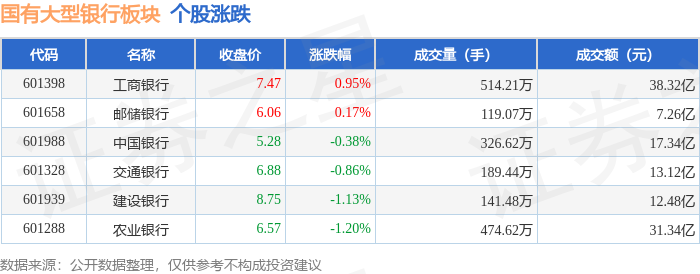
国有大型银行板块9月24日涨2.23%,工商银行领涨,主力资金净流出6.25亿元
Zheng Xing Xing Ye Ri Bao· 2025-09-24 08:46
| 代码 | 名称 | 主力净流入(元) | 主力净占比 游资净流入 (元) | | 游资净占比 散户净流入 (元) | | 散户净占比 | | --- | --- | --- | --- | --- | --- | --- | --- | | 601658 邮储银行 | | 1045.81万 | 1.44% | 3778.22万 | 5.21% | -4824.03万 | -6.65% | | 601398 工商银行 | | -2760.64万 | -0.72% | -2466.30万 | -0.64% | 5226.95万 | 1.36% | | 601328 交通银行 | | -4217.71万 | -3.22% | 1887.85万 | 1.44% | 2329.85万 | 1.78% | | 601939 建设银行 | | -1.40亿 | -11.20% | 8717.42万 | 6.98% | 5261.47万 | 4.22% | | 601988 中国银行 | | -1.47亿 | -8.46% | 8410.75万 | 4.85% | 6263.50万 | 3.61% | | 601288 ...



直销银行退场,邮储银行为何吸收合并邮惠万家银行?
3 6 Ke· 2025-09-24 07:57
Core Viewpoint - Postal Savings Bank of China (PSBC) announced the absorption and merger of its wholly-owned subsidiary, Postal Huinong Bank, reflecting a broader trend in the banking industry towards digital transformation and integration of direct banks [1][2][3] Company Summary - The merger will result in the cancellation of Postal Huinong Bank's independent legal status, with all its business, assets, debts, and rights transferred to PSBC, ensuring that customer rights remain unaffected [1][2] - The merger is part of PSBC's strategy to optimize management and business structure, enhancing its digital banking capabilities and reducing operational costs [4][5][6] - Postal Huinong Bank, established in January 2022, faced challenges in maintaining its independent value due to the rise of mobile banking and increased competition in the financial services market [3][4][8] Industry Summary - The banking industry is witnessing a shift from "extensive channel expansion" to "refined ecological cultivation," indicating a new phase of deep integration in digital banking [1][2] - Over 20 banks have shut down or integrated their direct banking operations in recent years, highlighting the trend towards unified operations [2][3] - The digital transformation of banks is driven by the need for enhanced customer experience and operational efficiency, with a focus on integrating technology and data into business models [9][10] Financial Metrics - As of the end of 2024, Postal Huinong Bank reported total assets of 12.828 billion yuan, a loss of 415 million yuan, and a non-performing loan ratio of 6.66% [8] - PSBC's capital adequacy ratio stood at 14.57% and its core tier 1 capital adequacy ratio at 10.52% as of June 2025, reflecting a year-on-year improvement [11]
开业不到四年,邮惠万家银行将被邮储银行吸收合并
Huan Qiu Lao Hu Cai Jing· 2025-09-24 04:07
Core Viewpoint - Postal Savings Bank of China (PSBC) announced the absorption and merger of its wholly-owned subsidiary, Postal Savings Bank Huinong Co., Ltd., to optimize management and business structure [1] Group 1: Merger Details - The merger will result in the cancellation of Postal Savings Bank Huinong's independent legal status, with all its business, assets, debts, and rights being inherited by PSBC [1] - Customers of Postal Savings Bank Huinong will not be affected, and existing contracts will remain valid [1] Group 2: Financial Impact - The merger is not expected to have a substantial impact on PSBC's financial status or operating results, as Postal Savings Bank Huinong's financial statements have already been fully consolidated into PSBC's reports [1] Group 3: Background and Purpose - The merger aligns with PSBC's strategy of increasing investment in financial technology and enhancing digital and centralized capabilities, particularly through mobile banking [1] - The integration of Postal Savings Bank Huinong's online operational experience is seen as a strong complement to PSBC's online business [1] - The merger aims to optimize resource allocation and reduce management costs [1] Group 4: Historical Context - Postal Savings Bank Huinong was established in January 2022 with a registered capital of 5 billion yuan, focusing on inclusive and digital finance [2] - As of the end of 2024, Postal Savings Bank Huinong had over 21 million registered users, total assets of 12.828 billion yuan, and a net asset of 4.159 billion yuan, with a revenue of 243 million yuan, down 31.55% year-on-year [2] - By mid-2025, its total assets were 12.005 billion yuan, net assets were 4.042 billion yuan, and it reported a revenue of 150 million yuan with a net loss of 118 million yuan, reducing losses by 38.74% year-on-year [2] Group 5: Industry Context - Following the merger, only Baixin Bank remains as an independent legal direct bank in the domestic market [3]
独立直销银行模式受挫邮惠万家三年半亏9.6亿将被邮储银行吸收合并
Xin Lang Cai Jing· 2025-09-24 03:05
Core Viewpoint - China Postal Savings Bank announced the absorption and merger of its wholly-owned subsidiary, Postal Savings Bank of China Huinong Bank, to optimize management and business structure, aiming for strategic integration and resource allocation [1] Group 1: Financial Performance of Postal Savings Bank of China Huinong Bank - Since its establishment on January 7, 2022, Huinong Bank has faced continuous losses, with total losses amounting to 9.58 billion RMB since inception [1][2] - By the end of 2022, Huinong Bank reported total assets of 7.022 billion RMB and a net asset of 4.838 billion RMB, with a net profit of -162 million RMB [1] - In 2023, total assets increased to 14.986 billion RMB, but net assets fell to 4.574 billion RMB, with a net profit of -263 million RMB, indicating an expanding loss [1] - The situation worsened in 2024, with total assets dropping to 12.828 billion RMB and a net profit of -415 million RMB [1] - As of mid-2025, total assets were 12.005 billion RMB, with a net profit of -118 million RMB, although losses were reduced by 38.74% year-on-year [1] Group 2: Challenges Faced by Independent Direct Banks - The merger reflects broader challenges faced by independent direct banks, which struggle with customer acquisition and profitability [2] - Independent direct banks are experiencing intense competition from both their parent banks and larger banks, leading to internal conflicts [3] - The high costs associated with technology investment and customer acquisition hinder the ability of independent direct banks to achieve economies of scale [3] - The business model of purely online operations has limitations in serving small and micro enterprises, leading to product homogenization with traditional banks [3] Group 3: Strategic Implications for Postal Savings Bank - The merger is a rational adjustment based on financial returns and strategic effectiveness, signaling a shift in focus towards internal capability development rather than merely establishing new entities [3] - The goal is to integrate Huinong Bank's operational experience and technology into the parent bank to enhance overall digital transformation [3] - The success of digital banking will depend on the internalization and reconstruction of capabilities rather than the mere establishment of new banks [3]