
PSBC(601658)

Search documents
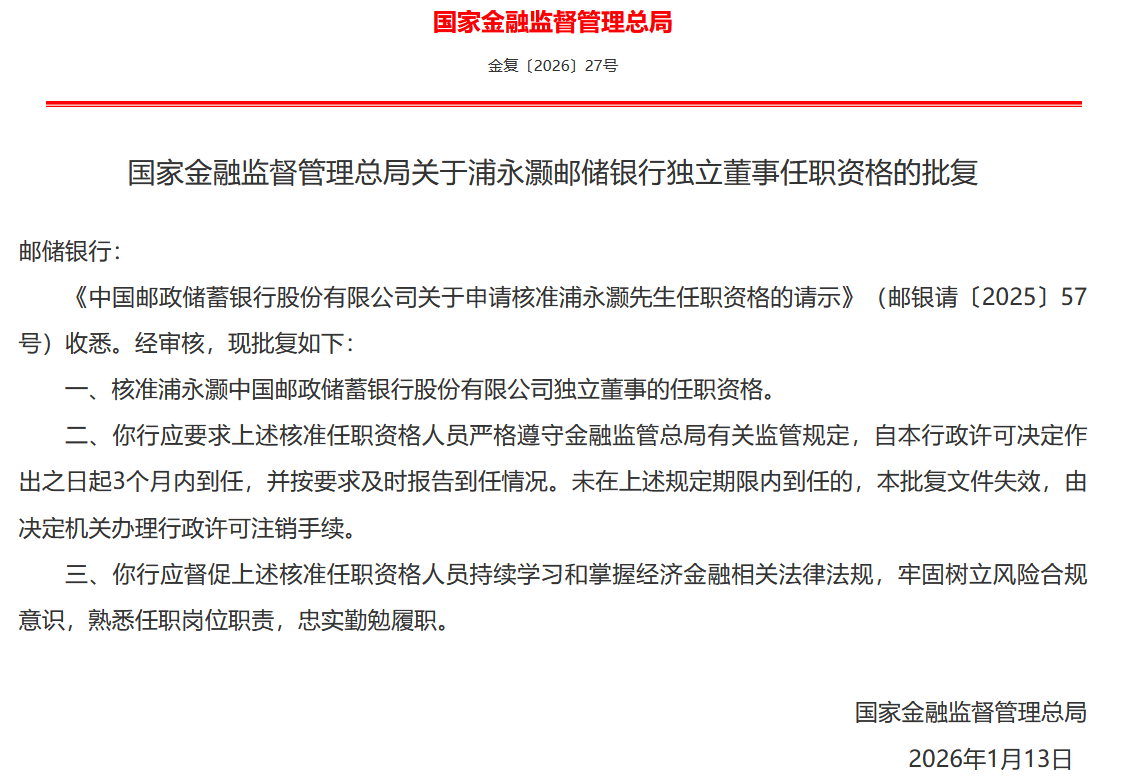
浦永灏获批担任邮储银行独立董事
Xin Lang Cai Jing· 2026-01-26 07:42
Group 1 - The National Financial Regulatory Administration has approved the appointment of Pu Yonghao as an independent director of China Postal Savings Bank [1][5] - Pu Yonghao has an extensive background in finance, having held various senior positions in institutions such as Bank of China International and UBS [4][8] - His educational qualifications include a Master's degree in Economics from Xiamen University and a Master's degree in Demography from the London School of Economics [4][8] Group 2 - Pu Yonghao's previous roles include being a senior economist and vice president at Bank of China International, a senior advisor at the Asian Development Bank, and managing director at UBS [4][8] - He is currently serving as an independent non-executive director at several companies, including Jiao Yin International Holdings and Guotai Junan Securities [4][8] - Pu Yonghao also holds the position of vice chairman at the Hong Kong China Financial Association [4][8]


银行业周报:财政金融协同政策加码,被动资金流出扰动行情-20260126
Yin He Zheng Quan· 2026-01-26 06:39
Investment Rating - The report maintains a "Recommended" rating for the banking sector, highlighting its dividend value and low valuation as attractive for long-term investors [5][10]. Core Insights - A package of fiscal and financial policies has been introduced to support the banking sector, particularly in optimizing loan structures and stabilizing interest margins [7][8]. - The banking sector has experienced a decline of 7.44% year-to-date, underperforming the broader market, primarily due to passive fund outflows [9][10]. - The report emphasizes the potential for credit growth and structural optimization in the banking sector, driven by government policies aimed at supporting small and medium enterprises [8][9]. Summary by Sections Latest Research Insights - The report discusses the implementation of six fiscal and financial policies aimed at enhancing credit support for small and medium enterprises, including a 1.5% interest subsidy on loans [7][8]. - These policies are expected to lower overall financing costs and stimulate demand, thereby benefiting the banking sector [8]. Weekly Market Performance - The banking sector index fell by 2.70% during the week, while the broader Shanghai and Shenzhen 300 index decreased by 0.62% [18]. - State-owned banks, joint-stock banks, city commercial banks, and rural commercial banks saw declines of 4.36%, 3.08%, 0.43%, and 0.70%, respectively [18]. Valuation and Company Performance - As of January 23, 2026, the banking sector's price-to-book ratio stands at 0.64, indicating a 32.99% discount compared to the overall A-share market [35]. - The sector's dividend yield is reported at 4.92%, which is higher than the average for all A-shares, ranking second among industries [35]. - Eight listed banks have reported stable earnings recovery for 2025, with most showing growth in total assets compared to 2024 [15][16].





2025年度中国上市公司治理和ESG优秀企业榜单
Sou Hu Cai Jing· 2026-01-25 08:10
Core Insights - The CCG50 Forum released the 2025 annual rankings of Chinese listed companies' governance and ESG performance, evaluating 5,292 companies based on various governance indices and ESG criteria [1][3][13]. Governance Rankings - The governance rankings include 11 core lists, with the top 100 companies ranked based on a comprehensive index. Notable companies include: - Health元, 唐山港, and 西部证券 leading the overall governance list [2][8]. - 中煤能源 topped the small investor protection list, evaluated on 36 indicators across four dimensions [2][15]. - 唐山港 ranked first in the board governance category, assessed on 38 indicators [2][21]. - 埃斯顿 led the financial governance list, evaluated on 31 indicators [2][39]. ESG Rankings - The ESG rankings are divided into non-financial and financial sectors: - In the non-financial sector, 中国石油, 中国石化, and 中国中铁 ranked highest, evaluated on 132 indicators with weights of 55% for governance, 35% for social responsibility, and 10% for environmental protection [3]. - The financial sector's top ten ESG companies include 工商银行 and 农业银行, evaluated based on industry-specific criteria [3]. Risk Awareness - The forum also published a list of 50 companies with governance risks, including *ST 广道 and ST 中迪, providing a reference for investors [3][19]. Methodology - The rankings were developed using scientific modeling and quantitative calculations rather than traditional voting methods, referencing international standards to showcase the differences in governance levels and ESG performance among Chinese listed companies [3][13][19].





个人贷款不良率骤增 银行超低折竞抛
经济观察报· 2026-01-25 04:58
Core Viewpoint - The article discusses the increasing trend of personal non-performing loan (NPL) transfers in the banking sector, driven by regulatory changes and the rising pressure of bad debts on financial institutions [1][5]. Group 1: Market Dynamics - The personal NPL transfer market is experiencing a surge, with transaction volumes rising from 186.48 billion in 2021 to 965.30 billion in 2023, and projected to reach 1583.50 billion in 2024 [3][4]. - As of January 22, 2026, there were 20 new announcements for personal NPL transfers within the month, indicating heightened activity in the market [2][8]. - The average discount rate for personal NPL packages has significantly decreased, with rates dropping from 8%-10% before 2023 to around 5% in 2026 [10][11]. Group 2: Regulatory Impact - A regulatory notification extended the trial period for bulk transfers of personal NPLs until December 31, 2026, allowing a wider range of financial institutions to participate in the transfer process [2][4]. - The expansion of trial institutions to include city commercial banks and rural commercial banks has led to a notable increase in the volume of NPL transfers [5][17]. Group 3: Borrower Profile and Economic Context - The borrower demographic for personal NPLs includes failed entrepreneurs, unemployed individuals relying on credit cards for living expenses, and consumers with excessive debt [4][20]. - The economic backdrop, characterized by macroeconomic fluctuations and income instability, has exacerbated the bad debt situation, compelling banks to offload risk assets [5][20]. Group 4: Challenges in Asset Recovery - The recovery rates for NPLs have declined, with some packages facing average recovery rates below 6%, marking the lowest in five years [12][13]. - Financial institutions are facing challenges in asset valuation and recovery due to incomplete documentation and inefficient legal processes [26][28]. Group 5: Strategic Adjustments - Banks are adapting their strategies by improving the quality of NPL packages, such as reducing overdue times and increasing the concentration of borrowers in economically developed areas [24][25]. - There is a push for enhanced transparency and standardization in the NPL transfer process to improve market confidence and asset pricing [28].


你的信用卡账单分期,国家要贴息啦
2 1 Shi Ji Jing Ji Bao Dao· 2026-01-24 02:33
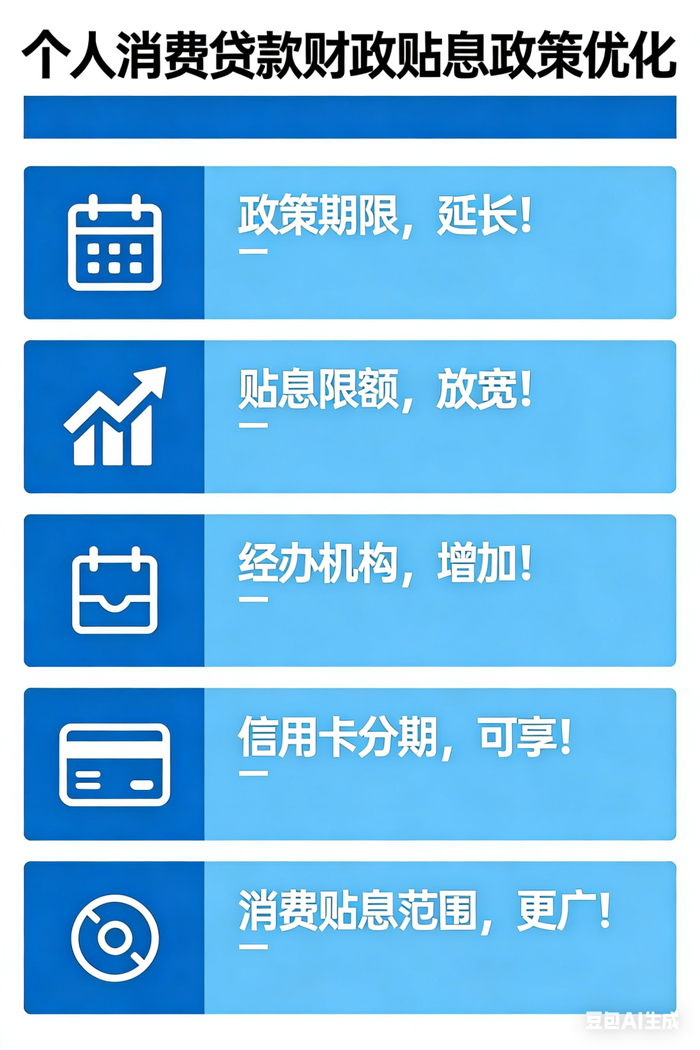
Group 1 - The core viewpoint of the news is the optimization of the personal consumption loan interest subsidy policy, which aims to stimulate consumer spending by extending the policy duration and expanding its coverage [1][2][4] - The new policy extends the implementation period until the end of this year and includes credit card installment payments in the subsidy scope, thereby broadening the areas eligible for interest subsidies [1][3] - Financial institutions, including major banks, are quickly responding to the policy by optimizing their services to ensure consumers can benefit from the subsidies seamlessly, enhancing the overall consumer experience [4][6] Group 2 - The collaboration between financial institutions and e-commerce platforms is highlighted, with initiatives like interest-free installment products being offered to consumers, which have led to significant increases in sales for participating brands [6] - The policy is part of a broader strategy to boost domestic demand and consumer confidence, aligning with the central economic work conference's focus on enhancing the domestic market [7] - The implementation of the policy is expected to improve consumer sentiment and market vitality, contributing to a stable economic outlook and encouraging higher quality consumption [7]

人民币对美元汇率中间价升破“7” 汇率预计将继续双向浮动、保持弹性
Ren Min Ri Bao· 2026-01-23 22:27
Core Viewpoint - The People's Bank of China announced a strengthening of the Renminbi (RMB) exchange rate against the US dollar, reaching a new high since May 2023, reflecting a phase of appreciation influenced by various internal and external factors [1]. Group 1: Exchange Rate Changes - On January 23, the central parity rate of the RMB against the US dollar was set at 6.9929, an increase of 90 basis points from the previous day's rate of 7.0019 [1]. - Both offshore and onshore RMB appreciated against the US dollar on the same day, with projections indicating that by the end of 2025, both rates may break the "7" mark, currently remaining above it [1]. Group 2: Economic Factors - The appreciation of the RMB is attributed to a combination of market supply and demand, policy guidance, and external environmental factors, as stated by a researcher from Postal Savings Bank of China [1]. - The Deputy Governor of the People's Bank of China highlighted that China's large-scale market, complete industrial chain, and the integration of technological and industrial innovation support the long-term stability of the RMB exchange rate [1]. Group 3: Future Outlook - The external environment remains complex, with uncertainties regarding interest rate adjustments in major economies and potential geopolitical shocks that may affect exchange rate trends [1]. - The RMB is expected to continue to exhibit two-way fluctuations and maintain elasticity in its exchange rate [1].


多家银行公告!落实个人消费贷款最新财政贴息政策
Sou Hu Cai Jing· 2026-01-23 19:43
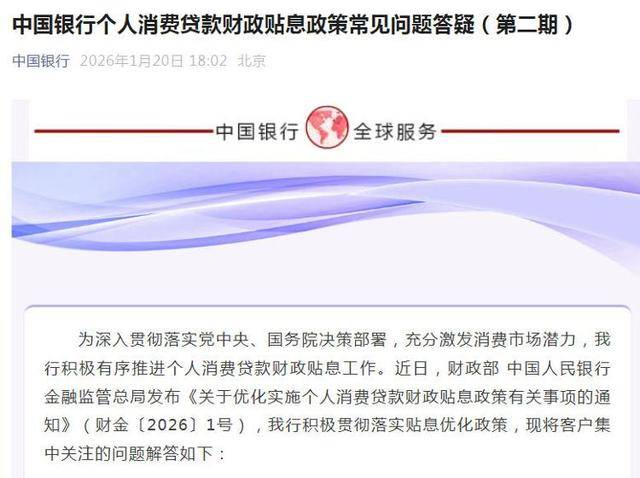
Core Viewpoint - The implementation of the latest fiscal interest subsidy policy for personal consumption loans aims to boost consumption and expand domestic demand, with several major banks actively participating in this initiative [1][6][7][8][9]. Group 1: Policy Implementation - The fiscal interest subsidy policy for personal consumption loans has been extended until December 31, 2026, covering the period from September 1, 2025, to December 31, 2026 [6][10]. - The credit card installment payment subsidy policy will be effective from January 1, 2026, to December 31, 2026 [6]. Group 2: Policy Optimization - The policy has been optimized to include credit card installment payments, expanding the support range [9][11]. - The subsidy criteria have been broadened by removing the restriction on single transactions of 50,000 yuan and above [9][12]. - The subsidy standards have been improved by eliminating the 500 yuan cap on single transaction subsidies and the 1,000 yuan cap for individual borrowers at the same financial institution [9][12]. - Customers who have previously signed the personal consumption loan subsidy agreement will automatically benefit from the new subsidy policy starting January 1, 2026, without needing to re-sign the agreement [12].

最高分红率35%!上市银行春节前大派红包
Guo Ji Jin Rong Bao· 2026-01-23 16:22
Core Viewpoint - The banking sector is experiencing a trend of increasing mid-term cash dividends, with several banks announcing significant payouts, indicating a stable earnings outlook and attractiveness for conservative investors [1][2][4]. Group 1: Mid-term Dividends - As of January 23, 2025, Huaxia Bank and Chongqing Rural Commercial Bank distributed over 3 billion yuan in cash dividends, contributing to a total of 25 A-share listed banks that have completed dividend payouts [1][2]. - A total of 31 A-share listed banks announced mid-term dividends for 2025, with 25 having released their plans and completed payouts. The six major state-owned banks collectively distributed 204.657 billion yuan, with Industrial and Commercial Bank of China leading at 50.396 billion yuan [2]. - China Merchants Bank made its first mid-term dividend distribution of 25.548 billion yuan, with a per-share payout of 1.013 yuan, marking a 35% dividend ratio, the highest among listed banks [2]. Group 2: Investment Appeal - The banking sector remains attractive for stable funds due to its high dividend yield and stable earnings expectations, particularly for large banks and quality regional banks [3][4]. - Recent share buybacks by major shareholders and executives in banks like Nanjing Bank and Chongqing Rural Commercial Bank indicate confidence in the sector, with Nanjing Bank's major shareholder increasing its stake from 13.02% to 14.02% [3]. - Analysts suggest that the low-risk interest rate environment and the ongoing "asset shortage" make dividend-paying assets appealing, with banks signaling stable earnings growth and improved asset quality [3][4]. Group 3: Future Outlook - The banking industry is expected to continue its earnings recovery trend into 2026, with a stabilizing operating environment and potential for net interest margin recovery, which could enhance profitability [4]. - The market may see a divergence in performance, with high-dividend large banks and quality regional banks likely to outperform, while smaller banks may face challenges related to asset quality and profitability [4].


丈量地方性银行(1):江苏127家区域性银行全梳理-20260123
GF SECURITIES· 2026-01-23 11:08
Investment Rating - The industry investment rating is "Buy" [2] Core Insights - The report provides a comprehensive analysis of 127 regional banks in Jiangsu Province, highlighting their asset and liability structures, profitability, and asset quality [6][18] - Jiangsu's regional banks have shown a significant increase in asset growth, with major city commercial banks growing at 19.4%, surpassing the growth of listed city commercial banks at 14.2% [24][26] - The report indicates that the loan-to-asset ratio for city commercial banks is projected to reach 48.4% in 2024, reflecting a gradual increase in lending activities [30] - Jiangsu's regional banks exhibit better return on assets (ROA) compared to listed banks, with city commercial banks outperforming by 16 basis points and rural commercial banks by 9 basis points [6][42] - The asset quality of Jiangsu's regional banks is superior to that of listed banks, with lower non-performing loan ratios and higher provision coverage ratios [6][42] Summary by Sections 1. Economic Structure of Jiangsu Province - Jiangsu Province is focusing on new industrialization and strategic emerging industries, with significant contributions from cities like Nanjing and Suzhou [13][14] 2. Overview of 127 Regional Banks in Jiangsu - The report categorizes the banks into city commercial banks, rural commercial banks, and others, with a total of 127 banks established between 2006 and 2015 [18][20] 3. Asset/Liability Structure - The asset growth of major city commercial banks is accelerating, while rural commercial banks are experiencing a decline in growth rates [24][26] - The loan-to-asset ratio for city commercial banks is expected to increase to 48.4% by 2024, indicating a shift towards more lending [30] 4. Profitability - Jiangsu's regional banks have a higher ROA compared to listed banks, with city commercial banks showing a 16 basis point advantage [6][42] 5. Asset Quality/Capital Levels - Jiangsu's regional banks maintain a lower non-performing loan ratio compared to listed banks, with city commercial banks having a 30 basis point lower ratio [6][42]

个人消费贷“国补”政策加码,实际利率跌入2字头
2 1 Shi Ji Jing Ji Bao Dao· 2026-01-23 10:49
Group 1 - The Ministry of Finance, the People's Bank of China, and the Financial Regulatory Administration have extended the personal consumption loan interest subsidy policy until the end of 2026, indicating a reinforcement of the "national subsidy" policy for personal consumption loans [1] - Major state-owned banks, including ICBC, ABC, BOC, CCB, BOCOM, and PSBC, have announced the implementation of the optimized personal consumption loan subsidy policy, which includes extending the policy deadline, expanding the support scope, and raising the subsidy standards [1][2] - The actual interest rates for high-quality customers benefiting from the subsidy can drop to around 2%, which is lower than the current housing loan rates, with annualized rates for consumer loans generally remaining around 3% [2] Group 2 - Ant Consumer Finance has also extended its subsidy policy until the end of 2026, removing the previous limit on single transaction subsidies and supporting diverse consumer needs [3] - Various banks are actively launching promotional measures, such as increasing loan limits and maintaining low interest rates, to stimulate consumer spending, especially in response to the upcoming Spring Festival [4] - The combination of fiscal subsidies and financial incentives from banks aims to lower consumer financing costs and enhance customer loyalty, effectively driving consumption [4]
