
PSBC(601658)

Search documents
邮储银行滨州市分行:8亿银团赋能沾化300MW渔光互补项目
Qi Lu Wan Bao· 2025-12-31 14:03
Group 1 - The project involves a 300MW fish-solar complementary photovoltaic power generation base in Shandong Province, utilizing saline-alkali land for dual purposes: energy generation and shrimp farming [1] - The project is developed by Jinhui New Energy, which employs a multi-faceted approach including "fishing, solar, storage, and transmission" to maximize land use [1] - The project faced significant financing challenges due to its large scale and tight timeline, necessitating financial support from Postal Savings Bank [1] Group 2 - Postal Savings Bank initiated a green credit approval process to expedite financing for the project, completing the necessary approvals in just two weeks [2] - The bank successfully led a syndicate to secure 800 million yuan in funding, providing crucial financial support to the project [2] - As of August, Postal Savings Bank's green loan balance reached 4.331 billion yuan, with a year-on-year growth rate of 20.14%, significantly outpacing other loan growth rates [2]

邮储银行贵阳市鸿通城营业所被罚22万元:违反账户管理规定
Xin Lang Cai Jing· 2025-12-31 12:50
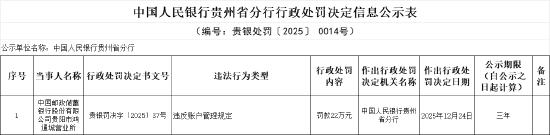
12月31日金融一线消息,据中国人民银行贵州省分行行政处罚决定信息公示表显示,中国邮政储蓄银行 股份有限公司贵阳市鸿通城营业所因违反账户管理规定,被罚款22万元。 | 中国人民银行贵州省分行行政处罚决定信息公示表 | | | | | | | | --- | --- | --- | --- | --- | --- | --- | | (编号:贵银处罚〔2025〕 0014号〕 | | | | | | | | 公示单位名称:中国人民银行贯州省分行 | | | | | | | | 序号 当事人名称 行政处罚决定书文号 | | 违法行为类型 | 行政处罚 内容 | 作出行政处罚 作出行政处 决定机关名称 罚决定日期 | | 公示期限 (目公示之 日起计算) | | 中国新政府营 | 银行控价有限 | | | 中国人民银行费州 | | | | 费银罚决字 2025] 37号 违反账户管理报定 | 公司骨因市场 量城营业所 | | 可能22万元 | 省分行 | 2025年12月24日 | = # | 责任编辑:秦艺 12月31日金融一线消息,据中国人民银行贵州省分行行政处罚决定信息公示表显示,中国邮政储蓄银行 股份有限公 ...

【财闻联播】关于《股票上市规则》,深交所发布!首批国产四价HPV疫苗上市!
券商中国· 2025-12-31 12:29
Macro Dynamics - The Ministry of Commerce announced safeguard measures for imported beef, stating that an investigation was initiated on December 27, 2024, due to domestic industry requests. The measures include country-specific quotas and additional tariffs for three years, with annual quota increases to support the domestic industry [2] Financial Institutions - Major state-owned banks, including ICBC, ABC, CCB, BOC, and Postal Savings Bank, announced that starting January 1, 2026, interest will be paid on the balances of real-name digital RMB wallets at the same rate as current deposits. The announcement emphasizes the distinction between real-name and anonymous wallets, with specific interest rules applying only to real-name wallets [9] Market Data - The A-share market closed on December 31, 2025, with the Shanghai Composite Index rising 0.09% for a total annual increase of 18.41%, marking a ten-year high. The Shenzhen Component Index increased by 29.87% over the year, while the ChiNext Index saw a significant rise of 49.57% [11] - The Hong Kong stock market also reported strong performance, with the Hang Seng Index increasing by 27.77% for the year, the best annual performance since 2017. The Hang Seng Tech Index rose by 23.45%, marking its best annual performance since 2020 [12] Company Dynamics - The first domestically produced quadrivalent HPV vaccine has been launched, developed by China National Pharmaceutical Group. The vaccine covers four HPV types and has shown 100% efficacy in preventing certain precancerous lesions in clinical trials, providing a cost-effective option for women aged 18 to 45 [14] - Tianqi Materials announced an expected net profit increase of 127.31% to 230.63% for 2025, driven by rising demand in the new energy vehicle and energy storage markets, along with improved production efficiency [15] - Platinum Technology is under investigation by the China Securities Regulatory Commission for suspected violations of information disclosure laws, but the company stated that its operations remain normal [16] - Changan Ford announced a recall of 38,473 units of the Ford Focus due to compliance with regulations regarding defective automotive products [17]






六大行集体官宣,事关数字人民币
Zhong Guo Zheng Quan Bao· 2025-12-31 12:28
Core Viewpoint - The announcement by six major banks in China regarding interest payments on digital RMB wallet balances marks a significant transition from "digital cash (M0)" to "digital deposit currency," indicating a shift in the nature of liabilities from the central bank to commercial banks [1][2] Group 1: Announcement Details - Starting from January 1, 2026, the six major banks will pay interest on the balances of real-name digital RMB wallets at the rate of the current deposit interest rate [1] - The current deposit interest rate for the Bank of Communications is set at 0.05% [1] - Balances in type four personal wallets will not earn interest, and specific interest rate standards can be checked through the bank's official website, mobile banking app, or physical branches [1] Group 2: Implications and Effects - This move enhances user willingness to hold digital RMB, promoting its adoption and dissemination [2] - It incorporates banking institutions into the reserve requirement framework, improving monetary statistics and macroeconomic regulation [2] - Establishing this mechanism is a crucial step towards the maturity of digital RMB, maintaining a dual-layer operational structure while achieving functional upgrades [2]


中行、工行、农行、建行、交行、邮储银行集体官宣:这笔钱要计利息!
Mei Ri Jing Ji Xin Wen· 2025-12-31 12:20
Core Viewpoint - Starting from January 1, 2026, six major state-owned banks in China will begin to pay interest on the balances of digital RMB real-name wallets at the same rate as their current deposit rates, following the same interest calculation rules as regular savings accounts [1][10]. Group 1: Announcement Details - The six banks involved are the Bank of China, Industrial and Commercial Bank of China, Agricultural Bank of China, China Construction Bank, Bank of Communications, and Postal Savings Bank [1]. - The current interest rate for regular savings accounts is noted to be 0.05% [10]. - Interest will be calculated quarterly, with the interest credited to accounts on the 21st of each quarter's last month [10]. Group 2: Wallet Types and Interest Eligibility - Digital RMB wallets are categorized into four types: Type 1, Type 2, and Type 3 are real-name wallets eligible for interest, while Type 4 is an anonymous wallet that does not earn interest [10][12]. - Type 1 wallets require in-person verification and must be linked to a domestic bank account, while Type 2 and Type 3 wallets can be opened remotely with varying identification requirements [12][13][14]. - The new definition of digital RMB indicates a shift from being classified as M0 (cash) to being recognized as a form of deposit currency, allowing for interest accrual [11][12].
工行、农行、中行、建行、交行、邮储,集体宣布
2 1 Shi Ji Jing Ji Bao Dao· 2025-12-31 11:49
Core Viewpoint - The digital renminbi will officially end its "interest-free era" as major state-owned banks announce that starting January 1, 2026, the balance in real-name digital renminbi wallets will earn interest based on the current deposit rate [1][4][5]. Group 1: Digital Renminbi Interest Policy - Six major state-owned banks, including ICBC, ABC, BOC, CCB, Bank of Communications, and Postal Savings Bank, will implement interest payments on digital renminbi wallet balances according to the current deposit rate [1][4]. - The interest payment policy is a result of the People's Bank of China's recent action plan aimed at enhancing the management and service system for digital renminbi [4][5]. - The new interest mechanism marks the transition of digital renminbi from a "digital cash" to a "digital deposit currency" [5][8]. Group 2: Digital Renminbi Overview - Digital renminbi is a legal digital currency issued by the People's Bank of China, applicable in various scenarios such as transportation, dining, shopping, and public services [6]. - The pilot program for digital renminbi has expanded from select cities to entire provinces, with applications in both consumer and governmental sectors [6]. - As of November 2025, digital renminbi has processed 3.48 billion transactions totaling 16.7 trillion yuan, with 230 million personal wallets opened [7]. Group 3: Future Implications of Interest Payments - The introduction of interest payments changes the liability nature of digital renminbi, making it a liability of commercial banks rather than the central bank, thus aligning it more closely with traditional bank deposits [8]. - This shift is expected to enhance the monetary elasticity of digital renminbi, allowing it to support credit activities and deposit expansion mechanisms [8]. - The future digital renminbi will be a modern digital payment and circulation tool, regulated by the central bank and possessing attributes of commercial bank liabilities [8].
邮储银行:陈雪担任非执行董事的任职资格获核准
Zhi Tong Cai Jing· 2025-12-31 11:47
邮储银行(601658)(01658)发布公告,该行2025年第二次临时股东大会审议通过了选举陈雪女士为该 行非执行董事的议案。该行于近日收到《国家金融监督管理总局关于陈雪邮储银行董事任职资格的批 复》(金复[2025]777号),据此国家金融监督管理总局已核准陈雪女士的任职资格。根据相关规定,陈雪 女士自2025年12月29日起就任该行非执行董事,任期3年。同时,陈雪女士担任该行董事会风险管理委 员会委员、董事会提名和薪酬委员会委员。 ...
工行、农行、中行、建行、交行、邮储,集体宣布
21世纪经济报道· 2025-12-31 11:44
Core Viewpoint - The digital renminbi will officially end its "interest-free era" as major state-owned banks announce that starting January 1, 2026, the balance in real-name digital renminbi wallets will earn interest based on the current deposit rate [1][4][10]. Group 1: Digital Renminbi Interest Policy - Six major state-owned banks, including ICBC, ABC, BOC, CCB, BOCOM, and PSBC, will implement interest payments on digital renminbi wallet balances according to the current deposit rate starting January 1, 2026 [1][4]. - The interest will be calculated based on the People's Bank of China's regulations for current deposits, with interest credited quarterly [3][4]. - The introduction of this interest policy is part of the People's Bank of China's action plan to enhance the management and service system for digital renminbi [4][10]. Group 2: Transition to Digital Deposit Currency - The implementation of the interest policy marks the transition of digital renminbi from a "digital cash" model to a "digital deposit currency" model [10]. - Previously, digital renminbi was classified as M0, similar to cash, and did not earn interest, limiting its attractiveness compared to bank deposits [10]. - With the new policy, digital renminbi will be treated as a liability of commercial banks, allowing it to support credit activities and deposit expansion mechanisms, thus enhancing its monetary elasticity [10][11]. Group 3: Current Status and Future Prospects - As of November 2025, digital renminbi has processed 3.48 billion transactions with a total transaction amount of 16.7 trillion yuan [8]. - The digital renminbi is being tested in various scenarios, including daily consumption and government services, and is expanding into cross-border payment initiatives [7][8]. - The future digital renminbi will be a modern digital payment and circulation tool, supported by the central bank and possessing attributes of commercial bank liabilities [10][11].

2025年中国创投:重拾向上动能,奔赴投资新程
Zheng Quan Shi Bao Wang· 2025-12-31 11:43
Group 1: Industry Recovery and Trends - In 2025, China's venture capital industry emerged from a two-year downturn, showing signs of recovery across the entire investment chain, driven by a combination of funding and project highlights, as well as supportive policies [1] - The year-end activities of venture capitalists indicate a strong return to the industry, fueled by a new wave of technological changes and ongoing policy benefits [1] Group 2: Government Investment Fund Policies - The State Council issued a significant document aimed at promoting the high-quality development of government investment funds, focusing on stricter controls on new fund establishments and optimizing investment policies [2] - Various local governments have responded by issuing supporting policy documents, further regulating the operation of government investment funds to promote high-quality industry development [2] Group 3: Banking Sector Involvement - Since the announcement of expanded pilot programs for bank-affiliated financial asset investment companies (AICs), banks have accelerated their entry into the primary market, with several major banks successfully establishing AICs [3] - As of now, AICs from six major state-owned banks and three national joint-stock banks have been established, with total investments reaching 45.272 billion yuan, a year-on-year increase of approximately 37.7% [3] Group 4: Special Bonds for Government Guidance Funds - Several local governments have issued special bonds to support government guidance funds, breaking the previous norm that prohibited such investments [4] - A total of 52 billion yuan in special bonds have been issued by nine provinces and cities, significantly enhancing the funding pool for the venture capital industry [4] Group 5: Long-Term Government Guidance Funds - New government guidance funds established this year have extended their duration beyond the typical 10 years, with some lasting up to 20 years, providing long-term support for projects [5] - This trend of extending fund durations is expected to create a more patient investment environment, allowing for better exit strategies [5] Group 6: Mergers and Acquisitions - The introduction of policies supporting private equity funds in acquiring listed companies has led to a surge in related acquisition cases, with several venture capital firms actively pursuing stakes in public companies [6][7] - The trend of startups acquiring listed companies is also on the rise, indicating a new strategy for both startups and venture capital firms to explore exit routes [7] Group 7: Domestic PE Firms Acquiring Foreign Brands - Domestic top-tier private equity firms have increasingly acquired the Chinese operations of overseas consumer brands, highlighting a trend of local capital participating in the localization of foreign brands [8] - This trend is driven by the combination of ample funding, local operational expertise, and the stable cash flow of established foreign brands [8] Group 8: Technology Innovation Bonds - The introduction of technology innovation bonds has opened new fundraising channels for venture capital institutions, with several private firms successfully issuing bonds at competitive interest rates [9] - The issuance of these bonds has significantly boosted market confidence and marked a transition towards a more normalized support phase for private venture capital institutions [9] Group 9: Mainland VC/PE Expansion into Hong Kong - Several mainland investment institutions have established offices in Hong Kong, attracted by the region's supportive environment for technological innovation [10] - The Hong Kong government's initiatives, including the establishment of a significant innovation and technology fund, have further encouraged mainland VC/PE firms to expand into the market [10] Group 10: Return of Dollar LPs to China - Multiple venture capital firms have successfully raised dollar-denominated funds, indicating a renewed interest from international investors in the Chinese market [11][12] - The return of dollar LPs coincides with the rapid growth of China's AI industry, highlighting the potential undervaluation of Chinese assets [11][12] Group 11: National Entrepreneurship Investment Fund - The establishment of a "carrier-level" national entrepreneurship investment fund aims to support startups across key economic regions in China, with a focus on early-stage investments [13] - This fund features a long duration of 20 years and aims to provide substantial financial backing to venture capital institutions and startups, enhancing the overall investment landscape [13]





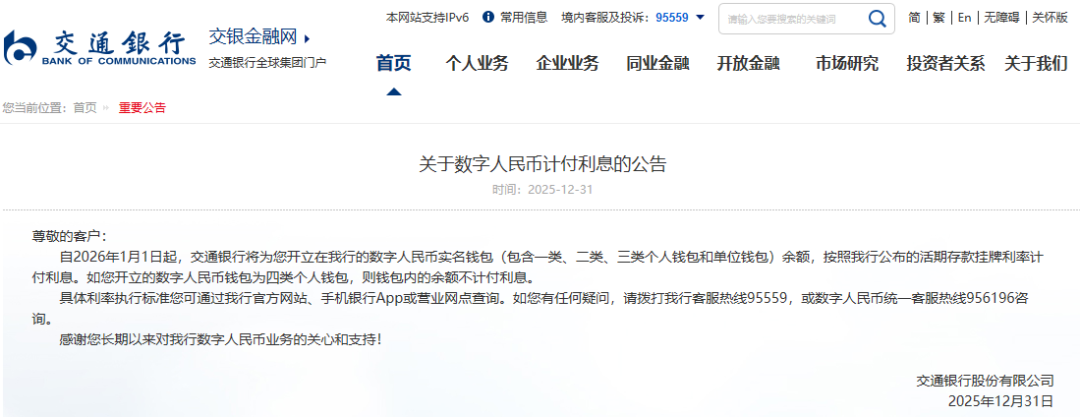
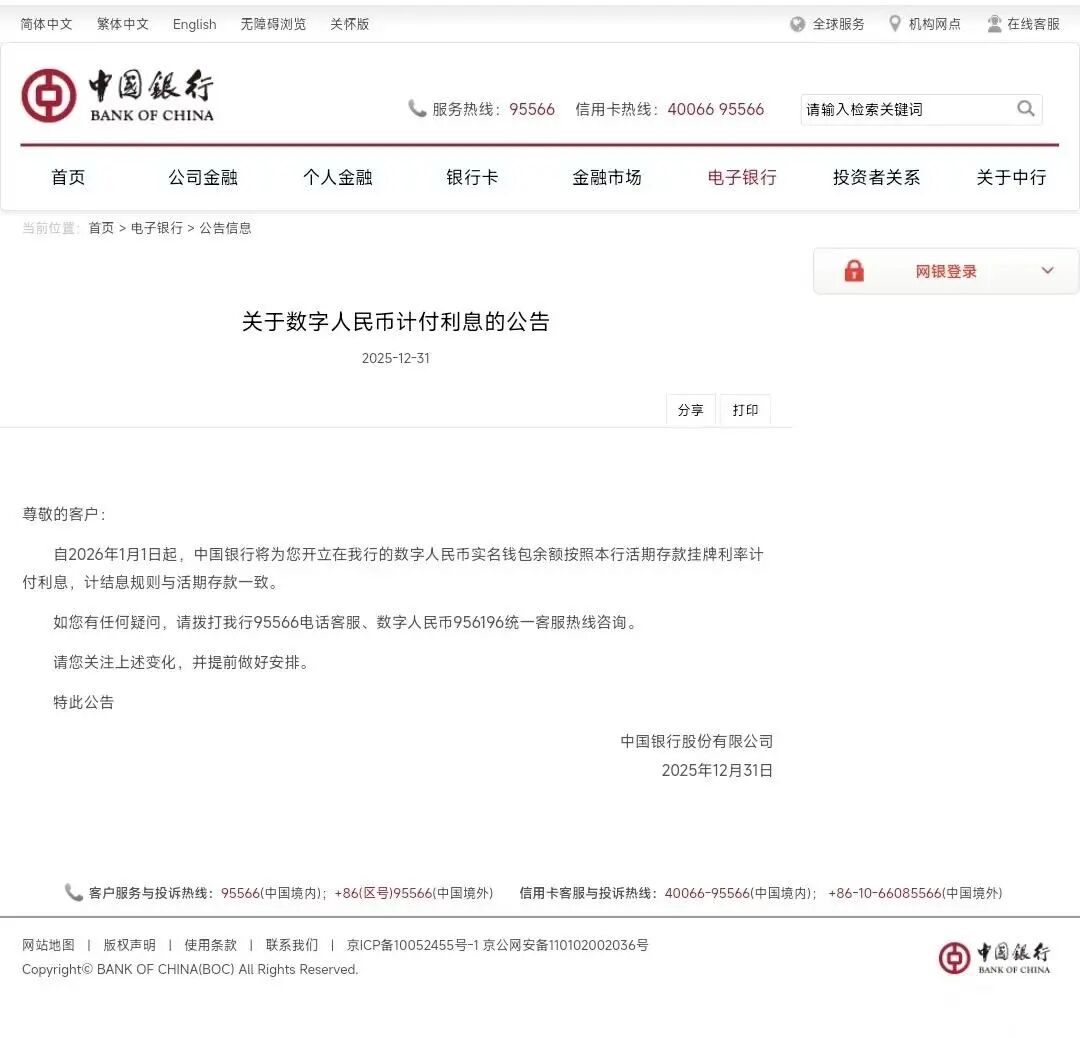
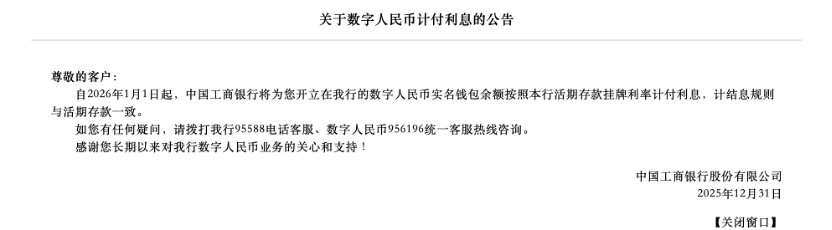
数字人民币迎来升级!2026年1月1日起,实名钱包余额开始计息
Xin Lang Cai Jing· 2025-12-31 11:37
建设银行指出,自2026年1月1日起,该行数字人民币实名钱包余额将按照该行活期存款挂牌利率计付利 息,计结息规则与活期存款一致,并相应修订《中国建设银行数字人民币钱包个人客户服务协议》相关 内容。该行也在公告中介绍到,数字人民币是指中国人民银行发行的法定数字货币和相关支付体系,采 用双层运营架构,由中国人民银行向数字人民币业务运营机构发行,再由数字人民币业务运营机构兑换 给公众。自2026年1月1日起,数字人民币钱包(不含四类钱包)中的钱包余额按照中国人民银行规定的 活期存款计结息规则计付利息,并由乙方依法代扣代缴利息税(如有)。 2026年1月1日起,数字人民币实名钱包余额将开始计付利息。 12月31日,工行、农行、建行、交行、邮储银行等国有银行公布了数字人民币钱包余额计息的规则。 工商银行、农业银行、邮储银行表示,为数字人民币实名钱包余额按照活期存款挂牌利率计付利息,计 结息规则与活期存款一致;交通银行表示,自2026年1月1日起,交通银行将数字人民币实名钱包(包含 一类、二类、三类个人钱包和单位钱包)余额,按照该行公布的活期存款挂牌利率计付利息。如用户开 立的数字人民币钱包为四类个人钱包,则钱包内的余额 ...