CSCEC(601668)

Search documents
中建八局、中建科技联合发布模块化“好房子”产品体系
Qi Lu Wan Bao· 2025-09-27 05:40
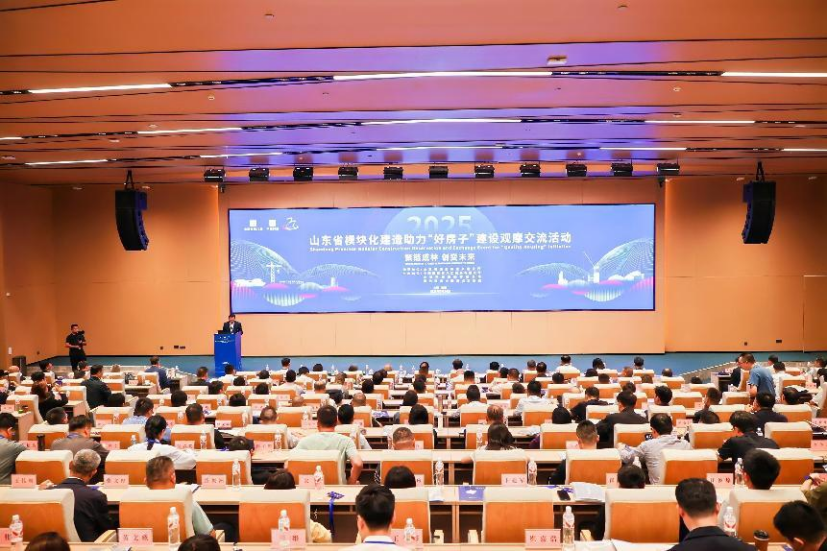
Core Viewpoint - The modular "Good House" product system was launched by China State Construction Engineering Corporation (CSCEC) and its subsidiary, focusing on meeting public needs and enhancing construction efficiency through advanced modular building technologies [3][5][6]. Group 1: Modular "Good House" Product System - The product system includes modular technologies for steel structures, concrete structures, and steel-concrete composite structures, covering seven major scenarios such as residential buildings, schools, hotels, and hospitals [3][5]. - The system addresses 101 public needs and has developed 35 modular solutions, such as high-wind-resistant windows and polyurethane waterproof systems for bathrooms [6][5]. Group 2: Intelligent Construction Factory - The intelligent construction factory in Jinan can produce a wall in 12 minutes and a modular house in 2 hours, showcasing high efficiency and automation [7][8]. - The factory's automation level is 80%, with a fourfold increase in production efficiency and a fivefold increase in product quality [8][9]. Group 3: Residential Park Experience - The newly established residential park serves as a display platform for various modular housing types, allowing consumers to experience different living scenarios [10][12]. - Consumers can customize their modular houses online, including interior and exterior designs, with the factory manufacturing based on their specifications [12].


中建玖合通州项目开盘热销 最低单价约5.5万元/平方米
Zhong Guo Jing Ying Bao· 2025-09-27 01:01
Core Viewpoint - The opening of the "Yunhe Jiuyuan" project by China State Construction's subsidiary, Zhongjian Jiuhuo, has garnered significant market attention, achieving rapid sales in the Beijing sub-center area, indicating a strong demand for new housing in Tongzhou following the relaxation of purchase restrictions [1][5]. Group 1: Project Overview - The "Yunhe Jiuyuan" project officially opened on September 20, 2023, with 573 units sold on the first day and a total of 364 units signed within five days, achieving a sales rate of 75% on the opening day [4][1]. - The project is part of a larger land acquisition by Zhongjian Jiuhuo, which secured a group of plots in Tongzhou for a total of 7.491 billion yuan, marking its return to the Beijing market after a two-year hiatus [2][5]. - The total land area for the project is 11.28 hectares, with a planned construction scale of nearly 300,000 square meters, making it one of the largest comprehensive projects in Tongzhou in recent years [2][5]. Group 2: Market Context - Since the relaxation of "dual purchase restrictions" last year, the Tongzhou real estate market has seen increased activity, with several new projects launched in the area [5][6]. - The project features a variety of unit sizes, with smaller units priced competitively against nearby projects, while larger units have set new price records for the area, with prices exceeding 80,000 yuan per square meter for units over 200 square meters [3][4]. - The competitive landscape includes other projects like "Manyun ONE," which has a lower average price per square meter, highlighting the diverse pricing strategies in the market [3][4]. Group 3: Company Strategy - Zhongjian Jiuhuo aims to strengthen its presence in the Beijing market, with the "Yunhe Jiuyuan" project being a key focus for the year, reflecting the company's strategy to enhance its market share in a competitive environment [7][5]. - The company has been relatively inactive in Beijing over the past two years, with its last land acquisition prior to this project occurring in June 2023, indicating a strategic shift to capitalize on current market conditions [7][6]. - In 2022, Zhongjian Jiuhuo's sales in Beijing were significantly lower compared to its performance in Shanghai, where it achieved higher sales figures, suggesting a need for improved performance in the Beijing market [7][6].
国务院国资委:国资央企要更好助力稳市场
Zheng Quan Ri Bao· 2025-09-26 16:14
Group 1 - The State-owned Assets Supervision and Administration Commission (SASAC) is focusing on stabilizing electricity and coal prices, preventing "involution-style" vicious competition, and enhancing the foundation for high-quality development of state-owned enterprises [1] - Central enterprises have shown resilience in facing various risks and challenges this year, with steady improvement in value creation and operational efficiency [1] - SASAC will optimize the regular communication mechanism for economic operations of state-owned enterprises and actively coordinate to address practical issues raised by enterprises [1] Group 2 - Zhang Yuzhuo emphasized the need for state-owned enterprises to align their thoughts and actions with the central government's economic judgments and decisions, maintaining strategic focus [2] - Enterprises are encouraged to enhance operational efficiency by optimizing investment structures and focusing on key areas such as industrial chain strengthening, infrastructure construction, and energy resource security [2] - There is a strong emphasis on resisting "involution-style" competition and promoting differentiated development and brand competition to foster a healthy and sustainable industry ecosystem [2]




国务院国资委召开国有企业经济运行座谈会 聚焦稳电价、稳煤价、防止“内卷式”恶性竞争等
Xin Hua Cai Jing· 2025-09-26 10:08
Group 1 - The meeting held by the State-owned Assets Supervision and Administration Commission (SASAC) focused on understanding the economic operation of state-owned enterprises and addressing challenges such as stabilizing electricity and coal prices, and preventing "involution" competition [1] - Six central enterprises, including China Huadian, China Mobile, AVIC Group, China State Construction, China Coal Group, and Poly Group, provided insights into their economic performance and industry trends, along with suggestions for improvement [1] - SASAC will enhance the regular communication mechanism for the economic operation of state-owned enterprises and actively coordinate to resolve practical issues raised by these enterprises [1] Group 2 - Emphasis was placed on maintaining stable operations, targeting the "one increase, one stability, and four enhancements" goal, optimizing operational strategies, and focusing on cost reduction and efficiency improvement [2] - Investment structure optimization is crucial, with a focus on strengthening the industrial chain, infrastructure construction, and energy resource security, while promoting digital and green upgrades [2] - There is a strong commitment to resisting "involution" competition, promoting differentiated development, and fostering a healthy and sustainable industry ecosystem [2] - Risk prevention measures will be strengthened, including the establishment of a regular risk monitoring and early warning system [2]
9月25日银河99(000959)指数跌0.09%,成份股山东黄金(600547)领跌
Sou Hu Cai Jing· 2025-09-25 09:45
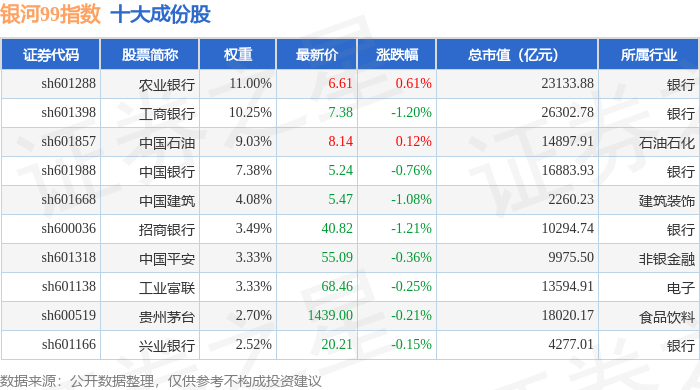
Market Overview - The Galaxy 99 Index closed at 7671.42 points, down 0.09%, with a trading volume of 3590.77 billion yuan and a turnover rate of 0.46% [1] - Among the index constituents, 37 stocks rose while 60 stocks fell, with Inspur Information leading the gainers at a 9.99% increase and Shandong Gold leading the decliners with a 4.75% drop [1] Key Constituents - The top ten constituents of the Galaxy 99 Index include major companies such as Agricultural Bank of China (11.00% weight), Industrial and Commercial Bank of China (10.25% weight), and China Petroleum (9.03% weight) [1] - The total market capitalization of the top ten constituents ranges from 2260.23 billion yuan for China State Construction to 26302.78 billion yuan for Industrial and Commercial Bank of China [1] Capital Flow - The net inflow of main funds into the Galaxy 99 Index constituents was 4.93 billion yuan, while retail investors saw a net inflow of 22.45 billion yuan, and speculative funds experienced a net outflow of 27.37 billion yuan [1] - Specific stocks such as Inspur Information and BYD saw significant net inflows from main funds, indicating strong institutional interest [2] ETF Performance - The Food and Beverage ETF (product code: 515170) has seen a decline of 2.03% over the past five days, with a current PE ratio of 20.26 times and a net outflow of 1972.9 million yuan [4] - The Cloud Computing 50 ETF (product code: 516630) increased by 5.99% over the last five days, with a high PE ratio of 125.24 times and a net outflow of 1077.1 million yuan [5]





中国建筑股份有限公司国际信用评级结果公告
Shang Hai Zheng Quan Bao· 2025-09-24 21:00
Core Viewpoint - The credit ratings for China State Construction Engineering Corporation have been updated by three major international credit rating agencies, indicating a stable outlook from S&P and Fitch, while Moody's has a negative outlook [1]. Group 1: Credit Ratings - S&P Global Ratings assigned a long-term issuer credit rating of "A" with a stable outlook to the company [1]. - Moody's Investors Service assigned a long-term issuer credit rating of "A2" with a negative outlook [1]. - Fitch Ratings assigned both a long-term default rating and a senior unsecured rating of "A-" with a stable outlook [1].
卢拉悼念巴西坠机遇难中国建筑学家
Xin Lang Cai Jing· 2025-09-24 20:39
Core Points - A small plane crashed in the city of Aquidauana, Mato Grosso do Sul, Brazil, on the evening of September 23, resulting in the death of all four individuals on board, including Chinese architect and Peking University professor Yu Kongjian [1] - Brazilian President Lula expressed condolences for the victims of the accident on social media on September 24 [1]
中国建筑(601668) - 中国建筑国际信用评级结果公告
2025-09-24 11:30
特此公告。 中国建筑股份有限公司董事会 二〇二五年九月二十四日 1 证券代码:601668 股票简称:中国建筑 公告编号:临 2025-058 国际信用评级结果公告 本公司董事会及全体董事保证本公告内容不存在任何虚假记载、误导性陈 述或者重大遗漏,并对其内容的真实性、准确性和完整性承担法律责任。 截至 2025 年 9 月 24 日,三大国际信用评级公司标普全球评级(以下简称"标 普")、穆迪投资者服务公司(以下简称"穆迪")和惠誉国际信用评级有限公司 (以下简称"惠誉")分别发布了对中国建筑股份有限公司(以下简称"公司") 的 2025 年信用评级更新报告。 标普给予公司长期发行人主体信用评级为"A",展望稳定;穆迪给予公司长 期发行人主体信用评级为"A2",展望负面;惠誉给予公司长期发行人违约评级 和高级无抵押评级均为"A-",展望稳定。 ...
15家企业跻身“万亿俱乐部” 前十首现民营互联网企业
Xin Jing Bao· 2025-09-24 08:50
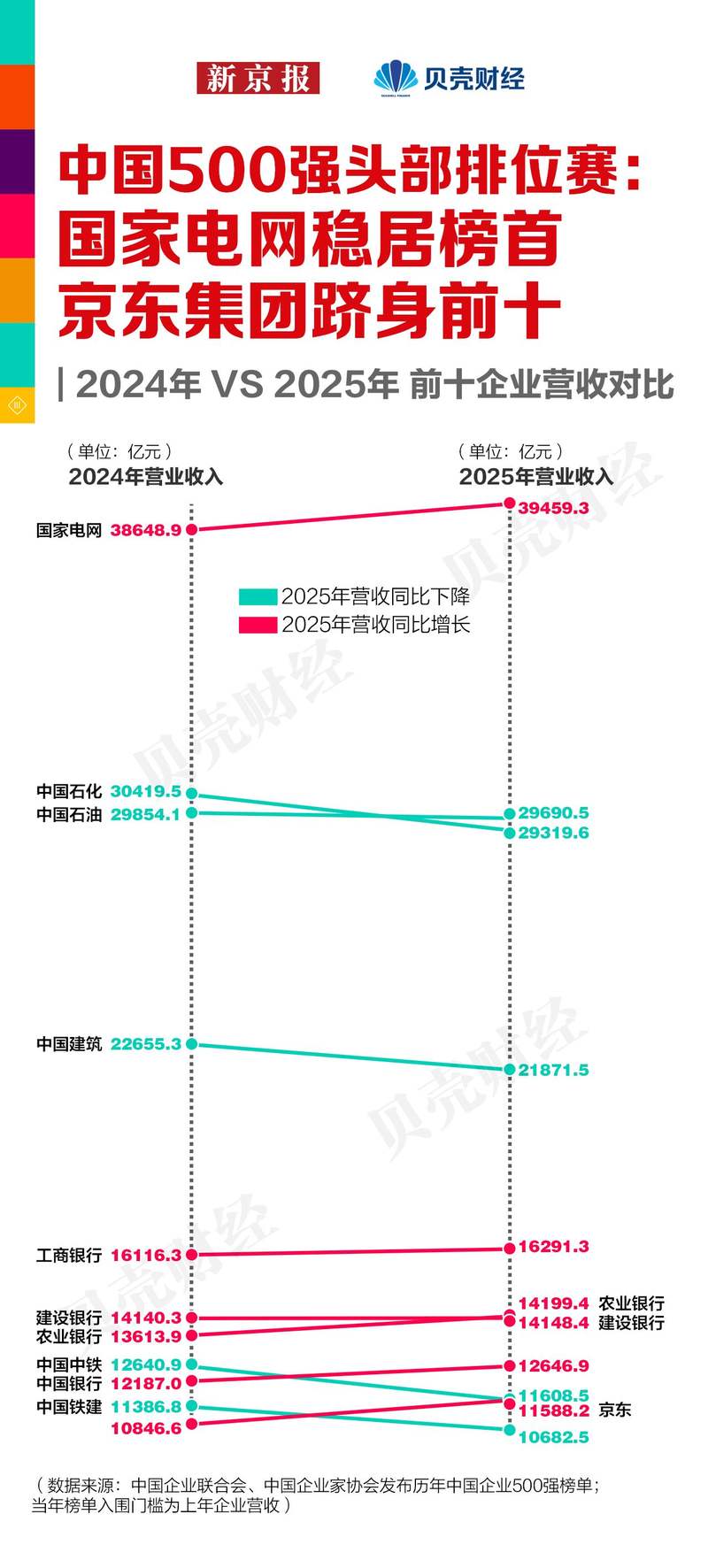
Group 1 - The threshold for entering the 2025 China Top 500 Enterprises list has increased to 47.96 billion yuan, marking a year-on-year rise of 579 million yuan, setting a new record [2] - A total of 15 companies have entered the "trillion yuan club" in 2025, indicating the substantial scale of leading enterprises, with energy and finance remaining the most stable sectors [2][8] - The top three companies by revenue are State Grid, China Petroleum, and Sinopec, collectively surpassing 900 billion yuan in revenue [2][3] Group 2 - Among the top ten companies, four experienced a decline in revenue compared to the previous year, with fluctuations in energy prices and demand impacting performance [3] - China Petroleum and Sinopec both saw rapid revenue growth in 2022-2023, exceeding 300 billion yuan, but are projected to decline to approximately 290 billion yuan in 2024-2025 [3][6] - JD Group has entered the top ten for the first time, while China Railway Construction has dropped to 11th place, with a revenue gap of 20.14 billion yuan between them in 2024 [3][8] Group 3 - The four major banks have shown continuous revenue growth, with Industrial and Commercial Bank of China leading the financial sector with a revenue of 1.63 trillion yuan in 2025 [7] - Agricultural Bank of China surpassed China Construction Bank in 2025, becoming one of the highest-grossing state-owned banks [7] - China Ping An's revenue has fluctuated, recovering to 1.14 trillion yuan in 2025 after a decline since 2021, while China Life surpassed 1.15 trillion yuan in the same year [7] Group 4 - The number of companies in the "trillion yuan club" has significantly increased from 8 in 2021 to 15 in 2025, reflecting a more diversified membership structure [8] - Traditional sectors such as energy, infrastructure, and finance maintain their stronghold, while emerging industries and the digital economy are gradually reshaping the landscape [8]



房屋建设板块9月24日涨0.24%,重庆建工领涨,主力资金净流出9.13亿元
Zheng Xing Xing Ye Ri Bao· 2025-09-24 08:46
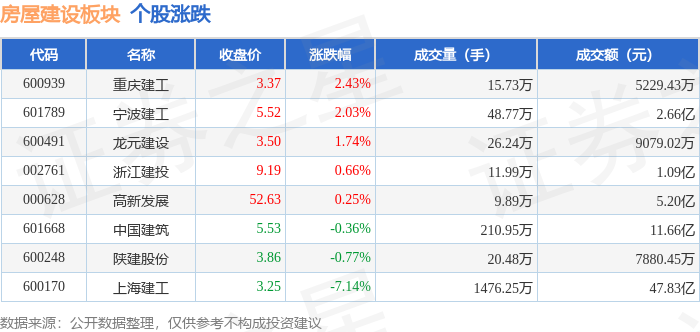
Market Overview - The housing construction sector increased by 0.24% on September 24, with Chongqing Construction leading the gains [1] - The Shanghai Composite Index closed at 3853.64, up 0.83%, while the Shenzhen Component Index closed at 13356.14, up 1.8% [1] Stock Performance - Notable stock performances include: - Chongqing Construction (600939) closed at 3.37, up 2.43% with a trading volume of 157,300 shares and a turnover of 52.29 million yuan - Ningbo Construction (601789) closed at 5.52, up 2.03% with a trading volume of 487,700 shares and a turnover of 266 million yuan - Longyuan Construction (600491) closed at 3.50, up 1.74% with a trading volume of 262,400 shares and a turnover of 90.79 million yuan - China State Construction (601668) closed at 5.53, down 0.36% with a trading volume of 2,109,500 shares and a turnover of 1.166 billion yuan - Shanghai Construction (600170) closed at 3.25, down 7.14% with a trading volume of 14,762,500 shares and a turnover of 4.783 billion yuan [1] Capital Flow - The housing construction sector experienced a net outflow of 913 million yuan from institutional investors, while retail investors saw a net inflow of 766 million yuan [1] - The capital flow for individual stocks shows: - Ningbo Construction had a net inflow of 16.41 million yuan from institutional investors, while retail investors had a net outflow of 16.34 million yuan [2] - Chongqing Construction had a net inflow of 11.64 million yuan from institutional investors, with retail investors also experiencing a net outflow [2] - Shanghai Construction had a significant net outflow of 82.50 million yuan from institutional investors, but retail investors had a net inflow of 689 million yuan [2]