CRRC(601766)

Search documents
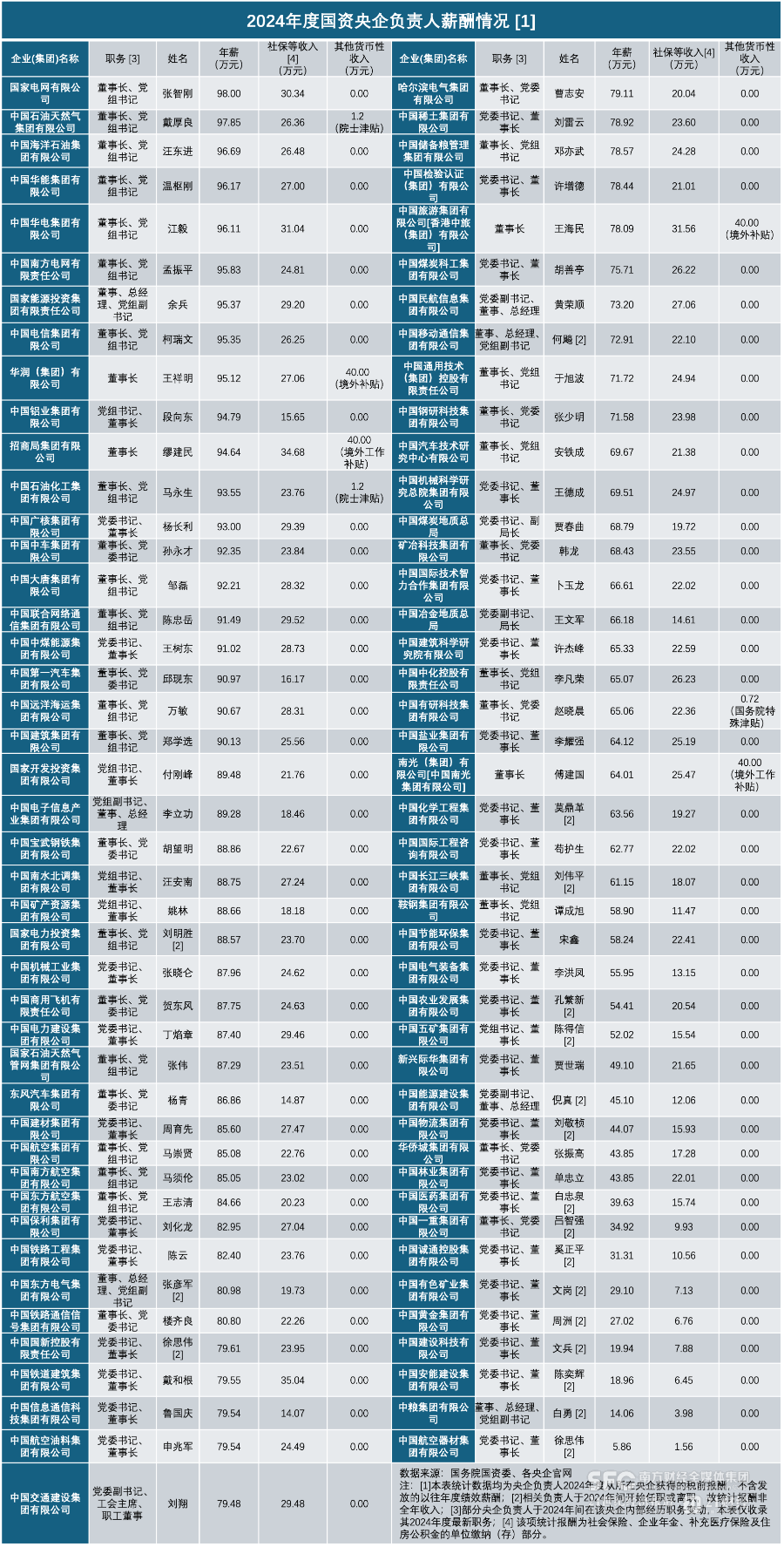
超20位央企掌门人年薪超90万元
2 1 Shi Ji Jing Ji Bao Dao· 2026-01-18 22:43
Core Viewpoint - The State-owned Assets Supervision and Administration Commission (SASAC) disclosed the 2024 salary information for 87 central enterprises, highlighting that 20 of these enterprises have executives earning over 900,000 yuan annually, primarily in the energy and power sectors [2][5]. Group 1: Salary Information - Among the 87 central enterprises, 20 executives have annual salaries exceeding 900,000 yuan, with 9 of them earning over 950,000 yuan [5][6]. - The highest reported salary is 980,000 yuan for Zhang Zhigang, Chairman of State Grid Corporation, reflecting his dual roles in 2024 [6][9]. - Other notable salaries include 978,500 yuan for Dai Houliang of China National Petroleum Corporation and 966,900 yuan for Wang Dongjin of China National Offshore Oil Corporation [9][10]. Group 2: Industry Focus - The energy and power sector dominates the high salary rankings, with major players like State Grid, China National Petroleum, and China Southern Power Grid leading the list [6][9]. - In the Guangdong-Hong Kong-Macau Greater Bay Area, four central enterprises have executives earning over 900,000 yuan, including China Southern Power Grid and China General Nuclear Power Group [11][12]. - The performance of these enterprises is strong, with State Grid reporting total revenue of 3.9459 trillion yuan and net profit of 77.298 billion yuan for 2024 [9][12]. Group 3: Performance Metrics - China Southern Power Grid achieved total assets of 1.3491 trillion yuan and revenue of 853.4 billion yuan in 2024, with a net profit of 19.7 billion yuan [11][12]. - China General Nuclear Power Group reported revenue of approximately 86.804 billion yuan, with a net profit of about 10.814 billion yuan [13]. - The overall performance of these enterprises indicates a robust financial health, contributing to their high executive compensation [9][10].





聚焦 | 从教育、科技、人才三维视角看国企重组整合
Sou Hu Cai Jing· 2026-01-16 09:06
Core Viewpoint - The article emphasizes that strategic restructuring and professional integration are two core paths in the current state-owned enterprise (SOE) reform, which complement each other to optimize state capital layout and enhance core functions [1] Group 1: Strategic Restructuring and Professional Integration - Strategic restructuring focuses on core responsibilities, reducing redundant investments and homogeneous competition, and emphasizes structural optimization through cross-industry and cross-enterprise resource integration [1] - Professional integration targets niche areas, enhancing technological breakthroughs and innovation collaboration, focusing on functional reinforcement [1] Group 2: Educational Perspective - Restructuring promotes the construction of platforms for industry-education integration and innovative customized talent training, as seen in Hunan's construction company, which restructured its talent development system through property rights reform [1] - The integration of education, talent, and industry chains is facilitated, creating a comprehensive mechanism from basic research to industrialization [4] Group 3: Technological Perspective - Strategic restructuring breaks innovation barriers and promotes interdisciplinary technology integration, as demonstrated by the merger of Baosteel and Wuhan Steel, which enhanced R&D investment intensity and achieved breakthroughs in high-end steel and smart manufacturing [3] - Professional integration is crucial for overcoming "bottleneck" technologies, as exemplified by China Railway's consolidation of R&D resources, leading to advancements in high-speed rail technology [3] Group 4: Innovation Ecosystem Construction - Restructuring fosters collaborative innovation mechanisms by breaking down departmental barriers, ensuring effective alignment between research and industrial needs [4] - The integration of resources across the entire industry chain, as seen in China Shipbuilding Group, has led to significant technological advancements in LNG transport and large cruise ships [4] Group 5: Digital Transformation Empowerment - Restructuring supports the intelligent transformation of traditional industries by optimizing production processes and resource allocation, significantly enhancing production efficiency [5] - The integration of digital technologies in high-end equipment manufacturing is exemplified by China Shipbuilding Group's application of digital twins and virtual reality in ship design and operation [6] Group 6: Talent Perspective - Restructuring enhances talent structure through the aggregation of high-end talent and precise allocation of key positions, as demonstrated by China National Chemical Corporation's establishment of a talent ladder system [10] - Innovative talent incentive mechanisms are introduced, transitioning from a position-oriented to a value-creation-oriented compensation system, enhancing employee retention and growth [11] Group 7: Future Outlook - The article suggests that SOEs should further develop an open talent system, break down institutional barriers, and promote cross-enterprise talent mobility while strengthening innovation ecosystem construction [13]



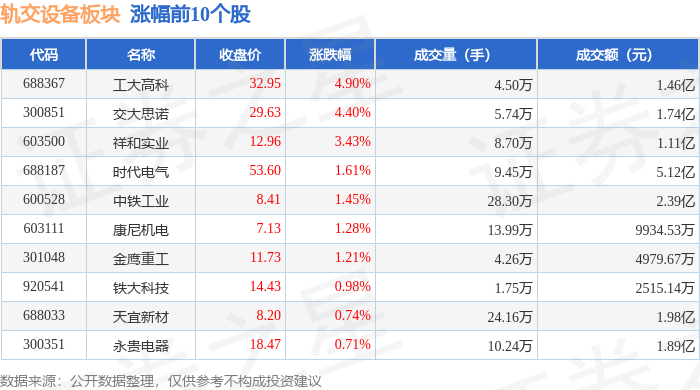
轨交设备板块1月16日跌0.62%,必得科技领跌,主力资金净流出7908.29万元
Zheng Xing Xing Ye Ri Bao· 2026-01-16 08:56
Market Overview - The rail transit equipment sector experienced a decline of 0.62% on January 16, with Bidu Technology leading the drop [1] - The Shanghai Composite Index closed at 4101.91, down 0.26%, while the Shenzhen Component Index closed at 14281.08, down 0.18% [1] Stock Performance - Notable gainers in the rail transit equipment sector included: - Gongda Gaoke (688367) with a closing price of 32.95, up 4.90% on a trading volume of 45,000 shares and a turnover of 146 million yuan [1] - Jiaoda Sino (300851) closed at 29.63, up 4.40% with a trading volume of 57,400 shares and a turnover of 174 million yuan [1] - Xianghe Industry (603500) closed at 12.96, up 3.43% with a trading volume of 87,000 shares and a turnover of 111 million yuan [1] Fund Flow Analysis - The rail transit equipment sector saw a net outflow of 79.08 million yuan from institutional investors, while retail investors experienced a net outflow of 75.46 million yuan [2] - Conversely, speculative funds recorded a net inflow of 155 million yuan [2] Individual Stock Fund Flow - China Railway Industry (600528) had a net inflow of 37.40 million yuan from institutional investors, but a net outflow of 34.22 million yuan from retail investors [3] - China Communication Signal (688009) saw a net inflow of 3.34 million yuan from institutional investors, while retail investors had a net outflow of 55.10 million yuan [3] - Xianghe Industry (603500) experienced a net inflow of 16.07 million yuan from institutional investors, with retail investors seeing a net outflow of 4.64 million yuan [3]





中国中车跌2.03%,成交额11.81亿元,主力资金净流出1.26亿元
Xin Lang Zheng Quan· 2026-01-16 06:02
Group 1 - The core viewpoint of the news is that China CRRC's stock has experienced a decline, with a notable drop in trading volume and market capitalization, indicating potential investor concerns [1] - As of January 16, the stock price of China CRRC was reported at 6.74 yuan per share, with a total market capitalization of 193.43 billion yuan [1] - The company has seen a year-to-date stock price decrease of 1.17%, with a 4.13% drop over the last five trading days and a 13.70% decline over the past 60 days [1] Group 2 - For the period from January to September 2025, China CRRC achieved operating revenue of 183.87 billion yuan, reflecting a year-on-year growth of 20.50%, and a net profit attributable to shareholders of 9.96 billion yuan, up 37.53% year-on-year [2] - The company has distributed a total of 63.60 billion yuan in dividends since its A-share listing, with 20.66 billion yuan distributed in the last three years [3] - As of September 30, 2025, the number of shareholders for China CRRC was reported at 498,200, a decrease of 2.91% from the previous period [2]
中国中车集团董事长:2026年CR450动车组样车将全面进行运用考核与设计优化
Zheng Quan Shi Bao Wang· 2026-01-16 05:11
Core Viewpoint - The article highlights significant advancements in China's railway technology, particularly the CR450 high-speed train, which is set to enter operational testing by 2026, marking a milestone in China's high-speed rail capabilities [1] Group 1: CR450 High-Speed Train - The CR450 train, developed by China CRRC Group, will undergo comprehensive operational testing and design optimization in 2026, indicating the imminent application of China's 400 km/h high-speed rail technology [1] - The CR450 is noted as the fastest high-speed train globally, featuring enhanced safety, energy efficiency, and passenger comfort [1] Group 2: Other Developments by China CRRC Group - In addition to the CR450, China CRRC Group plans to advance the operational testing of 200 km/h electric multiple units and 160 km/h diesel multiple units [1] - The company is also working on the development and demonstration of the standard metro 2.0 vehicles and aims to complete testing and finalization of the 20 MW offshore wind turbine "Qihang" [1]
今年 央企有哪些大国重器值得期待
Ren Min Ri Bao· 2026-01-15 22:16
Group 1: Central Enterprises' Responsibilities and Innovations - Central enterprises are urged to recognize their responsibilities and contribute to high-quality economic and social development, improve people's livelihoods, and support the modernization of China [1] - The State-owned Assets Supervision and Administration Commission has selected the top ten national key projects and super-engineering initiatives for central enterprises in 2025 [1] Group 2: China National Petroleum Corporation (CNPC) - CNPC's ethylene project in Dushanzi, Tarim, with a capacity of 1.2 million tons/year, is set to be completed in 2026, featuring over 98% localization of equipment and a green production model [2] - CNPC aims to enhance energy security by accelerating domestic oil and gas exploration and development, and expanding international energy cooperation [2] Group 3: National Petroleum and Natural Gas Pipeline Group - The Sichuan section of the "West-to-East Gas Transmission" project has been completed, increasing gas transmission capacity by approximately 14 billion cubic meters annually [4] - The company plans to implement innovative actions to support the construction of a new energy infrastructure focused on flexible energy conversion and efficient distribution [5] Group 4: China Electronics Corporation - The company aims to develop a complete domestic EDA tool system and high-performance chips by 2026, enhancing the "China Chip" capability [6] - China Electronics will focus on integrating the entire semiconductor industry chain, including design, manufacturing, and supply chain [7] Group 5: China Coal Energy Group - The liquid sunshine demonstration project in Inner Mongolia is expected to be operational in 2026, utilizing renewable energy to produce green hydrogen and methanol [8] - The company emphasizes the importance of technological innovation and aims to optimize its industrial layout towards clean and efficient coal utilization [9] Group 6: China National Building Material Group - The world's first zero-carbon intelligent manufacturing base for fiberglass is expected to be operational in 2026, using 100% green electricity [10] - The company plans to enhance its research and development efforts to support the modernization of the materials industry [11] Group 7: China Railway Rolling Stock Corporation (CRRC) - The CR450 high-speed train, capable of reaching speeds of 400 km/h, will undergo comprehensive testing in 2026, marking a significant advancement in China's high-speed rail technology [12] - CRRC aims to strengthen its innovation capabilities and maintain its leadership in the rail transportation equipment sector [12]



轨交设备板块1月14日跌1.35%,今创集团领跌,主力资金净流出4.99亿元
Zheng Xing Xing Ye Ri Bao· 2026-01-14 08:58
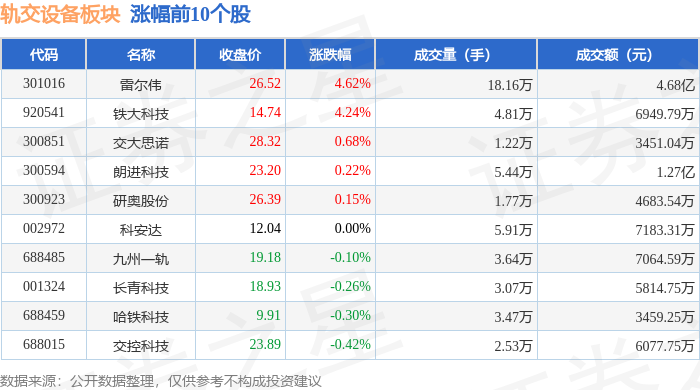
Market Overview - The rail transit equipment sector experienced a decline of 1.35% on January 14, with Jin Chuang Group leading the drop [1] - The Shanghai Composite Index closed at 4126.09, down 0.31%, while the Shenzhen Component Index closed at 14248.6, up 0.56% [1] Stock Performance - Notable gainers in the rail transit equipment sector included: - Railway Technology (301016) with a closing price of 26.52, up 4.62% on a trading volume of 181,600 shares and a transaction value of 468 million [1] - Tieda Technology (920541) closed at 14.74, up 4.24% with a trading volume of 48,100 shares and a transaction value of 69.5 million [1] - Conversely, Jin Chuang Group (603680) closed at 16.24, down 2.75% with a trading volume of 118,700 shares [2] Capital Flow - The rail transit equipment sector saw a net outflow of 499 million from institutional investors, while retail investors contributed a net inflow of 326 million [2] - The capital flow for key stocks included: - Railway Technology (301016) had a net inflow of 14.77 million from institutional investors, but a net outflow of 17.99 million from retail investors [3] - Tieda Technology (920541) experienced a net inflow of 4.54 million from institutional investors and a net inflow of 1.81 million from retail investors [3]
轨交设备板块1月13日跌0.98%,今创集团领跌,主力资金净流出2.35亿元


Zheng Xing Xing Ye Ri Bao· 2026-01-13 09:06
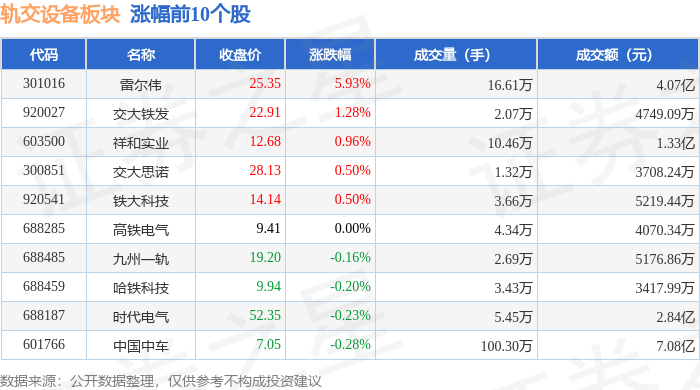
Market Overview - The rail transit equipment sector experienced a decline of 0.98% on January 13, with Jin Chuang Group leading the drop [1] - The Shanghai Composite Index closed at 4138.76, down 0.64%, while the Shenzhen Component Index closed at 14169.4, down 1.37% [1] Stock Performance - Notable gainers in the rail transit equipment sector included: - Railway Technology (301016) with a closing price of 25.35, up 5.93% on a trading volume of 166,100 shares and a transaction value of 407 million [1] - Jiaotong Iron and Steel (920027) closed at 22.91, up 1.28% with a trading volume of 20,700 shares [1] - Conversely, significant decliners included: - Jin Chuang Heavy Group (603680) which fell by 6.29% to a closing price of 16.70 [2] - Zhonghe Technology (000925) down 4.49% to 9.35 [2] Capital Flow - The rail transit equipment sector saw a net outflow of 235 million from institutional investors, while retail investors contributed a net inflow of 188 million [2] - The sector's capital flow details indicate: - China CNR (601766) had a net inflow of 36.78 million from institutional investors, but a net outflow of 42.75 million from retail investors [3] - Railway Technology (301016) also saw a net inflow of 35.21 million from institutional investors, with retail investors withdrawing 27.69 million [3]
轨交设备板块1月12日涨1.57%,朗进科技领涨,主力资金净流入8502.4万元
Zheng Xing Xing Ye Ri Bao· 2026-01-12 09:10
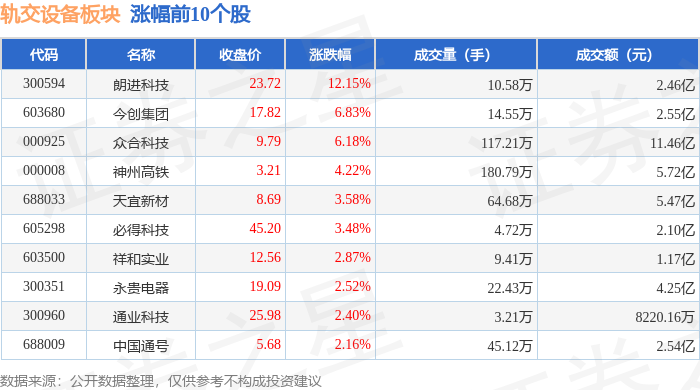
Core Insights - The railway transportation equipment sector experienced a 1.57% increase on January 12, with Langjin Technology leading the gains [1] - The Shanghai Composite Index closed at 4165.29, up 1.09%, while the Shenzhen Component Index closed at 14366.91, up 1.75% [1] Sector Performance - Langjin Technology (300594) closed at 23.72, up 12.15% with a trading volume of 105,800 shares [1] - Jinchuan Group (603680) closed at 17.82, up 6.83% with a trading volume of 145,500 shares [1] - Zhonghe Technology (000925) closed at 9.79, up 6.18% with a trading volume of 1,172,100 shares [1] - Shenzhou High-speed Railway (000008) closed at 3.21, up 4.22% with a trading volume of 1,807,900 shares [1] - Tianzhizhi New Materials (688033) closed at 8.69, up 3.58% with a trading volume of 646,800 shares [1] - Bidetech (605298) closed at 45.20, up 3.48% with a trading volume of 47,200 shares [1] - Xianghe Industrial (603500) closed at 12.56, up 2.87% with a trading volume of 94,100 shares [1] - Yonghui Electric (300351) closed at 19.09, up 2.52% with a trading volume of 224,300 shares [1] - Tongye Technology (300960) closed at 25.98, up 2.40% with a trading volume of 32,100 shares [1] - China Railway Signal & Communication (688009) closed at 5.68, up 2.16% with a trading volume of 451,200 shares [1] Capital Flow - The railway transportation equipment sector saw a net inflow of 85.024 million yuan from institutional investors, while retail investors experienced a net outflow of 38.8308 million yuan [1] - Major stocks like China CRRC (601766) had a net inflow of 81.3475 million yuan, while Shenzhou High-speed Railway (000008) had a net inflow of 66.1107 million yuan [2] - Retail investors showed significant outflows in several stocks, including Shenzhou High-speed Railway with a net outflow of 6.43381 million yuan [2]


欧盟FSR触发“过量申报”和业界不满,中企如何捍卫确定性
Di Yi Cai Jing· 2026-01-11 10:44
Core Insights - The EU's Foreign Subsidies Regulation (FSR) has led to over 200 transactions being reported to the European Commission by mid-October 2025, significantly exceeding the initial estimate of 30 transactions per year [1][4] - The FSR's broad applicability and complex reporting requirements have created substantial compliance burdens and uncertainties for both the EU and multinational transaction participants [1][5] Group 1: FSR Implementation and Impact - The FSR has triggered a large number of submissions, with nearly half (47%) of reported transactions involving EU investors, many of which have no clear connection to jurisdictions outside the EU [4] - Compliance procedures under the FSR are burdensome, requiring companies to detail all foreign financial support received over the past three years, often necessitating cross-departmental collaboration [5] - The European Commission has initiated an evaluation of the FSR, responding to feedback that the current review system is cumbersome and slows down transaction processes [5][6] Group 2: Future Developments and Regulatory Adjustments - Future enforcement of the FSR is expected to become more targeted, with potential simplification of review processes for low-risk transactions while maintaining vigilance for those in critical sectors [2] - A draft guideline from the European Commission aims to clarify the application of key FSR provisions, including the assessment of distortive effects and the initiation of pre-review for transactions below the reporting threshold [6] Group 3: Impact on Chinese Enterprises - Chinese enterprises have faced significant regulatory challenges under the FSR, with the Chinese Ministry of Commerce highlighting the adverse effects on their operations in Europe [7][8] - Reports indicate that Chinese companies' bids for public procurement projects are increasingly subjected to second-stage reviews by the European Commission, reflecting heightened scrutiny [8] - High-risk sectors for Chinese enterprises include automotive, pharmaceuticals, energy, battery, and chemicals, with state-owned enterprises being particularly vulnerable to investigations [8][9] Group 4: Strategic Recommendations for Enterprises - Despite regulatory obstacles, international expansion remains an irreversible trend, necessitating companies to identify viable investment opportunities within complex regulatory frameworks [9] - Companies are advised to conduct thorough risk assessments and develop effective response plans to navigate the regulatory landscape successfully [9]