EBSCN(601788)
Search documents
——2025年12月份债券托管量数据点评:商业银行持续增持利率债
EBSCN· 2026-01-19 09:27
1. Report Industry Investment Rating No relevant content provided. 2. Core Viewpoints of the Report - The total bond custody increased less on a month - on - month basis. In December 2025, the total bond custody of China Central Depository & Clearing Co., Ltd. (CCDC) and Shanghai Clearing House was 178.55 trillion yuan, with a net increase of 0.30 trillion yuan compared to the previous month, and 1.18 trillion yuan less than the month - on - month increase in November [1][11]. - In terms of the bond holder structure, among the allocation portfolios, except for credit cooperatives, all institutions increased their bond holdings; trading portfolios and overseas institutions decreased their bond holdings. Different institutions showed different trends in holding various types of bonds [2][26]. - The balance of bonds to be repurchased increased seasonally, and the bond market leverage ratio rose on a month - on - month basis. As of the end of December 2025, the estimated balance of repurchase - style repurchase of bonds to be repurchased was 11.91 trillion yuan, an increase of 859.04 billion yuan compared to the previous month. The leverage ratio was 107.14%, up 0.54 percentage points month - on - month and down 1.10 percentage points year - on - year [4][47]. 3. Summary by Related Catalogs 3.1 Bond Custody Total and Structure - The total bond custody increased less on a month - on - month basis. As of the end of December 2025, the total bond custody of CCDC and Shanghai Clearing House was 178.55 trillion yuan, with a net increase of 0.30 trillion yuan compared to the previous month, and 1.18 trillion yuan less than the month - on - month increase in November [1][11]. - By variety, interest - rate bonds, credit bonds, and financial bonds increased on a net basis month - on - month, while negotiable certificates of deposit (NCDs) decreased on a net basis. In December 2025, the custody of interest - rate bonds was 124.63 trillion yuan, accounting for 69.80% of the inter - bank bond market custody, with a net increase of 0.69 trillion yuan; the custody of credit bonds was 19.15 trillion yuan, accounting for 10.73%, with a net increase of 0.02 trillion yuan; the custody of non - policy financial bonds was 12.93 trillion yuan, accounting for 7.24%, with a net increase of 0.13 trillion yuan; the custody of NCDs was 19.69 trillion yuan, accounting for 11.03%, with a net decrease of 0.62 trillion yuan [1][11]. 3.2 Bond Holder Structure and Changes 3.2.1 Month - on - Month Changes in Custody by Institution - Among the allocation portfolios, except for credit cooperatives, all institutions increased their bond holdings; trading portfolios and overseas institutions decreased their bond holdings. Specifically, policy banks increased their holdings of interest - rate bonds, NCDs, and credit bonds across the board; commercial banks and securities companies increased their holdings of interest - rate bonds but decreased their holdings of NCDs and credit bonds; non - legal person products increased their holdings of interest - rate bonds and credit bonds but decreased their holdings of NCDs; credit cooperatives and overseas institutions decreased their holdings of interest - rate bonds, NCDs, and credit bonds across the board [2][26]. 3.2.2 Month - on - Month Changes in Custody by Bond Type - The custody of treasury bonds continued to increase on a month - on - month basis. Policy banks and commercial banks continued to increase their holdings, while non - legal person products continued to decrease their holdings. - The custody of local government bonds continued to increase on a month - on - month basis, and all major institutions in the bond market increased their holdings. - The custody of policy - based financial bonds continued to increase on a month - on - month basis. Commercial banks continued to increase their holdings, while policy banks changed to significantly decrease their holdings. - The custody of NCDs continued to decrease on a month - on - month basis. Policy banks changed to increase their holdings, while non - legal person products significantly decreased their holdings. - The custody of enterprise bonds continued to decrease on a month - on - month basis, and all major institutions in the bond market decreased their holdings. - The custody of medium - term notes continued to increase on a month - on - month basis. Commercial banks and non - legal person products were the main institutions increasing their holdings. - The custody of short - term financing bills and super - short - term financing bills continued to decrease on a month - on - month basis, and commercial banks were the main institutions decreasing their holdings. - The custody of privately - placed debt instruments changed to a decrease, and commercial banks were the main institutions decreasing their holdings [3][28]. 3.2.3 Holder Structure of Major Bond Types - As of the end of December 2025, the holder structure of treasury bonds: commercial banks accounted for 69.21%, overseas institutions 5.25%, policy banks 11.61%, non - legal person products 7.72%, securities companies 2.50%, insurance institutions 2.57%, and credit cooperatives 1.13% [33]. - The holder structure of policy - based financial bonds: commercial banks accounted for 56.73%, non - legal person products 31.54%, overseas institutions 2.82%, credit cooperatives 3.15%, insurance institutions 1.89%, securities companies 0.93%, and policy banks 2.94% [35]. - The holder structure of local government bonds: commercial banks accounted for 71.83%, non - legal person products 9.83%, policy banks 11.81%, insurance institutions 4.92%, securities companies 1.02%, credit cooperatives 0.57%, and overseas institutions 0.02% [37]. - The holder structure of enterprise bonds: non - legal person products accounted for 55.48%, commercial banks 31.29%, securities companies 9.09%, insurance institutions 3.23%, policy banks 0.54%, credit cooperatives 0.28%, and overseas institutions 0.08% [39]. - The holder structure of medium - term notes: non - legal person products accounted for 60.33%, commercial banks 24.90%, securities companies 4.56%, nominal holder accounts (domestic) 3.67%, policy banks 3.24%, insurance institutions 2.26%, overseas institutions 0.21%, other 0.57%, and credit cooperatives 0.25% [41]. - The holder structure of short - term financing bills and super - short - term financing bills: non - legal person products accounted for 66.21%, commercial banks 26.47%, nominal holder accounts (domestic) 2.97%, securities companies 1.01%, policy banks 2.73%, other 0.29%, insurance institutions 0.14%, credit cooperatives 0.02%, and overseas institutions 0.15% [46]. - The holder structure of NCDs: non - legal person products accounted for 63.66%, commercial banks 22.09%, policy banks 2.22%, credit cooperatives 1.90%, other 4.15%, nominal holder accounts (domestic) 2.09%, securities companies 0.81%, overseas institutions 2.92%, and insurance institutions 0.16% [45]. 3.3 Bond Market Leverage Ratio Observation - The balance of bonds to be repurchased increased seasonally, and the bond market leverage ratio rose on a month - on - month basis. As of the end of December 2025, the estimated balance of repurchase - style repurchase of bonds to be repurchased was 11.91 trillion yuan, an increase of 859.04 billion yuan compared to the previous month. The leverage ratio was 107.14%, up 0.54 percentage points month - on - month and down 1.10 percentage points year - on - year [4][47].
证券板块1月19日跌0.22%,华林证券领跌,主力资金净流出18.66亿元
Zheng Xing Xing Ye Ri Bao· 2026-01-19 08:58
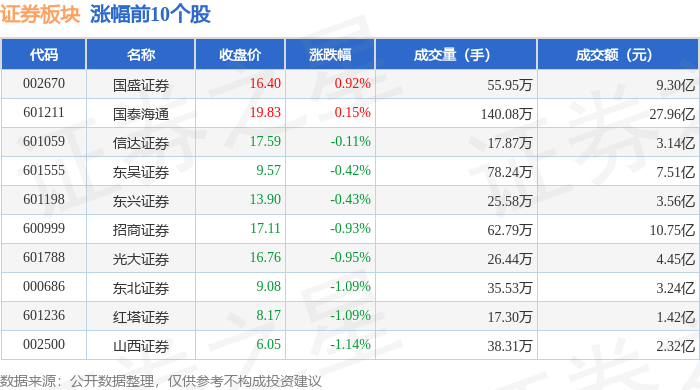
Market Overview - On January 19, the securities sector declined by 0.22%, with Huayin Securities leading the drop [1] - The Shanghai Composite Index closed at 4114.0, up 0.29%, while the Shenzhen Component Index closed at 14294.05, up 0.09% [1] Individual Stock Performance - Guolian Minsheng (601456) closed at 9.88, up 2.60% with a trading volume of 583,000 shares and a turnover of 577 million yuan [1] - Huayin Securities (002945) closed at 17.47, down 1.74% with a trading volume of 339,700 shares and a turnover of 594 million yuan [2] - Dongfang Caifu (300059) closed at 23.50, down 1.63% with a trading volume of 2,997,400 shares and a turnover of 7.065 billion yuan [2] Capital Flow Analysis - The securities sector experienced a net outflow of 1.866 billion yuan from institutional investors, while retail investors saw a net inflow of 1.136 billion yuan [2] - Major stocks like Guotai Junan (601211) had a net inflow of 118 million yuan from institutional investors, while retail investors had a net outflow of 66.72 million yuan [3] - The overall trend indicates a mixed sentiment among different investor types, with institutional investors pulling back while retail investors are more active [2][3]
光大证券:重视各国战略金属收储带来投资机会 全面看好战略金属价值重估
智通财经网· 2026-01-19 01:52
Core Viewpoint - The report from Everbright Securities highlights the increasing importance of strategic metals (copper, aluminum, cobalt, nickel, tin, antimony, tungsten, rare earths) due to supply disruptions and the limitations in production capacity in China and abroad [1][2]. Group 1: Strategic Metal Storage Initiatives - Australia announced a strategic reserve plan for critical minerals worth AUD 1.2 billion, with AUD 185 million allocated for necessary mineral reserves, prioritizing antimony, gallium, and rare earths [2] - The European Commission approved a resource revival action plan to raise EUR 3 billion for supply chain strategies, establishing a platform to support critical material reserves [2] - The U.S. Defense Logistics Agency (DLA) plans to procure USD 500 million in cobalt, USD 245 million in antimony, USD 100 million in tantalum, and USD 45 million in scandium [2] Group 2: Investment Opportunities in Strategic Metals - The focus on strategic metal storage in the U.S. and Australia presents significant investment opportunities, particularly in metals with concentrated supply chains and security risks, such as cobalt from the Democratic Republic of Congo and lithium from South America [3] - The rapid development of AI and energy transition is expected to drive demand for copper, aluminum, and tin, although supply constraints exist for these metals [4] - Military-related metals like tungsten, antimony, and rare earths are facing tightening supply, with production declines attributed to lower resource grades and regulatory controls [5] Group 3: Supply Concentration and Constraints - Copper, lithium, cobalt, and nickel supply is highly concentrated in South America, the Democratic Republic of Congo, and Indonesia, with Chile and Peru accounting for 35% of global copper production and the Democratic Republic of Congo producing 76% of global cobalt [4] - The rapid growth of AI is expected to significantly increase demand for copper, aluminum, and tin, but supply for these metals is constrained [4] - Tungsten, antimony, and rare earths are critical for military applications, but their production has decreased due to resource management practices and regulatory measures [5] Group 4: Investment Recommendations - For copper, recommended companies include Zijin Mining, Luoyang Molybdenum, and Western Mining [5] - For aluminum, Yunnan Aluminum is recommended, with China Aluminum as a focus [5] - For cobalt and nickel, Huayou Cobalt is recommended, with attention to Liqin Resources and Shengtun Mining [5] - For tungsten, focus on China Tungsten High-tech [5] - For tin, Xiyang Tin Industry is recommended, with interest in Xingye Silver Tin [5] - For antimony, Huaxi Nonferrous is highlighted, and for rare earths, Northern Rare Earth is recommended with a focus on China Rare Earth [5]
十大券商:轮动加快,聚焦这些板块!
天天基金网· 2026-01-19 01:00
Group 1 - The core viewpoint emphasizes a shift from narrative-driven trends to performance-based evaluations as the market enters the earnings forecast period, with a focus on sectors like chemicals, non-ferrous metals, and power equipment [2][5] - The adjustment of financing margin ratios is seen as a measure to stabilize the market and guide rational investment, indicating a potential shift towards a more balanced market environment [7][10] - The article highlights the acceleration of thematic rotation in the market, particularly focusing on domestic semiconductor and power sectors, driven by regulatory actions and strong demand [3][4] Group 2 - The market is expected to experience short-term fluctuations due to increased financing margin ratios and the cooling of previously hot themes, with a focus on sectors that show strong demand and industrial catalysts [4][8] - There is a recommendation for investors to adopt a cautious approach, focusing on sectors that benefit from structural changes and performance improvements, such as new energy and consumer goods [6][12] - The AI industry chain is identified as a key area for investment, with a consensus forming around its growth potential, despite some volatility in related sectors [13]
回归业绩!主题轮动加快,聚集这些板块
Zheng Quan Shi Bao Wang· 2026-01-19 00:45
Group 1 - The market is expected to experience a shift from a one-sided trend driven by narratives and capital to a more performance-focused environment as annual report forecasts approach [2][4] - The adjustment of financing margin ratios is seen as a signal to guide rational investment and maintain market stability, with a focus on sectors like traditional manufacturing and resource pricing [2][5] - The recent regulatory measures aim to prevent excessive speculation and market manipulation, leading to a more rational return of market sentiment [3][4] Group 2 - The focus is shifting towards sectors with strong demand support and industrial catalysts, particularly in low-position technology areas such as domestic computing power and new energy [3][4] - The upcoming earnings disclosures are expected to heighten the competitive sentiment around performance, with attention on sectors that may exceed expectations [4][9] - The market is likely to transition into a consolidation phase after reaching previous highs, with a recommendation for investors to adopt a stable allocation strategy [5][7] Group 3 - The "spring market" is facing short-term pressures due to various factors, including complex overseas macro environments and domestic regulatory intentions [6][8] - Despite recent market weaknesses, there is potential for continued upward movement in the AI application sector, driven by strong fundamentals [6][11] - The overall market valuation remains reasonable, supported by macro policies and a gradual recovery in corporate earnings [9][10]
【十大券商一周策略】回归业绩!主题轮动加快,聚焦这些板块
券商中国· 2026-01-18 15:07
Group 1 - The core viewpoint emphasizes a shift from narrative-driven trends to performance-based evaluations as the market enters the earnings forecast period, with a focus on sectors like chemicals, non-ferrous metals, and power equipment [2][5] - The adjustment of financing margins is seen as a part of counter-cyclical regulation, which does not affect the overall upward market trend but influences market structure [2][6] - The article suggests that a good investment combination should be based on "resources + traditional manufacturing pricing weight estimation," with recommendations to increase allocations in non-bank sectors and high-growth areas like semiconductors [2][6] Group 2 - The article discusses the acceleration of thematic rotation in the market, particularly focusing on domestic semiconductor and power sectors, driven by regulatory actions and increased demand for domestic computing power [3][4] - It highlights the importance of monitoring investor sentiment and market stability, suggesting that the current market may enter a period of volatility with potential for structural differentiation in investments [4][8] - The focus on performance-driven investment strategies is expected to intensify as companies begin to disclose earnings, with a recommendation to prioritize sectors that are likely to benefit from cyclical recovery and technological advancements [5][11] Group 3 - The article notes that the recent increase in financing margins reflects a policy signal aimed at guiding rational investment and maintaining market stability, which is crucial for the long-term bullish outlook [7][10] - It emphasizes that while the market may face short-term pressures, the underlying fundamentals and supportive policies are expected to sustain a gradual upward trend in the market [8][9] - The discussion includes the potential for new growth drivers post-holiday, with a focus on sectors like electronics, power equipment, and non-ferrous metals, as well as the ongoing interest in commercial aerospace [9][12] Group 4 - The article indicates that the AI industry chain is becoming a focal point for investment, with a notable shift in capital towards sectors related to AI applications and computing power [12] - It suggests that despite some funds exiting high-flying sectors, liquidity remains strong, allowing for continued investment in less leveraged sectors like chemicals and home appliances [12] - The overall sentiment is that the market is transitioning from rapid growth to a more stable and sustainable pace, with a focus on sectors that can provide solid returns amidst changing market dynamics [10][11]
研选 | 光大研究每周重点报告 20260103-20260109
光大证券研究· 2026-01-18 12:03
点击注册小程序 查看完整报告 特别申明: 本订阅号中所涉及的证券研究信息由光大证券研究所编写,仅面向光大证券专业投资者客户,用作新媒体形势下研究 信息和研究观点的沟通交流。非光大证券专业投资者客户,请勿订阅、接收或使用本订阅号中的任何信息。本订阅号 难以设置访问权限,若给您造成不便,敬请谅解。光大证券研究所不会因关注、收到或阅读本订阅号推送内容而视相 关人员为光大证券的客户。 市场观点纷繁芜杂,光大研究荟萃本周重点报告,涵盖总量、行业、公司研究,为您筛选有价值的 声音。 每周六早8点,"研选"助您快速厘清投资"点线面"! 发布日期: 2 0 2 6 / 0 1 / 1 2 分析师:张旭 行业研究 9个热点问题看理财新叙事——银行理财2025年回顾与2026年展望 总量研究 引入混合神经网络的中长期国债收益率预测——量化学习笔记之二 本文模型包含宏观经济、货币政策、市场情绪等输入变量来丰富学习维度,在 长短期记忆神经网络(LSTM)的基础上,引入门控神经网络(GRU)、卷积 神经网络(CNN)和注意力机制(ATT)构建多层混合神经网络模型,最优模 型预测:相较于2 0 2 6年1月末,2月末的十年期国债收益率将 ...
光大金工量化月报:未来6-12个月的投资收益率领先市场基准指数15%以上-20260117
EBSCN· 2026-01-17 09:45
行业及公司评级体系 | | 评级 | 说明 | | --- | --- | --- | | 行 | 买入 | 未来 6-12 个月的投资收益率领先市场基准指数 15%以上 | | 业 | 增持 | 未来 6-12 个月的投资收益率领先市场基准指数 5%至 15%; | | 及 | | | | 公 | 中性 | 未来 6-12 个月的投资收益率与市场基准指数的变动幅度相差-5%至 5%; | | 司 | 减持 | 未来 6-12 个月的投资收益率落后市场基准指数 5%至 15%; | | 评 | 卖出 | 未来 6-12 个月的投资收益率落后市场基准指数 15%以上; | | 级 | | | | | 无评级 | 因无法获取必要的资料,或者公司面临无法预见结果的重大不确定性事件,或者其他原因,致使无法给出明确的投资评级。 | | | 基准指数说明: | A 股市场基准为沪深 300 指数;香港市场基准为恒生指数;美国市场基准为纳斯达克综合指数或标普 500 指数。 | 分析、估值方法的局限性说明 本报告所包含的分析基于各种假设,不同假设可能导致分析结果出现重大不同。本报告采用的各种估值方法及模型均有其局限性,估值 ...
沪深两市单日成交额近4万亿 机构看好中资券商配置机会(附概念股)
Zhi Tong Cai Jing· 2026-01-16 12:46
Group 1 - The core viewpoint of the news is the adjustment of the minimum margin requirement for margin trading in the Shanghai and Shenzhen stock exchanges, increasing it from 80% to 100% for new margin contracts, which reflects a regulatory approach to stabilize the market and manage leverage [2][3] - The adjustment is expected to lead to a slowdown in the growth of margin financing in the short term, but it will create a more stable overall business environment for the securities industry [3] - The securities sector is anticipated to benefit from the migration of household deposits and the reconstruction of the stock market mechanism, which will support the growth of wealth management, investment banking, and institutional business [2][3] Group 2 - The adjustment of the margin requirement is seen as a measure to guide the market towards a healthier and more sustainable medium to long-term trend, similar to adjustments made in 2015 [2] - Companies in the securities industry, particularly those with strong capital and risk management capabilities, are recommended for investment opportunities [3] - The news highlights several Chinese securities firms listed in Hong Kong, including Huatai Securities, GF Securities, and China Galaxy, among others, indicating a broad interest in the sector [4]
直面转型阵痛!券商资管,最新布局曝光!
券商中国· 2026-01-16 04:22
Core Viewpoint - The brokerage asset management industry is undergoing significant changes due to two major events: the transition of public collective investment schemes ending by the end of 2025 and the obstacles faced in obtaining public fund licenses for brokerage asset management [1][2]. Group 1: Strategic Focus Areas - "Fixed Income +" and multi-asset allocation are identified as the two strategic focuses for brokerage asset management in 2026, aimed at meeting investor demand for stable returns in a low-interest-rate environment [3][6]. - Companies plan to enhance their competitive edge by developing differentiated strategies in areas such as Fund of Funds (FOF), equity, quantitative strategies, cross-border investments, and retirement products [3][4]. Group 2: Development of "Fixed Income +" Products - Brokerage firms are focusing on building a product lineup with varying risk characteristics in the "Fixed Income +" space, with firms like First Capital Asset Management emphasizing low-volatility products and ESG-focused offerings [4]. - Other firms, such as Caitong Asset Management, are refining their "Fixed Income +" strategies by creating a gradient of products from low to high volatility, while Guoxin Asset Management aims to expand its fixed income strategies while maintaining its traditional credit enhancement advantages [4]. Group 3: Multi-Asset and Diversified Strategies - Many firms are prioritizing multi-asset and diversified strategies, with Guangfa Asset Management planning to leverage its platform and digital capabilities to expand into "Fixed Income +", multi-strategy, and distinctive equity products [5]. - Caitong Asset Management is increasing its focus on QDII and retirement products, while Zhongtai Asset Management is set to emphasize FOF, active equity, and "Fixed Income +" products in 2026 [5]. Group 4: Passive Investment Tools - The trend towards passive investment is becoming increasingly significant, with firms developing index-enhanced and ETF products to improve asset allocation efficiency and reduce costs for clients [7][8]. - Companies like Guojin Asset Management are actively developing tool-based FOF and index-enhanced strategies, while Caitong Asset Management is working on a quantitative index-enhanced product line [8]. Group 5: Alternative Assets for Revenue Expansion - In the current low-interest-rate environment, alternative assets such as REITs, commodities, and derivatives are gaining traction as they offer low correlation with traditional assets and potential for enhanced returns [9][10]. - First Capital Asset Management has been a pioneer in public REITs investment and plans to deepen its involvement in this area, while Caitong Asset Management is focusing on a diversified investment approach that includes ABS and REITs [9][10].