
CEB BANK(601818)

Search documents
光大银行(601818) - 中国光大银行股份有限公司H股公告
2025-12-03 09:00
股份發行人及根據《上市規則》第十九B章上市的香港預託證券發行人的證券變動月報表 呈交日期: 2025年12月3日 本月底法定/註冊股本總額: RMB 59,085,551,061 FF301 I. 法定/註冊股本變動 | 1. 股份分類 | 普通股 | 股份類別 | H | | 於香港聯交所上市 (註1) | | 是 | | | --- | --- | --- | --- | --- | --- | --- | --- | --- | | 證券代號 (如上市) | 06818 | 說明 | | | | | | | | | | 法定/註冊股份數目 | | | 面值 | | 法定/註冊股本 | | | 上月底結存 | | | 12,678,735,500 | RMB | | 1 RMB | | 12,678,735,500 | | 增加 / 減少 (-) | | | 0 | | | RMB | | 0 | | 本月底結存 | | | 12,678,735,500 | RMB | | 1 RMB | | 12,678,735,500 | | 2. 股份分類 | 普通股 | 股份類別 | A | | 於香港聯交所上市 ...
光大银行:深耕普惠金融 以“金融底肥”滋养乡村振兴沃野良田
Xin Hua She· 2025-12-03 08:57
Core Viewpoint - China Everbright Bank is committed to promoting inclusive finance as a strategic priority, focusing on rural revitalization and addressing the challenges faced by rural areas in accessing financial services [1][2][3] Group 1: Inclusive Financial Products - The bank has innovated the "Huinong Loan" product to better serve agricultural clients, creating a series of loans such as Sunshine Business Loan, Sunshine Planting Loan, Sunshine Breeding Loan, and Sunshine Agricultural Chain Loan, with a total loan scale reaching 2.5 billion yuan across 11 provinces [1] Group 2: Integration into Agricultural Ecosystem - China Everbright Bank has integrated its services into the agricultural industry chain, establishing strategic partnerships with agricultural guarantee companies and leading enterprises to create a comprehensive inclusive financial service ecosystem [2] - Successful loan projects include 90 million yuan for garlic in Jinan and over 1.3 billion yuan for sugarcane in Nanning, demonstrating significant support for farmers [2] Group 3: Service Optimization - The bank is enhancing the convenience, accessibility, and precision of its inclusive financial services by optimizing approval processes and leveraging financial technology, ensuring that financial resources effectively contribute to agricultural production and farmers' income [2] Group 4: Future Commitment - Looking ahead, China Everbright Bank aims to deepen its integration into the national rural revitalization strategy, continuously enriching its inclusive financial services and expanding its service boundaries to support agricultural operators [3]
中国光大银行(06818) - 截至二零二五年十一月三十日止月份之股份发行人的证券变动月报表
2025-12-03 08:30
股份發行人及根據《上市規則》第十九B章上市的香港預託證券發行人的證券變動月報表 截至月份: 2025年11月30日 狀態: 新提交 致:香港交易及結算所有限公司 公司名稱: 中國光大銀行股份有限公司(於中華人民共和國註冊成立的股份有限公司) 呈交日期: 2025年12月3日 I. 法定/註冊股本變動 | 1. 股份分類 | 普通股 | 股份類別 | H | | 於香港聯交所上市 (註1) | | 是 | | | --- | --- | --- | --- | --- | --- | --- | --- | --- | | 證券代號 (如上市) | 06818 | 說明 | | | | | | | | | | 法定/註冊股份數目 | | | 面值 | | 法定/註冊股本 | | | 上月底結存 | | | 12,678,735,500 | RMB | | 1 RMB | | 12,678,735,500 | | 增加 / 減少 (-) | | | 0 | | | RMB | | 0 | | 本月底結存 | | | 12,678,735,500 | RMB | | 1 RMB | | 12,678,735,500 ...
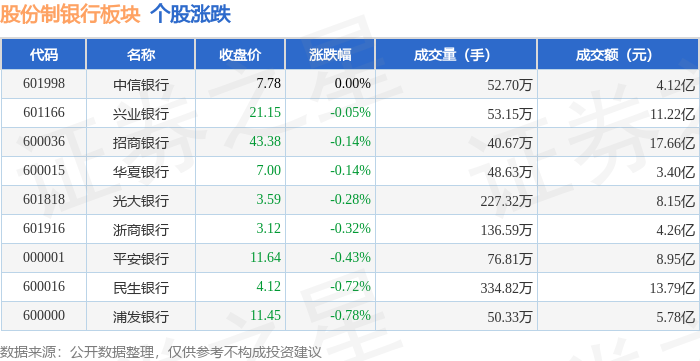
股份制银行板块12月2日跌0.26%,浦发银行领跌,主力资金净流出4.26亿元
Zheng Xing Xing Ye Ri Bao· 2025-12-02 09:05
Market Overview - On December 2, the shareholding banks sector declined by 0.26% compared to the previous trading day, with Pudong Development Bank leading the decline [1] - The Shanghai Composite Index closed at 3897.71, down 0.42%, while the Shenzhen Component Index closed at 13056.7, down 0.68% [1] Individual Bank Performance - Citic Bank (601998) closed at 7.78 with no change in price, trading volume of 527,000 shares, and a transaction value of 412 million yuan [1] - Industrial Bank (601166) closed at 21.15, down 0.05%, with a trading volume of 531,500 shares and a transaction value of 1.122 billion yuan [1] - China Merchants Bank (600036) closed at 43.38, down 0.14%, with a trading volume of 406,700 shares and a transaction value of 1.766 billion yuan [1] - Huaxia Bank (600015) closed at 7.00, down 0.14%, with a trading volume of 486,300 shares and a transaction value of 340 million yuan [1] - Everbright Bank (601818) closed at 3.59, down 0.28%, with a trading volume of 2.2732 million shares and a transaction value of 815 million yuan [1] - Zhejiang Commercial Bank (601916) closed at 3.12, down 0.32%, with a trading volume of 1.3659 million shares and a transaction value of 426 million yuan [1] - Ping An Bank (000001) closed at 11.64, down 0.43%, with a trading volume of 768,100 shares and a transaction value of 895 million yuan [1] - Minsheng Bank (600016) closed at 4.12, down 0.72%, with a trading volume of 3.3482 million shares and a transaction value of 1.379 billion yuan [1] - Pudong Development Bank (600000) closed at 11.45, down 0.78%, with a trading volume of 503,300 shares and a transaction value of 578 million yuan [1] Capital Flow Analysis - The shareholding banks sector experienced a net outflow of 426 million yuan from main funds, while speculative funds saw a net inflow of 242 million yuan, and retail investors had a net inflow of 183 million yuan [1] - Citic Bank had a main fund net inflow of 56.67 million yuan, while retail investors contributed a net inflow of 8.34 million yuan [2] - Huaxia Bank saw a main fund net inflow of 20.20 million yuan, but retail investors had a net outflow of 1.99 million yuan [2] - Pudong Development Bank experienced a main fund net inflow of 0.89 million yuan, with a net outflow from retail investors of 32.71 million yuan [2] - Minsheng Bank had a significant main fund net outflow of 96.31 million yuan, while speculative funds saw a net inflow of 61.08 million yuan [2] - Industrial Bank faced a main fund net outflow of 101 million yuan, but retail investors contributed a net inflow of 82.80 million yuan [2]






中国金融板块-追踪工业风险:制造业固定资产投资增速显著放缓,助力更快管控风险-China Financials-Tracking industrial risks further notable slowdown in manufacturing FAI growth to help contain risks more quickly
2025-12-02 02:08
Summary of Key Points from the Conference Call Industry Overview - **Industry**: China Financials, specifically focusing on manufacturing and infrastructure investments in China [1][5][7] Core Insights and Arguments - **Manufacturing FAI Growth**: There has been a notable slowdown in manufacturing Fixed Asset Investment (FAI) growth, dropping to 2.7% year-over-year (yoy) from 4.0% yoy in the previous month, indicating steady progress on capital expenditure (capex) slowdown [7] - **Liability Growth**: Total liability growth for industrial firms moderated to 5.0% yoy, while manufacturing firms saw a slight increase to 5.9% yoy. This moderation is expected to lead to more rational capacity expansion [2][7] - **Revenue Decline**: Manufacturing revenue declined by 4.3% yoy, attributed to lower production levels due to overcapacity control efforts. The Value-Added Industrial (VAI) growth also slowed to 4.9% yoy from 6.5% yoy in September [3][10] - **Profit Growth**: Manufacturing profit growth moderated to 7.7% yoy from 9.9% yoy in September, influenced by higher financing costs and lower production [10] Future Outlook - **Infrastructure Investment**: A potential increase in infrastructure investments, supported by a new RMB 500 billion fund from the China Development Bank, is expected to bolster demand in 2026 and aid in the digestion of overcapacity risks [8][3] - **Sector Performance**: 77.1% of sectors experienced a slowdown in capex in October 2025 compared to the first half of 2025, while 39.3% of sectors showed profit improvement [9][7] Additional Important Information - **PPI Trends**: The Producer Price Index (PPI) rebounded month-over-month for the first time since December 2024, with the year-over-year decline narrowing to 2.1% [7] - **Investment Sentiment**: The overall sentiment towards the China Financials sector remains attractive, with ongoing efforts in financial tightening contributing to anti-involution measures [5][4] This summary encapsulates the critical insights from the conference call, highlighting the current state and future expectations of the manufacturing and financial sectors in China.





【华创金融 徐康团队】红利资产月报:多因素催化银行股涨幅居前,地产风险可控
Xin Lang Cai Jing· 2025-12-01 15:07
Monthly Performance - The banking sector increased by 2.99% from November 1 to November 28, 2025, outperforming the CSI 300 index by 5.4 percentage points, ranking second among 31 Shenwan first-level industries [1][6] - Institutional investors increased their holdings in bank stocks due to a stable improvement in fundamentals, shareholder buybacks, and expectations of valuation recovery [1][6] Valuation Trends - State-owned banks saw a significant increase in valuation, with their PB ratio rising from approximately 0.76X at the beginning of the month to 0.78X by the end, while the PB ratios for joint-stock banks and city commercial banks remained stable at 0.67X and 0.60X, respectively [1][9] - As of November 28, the overall PE ratio for the banking sector was 6.53 times, with a historical percentile of 56.18%, and the PB ratio was 0.56 times, with a historical percentile of 32.25% [21] Individual Bank Performance - Notable gainers included Bank of China (8.20%), China Everbright Bank (8.08%), China Construction Bank (5.81%), and Nanjing Bank (5.13%), while Qingdao Bank and rural commercial banks experienced significant declines [1][12] - The performance of banks with improved earnings and mid-term dividend payouts led to notable increases in their stock prices [1][12] Market Environment - The 10-year government bond yield rose from around 1.80% in early November to 1.84% by the end of the month, while the 1-year bond yield remained stable at approximately 1.40% [16] - The trading volume in the banking sector increased by 13.07% year-on-year, accounting for 1.65% of the total trading volume in the AB share market, although it decreased by 0.18 percentage points compared to the previous month [19] Social Financing and Credit Trends - In October, the social financing growth rate fell to 8.5%, with new social financing of 816.1 billion yuan, a year-on-year decrease of 5.959 billion yuan [25] - The decline in credit supply was attributed to a shift in government bond issuance timing and a decrease in demand for consumer loans [25]



多因素催化银行股涨幅居前,地产风险可控:华创金融红利资产月报(2025年11月)-20251201
Huachuang Securities· 2025-12-01 09:13
Investment Rating - The report maintains a "Buy" rating for the banking sector, highlighting that multiple factors are driving the rise in bank stocks, while real estate risks are deemed manageable [2]. Core Insights - The report emphasizes that the balance between supply and demand is crucial for economic recovery, with recent policies aimed at boosting consumer demand expected to enhance this balance [2]. - The M1 growth rate peaked and has started to decline, indicating a shift in deposit flows towards non-bank deposits due to a buoyant capital market [2]. - The exposure to real estate risks is decreasing, with a notable reduction in the balance of real estate development loans, suggesting that banks are adopting a more cautious approach [2][7]. - The report notes that the non-performing loan ratio for real estate has decreased, indicating improved risk management within the banking sector [7]. Monthly Market Performance - In November 2025, the banking sector saw a cumulative increase of 2.99%, outperforming the CSI 300 index by 5.4 percentage points, ranking second among 31 sectors [11]. - The report indicates that institutional investors have increased their holdings in bank stocks, driven by a stable fundamental outlook and expectations of valuation recovery [11]. - The valuation of state-owned banks has shown significant improvement, with the price-to-book (PB) ratio rising from approximately 0.76X at the beginning of the month to 0.78X by the end [13]. Banking Sector Fundamentals - The report tracks monthly data indicating that the banking sector's core revenue-generating capacity has strengthened, with asset quality remaining stable [8]. - The report highlights that the banking sector's current valuation is at a historically low level, with a price-to-earnings (PE) ratio of 6.53 and a PB ratio of 0.56 [11]. Investment Recommendations - The report suggests a diversified investment strategy focusing on banks with high dividend yields and strong asset quality, particularly smaller banks with solid provisioning coverage [7]. - It also recommends attention to low-valuation joint-stock banks with potential for return on equity (ROE) improvement, such as CITIC Bank and Industrial Bank [7]. - The report indicates that banks with robust customer bases and excellent risk control are likely to have greater valuation elasticity in the context of economic structural transformation [7].
“创新服务+金融活水”双轮驱动 点燃“冰雪经济”热引擎
Yang Shi Wang· 2025-12-01 07:22
Group 1 - The core viewpoint of the articles highlights the rapid growth of winter tourism in China, particularly in regions like Heilongjiang and Xinjiang, driven by special train services and school holidays [1][3][9] - The first winter tourism train to Mohe, Heilongjiang, carried over 300 tourists, emphasizing a "slow travel, deep experience" approach, allowing visitors to enjoy the unique winter landscapes [3][5] - In Xinjiang, the introduction of the first "snow holiday" for students from December 1 to 5, combined with various discounts at ski resorts, is expected to boost local tourism and related economic activities [9][11] Group 2 - The transportation network in Mohe is expanding to meet the demands of the winter tourism peak, with additional train services and increased flight frequencies to connect with other tourist cities [9] - In Alatau, ski resorts are offering significant discounts for students, including free ski passes and reduced prices for rentals and dining, which is anticipated to attract more families and enhance local tourism [11][12] - The "Ice and Snow Go Crazy Festival" launched in Shenyang aims to transform cold resources into a vibrant economy through cross-regional financial collaboration and consumer incentives [13][15][17] Group 3 - The festival connects seven cities, creating a comprehensive service network to promote unique ice and snow experiences across different regions [15] - Financial services are being coordinated to support small and micro enterprises in the tourism sector, while also providing consumers with substantial discounts on travel-related expenses [19]

春风化雨润京华 光大银行北京分行服务首都实体经济高质量发展
Xin Jing Bao· 2025-12-01 02:25
Core Viewpoint - In 2025, China's economy is steadily advancing towards a new stage of high-quality development, with financial services playing a crucial role in supporting the real economy, as exemplified by the efforts of China Everbright Bank's Beijing branch in various sectors [1] Group 1: Supporting Private Economy - China Everbright Bank's Beijing branch has shifted from being a mere fund provider to a comprehensive service provider, addressing the financing challenges faced by small and micro enterprises through innovative supply chain financing models [2] - The bank has successfully implemented the "e-payment" financing product, leveraging the credit of core enterprises to provide flexible and low-cost financing to upstream small and micro suppliers [2][3] - As of September 2025, the bank has visited over 6,200 small micro enterprises, granting credit amounts exceeding 25.2 billion and disbursing over 15.4 billion, positioning itself among the top in Beijing's banking sector [3] Group 2: Elderly Financial Services - The bank has established specialized "Elderly Financial Service Centers," enhancing the professionalism and standardization of its services, with three branches recognized as such [4] - The bank has introduced seven exclusive services for elderly clients, including dedicated service personnel and educational activities to raise awareness about financial fraud [4][5] - By September 2025, the bank has opened 127,000 personal pension accounts with a total deposit amount of 230 million, leading the entire bank in this area [5] Group 3: Responsibility in Key Areas - The bank has actively participated in the financing coordination mechanism for urban real estate projects, providing nearly 2.5 billion in loans to support the stable development of the real estate market [7] - In response to extreme weather events, the bank demonstrated its emergency capabilities by quickly assisting over 80 migrant workers with banking services during severe rainfall in July 2025 [7] - The bank has conducted community outreach programs to enhance public awareness of anti-counterfeiting measures and fraud prevention [7] Group 4: Commitment to High-Quality Development - China Everbright Bank's Beijing branch emphasizes practical actions to fulfill its financial responsibilities, focusing on supporting the real economy and social welfare [8] - The bank aims to continue its commitment to the "financial for the people" philosophy, contributing to the economic and social development of the capital [8]
中信金融资产推动转型两年半赚175亿 持续优化业务增持光大银行或耗资39亿
Chang Jiang Shang Bao· 2025-12-01 01:08
Core Viewpoint - CITIC Financial Asset Management Company (02799.HK) has increased its stake in Everbright Bank to 9%, following a strategic plan to enhance its business channels and optimize its business structure [2][4]. Group 1: Stake Acquisition - CITIC Financial Asset has rapidly implemented its plan to acquire shares in Everbright Bank, spending approximately RMB 39 billion to achieve this [2][4]. - The company first entered Everbright Bank in March 2023 by converting 140 million convertible bonds into 4.185 billion A-shares, resulting in a 7.08% ownership stake [3]. - By November 2025, CITIC Financial Asset had increased its holdings to 9% through additional purchases of A-shares and H-shares [4]. Group 2: Financial Performance - From 2023 to the first half of 2025, CITIC Financial Asset reported a total net profit attributable to shareholders of RMB 175.52 billion [2][6]. - In the first half of 2025, the company achieved a total revenue of RMB 311.36 billion, with a net profit of RMB 61.68 billion, reflecting a year-on-year growth of 15.7% [6][7]. - The company's core business in non-performing asset management saw significant growth, with revenue reaching RMB 305.98 billion and a pre-tax profit of RMB 121.41 billion, marking increases of 58.3% and 522.4% respectively [7]. Group 3: Business Strategy - CITIC Financial Asset is focusing on expanding its non-performing asset management business while reducing traditional acquisition and restructuring activities [6][7]. - The company aims to leverage national policy opportunities and industry transitions to enhance its business structure and promote high-quality development in asset acquisition and disposal [7][8]. - As of mid-2025, CITIC Financial Asset's total assets reached RMB 1.01 trillion, with a 2.7% increase from the previous year [7].