
CEB BANK(601818)

Search documents
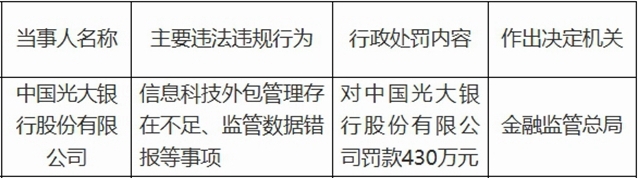
光大银行被金融监管总局罚430万元 涉监管数据错报等
Zhong Guo Jing Ji Wang· 2025-09-15 06:57
以下为原文: | 当事人名称 | 主要违法违规行为 | 行政处罚内容 | 作出决定机关 | | --- | --- | --- | --- | | 中国光大银 信息科技外包管理存 对中国光大银 | | | | | 行股份有限 在不足、监管数据错 行股份有限公 金融监管总局 | | | | | 公司 | 报等事项 | 司罚款430万元 | | (责任编辑:马欣) 中国经济网北京9月15日讯 国家金融监督管理总局网站近日公布的行政处罚信息公示列表显示,中国光 大银行股份有限公司涉及信息科技外包管理存在不足、监管数据错报等事项。金融监管总局依据相关法 律法规对中国光大银行股份有限公司罚款430万元。 ...


中国光大银行将在9月18日进行系统升级维护
Jin Tou Wang· 2025-09-15 02:58
Core Viewpoint - China Everbright Bank (601818) announced a system upgrade maintenance for its various online banking services to enhance service quality, which may affect the availability of certain services during the maintenance period [1] Group 1 - The system upgrade will take place on September 18, 2025, from 20:00 to 24:00 [1] - Affected services include personal mobile banking, personal online banking, corporate online banking, and other financial service platforms [1] - Customers are advised to make necessary arrangements in advance due to potential service disruptions [1]
金融为民显担当 光大信用卡以实干赋能消费升级
Sou Hu Cai Jing· 2025-09-15 02:55
Core Viewpoint - The company is actively enhancing consumer financial services in response to the evolving consumption market, aligning with national policies to stimulate and expand consumption [1][2]. Group 1: Policy Alignment - The company is integrating financial services with national policies aimed at boosting large-scale consumption and promoting the replacement of consumer goods [2]. - Initiatives include collaborations with automotive companies and charging infrastructure providers to alleviate concerns for electric vehicle owners, as well as promotional activities for fuel vehicle owners [2]. - In the consumer electronics and home appliance sectors, the company is optimizing installment services and offering discounts to lower the purchasing threshold for high-end technology products [2]. Group 2: Innovative Scenarios - The company is leveraging ecological thinking to activate consumer value by focusing on high-frequency essential scenarios [3]. - Collaborations with platforms like Meituan to provide discounts and incentives for daily meals integrate financial benefits into everyday life [3]. - The company is expanding installment payment options to digital platforms and enhancing its points system to encourage consumer spending across various demographics [3]. Group 3: Ecological Collaboration - The company is building a collaborative ecosystem that combines government guidance, financial empowerment, platform support, and consumer benefits [4]. - A partnership with JD.com allows customers to enjoy national subsidies on selected products while using the company's credit card for additional discounts, enhancing the shopping experience [4]. - The company aims to continue evolving its services to support national strategies and improve the quality of life for consumers [4].
股东高管密集出手 银行股增持潮涌
Bei Jing Shang Bao· 2025-09-14 17:06
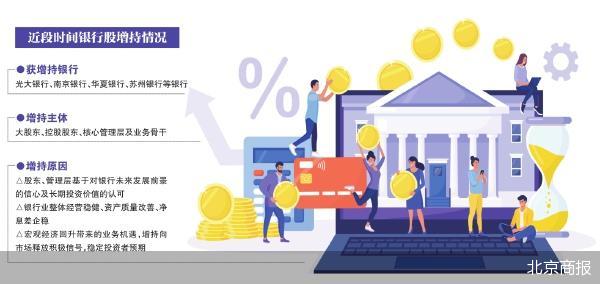
Core Viewpoint - The recent surge in share buybacks among A-share listed banks reflects confidence in their future development and the recognition of long-term investment value, supported by a stable banking industry fundamental and improved financial performance [1][5][6]. Group 1: Share Buyback Activities - Multiple listed banks, including Everbright Bank, Nanjing Bank, Huaxia Bank, and Suzhou Bank, have disclosed share buyback progress, involving major shareholders, core management, and key personnel [1][4]. - Everbright Bank's major shareholder plans to increase its stake by investing between 50 million to 100 million yuan, with a reported buyback of 13.97 million shares, amounting to approximately 51.66 million yuan [3]. - Nanjing Bank's major shareholder increased its stake by 5.68 million shares, raising its total holding from 12.56% to 13.02% [3]. Group 2: Financial Performance - In the first half of 2025, 42 listed banks in A-shares reported a total operating income of 2.92 trillion yuan and a net profit of approximately 1.1 trillion yuan, with over 60% of banks achieving growth in both metrics [1][7]. - The improvement in financial performance is accompanied by innovations in mid-term dividend mechanisms, enhancing the investment value of banks [7]. Group 3: Market Sentiment and Investment Value - The buybacks are seen as a positive signal to the market, reinforcing investor confidence in the banking sector's development [6]. - The banking sector is experiencing a valuation recovery, with banks previously trading at historical lows now showing signs of improvement in both valuation and performance [7][8]. - Long-term funds, including insurance and social security, are increasingly investing in bank stocks, further solidifying their investment value [8]. Group 4: Industry Transformation - The banking industry is undergoing a significant transformation, shifting from a scale-driven growth model to a more refined, quality-focused approach, which is expected to enhance capital efficiency and increase non-interest income [9]. - This transformation is crucial for investment strategies, as banks with low valuations, high dividends, and weak cyclical resilience will continue to play a vital role in asset allocation [9].



9家金融机构,被罚超1.5亿元
Shang Hai Zheng Quan Bao· 2025-09-13 08:37
Core Viewpoint - A number of financial institutions in China have been penalized by the Financial Regulatory Bureau, with total fines exceeding 150 million yuan, highlighting issues related to compliance and risk management practices across the sector [1][2]. Group 1: Penalties on Major Banks - Guangfa Bank and Hengfeng Bank were fined over 60 million yuan each, with Guangfa Bank receiving a fine of 66.7 million yuan due to imprudent management of loans, bills, and factoring, as well as non-compliance in regulatory data reporting [2]. - Hengfeng Bank was fined 61.5 million yuan for similar violations, including imprudent management of loans and regulatory data reporting [2]. - Both banks acknowledged the penalties and stated they have completed the necessary rectifications and are committed to improving their risk management frameworks [2]. Group 2: Other Financial Institutions Penalized - Huaxia Wealth Management was fined 12 million yuan for non-compliance in investment operations and regulatory data reporting [3]. - Several other institutions, including China Export-Import Bank, China Construction Bank, and Everbright Bank, received fines exceeding 1 million yuan for various compliance failures, such as inaccurate risk classification and inadequate management of outsourced IT services [4]. - Notably, China Export-Import Bank was fined 1.3 million yuan for inadequate country risk management, while Everbright Bank faced a fine of 4.3 million yuan for deficiencies in IT outsourcing management [4].


8家银行被罚1.487亿元!多张罚单,集中公布……
券商中国· 2025-09-13 05:16
Core Viewpoint - Multiple financial institutions have been fined by regulatory authorities for various compliance and operational deficiencies, highlighting the need for improved risk management and compliance systems across the sector [2][3][4]. Group 1: Penalties Overview - On September 12, the National Financial Regulatory Administration disclosed penalties against several financial institutions, with a total of 148.7 million yuan (approximately 21.1 million USD) imposed on 8 banks, 14.2 million yuan (approximately 2 million USD) on 2 wealth management companies, and 2.825 million yuan (approximately 400,000 USD) on 1 insurance company [2]. - The penalties stem from issues such as deficiencies in information technology and system management, weak risk management and internal controls, violations in investment and wealth management operations, and problems with data governance and reporting [2]. Group 2: Specific Violations by Banks - Several banks, including Guangfa Bank, Hengfeng Bank, Minsheng Bank, and others, received fines exceeding 1 million yuan for violations related to regulatory data misreporting and improper management of loans and wealth management [3]. - Guangfa Bank was fined 66.7 million yuan (approximately 9.5 million USD) for improper management of loans and regulatory data misreporting, with two responsible individuals fined a total of 100,000 yuan (approximately 14,000 USD) [3]. - Hengfeng Bank faced a fine of 61.5 million yuan (approximately 8.7 million USD) for similar violations, with four responsible personnel fined a total of 250,000 yuan (approximately 35,000 USD) [3]. Group 3: Wealth Management and Investment Violations - Wealth management and investment operations were significant areas of concern, with institutions like Huaxia Wealth Management fined 12 million yuan (approximately 1.7 million USD) for non-compliance in investment operations and data reporting [4]. - Citic Bank was fined 5.5 million yuan (approximately 780,000 USD) for inaccurate risk classification in wealth management assets, while its subsidiary, Xinyin Wealth Management, was fined 2.2 million yuan (approximately 310,000 USD) for regulatory non-compliance in product naming and investment ratios [4]. - In the insurance sector, Hengda Life Insurance faced penalties for severe non-compliance in fund utilization and management, resulting in fines totaling 2.825 million yuan (approximately 400,000 USD) for 20 responsible personnel [4]. Group 4: Policy Bank Penalties - The only policy bank involved in this round of penalties was the China Export-Import Bank, which was fined 1.3 million yuan (approximately 180,000 USD) for inadequate country risk management and salary payment management [5].


中国光大银行以更实举措服务高水平对外开放
Sou Hu Cai Jing· 2025-09-12 23:57
Group 1 - The global political and economic landscape is rapidly evolving since 2025, with increasing trade barriers and deep restructuring of supply chains [1] - China Everbright Bank is committed to serving the country's high-level opening-up with competitive overseas business, focusing on green finance and sustainable development [1] - In the first half of 2025, the bank's overseas institutions embedded ESG principles into the entire process of credit, investment, and risk control, achieving significant milestones in green loans and bonds [1] Group 2 - The bank actively supports high-level opening-up by aligning cross-border financial services with national strategic initiatives, such as the Guangdong-Hong Kong-Macao Greater Bay Area [2] - In the first half of 2025, the Hong Kong branch facilitated a loan of 100 million HKD for infrastructure projects, enhancing regional integration [2] - The establishment of RMB interbank accounts in multiple overseas branches has effectively expanded cross-border RMB financing channels, contributing to the internationalization of the RMB [2] Group 3 - The bank is enhancing cross-border financial service solutions to meet the needs of enterprises going abroad, focusing on key sectors like infrastructure, energy transition, and digital economy [3] - The "Sunshine Easy Exchange" product system has been improved to better cater to the financing needs of enterprises in the Belt and Road Initiative [3] - As of June 2025, the bank provided a cross-border direct loan balance of 16.14 billion CNY, with approximately 4.03 billion CNY in loans to countries along the Belt and Road [3]
服贸会秀“绿”绩
2 1 Shi Ji Jing Ji Bao Dao· 2025-09-12 23:06
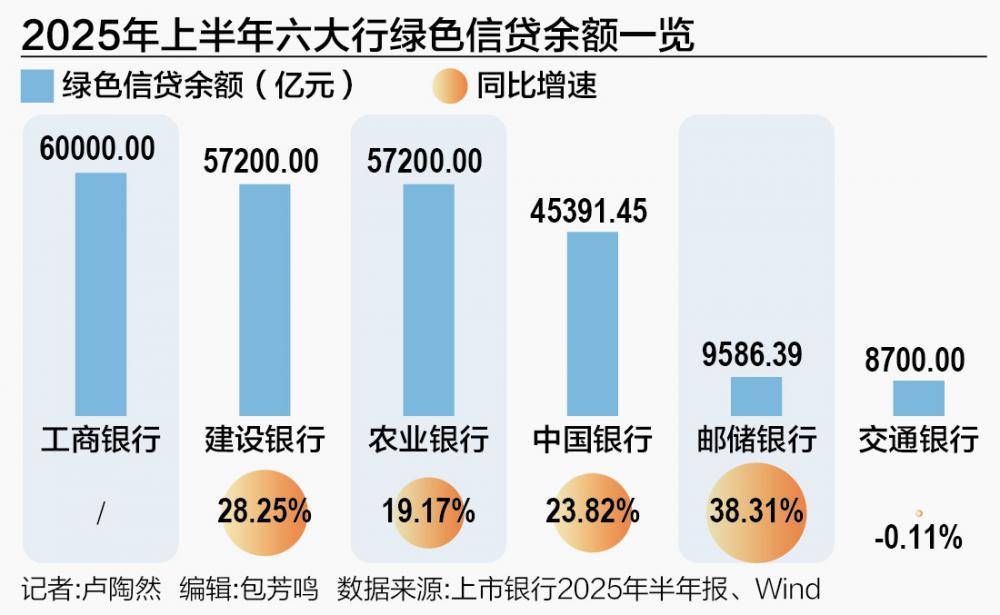
Core Insights - As of the end of Q2 2025, China's green loan balance reached approximately 42.4 trillion yuan, and the green bond balance exceeded 2.2 trillion yuan, positioning China among the top globally [1] - The carbon reduction support tool has guided financial institutions to issue carbon reduction loans exceeding 1.38 trillion yuan [1] - A total of 37 listed banks reported a combined green loan balance of 29.22 trillion yuan, with an average balance exceeding 800 billion yuan, reflecting a year-on-year growth of 41.79% [1][5] Green Loan Growth - The green loan balance of the banking system in China is leading globally, with state-owned banks playing a significant role [4] - Among the six major state-owned banks, the Industrial and Commercial Bank of China (ICBC) leads with a green loan balance of 6 trillion yuan, followed by China Construction Bank and Agricultural Bank of China, each with 5.72 trillion yuan [5] - Postal Savings Bank of China showed a remarkable year-on-year growth rate of 38.31%, nearing the 1 trillion yuan mark [5] Innovation in Green Financial Products - Banks are actively expanding and innovating specialized green financial products and service models, covering areas such as clean energy and environmental remediation [2] - The green financial product system is becoming increasingly diverse, showcasing various practical paths and innovative outcomes [2] Carbon Reduction Support Tool - The carbon reduction support tool is becoming a key indicator of banks' green financial capabilities, effectively directing financial resources towards green and low-carbon sectors [9] - In Q2 2025, 16 banks reported carbon reduction loans that facilitated a carbon reduction equivalent of over 7 million tons, with a total loan amount of nearly 24 billion yuan [9] - Major banks like ICBC and China Construction Bank have over 100 projects funded through carbon reduction loans, leading in both project numbers and loan amounts [9] Performance of Smaller Banks - Smaller banks, including city commercial banks and rural commercial banks, are showing significant growth in green loan balances, with some achieving substantial year-on-year increases [8] - Zhangjiagang Rural Commercial Bank led the rural commercial banks with a growth rate of 30.25% in green loan balances [7] - Smaller banks are encouraged to leverage local advantages and develop differentiated paths to support local green projects [8]




金融监管总局一个星期开出近2.7亿罚单,涉及17家机构,多人遭禁业
Xin Lang Cai Jing· 2025-09-12 22:13
Core Viewpoint - The National Financial Regulatory Administration has issued a second batch of fines in September, totaling over 166 million yuan, targeting various financial institutions for issues related to credit approval, regulatory data reporting, and capital operation risks [1][2][11]. Summary by Category Fines and Penalties - A total of 18 entities, including policy banks, state-owned banks, joint-stock banks, and local banks, have been penalized, with fines amounting to approximately 269 million yuan in September alone [2][11]. - Specific fines include: - Guangfa Bank: 66.7 million yuan for improper management of loans and regulatory data reporting [2]. - Hengfeng Bank: 61.5 million yuan for similar issues [2][3]. - Minsheng Bank: 5.9 million yuan for inadequate system control [4]. - Citic Bank: 5.5 million yuan for inaccurate risk classification [5]. - China Export-Import Bank: 1.3 million yuan for poor country risk management [6]. Regulatory Focus - The regulatory focus remains on compliance in credit and bill operations, with significant scrutiny on the capital operations of wealth management subsidiaries and financial asset investment companies [11]. - The recent fines highlight a trend of "responsibility to individuals," with 32 individuals facing penalties, including warnings, fines, and bans from the banking industry [11]. Institutional Responses - Guangfa Bank and Hengfeng Bank have both acknowledged the penalties and stated that they have completed the necessary rectifications and are committed to improving their risk management and internal controls [2][3]. - Huaxia Wealth Management has also accepted the penalties and emphasized compliance with regulatory requirements in their operations [7]. Notable Cases - The only individual penalty involved former employees of the Industrial and Commercial Bank of China, who were banned from the banking industry for serious violations of prudent management rules [11].

三家机构被罚超千万,最新回应
中国基金报· 2025-09-12 16:19
Core Viewpoint - A series of significant fines have been imposed on multiple financial institutions in China, highlighting ongoing regulatory scrutiny and the need for compliance improvements within the industry [2][12]. Group 1: Major Fines Imposed - Three financial institutions received fines exceeding ten million yuan: Guangfa Bank was fined 66.7 million yuan, Hengfeng Bank 61.5 million yuan, and Huaxia Wealth Management 12 million yuan [4][5]. - The total fines for ten institutions reached 162.9 million yuan, indicating a broader trend of regulatory enforcement across the sector [2][9]. Group 2: Reasons for Penalties - Guangfa Bank was penalized for improper management of loans, bills, and factoring, as well as non-compliance in regulatory data reporting [4][5]. - Hengfeng Bank faced similar issues related to loan and wealth management practices, along with non-compliance in data reporting [4][5]. - Huaxia Wealth Management was fined for irregular investment operations and inadequate system controls [4][5]. Group 3: Institutional Responses - Hengfeng Bank acknowledged the penalty and committed to addressing the underlying issues, enhancing internal controls, and improving risk management [6]. - Guangfa Bank accepted the regulatory decision and has already implemented corrective measures to optimize its risk management framework [7]. - Huaxia Wealth Management expressed its commitment to compliance and improving risk management capabilities to protect investor interests [7]. Group 4: Additional Penalties - Seven other institutions were also fined for various compliance issues, including inadequate system management and improper handling of wealth management products [9][10][11]. - Notable fines included 5.9 million yuan for Minsheng Bank and 5.5 million yuan for Citic Bank, reflecting a widespread regulatory crackdown [9][10].
