SRCB(601825)

Search documents
A股银行股集体下跌:成都银行跌5%,浦发银行跌超3%
Ge Long Hui A P P· 2025-10-29 04:03
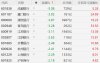
Group 1 - The A-share market saw a collective decline in bank stocks, with Chengdu Bank dropping by 5% and several others, including Xiamen Bank, Shanghai Pudong Development Bank, and Qingdao Bank, falling over 3% [1] - Specific declines included Jiangyin Bank, Qilu Bank, Hangzhou Bank, Shanghai Bank, and Hu Nong Commercial Bank, all experiencing drops exceeding 2% [1] Group 2 - Chengdu Bank's market capitalization is reported at 72.9 billion, with a year-to-date increase of 5.28% despite the recent decline of 5.08% [2] - Xiamen Bank has a market capitalization of 18.1 billion, with a year-to-date increase of 24.69%, but it fell by 3.92% today [2] - Shanghai Pudong Development Bank's market capitalization stands at 396.7 billion, with a year-to-date increase of 19.25%, experiencing a decline of 3.87% [2] - Qingdao Bank's market capitalization is 29.2 billion, with a year-to-date increase of 33.50%, and it dropped by 3.28% [2] - Jiangsu Bank has a market capitalization of 194.5 billion, with a year-to-date increase of 13.38%, and it fell by 3.11% [2] - Other banks like Jiangyin Bank, Qilu Bank, Hangzhou Bank, Shanghai Bank, and Hu Nong Commercial Bank also reported declines, with respective market capitalizations of 11.8 billion, 36.4 billion, 114.4 billion, 133.3 billion, and 82.1 billion [2]




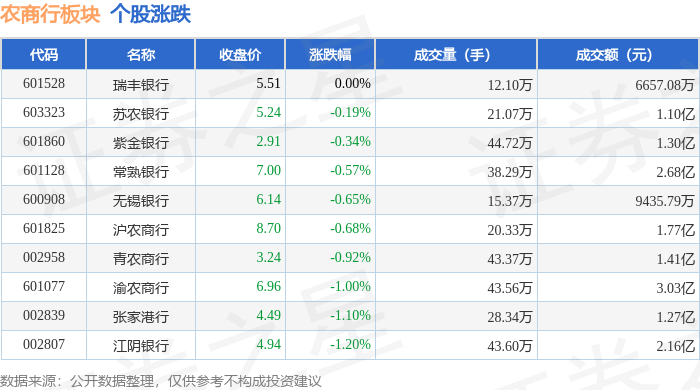
农商行板块10月28日跌0.75%,江阴银行领跌,主力资金净流入1650.52万元
Zheng Xing Xing Ye Ri Bao· 2025-10-28 08:40
Market Overview - The rural commercial bank sector experienced a decline of 0.75% on October 28, with Jiangyin Bank leading the drop [1] - The Shanghai Composite Index closed at 3988.22, down 0.22%, while the Shenzhen Component Index closed at 13430.1, down 0.44% [1] Individual Stock Performance - Key stock performances in the rural commercial bank sector included: - Ruifeng Bank: Closed at 5.51, unchanged - Sunong Bank: Closed at 5.24, down 0.19% - Zijin Bank: Closed at 2.91, down 0.34% - Changshu Bank: Closed at 7.00, down 0.57% - Yuanxi Bank: Closed at 6.14, down 0.65% - Hunan Rural Commercial Bank: Closed at 8.70, down 0.68% - Qingnong Bank: Closed at 3.24, down 0.92% - Yunnan Rural Commercial Bank: Closed at 6.96, down 1.00% - Zhangjiagang Bank: Closed at 4.49, down 1.10% - Jiangyin Bank: Closed at 4.94, down 1.20% [1] Capital Flow Analysis - The rural commercial bank sector saw a net inflow of 16.51 million yuan from institutional investors, while retail investors experienced a net outflow of 25.96 million yuan [1] - Detailed capital flow for selected banks included: - Sunong Bank: Net inflow of 13.07 million yuan from institutional investors, with a net outflow of 9.25 million yuan from retail investors [2] - Hunan Rural Commercial Bank: Net inflow of 13.06 million yuan from institutional investors, with a net outflow of 16.03 million yuan from retail investors [2] - Qingnong Bank: Net inflow of 7.95 million yuan from institutional investors, with a net outflow of 7.73 million yuan from retail investors [2] - Jiangyin Bank: Net outflow of 5.93 million yuan from institutional investors, with a net inflow of 8.14 million yuan from retail investors [2]




SunCar Announces First Half 2025 Financial Results
Globenewswire· 2025-10-27 20:05
Core Insights - SunCar Technology Group Inc. reported a 9% increase in total revenue to $222.3 million for the first half of 2025, compared to $203.1 million in the same period of 2024 [5][8] - The company achieved a significant increase in EV insurance premiums, which rose by 111.3% to $697.6 million, up from $330.2 million year-over-year [5][8] - SunCar's net loss decreased to $5.5 million in the first half of 2025, a substantial improvement from a net loss of $60.1 million in the prior year [5][8] Financial Performance - Total revenue for the first half of 2025 was $222.3 million, reflecting a 9% increase from $203.1 million in the first half of 2024 [5][8] - Adjusted EBITDA for the first half of 2025 was $2.5 million, down from $6 million in the prior year [5][8] - The company reported a net loss of $5.5 million for the first half of 2025, compared to a net loss of $60.1 million in the same period of 2024 [5][8] Business Highlights - SunCar deepened collaborations with major EV manufacturers, including Tesla, Xiaomi, and NIO, enhancing its insurance offerings and user experience [5][6][9] - The integration of ByteDance's Doubao large language model into SunCar's platform is expected to enhance its AI-driven digitalization efforts [4][5] - The company has initiated innovative auto services projects in partnership with China ZheShang Bank and Shanghai Rural Commercial Bank, expanding its service offerings [5][9] Market Position - SunCar ranked first in China for auto insurance premiums tailored to EV owners, indicating a strong market presence in the growing EV insurance sector [5][8] - Revenue from auto eInsurance services increased by 33% to $97.8 million, driven by strong partnerships with emerging EV OEMs [5][8] - Technology services revenue grew by 11% to $24.3 million, reflecting increased adoption of SunCar's enterprise software tools [5][8] Strategic Outlook - The company is prioritizing profitability and cash generation, withdrawing its previous full-year revenue guidance of $521 million to $539 million [14] - SunCar aims to focus on accounts and partnerships that enhance margins and long-term value, positioning itself for sustainable growth [14]





农商行板块10月27日跌0.13%,沪农商行领跌,主力资金净流入2473.66万元
Zheng Xing Xing Ye Ri Bao· 2025-10-27 08:25
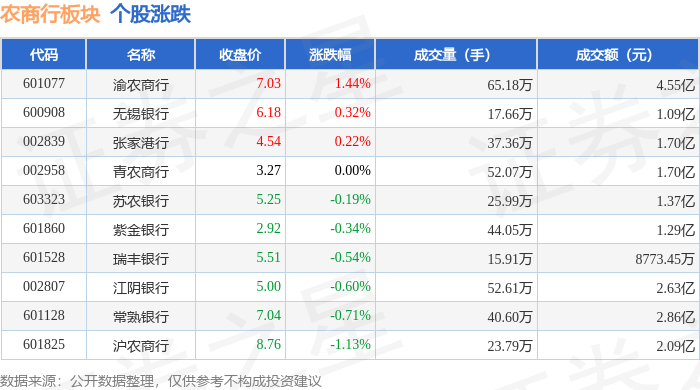
Core Insights - The agricultural commercial bank sector experienced a slight decline of 0.13% on October 27, with the Shanghai Agricultural Commercial Bank leading the drop [1] - The Shanghai Composite Index closed at 3996.94, up 1.18%, while the Shenzhen Component Index closed at 13489.4, up 1.51% [1] Stock Performance - The closing prices and performance of key agricultural commercial banks are as follows: - Yunnan Agricultural Commercial Bank (601077) closed at 7.03, up 1.44% with a trading volume of 651,800 shares and a transaction value of 455 million [1] - Wuxi Bank (600908) closed at 6.18, up 0.32% with a trading volume of 176,600 shares and a transaction value of 109 million [1] - Zhangjiagang Bank (002839) closed at 4.54, up 0.22% with a trading volume of 373,600 shares and a transaction value of 170 million [1] - Other banks like Su Nong Bank (603323) and Zijin Bank (601860) saw declines of 0.19% and 0.34% respectively [1] Fund Flow Analysis - The agricultural commercial bank sector saw a net inflow of 24.73 million from institutional investors and 41.41 million from retail investors, while retail investors had a net outflow of 66.14 million [1] - Detailed fund flow for specific banks indicates: - Jiangyin Bank (002807) had a net inflow of 9.34 million from institutional investors and a net outflow of 18.65 million from retail investors [2] - Wuxi Bank (600908) had a net inflow of 8.72 million from institutional investors and a net outflow of 10.73 million from retail investors [2] - Other banks like Zijin Bank (601860) and Yunnan Agricultural Commercial Bank (601077) also experienced mixed fund flows with significant retail outflows [2]
行业深度报告:零售风险及新规影响有限,兼论信贷去抵押化
KAIYUAN SECURITIES· 2025-10-27 05:44
Investment Rating - The investment rating for the industry is "Positive" (maintained) [1] Core Insights - The report highlights that retail non-performing loan (NPL) rates and generation rates are currently high, indicating ongoing pressure on bank profitability. Despite a low overall NPL rate, the retail sector shows signs of risk, with a marginal increase in the NPL rate to 1.28% [14][15] - The transition period for new risk regulations is nearing its end, with concerns about the impact on banks' provisioning levels. However, the report suggests that the actual impact may be less severe than market expectations [16] - The trend of de-collateralization in bank lending is evident, driven by both business characteristics and strategic choices made by banks to reduce reliance on collateralized loans [17] Summary by Sections 1. Retail NPL and Generation Rates - The retail NPL rate has increased to 1.28%, with a steepening curve indicating ongoing risk. The generation rate for retail loans remains high, with significant increases noted in certain banks [14][18] - The report indicates that while the overall NPL rate is low, the divergence between overdue and NPL indicators suggests underlying risks in the retail sector [19] 2. Impact of New Risk Regulations - The new risk regulations will require banks to classify impaired loans as NPLs, potentially increasing reported NPL rates. However, the report anticipates that the actual provisioning pressure may be manageable [16][17] 3. De-Collateralization in Lending - The report notes a significant decline in the proportion of collateralized loans, with banks shifting towards non-collateralized lending strategies. This shift is influenced by the need to manage risk more effectively [17][18] 4. Investment Recommendations - The report recommends certain state-owned banks due to their customer base advantages and manageable retail risk pressures. It also highlights specific banks such as CITIC Bank and Agricultural Bank of China as beneficiaries of this trend [6]






本周聚焦:黄金波动下的机遇与挑战:银行贵金属业务有望成重要增长极
GOLDEN SUN SECURITIES· 2025-10-27 00:58
Investment Rating - The report maintains an "Accumulate" rating for the banking sector, indicating a positive outlook despite challenges in the gold market in 2025 [1]. Core Insights - The gold market is expected to present both opportunities and challenges for banks, with a trend towards deepening precious metal business driven by central bank purchases [1][2]. - The demand for gold bars and coins has increased significantly, reflecting a growing need for gold as a hedge and store of value among residents [4]. - The establishment of a market-making system for gold trading is anticipated to enhance market liquidity and stability, positioning listed banks as key players [3][4]. Summary by Sections 1. Policy and Market Environment - As of September 2025, China's official gold reserves reached 74.06 million ounces, marking an increase for 11 consecutive months [2]. - In Q2 2025, global central banks added 166 tons of gold to their reserves, with 95% of surveyed central banks expecting further increases in the next 12 months [2]. - New policies allowing insurance funds to invest in gold are expected to create new opportunities for banks to provide services to insurance institutions, enhancing their intermediary income [2]. 2. Business Dynamics and Revenue Contribution - In the first half of 2025, China's gold consumption was 505.205 tons, a year-on-year decrease of 3.54%, with significant growth in gold bar and coin consumption by 23.69% [4]. - The decline in gold jewelry consumption is prompting banks to shift focus from traditional jewelry sales to investment-oriented precious metal businesses [4]. - The growth in investment demand for gold bars and coins is expected to stabilize income from investment-related businesses, enhancing the profitability of the precious metals segment for banks [4]. 3. Industry Trends - The report highlights a structural shift in gold consumption, with investment demand rising while jewelry demand declines, indicating a need for banks to adapt their business strategies [4]. - The performance of the banking sector is expected to benefit from expansionary policies aimed at stabilizing the economy, with specific banks like Ningbo Bank and Jiangsu Bank recommended for investment due to positive fundamental changes [8]. 4. Key Data Tracking - The report includes various financial metrics, such as average daily trading volume and margin financing balances, which are essential for assessing market conditions [9][10].




关注信贷需求修复:银行业周报-20251026
Xiangcai Securities· 2025-10-26 14:50
Investment Rating - The industry investment rating is maintained at "Overweight" [4][7]. Core Insights - The new policy financial tools have been implemented to boost credit demand, with over 330 billion yuan allocated by three policy banks [3][27]. - A total of 500 billion yuan in new policy financial tools has been initiated, with 250 billion yuan already invested in 12 major economic provinces, focusing on infrastructure, foreign trade, and emerging sectors like digital economy and AI [4][5]. - The expected leverage effect of the 500 billion yuan policy financial tools could generate approximately 5 trillion yuan in investments and 4 trillion yuan in loans [4][29]. - The rapid deployment of these financial tools is anticipated to enhance credit demand in the fourth quarter, particularly benefiting regional banks due to the demonstration effect from major economic provinces [5][29]. Summary by Sections Market Review - The banking index increased by 1.40% during the period from October 20 to October 26, 2025, underperforming the CSI 300 index by 1.84 percentage points [9]. - The performance of major banks was relatively strong, with Agricultural Bank of China leading with a 4.86% increase [9]. Financial Market - The central bank's net injection in the open market was 198.1 billion yuan, maintaining a loose monetary environment [18]. - The average issuance rates for one-year interbank certificates of deposit were 1.68% for state-owned banks and 1.74% for regional banks, with a notable increase in net financing of 425.3 billion yuan in October [22][26]. Industry Dynamics - The policy financial tools are expected to support long-term public loans and improve loan term structures, with a focus on sustainable credit demand release during project operation cycles [29]. - Investment in emerging industries, particularly AI, is projected to maintain strong financing demand, with technology innovation loans expected to grow rapidly [5][29]. Investment Recommendations - The report suggests focusing on state-owned banks for their stable high dividend yields and potential valuation recovery opportunities for joint-stock and regional banks amid improving economic expectations [7][30].

太平资产副总辞任沪农商行董事 或触发会计核算方式调整
2 1 Shi Ji Jing Ji Bao Dao· 2025-10-24 14:41
Core Viewpoint - The resignation of Li Guanying from the board of Shanghai Rural Commercial Bank is linked to the adjustment of accounting standards for insurance funds, which may impact the bank's financial reporting and investment classification by China Taiping Insurance Group [2][6][12] Group 1: Resignation Details - Li Guanying resigned from his position as a non-executive director on October 17, 2023, nearly one year before his term was set to end on October 10, 2026 [6] - His resignation will not affect the legal number of board members or the normal operation of the board [2][6] Group 2: Investment Implications - Taiping Asset Management stated that investing in Shanghai Rural Commercial Bank is part of a diversified investment strategy for insurance funds, and the resignation is due to accounting adjustments [6][12] - The resignation may lead to a change in how China Taiping accounts for its investment in Shanghai Rural Commercial Bank, potentially shifting from equity method accounting to fair value measurement [12] Group 3: Market Reactions and Speculations - There are speculations in the market that Taiping Asset may plan to reduce its stake in Shanghai Rural Commercial Bank or adjust its cooperation strategy following Li Guanying's resignation [8][10] - Experts suggest that the impact of the resignation is difficult to predict and may simply be a normal personnel change rather than a significant strategic shift [8][10]

农商行板块10月24日跌0.82%,江阴银行领跌,主力资金净流出1.44亿元
Zheng Xing Xing Ye Ri Bao· 2025-10-24 08:27
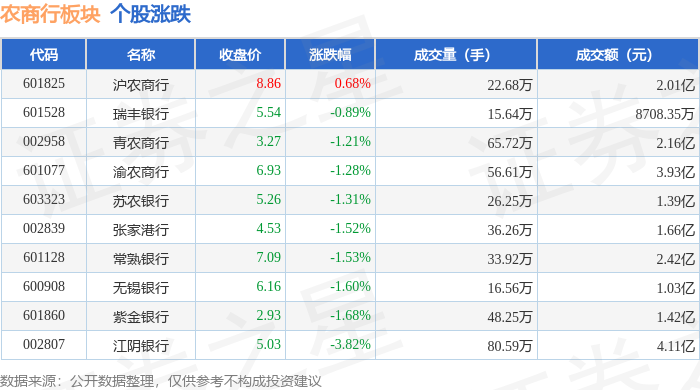
Market Overview - The rural commercial bank sector experienced a decline of 0.82% on October 24, with Jiangyin Bank leading the drop [1] - The Shanghai Composite Index closed at 3950.31, up 0.71%, while the Shenzhen Component Index closed at 13289.18, up 2.02% [1] Individual Stock Performance - The closing prices and changes for key rural commercial banks are as follows: - Hu Nong Commercial Bank: 8.86, +0.68% - Ruifeng Bank: 5.54, -0.89% - Qingnong Commercial Bank: 3.27, -1.21% - Yunnan Commercial Bank: 6.93, -1.28% - Su Nong Bank: 5.26, -1.31% - Zhangjiagang Bank: 4.53, -1.52% - Changshu Bank: 7.09, -1.53% - Wuxi Bank: 6.16, -1.60% - Zijin Bank: 2.93, -1.68% - Jiangyin Bank: 5.03, -3.82% [1] Capital Flow Analysis - The rural commercial bank sector saw a net outflow of 144 million yuan from main funds, while retail funds experienced a net inflow of 63.71 million yuan [1] - The detailed capital flow for individual banks indicates: - Hu Nong Commercial Bank: Main funds net inflow of 6.22 million yuan, retail net outflow of 16.25 million yuan - Wuxi Bank: Main funds net outflow of 29.30 million yuan, retail net outflow of 0.99 million yuan - Jiangyin Bank: Main funds net outflow of 56.10 million yuan, retail net inflow of 36.93 million yuan [2]
沪农商行董事离任引发减持误读 太平资管称仅为会计准则调整
Jing Ji Guan Cha Wang· 2025-10-23 15:00
Core Viewpoint - The resignation of Li Guanying from the board of Shanghai Rural Commercial Bank has sparked speculation in the capital market regarding potential stock divestment by China Taiping Insurance, despite assurances that the resignation will not affect the bank's board operations [3][4][6]. Summary by Sections Announcement Details - On October 20, Shanghai Rural Commercial Bank announced the resignation of Li Guanying due to work reasons, confirming that this will not lower the board's membership below the legal requirement [3][4]. - Li Guanying is currently the Deputy General Manager and Financial Officer of Taiping Asset Management, which manages investments for China Taiping Insurance [4]. Market Speculation - The explanation regarding the "adjustment needs of insurance company accounting standards" has led to market speculation that this could indicate a reduction in China Taiping's stake in Shanghai Rural Commercial Bank [4][5]. - The new accounting standards, effective in early 2026, will require insurance companies to classify stocks they hold as FVOCI (Fair Value Through Other Comprehensive Income) if they meet certain criteria, including holding over 5% of shares or having board representation [4][5]. Accounting Implications - FVOCI assets allow for stock price fluctuations to be excluded from annual profit reports, enhancing profit stability for insurance companies. However, once classified as FVOCI, these stocks must be held long-term [5]. - With Li Guanying's departure, and given that China Taiping holds less than 5% of the bank's shares, there is speculation that the bank's stock may be reclassified to FVTPL (Fair Value Through Profit or Loss), allowing for easier divestment [5][6]. Future Actions and Dividends - Insiders suggest that the market may have misunderstood the implications of the accounting adjustments, indicating that China Taiping is unlikely to reduce its holdings in the near term [6]. - As a significant shareholder with a 4.3% stake, the future nomination of a new board member by China Taiping is of interest to the market [7]. - Shanghai Rural Commercial Bank has consistently provided substantial cash dividends, with a total of 41.66 billion yuan distributed in the 2024 fiscal year, representing 33.91% of its net profit, indicating a strong return on investment for shareholders [7].