PETROCHINA(601857)

Search documents
天然气行业-地缘变局-价差展望与投资机遇
2026-03-09 05:18
Summary of Natural Gas Industry Conference Call Industry Overview - The natural gas industry is experiencing a decline in domestic demand growth, with industrial electricity pricing and carbon accounting disadvantages weakening the substitution advantage of natural gas [1][2] - The LNG spot market share is continuously shrinking due to geopolitical conflicts causing production halts in Qatar and shipping disruptions, which temporarily reverses the expectation of supply looseness [1][2] - By Q2 2026, the pricing formula for PetroChina is expected to adjust, with the regulated gas proportion reduced to 55% and the floating proportion linked to COD increased to 12%, leading to a slight increase in comprehensive gas prices [1][10] Key Insights - The rise in gas prices benefits renewable energy and nuclear power, with coal-fired power generation's share expected to drop below 50% [1] - The short-term focus should be on the navigation of the Hormuz Strait and the resumption of production in Qatar, while the medium-term focus is on the impact of PetroChina's pricing policy on costs [1][2] - The profitability of upstream self-produced gas companies is highly elastic, with a 10% increase in gas prices leading to approximately a 20% increase in net profit [1][12] Geopolitical Impact - The recent geopolitical tensions have led to a significant increase in international gas prices, but the long-term supply logic remains intact, with expectations of increased LNG capacity from non-Qatar sources by 2026 [5][6] - The current geopolitical situation has created a temporary supply tightness, but the long-term outlook is still for a return to supply looseness [5][6] Pricing and Cost Structure - The domestic LNG spot market's direct impact on gas companies is limited due to the low proportion of LNG spot volume, with the main concern being the long-term pricing mechanisms of onshore and offshore long-term contracts [2][12] - The pricing structure for PetroChina in 2025 includes a regulated gas proportion of 60% and a floating portion linked to the Shanghai Natural Gas Trading Center's import spot price [11] Market Dynamics - The LNG market is characterized by a lack of significant arbitrage opportunities compared to 2022, with current price differentials being insufficient to create profitable resale opportunities [9] - The domestic LNG price has risen to approximately 4,500 RMB/ton, reflecting a 13% increase from February, driven by international price transmission and recovering domestic demand [10][11] Investment Opportunities - Upstream gas companies are expected to benefit the most from rising gas prices, with a focus on companies with shale gas and coalbed methane assets [15] - The midstream sector, particularly companies with fixed income from pipeline transportation and LNG trading, is expected to maintain stable earnings despite price fluctuations [16] Long-term Outlook - The long-term outlook for the industry suggests a gradual return to a balanced supply-demand scenario, with increasing imports of Russian gas and expanded LNG receiving station capacities [8][13] - The industry is expected to see a gradual recovery in price differentials, with a focus on companies that can effectively pass on costs to consumers [17][19] Monitoring Variables - Key variables to monitor in the coming weeks include geopolitical developments, international gas price fluctuations, PetroChina's pricing policy, and changes in industry demand [20] Conclusion - The natural gas industry is navigating a complex landscape influenced by geopolitical tensions, pricing adjustments, and evolving market dynamics, with significant implications for investment strategies and company profitability [1][5][20]

亚太股市全线飘绿,A股电网、OpenClaw板块逆势上涨,中海油股价盘中创新高
21世纪经济报道· 2026-03-09 04:23
Market Overview - Global markets are experiencing a sell-off trend due to risk aversion and inflation concerns, with the Nikkei 225 index dropping over 6% and falling below 52,000 points [1] - The A-share market also saw declines, with the Shanghai Composite Index down 1.13%, Shenzhen Component down 2.14%, and ChiNext Index down 2.42% [1][2] - The total trading volume in the Shanghai and Shenzhen markets reached 1.79 trillion yuan, an increase of 403.1 billion yuan compared to the previous trading day [1] Stock Performance - In the A-share market, over 4,500 stocks declined, while only 872 stocks rose [3] - The Hong Kong stock market also faced declines, with the Hang Seng Index and Hang Seng Tech Index both dropping over 2% [4] - Key sectors such as communication equipment and computing hardware experienced significant pullbacks, while oil, coal, and electricity sectors showed strength [4] Sector Analysis - The oil and gas sector saw a surge, with international oil prices rising over 30%, leading to strong performances from major oil companies [7][8] - China National Offshore Oil Corporation hit a new high since its A-share listing, with a market capitalization of 2.12 trillion yuan [8] - The methanol sector was notably active, with several stocks hitting the daily limit up, driven by rising global prices and supply chain disruptions [8][9] Investment Opportunities - The rising oil prices are expected to enhance the sales revenue of oil extraction companies, leading to improved profit margins [8] - The chemical industry is undergoing a significant supply-demand restructuring, with methanol being one of the most affected products [9][10]




Two must-own China stocks poised to rally on higher oil prices
Invezz· 2026-03-09 04:16
Core Viewpoint - The article highlights two Chinese energy stocks, CNOOC and PetroChina, as prime investment opportunities due to the rising oil prices driven by geopolitical tensions, particularly the US-Iran conflict, which has pushed oil prices past $115 [1]. Group 1: CNOOC - CNOOC is well-positioned to benefit from the rising oil prices due to its focus on exploration and production, allowing it to capture price increases quickly [1]. - Goldman Sachs estimates that even if Brent crude averages around $85, CNOOC's full-year cash flow could increase by over 10% [1]. - CNOOC's stock is considered relatively discounted compared to developed market peers like Exxon and Chevron, making it an attractive investment option [1]. Group 2: PetroChina - PetroChina offers a diversified and integrated approach to the energy crisis, managing both domestic extraction and extensive refining and distribution networks [1]. - The company is expected to see double-digit growth in free cash flow, even if oil prices stabilize below current highs [1]. - Unlike CNOOC, PetroChina does not face US investment restrictions, making it a more accessible option for investors looking to capitalize on Asian energy growth [1].


油气行业2026年2月月报:受地缘冲突博弈影响,2月油价大幅上涨,关注美伊冲突进展-20260309
Guoxin Securities· 2026-03-09 02:50
Investment Rating - The oil and gas industry is rated as "Outperform" [1][6][5] Core Views - Oil prices surged in February 2026 due to geopolitical tensions, particularly the U.S.-Iran conflict, with Brent crude averaging $69.4 per barrel and WTI averaging $64.4 per barrel, marking increases of $4.7 and $4.2 respectively [1][13] - OPEC+ plans to restore production by 20,600 barrels per day starting April 2026, following a gradual exit from previous voluntary production cuts [2][15] - Global oil demand is projected to grow by 850,000 to 1,380,000 barrels per day in 2026, with further increases expected in 2027 [3][16] Summary by Sections Oil Price Review - February 2026 saw Brent crude futures average $69.4 per barrel, up $4.7 from the previous month, while WTI averaged $64.4 per barrel, up $4.2 [1][13] - Geopolitical events, including U.S. military actions and Iranian military exercises, contributed to price volatility [1][13] Oil Price Outlook - OPEC+ will restore production by 20,600 barrels per day in April 2026, following a complete exit from previous cuts by September 2025 [2][15] - The expected price range for Brent crude in 2026 is between $65 and $75 per barrel, while WTI is projected between $62 and $72 per barrel [4][38] Demand Forecast - Major energy agencies forecast 2026 oil demand at 10.652 million barrels per day (OPEC), 10.464 million (IEA), and 10.480 million (EIA), with increases of 138, 85, and 120 thousand barrels per day respectively from 2025 [3][16] - For 2027, demand is expected to rise further, with OPEC and EIA predicting increases of 134,000 and 128,000 barrels per day respectively [3][19] Key Company Earnings Forecast and Investment Ratings - Key companies such as China National Offshore Oil Corporation (CNOOC), China Petroleum, and Satellite Chemical are rated as "Outperform" with respective earnings per share (EPS) forecasts for 2024 and 2025 [5][6]


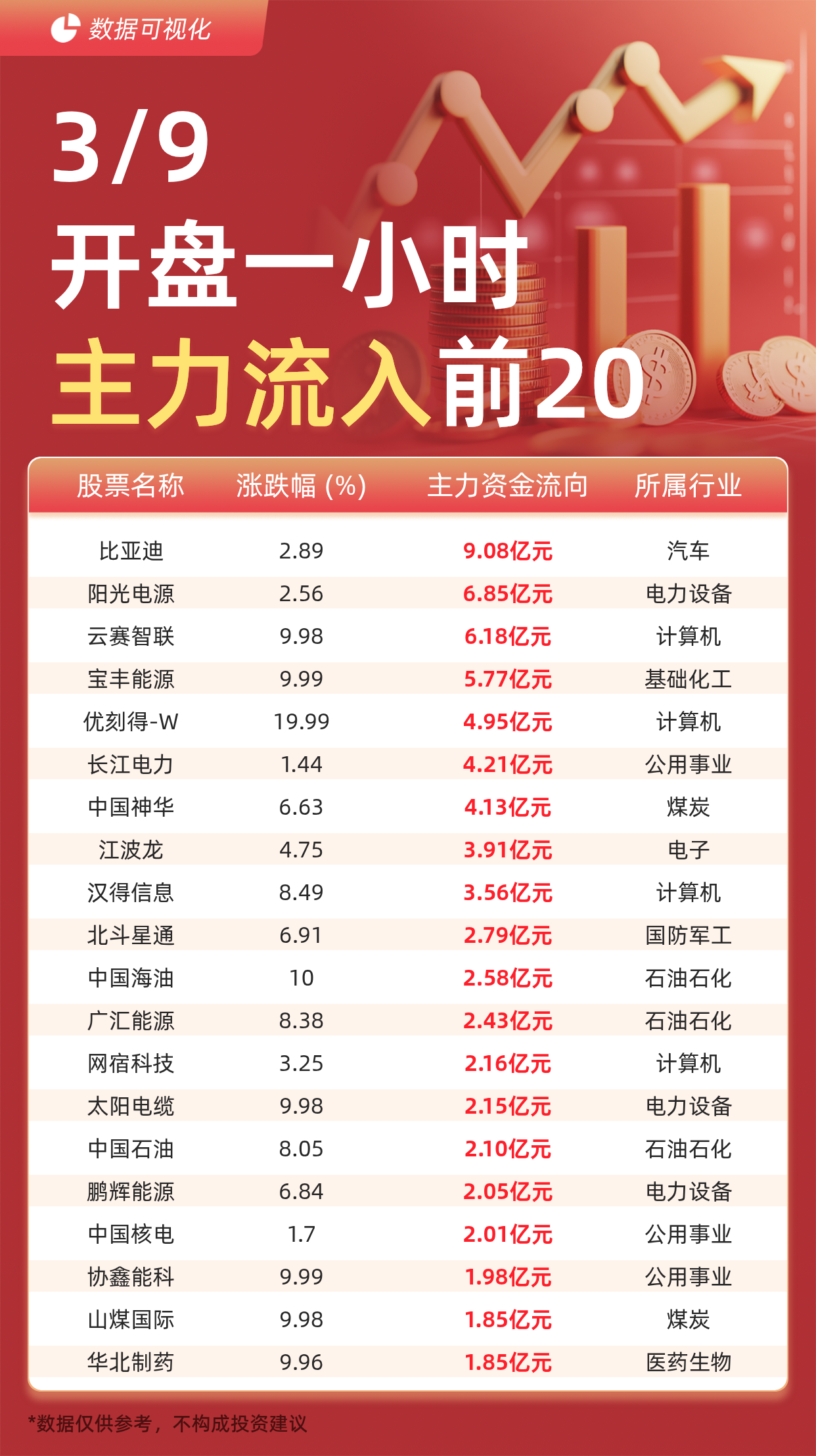
主力资金流入前20:比亚迪流入9.08亿元、阳光电源流入6.85亿元
Jin Rong Jie· 2026-03-09 02:41
Group 1 - The main stocks with significant capital inflow include BYD (9.08 billion), Sungrow Power (6.85 billion), and YunSai ZhiLian (6.18 billion) [1] - The top performing stocks by percentage increase are Baofeng Energy (9.99%), YK Technology-W (19.99%), and YunSai ZhiLian (9.98%) [2][3] - The sectors represented in the top inflow stocks include automotive, power equipment, computer, and coal [2][3] Group 2 - BYD leads with a capital inflow of 9.08 billion and a price increase of 2.89% [2] - Sungrow Power has a capital inflow of 6.85 billion with a price increase of 2.56% [2] - The total capital inflow for the top 20 stocks reflects strong investor interest across various sectors [1]




A股港股低开,油气股爆发,中海油再拉涨停板
21世纪经济报道· 2026-03-09 01:44
Core Viewpoint - The A-share market experienced a collective decline, with significant drops in technology and renewable energy sectors, while oil and gas stocks surged due to rising crude oil prices driven by geopolitical tensions [1][3]. Group 1: Market Performance - The A-share indices opened lower, with the Shanghai Composite Index down 0.81%, the Shenzhen Component down 2.21%, and the ChiNext Index down 2.77% as of 9:31 AM [1]. - The Hang Seng Index fell by 2.65%, and the Hang Seng Tech Index dropped by 3.79%, indicating a broad market downturn [3]. Group 2: Sector Analysis - Oil and gas stocks saw significant gains, with China National Offshore Oil Corporation (CNOOC) and China Petroleum & Chemical Corporation (Sinopec) both experiencing notable price increases, with CNOOC rising over 8% and Sinopec over 7% [3]. - The energy crisis is impacting various sectors, with rising costs in shipping and agricultural inputs affecting food security and agricultural production [5]. Group 3: Commodity Prices - International crude oil prices surged, with WTI crude oil exceeding $110 per barrel, marking an increase of over 20% [3][4]. - The price of methanol, a key chemical, is expected to rise due to the geopolitical situation, as Iran is a major producer and exporter of methanol [4]. Group 4: Beneficiary Sectors - Beneficiary sectors from the rising oil prices include oil and gas extraction, coal chemical industries, and agricultural inputs, with companies like China National Petroleum Corporation and Huayi Group highlighted as key players [7][8].

油气股爆发!A股“三桶油”大幅高开
第一财经· 2026-03-09 01:44
2026.03. 09 09:25 A股开盘丨三大指数集体低开 本文字数:640,阅读时长大约1分钟 作者 | 一财 阿驴 09:29 A股"三桶油"大幅高开 中国海油涨停,中国石油涨超9%,中国石化涨超8%。 09:29 煤化工概念股大幅高开,卫星化学、华鲁恒升、宝丰能源创新高,金开新能、赤天化、金牛化 工2连板,广汇能源涨停,贝肯能源、泸天化、中国石化、兖矿能源、中油工程跟涨。 沪指低开0.62%,深成指低开1.78%,创业板指低开2.37%,科创综指低开2.59%。 | 代码 | 名称 | 两日图 | 现价 | 涨跌 | 涨跌幅 | | --- | --- | --- | --- | --- | --- | | 000001 | 上证指数 | 2 | 4098.70 | -25.50 | -0.62% | | 399001 | 深证成指 | | 13920.29 | -252.34 | -1.78% | | 399006 | 创业板指 | Company of the company of the coun | 3152.72 | -76.58 | -2.37% | | 000680 | 科创综指 | ...

原油狂飙冲击100美元,A股受益板块大盘点
21世纪经济报道· 2026-03-08 15:24
Core Viewpoint - The ongoing conflict between the U.S. and Iran is driving oil prices towards a potential $100 per barrel, with significant implications for various industries and investment opportunities arising from the energy crisis [1][2]. Oil Price Surge and Its Impact - International oil prices have surged dramatically, with U.S. oil and Brent crude both surpassing $90 per barrel, marking the largest weekly increases since 1983 and 1991, respectively [1]. - The conflict has severely affected the shipping traffic through the Strait of Hormuz, with daily vessel traffic plummeting by 94%, leading to a significant loss in global oil supply estimated between 7 million to 11 million barrels per day [1][5]. Beneficiary Sectors in A-Share Market - The oil and gas extraction sector is expected to benefit directly from rising oil prices, with companies like China National Petroleum and China National Offshore Oil Corporation showing strong performance [3]. - Other sectors such as coal chemical and energy-related companies are also positioned to gain from the current high oil price environment, with companies like Baofeng Energy and China Coal Energy showing promising growth [4][5]. Energy Sector Valuation Reassessment - The surge in oil prices is reshaping the internal valuation system of the energy sector, with upstream oil and gas extraction companies experiencing the most direct benefits [5]. - Analysts suggest that the geopolitical tensions may sustain high oil prices, benefiting major state-owned enterprises in the oil and gas sector [5]. Coal Chemical Industry Dynamics - The rising oil prices are expected to enhance the competitiveness of coal chemical products, as companies in this sector can leverage stable raw material costs while benefiting from rising product prices [6]. - The coal chemical sector is seen as having clear upward momentum in the current high oil price environment, making it a focal point for investment [6]. Chemical Supply Chain Disruptions - The conflict is causing significant disruptions in the global chemical supply chain, particularly affecting methanol production, with Iran being a major supplier [8][9]. - The rising costs of raw materials, including natural gas and shipping, are expected to push up prices for various chemical products, including bromine and methanol [10][11]. Agricultural Sector Implications - The energy crisis is impacting agricultural production costs, particularly through rising fertilizer prices, which could lead to reduced fertilizer usage and potential declines in crop yields [12][13]. - The geopolitical tensions are also expected to affect the supply of key agricultural inputs like urea and potash, with potential price increases anticipated [14].



基础化工行业周报:周内化工品价格走高,关注化工旺季到来—看好全球化工反内卷大周期+AI需求大周期-20260308
Guohai Securities· 2026-03-08 14:34
Investment Rating - The report maintains a "Recommended" rating for the chemical industry [1][28]. Core Insights - The global chemical industry is entering a significant upward cycle driven by anti-involution and AI demand, with China's leading companies benefiting from solid cost and efficiency advantages. The industry is expected to see a substantial increase in free cash flow as capacity expansion slows, transforming companies from cash-consuming entities to cash-generating ones. The upcoming peak season for chemicals is anticipated to enhance profitability, making it crucial to focus on demand, value, and supply dynamics for investment opportunities [3][28]. Summary by Sections Recent Trends - As of March 5, 2026, the Guohai Chemical Prosperity Index stands at 99.35, reflecting a 5.16 increase from February 26, 2026 [1]. Performance Metrics - The basic chemical sector has shown a performance increase of 7.4% over the past month, 23.6% over the past three months, and 50.8% over the past year [4]. Investment Opportunities 1. **Value-Driven Opportunities**: Potential for increased dividend yields in sectors such as coal chemicals (e.g., Hualu Hengsheng, Luxi Chemical), oil refining (e.g., Hengli Petrochemical, Sinopec), pesticides (e.g., Yangnong Chemical), and potassium fertilizers (e.g., Salt Lake Industry) [3]. 2. **Supply-Driven Opportunities**: Focus on domestic anti-involution policies and European capacity exits, with key players including PTA/Polyester (e.g., Xinfengming, Tongkun), glyphosate and organosilicon (e.g., Xingfa Group), and industrial silicon (e.g., Hoshine Silicon) [6]. 3. **Demand-Driven Opportunities**: Highlighting sectors benefiting from large-scale opportunities, including gas turbines (e.g., Zhenhua Group), refrigerants (e.g., Juhua), and energy storage (e.g., Chuanheng) [6]. Key Companies and Earnings Forecasts - The report tracks several key companies with their respective earnings per share (EPS) forecasts for 2024 to 2026, indicating a positive outlook for many, including Dongfang Shenghong, Hubei Yihua, and Wanhua Chemical [29]. Market Observations - The report notes that geopolitical tensions, particularly in the Middle East, are likely to drive oil prices higher, benefiting companies like China National Petroleum and CNOOC, while also increasing costs for petrochemical products [9][13]. Price Trends - Recent price increases have been observed in various chemical products, including MDI and TDI, with significant upward movements in raw material costs due to geopolitical events [14][18]. Conclusion - The chemical industry is positioned for a favorable outlook, driven by structural changes in supply and demand dynamics, with a focus on companies that can leverage these trends for growth and profitability [28].



原油周报:霍尔木兹海峡航运瘫痪,国际油价大幅上涨-20260308
Xinda Securities· 2026-03-08 11:29
Investment Rating - The report rates the oil processing industry as "Positive" [1] Core Insights - The escalation of the conflict between the US and Iran has led to a significant increase in international oil prices, with Brent and WTI prices reaching 92.69 and 90.90 USD per barrel respectively as of March 6, 2026 [2][9] - The report highlights a substantial rise in oil prices, with Brent increasing by 27.20% and WTI by 35.63% over the past week [2][24] - The oil and petrochemical sector has shown strong performance, with an 8.06% increase in the sector index, while the broader market (CSI 300) fell by 1.07% [10][13] Summary by Sections Oil Price Review - As of March 6, 2026, Brent crude futures settled at 92.69 USD/barrel, up 19.82 USD/barrel (+27.20%) from the previous week, while WTI crude futures settled at 90.90 USD/barrel, up 23.88 USD/barrel (+35.63%) [2][24] - The report notes that geopolitical tensions in the Middle East have exacerbated supply concerns, contributing to the price surge [9] Offshore Drilling Services - The number of global offshore self-elevating drilling rigs increased to 376, with a net addition of 1 rig, while floating drilling rigs rose to 134, with a net addition of 2 rigs [32] Oil Supply - As of February 27, 2026, US crude oil production was reported at 13.696 million barrels per day, a decrease of 0.06 million barrels per day from the previous week [39] - The number of active drilling rigs in the US increased to 411, up by 4 rigs [39] Oil Demand - US refinery crude processing increased to 15.841 million barrels per day, up by 0.18 million barrels per day, with a refinery utilization rate of 89.20%, an increase of 0.6 percentage points [49] Oil Inventory - As of February 27, 2026, total US crude oil inventories stood at 855 million barrels, an increase of 3.475 million barrels (+0.41%) from the previous week [57] - The report indicates that commercial crude oil inventories rose to 439 million barrels, up by 3.475 million barrels (+0.80%) [57] Related Companies - The report mentions several key companies in the sector, including China National Offshore Oil Corporation (CNOOC), China Petroleum & Chemical Corporation (Sinopec), and China National Petroleum Corporation (PetroChina) [3]