YONGHUI SUPERSTORES(601933)

Search documents
永辉超市已连续5年亏损 2025年归母净亏损21.4亿元
Qi Lu Wan Bao· 2026-01-27 07:51
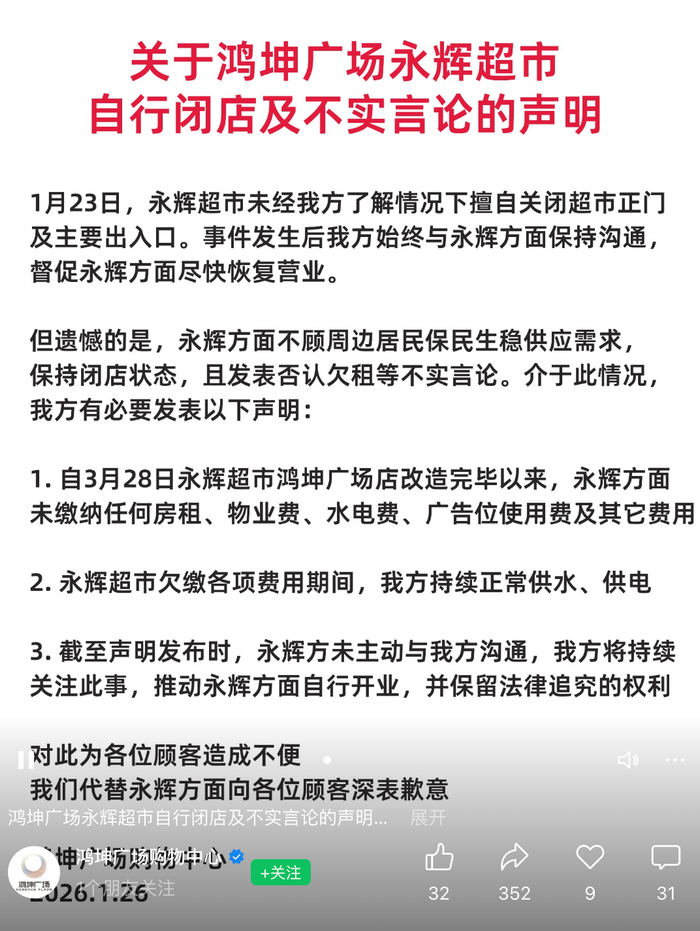
Core Viewpoint - Yonghui Supermarket (601933.SH) has announced a projected net loss of 2.14 billion RMB for 2025, attributing this loss to significant operational strategy adjustments [1] Company Information - Yonghui Supermarket Co., Ltd. was established in April 2001, with a registered capital of 9.08 billion RMB. The company engages in online trade agency, internet retail, and information service businesses [1] - The legal representative of the company is Zhang Xuansong, and the shareholders include Zhang Xuansong, Wu Kai, and Gan Wangheng [1] Legal and Risk Information - The company is involved in multiple legal disputes, including joint venture contract disputes and shareholder liability disputes that harm the interests of the company's creditors [1] Intellectual Property - Yonghui Supermarket has applied for trademarks such as "辉胖," "胖辉," "胖永辉," and "胖小辉," with international classifications covering advertising sales and convenience foods. Several "胖永辉" trademarks have been successfully registered [1]


反转来了?永辉超市回应北京一调改门店停业…
Xin Lang Cai Jing· 2026-01-27 04:57
Core Viewpoint - Yonghui Supermarket's recent store closure in Beijing's Daxing district has raised concerns, primarily due to disputes with the property management regarding operational disruptions and unpaid fees [3][5][14]. Group 1: Store Operations and Closure - Yonghui Supermarket confirmed that all other stores in Beijing are operating normally despite the closure of the Hongkun Plaza store [6][11]. - The Hongkun Plaza store was forced to close due to the property management's unilateral actions, including cutting off water and heating, which hindered normal operations [3][11]. - The property management accused Yonghui of closing the store without proper communication, which Yonghui disputes, stating that the management's claims are inaccurate [3][14]. Group 2: Financial Disputes - Yonghui Supermarket stated that the property management's claims regarding unpaid fees lack contractual and factual basis, and the company has received court documents related to a debt dispute that require it to suspend rent payments to protect creditor interests [5][13]. - The property management claims that Yonghui has not paid any rent or associated fees since the store's renovation, while Yonghui asserts that the management continued to provide utilities during this period [14]. Group 3: Business Strategy and Expansion - Founded in 2000, Yonghui Supermarket initially focused on fresh produce and has recently embarked on a transformation journey, adopting the "Fat Donglai" business model [8][16]. - As of November 30, 2023, Yonghui has opened five "Fat Yonghui" stores, with the majority operating normally except for the Hongkun Plaza location [9][17].
永辉超市发布北京鸿坤广场店暂停营业情况声明:门店系被迫闭店,此前物业方多次阻碍门店正常营业
Cai Jing Wang· 2026-01-27 01:54
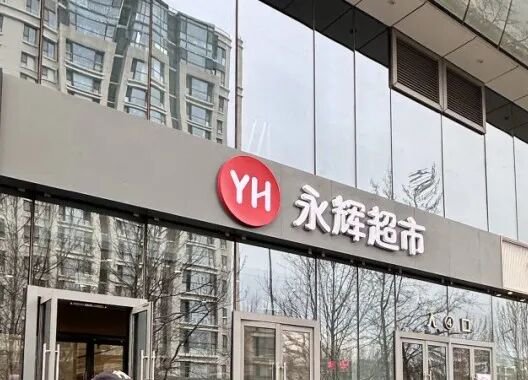
Core Viewpoint - The dispute between Yonghui Supermarket and the property management of Beijing Hongkun Plaza has led to the temporary closure of the supermarket, with both parties issuing conflicting statements regarding the reasons and responsibilities for the closure [1][2][3] Group 1: Reasons for Closure - The supermarket was forced to close on January 23, 2026, due to the property management's unilateral actions, including cutting off water and heating, which obstructed normal operations [1] - The property management claims that Yonghui Supermarket closed the main entrance without proper communication, and has not paid any rent or related fees since the store's renovation completion on March 28 [3] Group 2: Financial Disputes - Yonghui Supermarket asserts that the claims regarding unpaid rent and fees lack contractual and factual basis, and that they have received court documents instructing them to suspend rent payments due to the property management's debt disputes [2] - The property management maintains that they have continued to provide utilities despite Yonghui's alleged non-payment of various fees [3] Group 3: Current Operations - All other Yonghui Supermarket locations in Beijing are operating normally, and the company is actively communicating with relevant parties to restore operations at the Hongkun Plaza store [2]
永辉超市深夜回应北京一调改门店停业:物业方“擅自闭店”的说法与事实严重不符
Xin Lang Cai Jing· 2026-01-27 01:17
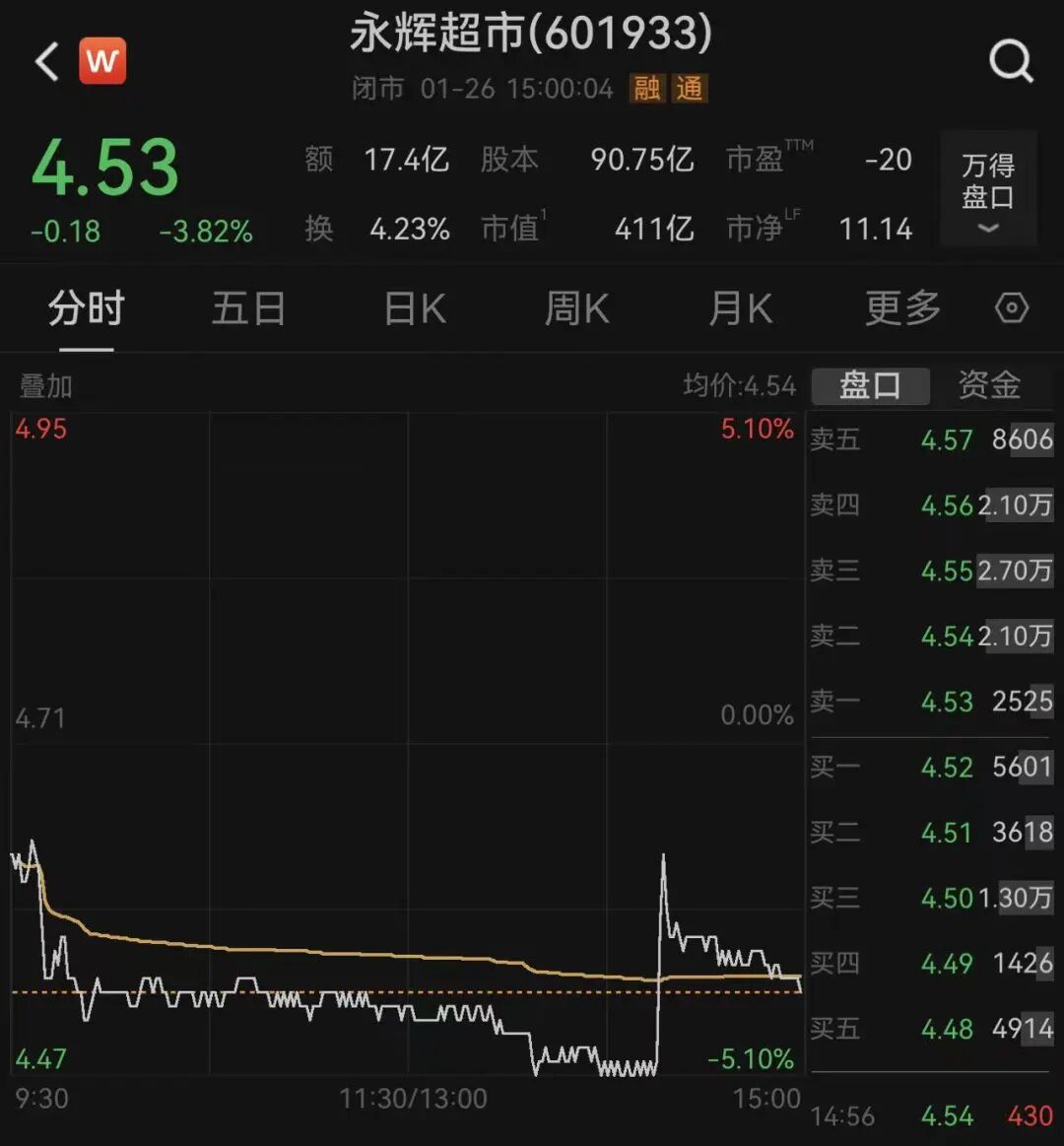
Core Viewpoint - The recent sudden closure of Yonghui Supermarket's Hongkun Plaza store in Beijing has raised concerns, primarily due to disputes with the property management regarding operational conditions and unpaid fees [1][7]. Group 1: Store Closure Details - Yonghui Supermarket announced the closure of its Hongkun Plaza store due to the property management's unilateral actions, including cutting off water and heating since January 15, 2026, without effective communication [1]. - The company attempted to restore operations by transporting water to the store, but the property management obstructed access by blocking entrances [1]. - The property management claimed that Yonghui closed the store without proper communication and has not paid any rent or utility fees since the store's renovation [7]. Group 2: Operational Status and Financial Performance - All other Yonghui Supermarket locations in Beijing are operating normally, and the company is actively working to resolve the issues with the Hongkun Plaza store [4]. - Yonghui Supermarket's recent financial report indicated an expected net loss of 2.14 billion yuan for the year 2025, marking the fifth consecutive year of losses, with the loss amount increasing compared to 2024 [7]. - The company plans to close 381 underperforming stores and significantly restructure 315 stores, which has led to substantial one-time expenses affecting overall performance [7].
探店北京区域“胖改”店
Sou Hu Cai Jing· 2026-01-26 16:36
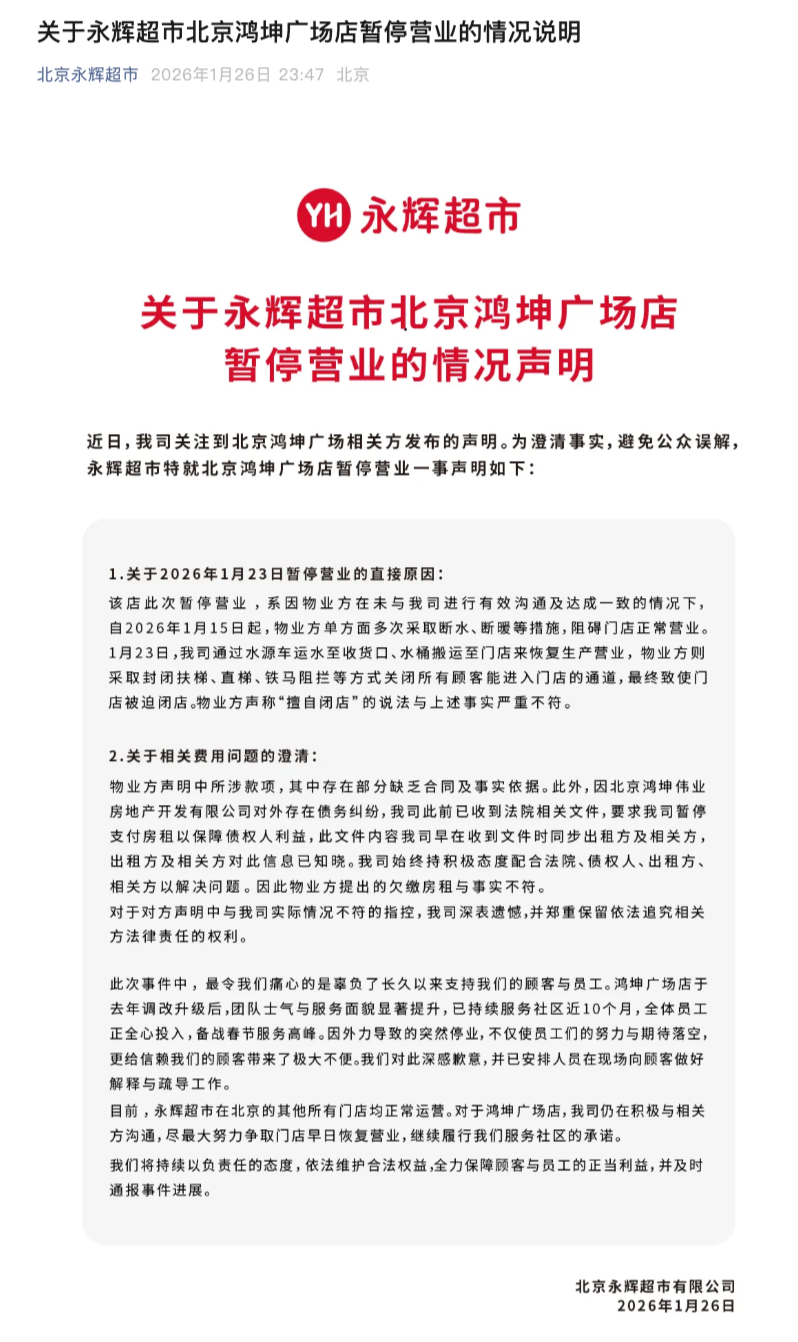
Core Viewpoint - The transformation of traditional supermarkets is not just about store renovation but involves deeper challenges such as supply chain restructuring, organizational culture change, and sustainable profitability [1]. Group 1: Consumer Behavior and Store Experience - Consumers have decreased in number at renovated stores, with some expressing dissatisfaction over higher prices and a lack of everyday items like fresh produce [3][6][8]. - Renovated stores have adopted a more boutique supermarket style, which some consumers find appealing, but others feel it lacks the "liveliness" and affordability of previous offerings [6][10][11]. - Observations indicate that foot traffic has significantly declined post-renovation, with stores that were once crowded now appearing empty, especially during peak shopping times [8][10]. Group 2: Pricing and Competition - The price increases following renovations have led consumers to seek alternatives, with many opting for online shopping where prices are often lower [14][16]. - Comparisons show that some products in renovated stores are priced significantly higher than similar items available on e-commerce platforms, leading to a perception of poor value [16][18]. - The competition from membership-based warehouse stores like Sam's Club adds pressure on traditional supermarkets to justify their pricing strategies [31]. Group 3: Operational Challenges and Employee Dynamics - The transformation efforts have resulted in a substantial increase in labor costs, with employee numbers and salaries rising significantly, which poses challenges to profitability [35][37]. - The need for consistent service quality across different locations and store sizes remains a critical challenge as companies scale their renovation efforts [37]. - The unique cultural and operational strengths of successful models like "胖东来" are difficult to replicate, creating a gap in execution for other supermarkets [35][37]. Group 4: Future Outlook and Strategic Considerations - The ongoing transformation of traditional supermarkets is seen as a necessary evolution in response to changing consumer preferences and competitive pressures [29][33]. - The ability of companies to navigate deeper operational challenges will determine whether they can establish themselves as sustainable "quality supermarkets" rather than fleeting trends [37][38].
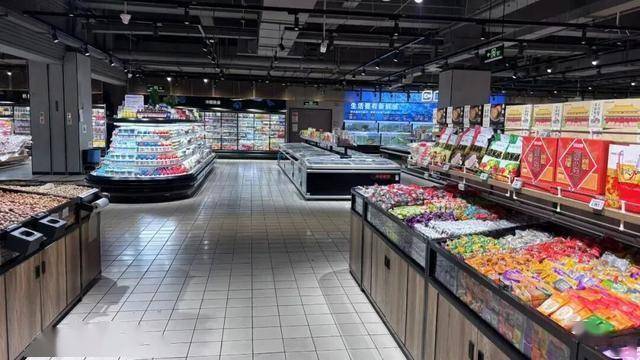
北京一“胖改”永辉暂停营业 已非首例
经济观察报· 2026-01-26 15:20
Core Viewpoint - Yonghui Supermarket continues to face significant profitability pressure, with a projected net loss of 2.14 billion yuan in 2025, compared to a net loss of 1.47 billion yuan in the previous year, marking the fifth consecutive year of losses [1][5]. Group 1: Store Operations and Challenges - The Yonghui Supermarket store at Hongkun Plaza in Beijing, which underwent a "fat modification" and reopened less than a year ago, has now suspended operations. The store was reported to be closed on January 23, 2025, due to disputes over unpaid rent and other fees [2][3]. - The property management of Hongkun Plaza stated that Yonghui Supermarket had not paid any rent or related fees since the store's renovation was completed on March 28, 2025, and has not communicated with them regarding the closure [3]. - This incident is not isolated, as another Yonghui Supermarket in Fuzhou, which was also modified to follow the "fat model," closed just four months after reopening, indicating ongoing operational challenges [4]. Group 2: Strategic Adjustments and Market Position - The "fat modification" strategy, inspired by the successful model of another supermarket chain, aims to enhance product quality, improve shopping experiences, and optimize store layouts. Yonghui Supermarket has been implementing this strategy since May 2024, with 315 out of 403 stores having completed the modifications by the end of 2025 [4].
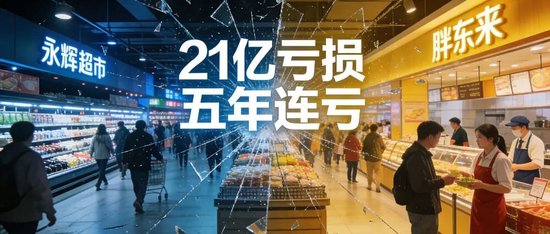
永辉学胖东来巨亏21亿:“形似神离”的转型困局
Xin Lang Cai Jing· 2026-01-26 15:09
Core Insights - The retail industry in China is experiencing a stark contrast, with Yonghui Supermarket forecasting a loss of 2.14 billion yuan for the year, marking five consecutive years of losses exceeding 10 billion yuan, while regional giant Pang Donglai reports impressive revenue of 23.5 billion yuan [1][8] - Yonghui's aggressive transformation attempt, which cost 1.8 billion yuan and involved 315 stores, has been deemed a complete failure, despite initial sales growth of 324% in the first month [1][8] Group 1: Transformation Challenges - Yonghui's transformation strategy, which aimed to replicate Pang Donglai's model, faced fundamental issues due to a conflict in business models, leading to a logistics cost that is 30% higher than regional competitors [3][10] - The company's high employee costs, ranging from 9 million to 18 million yuan per store annually, contributed to a "scale inefficiency" trap, making the national network a burden during the transformation [3][10] - The aggressive strategy resulted in direct losses of 1.8 billion yuan, including 910 million yuan in asset write-offs and 300 million yuan in lost operating profits from store closures [3][10] Group 2: Supply Chain and Operational Issues - Yonghui's shift to a "bare price direct procurement" model, after eliminating supplier backend fees, led to a decline in gross margin to 20.52% and an increase in stockout rates [4][11] - The company's revenue for Q3 2025 was 42.434 billion yuan, a year-on-year decline of 22.21%, indicating a disparity between rising costs and falling revenues [4][11] - Compared to competitors like Bubu Gao and Jiajiayue, which adopted a more cautious approach, Yonghui's rapid transformation exacerbated supply chain disruptions [4][11] Group 3: Employee and Consumer Trust Issues - Yonghui's strategy of high salaries combined with strict performance evaluations resulted in high employee turnover and a decline in service quality, with customers reporting a lack of patience from staff [5][12] - The company's pricing strategy, which raised prices without improving quality, led to a loss of consumer trust, with the repurchase rate dropping below 30% after an initial spike [5][12] - The essence of retail being human-centric was overlooked by Yonghui, which failed to adopt Pang Donglai's employee satisfaction-driven customer service model [5][12] Group 4: Recommendations for Recovery - Yonghui needs to abandon a one-size-fits-all approach and implement regional adaptations, maintaining high-end stores in core cities while focusing on value for money in lower-tier markets [6][13] - The company should establish a "joint procurement alliance" based on regional needs, aiming to reduce fresh produce loss rates from the industry average of 3.5% to below 1.5% within three years [6][13] - Rebuilding consumer trust through profit-sharing models and transparent pricing strategies is essential, with a goal to increase the share of essential goods to over 50% [6][13] Conclusion - Yonghui's 2.1 billion yuan loss serves as a warning to the retail industry that transformation must align with the company's inherent capabilities rather than superficial imitation [7][14] - The future of retail lies not with quick imitators but with those who respect industry dynamics and focus on value creation [7][14]
“胖改”失灵?永辉北京一门店突然停业,调改不满1年
Mei Ri Jing Ji Xin Wen· 2026-01-26 15:03
Core Viewpoint - Yonghui Supermarket's store at Hongkun Plaza in Beijing has suspended operations due to issues with the property management, including the inability to access the main entrance and interruptions in water and heating supply. The store had recently undergone renovations and reopened in March 2025, but it is now facing significant operational challenges and financial disputes with the property management [1][4][10]. Group 1: Store Operations and Financial Issues - The Yonghui Supermarket at Hongkun Plaza has been closed since January 23, with customers reporting blocked entrances and locked escalators [3][4]. - The shopping center claims Yonghui has not paid over 16 million yuan in rent and other fees since the store's renovation completion [10][11]. - Yonghui's official response indicates that they are in discussions to resolve the issues and aim to reopen the store soon [10][11]. Group 2: Financial Performance and Strategic Adjustments - Yonghui Supermarket is projected to incur a net loss of 2.14 billion yuan for 2025, marking a 45.6% increase in losses compared to the previous year [14]. - The company has been in a continuous loss situation for five years, with total losses exceeding 10 billion yuan during this period [15]. - In 2025, Yonghui closed 381 stores that did not align with its strategic direction, leading to significant one-time costs related to asset write-offs and operational disruptions [19][22]. Group 3: Market Position and Competitive Strategy - Yonghui has completed renovations on 315 stores, making it the supermarket brand with the most "Pang Donglai-style" adjustments in China [24]. - The company is shifting its strategy from "scale expansion" to "quality growth," aiming to redefine its market positioning [18]. - The challenges faced by Yonghui in adopting the Pang Donglai model reflect broader industry difficulties, as other retailers also struggle with similar transformations [25][27].
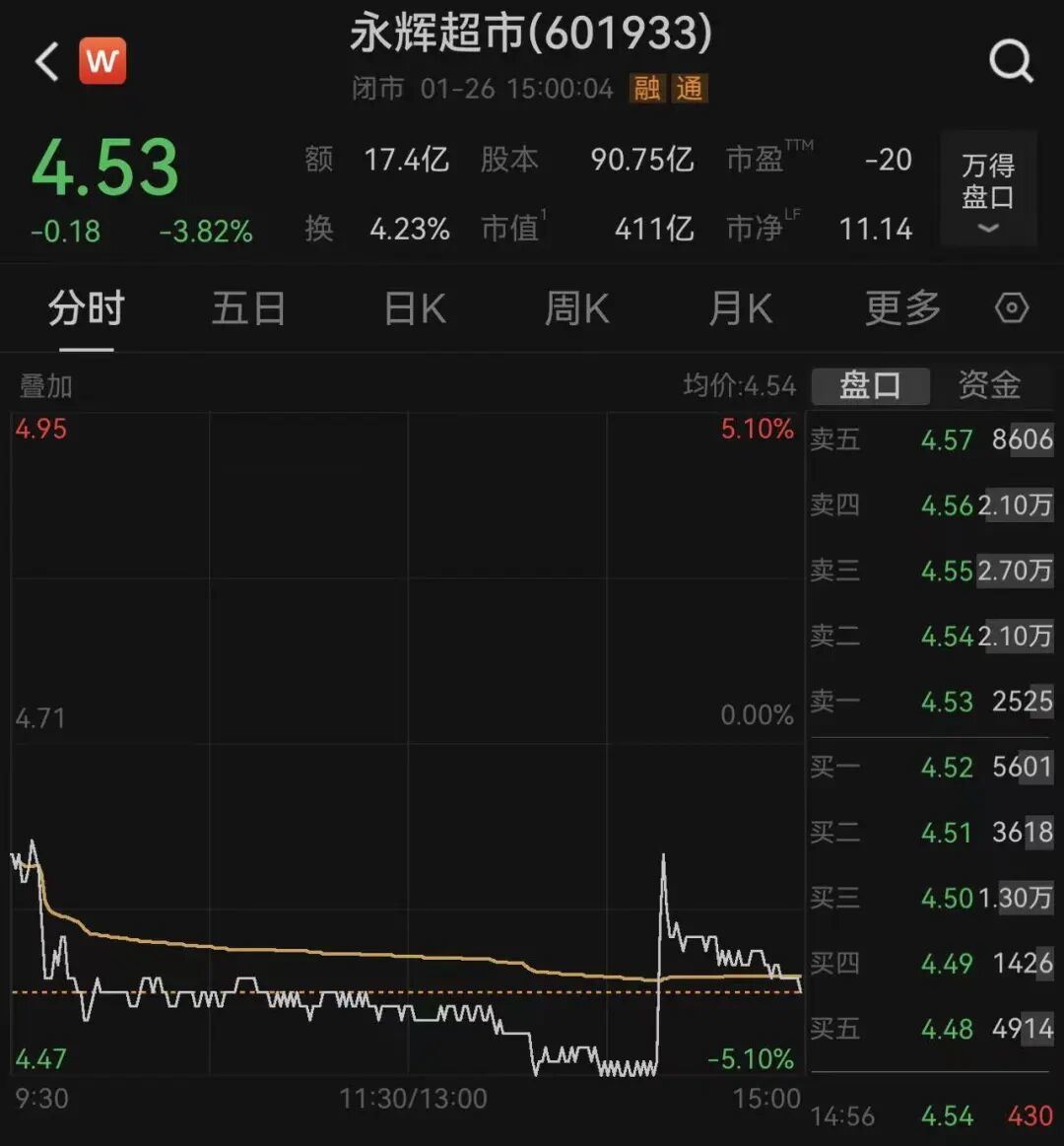
“胖改”失灵?永辉北京一门店突然停业,调改不满1年,商场:还欠房租等费用;永辉否认!公司5年亏掉上百亿元,去年关店381家
Mei Ri Jing Ji Xin Wen· 2026-01-26 14:39
Core Viewpoint - Yonghui Supermarket's store at Hongkun Plaza in Beijing has suspended operations due to issues with the property management, including the inability to access the main entrance and interruptions in water and heating supply. The store had recently undergone renovations and reopened in March 2025, but has now been closed for several days without a clear timeline for reopening [1][2][4]. Group 1: Store Operations and Financial Issues - The Hongkun Plaza shopping center claims that Yonghui Supermarket has not paid over 16 million yuan in rent and other fees since the store's renovation was completed [5][8]. - Yonghui Supermarket confirmed the store is not permanently closed but is in a state of suspension due to the ongoing issues with the property management [2][6]. - The shopping center has expressed its intention to pursue legal action if the situation is not resolved and has apologized to customers for the inconvenience caused by the store's closure [8]. Group 2: Financial Performance and Strategic Adjustments - Yonghui Supermarket is expected to report a net loss of 2.14 billion yuan for 2025, marking a 45.6% increase in losses compared to the previous year, continuing a trend of losses for five consecutive years [9][11]. - The company has closed 381 stores that do not align with its future strategic direction, while also undergoing significant operational adjustments, including the renovation of 315 stores [11][12]. - The financial impact of these adjustments includes asset write-offs and losses from store closures, totaling over 1.2 billion yuan due to the "Pang Donglai" reform strategy [11][12].
永辉北京一调改门店停业,购物中心发声:系永辉自行闭店,确有欠租情况
Xin Lang Cai Jing· 2026-01-26 10:26
Core Viewpoint - The sudden closure of Yonghui Supermarket at Hongkun Plaza in Beijing has raised concerns regarding unpaid fees and operational transparency, with both parties exchanging conflicting statements about the reasons for the closure [1][2]. Group 1: Company Actions - Yonghui Supermarket closed its main entrance and primary access points without prior communication with Hongkun Plaza management on January 23 [1][2]. - The supermarket has not paid any rent, property fees, utility costs, or advertising fees since the completion of its renovation on March 28, 2025 [2]. Group 2: Communication and Response - Hongkun Plaza has maintained communication with Yonghui, urging the supermarket to resume operations promptly [1][2]. - Yonghui has denied allegations of unpaid rent and stated that it is actively coordinating with relevant parties to resolve the issues and restore operations [1]. Group 3: Community Impact - The closure has caused inconvenience to local residents, with reports indicating that the water supply was cut off due to Yonghui's failure to pay property rent, a claim that Yonghui has refuted [1][2].