CCB(601939)

Search documents
六大行日赚39亿,农行利润增速领跑,中行营收增长第一
3 6 Ke· 2025-11-05 23:51
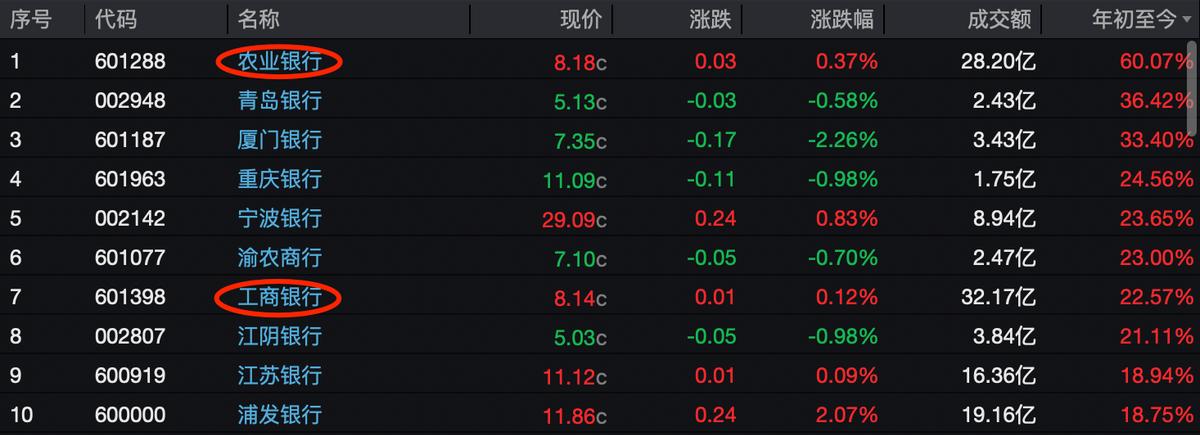
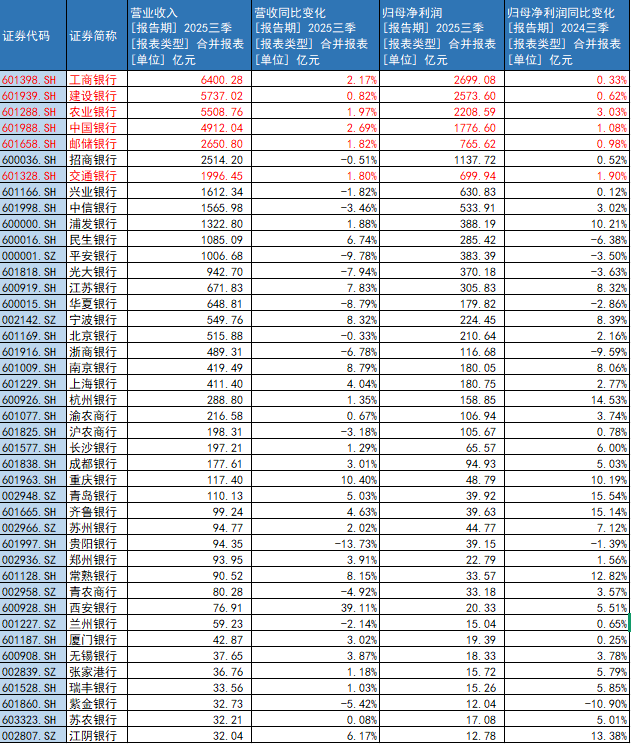
Core Insights - The six major state-owned banks in China reported a total operating income of 27,205.35 billion yuan for the first three quarters of 2025, representing a year-on-year growth of 1.87% [1] - The total net profit attributable to shareholders reached 10,723.43 billion yuan, with a year-on-year increase of 1.22%, equivalent to an average daily profit of 39.14 billion yuan [1] - Agricultural Bank led in net profit growth at 3.03%, while China Bank had the highest revenue growth at 2.69% [1][4] Financial Performance - The total asset size of the six banks reached 217.97 trillion yuan by the end of Q3 2025, marking a 9.16% increase from the previous year [2][9] - Total loans amounted to 127.14 trillion yuan, up 8.54%, while total deposits were 149.76 trillion yuan, reflecting a 6.92% growth [2][12] - The net interest margin for the banks faced pressure, with a decline noted across the board, although non-interest income showed growth, with five banks achieving double-digit increases [1][7] Revenue and Profit Breakdown - In terms of revenue, the banks achieved the following figures: Industrial Bank (6,400.28 billion yuan), Construction Bank (5,737.02 billion yuan), and Agricultural Bank (5,508.76 billion yuan) [4][5] - Non-interest income for the banks was as follows: Industrial Bank (1,666.12 billion yuan), Construction Bank (1,460.96 billion yuan), and Agricultural Bank (1,235.68 billion yuan), with Agricultural Bank showing the highest growth rate at 20.65% [7] - Investment income also saw significant growth, with Construction Bank leading at 150.55% year-on-year [8] Asset Quality and Capital Adequacy - The overall asset quality remained stable, with five banks reporting a decrease in non-performing loan ratios compared to the end of the previous year [15] - The highest non-performing loan ratio was recorded by Postal Savings Bank at 0.94%, while Agricultural Bank had the highest provision coverage ratio at 295.08% [16][17] - Core Tier 1 capital adequacy ratios were robust, with Construction Bank at 14.36%, the highest among the six banks [18] Dividend and Shareholder Returns - The rolling dividend yield for the banks was above 2.5%, significantly higher than the 5-year fixed deposit rates, with the highest yield from the Transportation Bank at 4.10% [1][18]







五家银行跻身绿色信贷“万亿俱乐部” 绿色债券存量规模近2万亿
2 1 Shi Ji Jing Ji Bao Dao· 2025-11-05 23:42
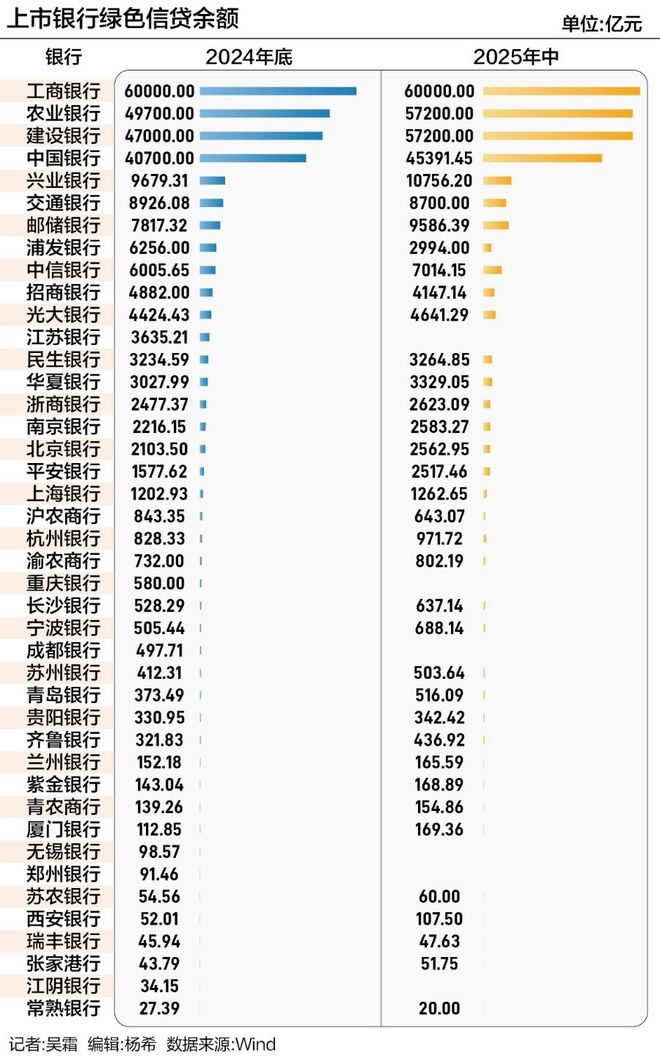
Core Insights - Green finance has transitioned from an optional choice to a mandatory requirement for the banking industry, serving as a new engine for strategic transformation and a blue ocean market for future growth [1] - The balance of green financing at Industrial Bank has reached nearly 2.5 trillion yuan, with green loans exceeding 1 trillion yuan and a non-performing loan rate of only 0.57% [1] - The People's Bank of China and other departments have issued a unified policy framework for green finance, effective from October 1, 2025, to standardize various financial products [2] Group 1: Green Credit Growth - As of the end of 2024, the total balance of green credit among 42 A-share listed banks exceeded 27 trillion yuan, reflecting a year-on-year growth of approximately 20% [3] - State-owned banks dominate the green credit market, with the six major state-owned banks accounting for over 21 trillion yuan, representing 77.6% of the total [3] - Industrial Bank's green loan balance has risen to 1.08 trillion yuan, joining the "trillion club" [3] Group 2: Performance and Sector Focus - The average growth rate of green credit for A-share listed banks in 2024 was 20.6%, a slowdown from approximately 28% in 2023, yet leading institutions maintained strong growth [4] - The focus of green credit issuance is concentrated in four key areas: clean energy, green transportation, energy conservation and environmental protection, and green buildings [4] - The Yangtze River Delta, Guangdong-Hong Kong-Macau Greater Bay Area, and Chengdu-Chongqing Economic Circle are identified as core regions for green credit [4] Group 3: Product Innovation - A-share listed banks are deepening innovation in green financial products, creating a multi-dimensional product system that includes loans, bonds, asset securitization, insurance, and carbon finance [5] - Sustainable Development Linked Loans (SLL), carbon emission rights pledge financing, and environmental rights collateral loans are gaining traction [5] - Industrial Bank has launched the first green loan with biodiversity protection insurance, while Bohai Bank introduced a green loan linked to data center energy efficiency [6] Group 4: Broader Financial Tools - The issuance of green bonds has expanded, with the cumulative issuance of labeled green bonds in 2024 surpassing 4 trillion yuan [6] - Banks are actively participating in green wealth management and fund products, enhancing investor engagement through innovative offerings [6] - Carbon finance tools are transitioning from pilot programs to broader applications, with various banks introducing carbon emission rights pledge financing products [6] Group 5: Future Directions - The banking industry is expected to continue innovating green financial products to support sustainable economic development, moving beyond traditional green credit [7] - The development of ESG-linked loans and financing models using carbon emission rights as collateral will be explored [7] - These innovations will not only assist in achieving national carbon reduction goals but also cultivate new growth momentum for banks [7]


险资三季度加码银行股 国有大行成布局重点
Zhong Guo Zheng Quan Bao· 2025-11-05 20:08
Core Viewpoint - Insurance capital is increasingly investing in the banking sector, particularly in state-owned banks, due to the high dividend yields that align with their investment needs [1][2][3] Group 1: Insurance Capital Increases in State-Owned Banks - Insurance capital has significantly increased its holdings in major state-owned banks, with Postal Savings Bank and China Construction Bank being the primary targets for investment [1] - Ping An Life has increased its stake in Postal Savings Bank by 2.189 billion shares, making it the second-largest shareholder [1] - New China Life Insurance has also increased its holdings in China Construction Bank by 8.8 million shares, becoming its fifth-largest shareholder [1] Group 2: Entry of Insurance Capital in Other Major Banks - For the first time, insurance capital appears in the top ten shareholders of Industrial and Commercial Bank of China and Agricultural Bank of China, with China Life Insurance and Ping An Life becoming significant shareholders [2] - Insurance capital has also been active in the Hong Kong market, frequently increasing stakes in H-shares of state-owned banks [2] Group 3: Attractive Features of Banking Stocks - The six major banks have shown stable profit growth, with a total net profit of 1.07 trillion yuan in the first three quarters, alongside improved asset quality [2] - The low valuation and high dividend yield of banking stocks align well with the asset allocation needs of insurance capital, making them a core investment area [3] Group 4: Future Outlook for Insurance Capital Investment - Industry experts predict that insurance capital will increase its market presence and allocation in banking stocks due to favorable policy environments [3] - The implementation of new accounting standards in early 2026 will likely enhance the demand for stable, low-volatility stocks, further solidifying the preference for banking stocks among insurance capital [4]
建行山东省分行:多维深耕养老金融,为齐鲁银发经济注入强劲动能
Qi Lu Wan Bao· 2025-11-05 16:19
Core Insights - The article discusses innovative financing solutions to address the challenges faced by private elderly care institutions in securing funding and collateral for expansion and service upgrades [1][2][7] Group 1: Financing Challenges in Elderly Care - The shortage of funds and difficulties in using social welfare land as collateral have been significant barriers for private elderly care institutions to expand and upgrade services [1] - Daylight Jiahao Yintai Elderly Service Co., Ltd. faced a funding gap of 30 million yuan for its third-phase project due to the land being classified as social welfare land, which does not meet traditional bank collateral requirements [1] Group 2: Innovative Financing Solutions - China Construction Bank (CCB) Shandong Branch identified the pain points in the elderly care industry and initiated a "breaking the wall" action by innovating policies to allow social welfare land usage rights as collateral for loans [2] - CCB Shandong Branch provided a loan of 30 million yuan to the third-phase project of Daylight Jiahao, marking the first loan using social welfare land usage rights as collateral for a profit-oriented elderly care institution [2] Group 3: Mergers and Acquisitions in Elderly Care - A company with state-owned background plans to acquire a well-known local elderly care institution to enhance regional service standards and address funding challenges faced by the target institution [3][4] - CCB Weifang Branch has successfully issued 185 million yuan in elderly care industry acquisition loans, supporting the merger and enhancing service quality in the region [5] Group 4: Human-Centric Financial Services - CCB Shandong Branch has integrated financial services with humanistic care, offering activities like financial literacy classes and handcraft sessions for elderly clients, enhancing their overall experience [6] - The bank's efforts in elderly finance have expanded to cover various sectors, providing strong support for the development of the elderly care industry in Shandong [6][7] Group 5: Strategic Importance of Elderly Finance - The aging population in China is driving the demand for diverse and high-quality elderly care services, making the development of elderly finance crucial for addressing funding bottlenecks and improving service quality [7] - CCB Shandong Branch recognizes the importance of elderly finance and is committed to innovating financing models and enhancing human services to support the high-quality development of the silver economy in Shandong [7]
透视银行三季报:超30家净息差收窄 债市波动拖累非利息收入
Bei Ke Cai Jing· 2025-11-05 11:12
Core Insights - The overall performance of A-share listed banks in the first three quarters of the year is positive, with over 80% achieving year-on-year growth in net profit attributable to shareholders [2][3] - The growth in net profit is primarily driven by stable net interest income and improved asset quality, despite a decline in non-interest income due to bond market fluctuations [2][3] - The six major banks collectively reported over 1 trillion yuan in net profit, marking a significant milestone [3][4] Financial Performance - Among the 42 listed banks, 35 reported year-on-year growth in net profit, while only 7 experienced a decline [3][4] - The top four state-owned banks (Industrial and Commercial Bank of China, China Construction Bank, Agricultural Bank of China, and Bank of China) all achieved growth in both revenue and net profit [4][5] - Industrial and Commercial Bank of China led in revenue with 640.03 billion yuan, a 2.17% increase year-on-year, and a net profit growth of 0.33% [4][6] Non-Interest Income and Market Impact - Many banks faced a decline in non-interest income due to volatility in the bond market, with several banks reporting significant losses in fair value changes [9][10] - For instance, China Merchants Bank reported a fair value loss of 8.83 billion yuan, transitioning from profit to loss [10][12] - The decline in non-interest income is attributed to reduced earnings from bond and fund investments [10][13] Interest Income Trends - Some banks, particularly city commercial banks, saw substantial growth in interest income, with Xi'an Bank's interest income increasing over 60% [7][8] - Conversely, banks like Guiyang Bank and Capital Bank reported declines in interest income of 12.29% and 17.34%, respectively [8][9] Net Interest Margin - The overall net interest margin for listed banks has narrowed compared to the end of the previous year, although some banks have seen a recovery from the second quarter [16][20] - As of the end of the third quarter, Xi'an Bank's net interest margin was 1.79%, reflecting a 0.43% increase from the end of the previous year [16][17] - The stability of net interest margins in the fourth quarter will depend on the banks' ability to optimize their liability structures and find high-quality investment opportunities [20]


上市银行2025年三季报综述:盈利温和修复,利息与中收共振回暖
Ping An Securities· 2025-11-05 10:38
Investment Rating - The report maintains a "stronger than the market" rating for the banking sector [1][4]. Core Views - As of the end of October, 42 listed banks reported a 1.5% year-on-year increase in net profit for the first three quarters of 2025, an improvement of 0.7 percentage points compared to the first half of 2025 [4][9]. - The report highlights a continued recovery in profitability, driven by a rebound in interest income and non-interest income [4][10]. - The report anticipates that the positive signals from interest margin and non-interest income will persist into the fourth quarter of 2025, with a focus on the impact of policies aimed at reducing competition and the quality of retail assets [15][4]. Summary by Sections Profitability Analysis - The net interest income for the first three quarters of 2025 decreased by 0.6% year-on-year, while non-interest income from fees and commissions grew by 4.6% [10][6]. - The report notes that the profitability of individual banks varies, with some banks like Shanghai Pudong Development Bank and Agricultural Bank of China showing significant growth rates of 10.2% and 3.0% respectively [4][9]. Operational Breakdown - Total asset growth for the 42 listed banks was 9.3% year-on-year, with loan growth at 7.7% and deposit growth at 7.9% [22][4]. - The annualized net interest margin for the third quarter was stable at 1.36%, with a decrease in the cost of interest-bearing liabilities [4][6]. Investment Recommendations - The report suggests a shift towards reallocation rather than trading, emphasizing the importance of structural changes in funding flows that support valuation recovery in the banking sector [6][4]. - Specific banks such as Chengdu Bank, Jiangsu Bank, and Suzhou Bank are highlighted for their regional advantages and potential for continued profit growth [6][4].

五家银行跻身绿色信贷“万亿俱乐部”,绿色债券存量规模近2万亿
2 1 Shi Ji Jing Ji Bao Dao· 2025-11-05 09:41
Core Insights - Green finance has transitioned from an optional strategy to a mandatory focus for banks, becoming a new engine for strategic transformation and a blue ocean market in the context of a shift towards a green low-carbon economy [1][2] - The balance of green financing at Industrial Bank has reached nearly 2.5 trillion yuan, with green loans exceeding 1 trillion yuan and a non-performing loan rate of only 0.57% [1] - The People's Bank of China and other departments have issued a unified policy framework for green finance, effective from October 1, 2025, to standardize the support scope for green loans and bonds [2] Green Credit Landscape - By the end of 2024, the total balance of green credit among 42 A-share listed banks exceeded 27 trillion yuan, with a year-on-year growth of approximately 20% [3] - State-owned banks are the main contributors to green credit, with the six major state-owned banks holding over 21 trillion yuan, accounting for 77.6% of the total [3] - The growth pattern shows large banks maintaining scale, joint-stock banks demonstrating strong vitality, and regional banks achieving rapid growth [3] Green Loan Balances - As of the end of 2024, only four listed banks had green loan balances exceeding 1 trillion yuan: Industrial Bank, Agricultural Bank, Construction Bank, and Bank of China [5] - Industrial Bank's green loan balance rose to 1.08 trillion yuan in the first half of the year, joining the "trillion club" [5] - Among joint-stock banks, Industrial Bank, CITIC Bank, and Pudong Development Bank lead in green credit scale, collectively accounting for nearly 40% of the total [5] Growth Rates and Sector Focus - The average growth rate of green credit for A-share listed banks in 2024 was 20.6%, a slowdown from approximately 28% in 2023, yet leading institutions maintained strong growth [5] - The focus of green credit is heavily concentrated in clean energy, green transportation, energy conservation, and green buildings, with key regions being the Yangtze River Delta, Guangdong-Hong Kong-Macau Greater Bay Area, and Chengdu-Chongqing economic circle [6] Financial Product Innovation - A-share listed banks are deepening innovation in green financial products, creating a multi-dimensional product system that includes loans, bonds, asset securitization, insurance, and carbon finance [7] - Green loans remain the core vehicle for green finance, with a total balance exceeding 27 trillion yuan by the end of 2024, reflecting a year-on-year growth of about 20% [7] - Innovative tools such as sustainability-linked loans and carbon emission rights pledge financing are gaining traction [7] Bond and Investment Developments - The issuance of green bonds has expanded, with the cumulative issuance of labeled green bonds in 2024 surpassing 4 trillion yuan [8] - Banks are actively participating in green wealth management and fund products, enhancing investor engagement through innovative offerings [8] - Carbon finance tools are transitioning from pilot programs to broader applications, with banks launching carbon emission rights pledge financing products [8] Future Directions - The banking sector is expected to continue innovating green financial products to support sustainable economic development more effectively [9] - This evolution will extend beyond traditional green loans to include financing models linked to carbon emissions and environmental rights [10]
建设银行(00939) - 截至2025年10月31日止股份发行人的证券变动月报表
2025-11-05 09:27
FF301 致:香港交易及結算所有限公司 公司名稱: 中國建設銀行股份有限公司 呈交日期: 2025年11月5日 I. 法定/註冊股本變動 | 1. 股份分類 | 普通股 | 股份類別 | H | | 於香港聯交所上市 (註1) | | 是 | | | --- | --- | --- | --- | --- | --- | --- | --- | --- | | 證券代號 (如上市) | 00939 | 說明 | | | | | | | | | | 法定/註冊股份數目 | | | 面值 | | 法定/註冊股本 | | | 上月底結存 | | | 240,417,319,880 | RMB | | 1 RMB | | 240,417,319,880 | | 增加 / 減少 (-) | | | 0 | | | RMB | | 0 | | 本月底結存 | | | 240,417,319,880 | RMB | | 1 RMB | | 240,417,319,880 | | 2. 股份分類 | 普通股 | 股份類別 | A | | 於香港聯交所上市 (註1) | | 否 | | | --- | --- | --- | ...
银行积存金业务火速变阵,黄金税收新政有何影响?
Guo Ji Jin Rong Bao· 2025-11-05 07:59
Core Viewpoint - The implementation of the new gold tax policy in November has led banks to adjust their gold accumulation and redemption services, impacting how these products are offered to consumers [1][4][7]. Group 1: Bank Adjustments - Major banks such as Industrial and Commercial Bank of China (ICBC) and China Construction Bank (CCB) quickly suspended certain gold accumulation services following the new tax policy [1][3]. - ICBC announced the suspension of its "Ruyi Gold Accumulation" service, affecting new account openings and physical gold redemption, although existing plans for current customers remain unaffected [3][7]. - China Merchants Bank (CMB) has also temporarily limited the types of gold products available for redemption, focusing on jewelry and high-cost gold bars [2][4]. Group 2: Tax Policy Changes - The new tax regulations, effective from November 1, differentiate between investment and non-investment gold, with specific tax implications for each category [5][6]. - Standard gold transactions on exchanges are exempt from value-added tax (VAT), while physical gold transactions incur a 13% VAT, which may shift investor preferences towards accumulation products offered by banks [6][7]. - The policy aims to enhance market order and transparency, encouraging investment in standard gold while regulating the consumption of physical gold [6][7]. Group 3: Market Implications - The adjustments in bank services are seen as necessary responses to the increased market volatility and the need for risk management in light of the new tax policy [4][6]. - Experts suggest that banks should communicate changes effectively to minimize potential impacts on investors, as the adjustments may lead to a temporary disruption in service availability [8].
晨会纪要:2025年第188期-20251105
Guohai Securities· 2025-11-05 03:12
Key Insights - The report highlights a rebound in the electrolyte industry, with significant growth potential in fluorinated liquids, particularly for the company Xinzhou Bang, which reported a revenue of 6.616 billion yuan for the first three quarters of 2025, a year-on-year increase of 16.75% [6][10] - The company achieved a net profit of 748 million yuan, up 6.64% year-on-year, with a sales gross margin of 24.51%, reflecting a decline of 2.58 percentage points [6][10] - The report indicates that the company is well-positioned to benefit from the recovery in the electrolyte market, driven by rising prices of lithium hexafluorophosphate and improved operational efficiency [10][11] Group 1: Xinzhou Bang (Battery) - The company reported a revenue of 2.368 billion yuan in Q3 2025, a year-on-year increase of 13.60% and a quarter-on-quarter increase of 5.45% [7] - The net profit for Q3 2025 was 264 million yuan, down 7.51% year-on-year but up 4.03% quarter-on-quarter, indicating a mixed performance [7][8] - The company is focusing on optimizing its product structure and enhancing operational efficiency, with a stable growth trajectory in its organic fluorine chemicals and electronic information chemicals [9][10] Group 2: Weijian Medical (Personal Care Products) - The company achieved a revenue of 7.897 billion yuan in the first three quarters of 2025, a year-on-year increase of 30.10%, with a net profit of 732 million yuan, up 32.36% [13][14] - The medical segment saw a revenue increase of 44.4%, driven by strong growth in surgical consumables and high-end dressings [14] - The consumer segment also performed well, with a revenue of 4.01 billion yuan, up 19.1%, led by significant growth in the sales of sanitary products [15] Group 3: Longqi Technology (Consumer Electronics) - The company reported a revenue of 31.332 billion yuan for the first three quarters of 2025, a year-on-year decrease of 10.28%, but a net profit increase of 17.74% [21] - In Q3 2025, the revenue was 11.424 billion yuan, down 9.62% year-on-year, while the net profit increased by 64.46% [22] - The company is expanding its product portfolio under the "1+2+X" strategy, focusing on smart devices and automotive electronics [23][24] Group 4: Minxin Technology (Semiconductors) - The company reported a revenue of 464 million yuan in the first three quarters of 2025, a year-on-year increase of 37.73%, with a gross margin of 30.28% [25][26] - In Q3 2025, the revenue was 160 million yuan, up 21.9% year-on-year, indicating strong demand for pressure and inertial sensors [25][27] - The company is well-positioned to benefit from the growth of MEMS sensors in the AI era, with a diverse product matrix [26][28] Group 5: Yingly Technology (General Equipment) - The company reported a revenue of 2.121 billion yuan in the first three quarters of 2025, a year-on-year increase of 11.02%, with a net profit of 294 million yuan, up 29.59% [35][36] - The company is expanding its processing and coating capabilities in the blade and casing industry, which is expected to enhance its production capacity [37] - The gross margin for Q3 2025 was 38.03%, reflecting a significant improvement in profitability [38] Group 6: Weichai Power (Automotive Parts) - The company reported a revenue of 170.57 billion yuan for the first three quarters of 2025, a year-on-year increase of 5.3%, with a net profit of 8.88 billion yuan, up 5.7% [44] - In Q3 2025, the revenue was 57.42 billion yuan, up 16.1% year-on-year, driven by strong demand in the heavy truck sector [44] - The company is benefiting from the recovery in the heavy truck market, with significant growth in natural gas and electric vehicle sales [44]