
CCB(601939)

Search documents
税收新政落地后,怎么买金更划算?
Zhong Guo Xin Wen Wang· 2025-11-05 03:05
Core Viewpoint - The new tax policy on gold, effective from November 1, 2025, is expected to significantly impact gold prices and trading behaviors in the market, leading to increased price volatility and changes in consumer purchasing patterns [1][10]. Group 1: Tax Policy Details - The announcement from the Ministry of Finance and the State Administration of Taxation categorizes gold transactions into "investment use" and "non-investment use," with different tax implications for each [1][4]. - Gold that does not undergo physical delivery will not be affected by the new tax policy, while those that do will face tax changes based on their usage classification [1]. Group 2: Price Fluctuations - Following the announcement, the price of gold at the Shenzhen Shui Bei Gold Trading Center surged from 929 yuan per gram to 991 yuan per gram, an increase of 62 yuan [2][3]. - Major retailers like Chow Tai Fook adjusted their prices significantly, with gold jewelry prices rising from 1198 yuan per gram to 1259 yuan per gram, and investment gold prices from 1058 yuan per gram to 1120 yuan per gram [3][4]. Group 3: Market Reactions - Some banks, including Industrial and Commercial Bank of China and China Construction Bank, temporarily suspended certain gold accumulation services to comply with the new tax regulations and manage potential risks associated with high gold prices [5][7]. - The new policy is expected to encourage market-oriented gold trading and may lead to a shift in trading habits, with a focus on distinguishing between investment and non-investment uses [8][10]. Group 4: Industry Implications - Analysts predict that the price gap between investment gold bars and gold jewelry may widen due to the new tax policy, as costs for non-investment gold may increase significantly [4]. - The new tax framework is anticipated to reshape the gold market's ecosystem, leading to increased concentration in trading activities and a potential shift towards exchange-based transactions for institutional investors [10].




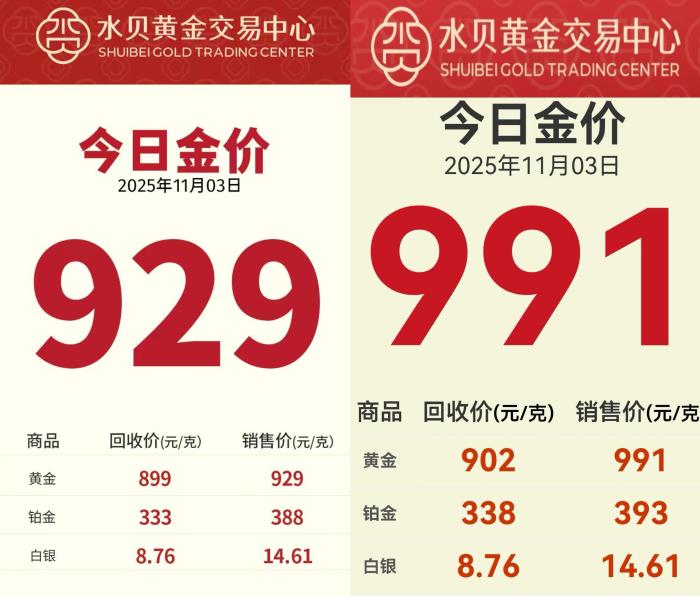
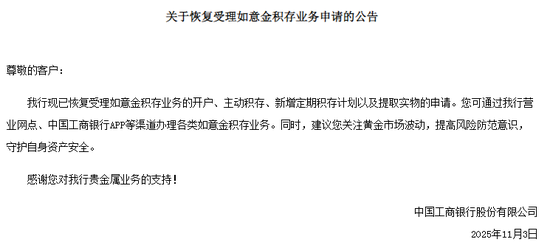
黄金税收新规实施后,工行如意金积存业务暂停又恢复!招行金条价格已含税
Xin Lang Cai Jing· 2025-11-05 01:00
Core Viewpoint - Several banks have adjusted their gold accumulation businesses in response to recent macroeconomic policies and tax changes related to gold transactions, leading to temporary suspensions and subsequent restorations of certain services [1][17]. Group 1: Business Adjustments - On November 3, Industrial and Commercial Bank of China (ICBC) announced the suspension of its "Ruyi Gold Accumulation" business, which includes account openings, active accumulation, new fixed accumulation plans, and physical gold withdrawals [1][3]. - China Construction Bank (CCB) also announced similar suspensions on the same day, citing market volatility and risk management requirements [3][10]. - ICBC later restored its Ruyi Gold Accumulation services on the same evening, confirming that customers could resume various transactions through multiple channels [4][5]. Group 2: Tax Policy Changes - On November 1, the Ministry of Finance and the State Administration of Taxation released an announcement adjusting the value-added tax (VAT) policies related to gold transactions, which took effect on November 1 [1][17]. - The new tax policies specify that transactions involving standard gold at the Shanghai Gold Exchange and Shanghai Futures Exchange will be exempt from VAT under certain conditions, impacting how banks manage their gold accumulation services [17]. Group 3: Market Reactions - Following the announcement of tax policy changes, many banks, including ICBC and CCB, issued risk warnings regarding gold investments, advising customers to be cautious due to increased market volatility [16][18]. - As of now, ICBC's app indicates that physical Ruyi gold bars are temporarily out of stock, reflecting the impact of these adjustments on product availability [7][9]. Group 4: Customer Communication - Banks have been proactive in communicating changes to customers, with ICBC staff confirming the restoration of services and advising clients to stay informed about market fluctuations [5][6]. - Customer service representatives from various banks, including China Merchants Bank, have indicated that adjustments to gold bar prices now include tax costs, aligning with the new tax regulations [15].
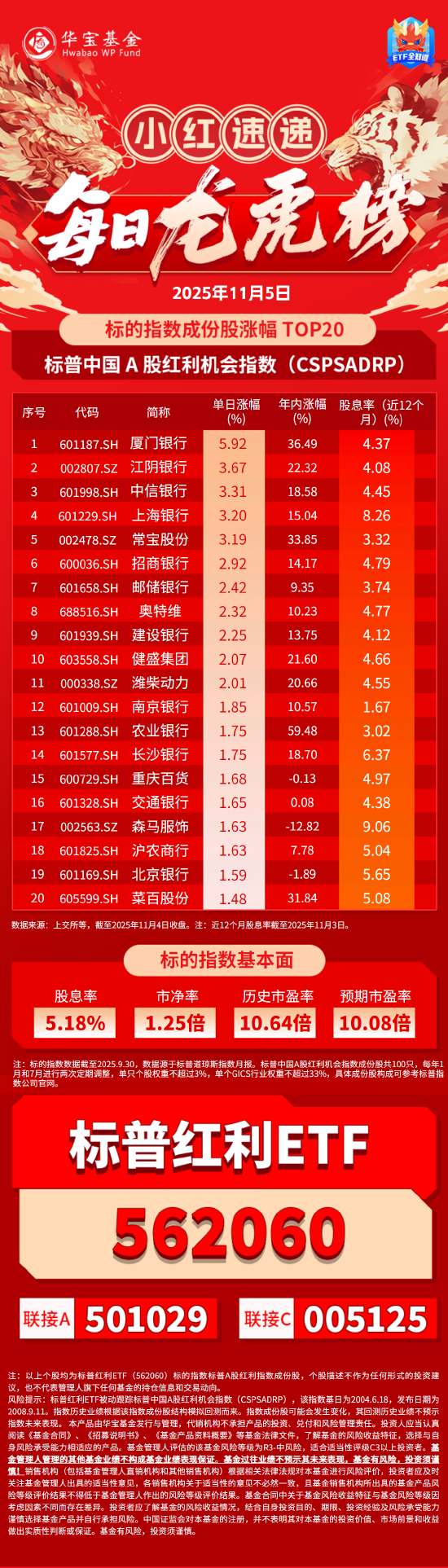
小红日报 | 银行再度领涨!标普红利ETF(562060)标的指数收跌0.06%显韧性
Xin Lang Ji Jin· 2025-11-05 00:50
Core Insights - The article highlights the top-performing stocks in the S&P China A-Share Dividend Opportunity Index, showcasing significant year-to-date gains and dividend yields for various companies [1]. Group 1: Stock Performance - Xiamen Bank (601187.SH) leads with a 5.92% increase in the latest trading session and a 36.49% year-to-date gain, along with a dividend yield of 4.37% [1]. - Jiangyin Bank (002807.SZ) follows with a 3.67% daily increase and a 22.32% year-to-date gain, offering a dividend yield of 4.08% [1]. - CITIC Bank (601998.SH) shows a 3.31% rise today and an 18.58% increase year-to-date, with a dividend yield of 4.45% [1]. - Shanghai Bank (601229.SH) has a daily increase of 3.20% and a year-to-date gain of 15.04%, boasting a high dividend yield of 8.26% [1]. - Other notable performers include Changbao Co. (002478.SZ) with a 3.19% daily increase and a 33.85% year-to-date gain, and China Merchants Bank (600036.SH) with a 2.92% daily rise and a 14.17% year-to-date increase [1]. Group 2: Dividend Yields - Shanghai Bank (601229.SH) offers the highest dividend yield at 8.26%, indicating strong returns for investors [1]. - Other companies with notable dividend yields include Semei Clothing (002563.SZ) at 9.06% and Changsha Bank (601577.SH) at 6.37% [1]. - The average dividend yield among the top 20 stocks reflects a trend towards higher returns for dividend-seeking investors [1].




中金2026年展望 | 银行:稳中求进(要点版)
中金点睛· 2025-11-04 23:48
Core Viewpoint - The banking industry is expected to maintain stable performance through 2026, with revenue and profit growth remaining steady due to narrowing net interest margin pressure and slowing credit growth driven by weak demand and insufficient risk compensation [2][3]. Group 1: Industry Performance - Revenue and profit for listed banks are projected to remain stable year-on-year, primarily due to a further narrowing of net interest margin, which is expected to decrease by 12 basis points in 2025 and remain within 10 basis points in 2026 [3]. - As of September, the year-on-year growth rate of credit balance is 6.6%, while the social financing balance growth rate is 8.7%, both of which are influenced by fiscal policy [3]. - Fee income growth is expected to stabilize and recover after several years of fee reductions and high base pressure [3]. - Small and micro enterprises, along with retail customer exposures, continue to be the main sources of non-performing loans, while corporate business exposures show stable or improving trends in net non-performing loan generation rates [3][5]. Group 2: Strategic Adjustments - The banking sector is undergoing a transformation towards high-quality development, driven by macroeconomic changes, industrial structure adjustments, technological applications, and regulatory cycles [6]. - Banks are optimizing their operational strategies to focus on high-quality development, utilizing technology and big data to enhance strategic execution efficiency [6]. - There is a shift in focus towards acquiring and managing target customer groups, with operational results observable through indicators such as funding costs and funding structure [6]. Group 3: Investment Perspective - The banking sector has entered a phase of high-quality development, with only a few listed banks achieving double-digit growth, making high-dividend investments a primary strategy [3][6]. - The financial indicators related to high dividends require a focus on high-quality development to sustain performance [3].


10克金条涨破万元,但别急着冲!业内提醒:这可能是个危险信号
Sou Hu Cai Jing· 2025-11-04 18:14
Core Insights - A significant surge in gold prices has been observed, with investment gold bars rising from 9280 yuan to 10218 yuan within a single day, driven by new tax policies announced by the Ministry of Finance and the State Administration of Taxation [1][11][24] - The price of branded investment gold bars has exceeded 1000 yuan per gram, with some even surpassing 1200 yuan per gram, making them more expensive than gold jewelry [1][9][24] Market Reaction - Following the announcement of the new tax policy, many investors expressed confusion and concern about the rapid price increases, with some noting that gold bars priced below 1000 yuan had nearly disappeared from the market [3][5][23] - Major banks, including Industrial and Commercial Bank of China and China Construction Bank, temporarily suspended certain gold investment services in response to market volatility, reflecting a cautious approach to risk management [13][24] Tax Policy Impact - The new tax policy, effective from November 1, 2025, primarily targets investment gold transactions and does not affect the tax treatment of gold jewelry, which remains unchanged [11][24] - The policy specifies that value-added tax (VAT) will apply to standard gold transactions, while gold jewelry will continue to include VAT and consumption tax in its retail price [11] Global Context - The recent fluctuations in China's gold market are part of a broader trend, with international gold prices having increased by over 50% since 2025, marking the strongest rise in 46 years [15][16][24] - Factors contributing to the global gold price surge include expectations of interest rate cuts by the Federal Reserve, heightened demand for safe-haven assets, and ongoing purchases by central banks [17][20][24] Future Outlook - Experts predict that gold prices may continue to experience upward pressure, with some international investment banks projecting prices could reach 5000 USD per ounce [20][24] - While there is a potential for long-term price increases, analysts caution that the current volatility may not be suitable for short-term speculation, emphasizing the importance of treating gold as a long-term asset allocation tool [21][24]


建设银行(601939):利润同比增速改善幅度为国有大行中最高
Guohai Securities· 2025-11-04 15:10
Investment Rating - The investment rating for the company is "Buy" (maintained) [1][4][17] Core Insights - The company's operating income for Q1-Q3 2025 increased by 0.82% year-on-year, while the net profit attributable to the parent company grew by 0.62% year-on-year. The non-performing loan ratio remained stable, and asset growth accelerated, with significant progress in pension finance [4][6] - The year-on-year growth rate of net profit attributable to the parent company turned positive, primarily driven by net interest margin and provisioning factors. In Q3 2025, the net profit attributable to the parent company increased by 4.19% year-on-year, an improvement of 5.6 percentage points compared to the first half of the year [4][6] - The total assets of the company grew by 10.9% year-on-year as of the end of Q3 2025, with loans and deposits increasing by 7.6% and 7.3% year-on-year, respectively. The balance of inclusive small and micro enterprise loans reached 3.81 trillion yuan, up 16% year-on-year [4][6] - The company is steadily advancing towards its goal of becoming a "pension finance professional bank," with the corporate annuity custody scale reaching 770 billion yuan, a growth of 12.64% compared to the end of the previous year [4][6] Summary by Sections Financial Performance - The company forecasts revenue for 2025-2027 to be 721.6 billion, 761.3 billion, and 811.7 billion yuan, with year-on-year growth rates of -3.80%, 5.50%, and 6.62%, respectively. The net profit attributable to the parent company is projected to be 338.5 billion, 346.2 billion, and 363.0 billion yuan, with growth rates of 0.89%, 2.27%, and 4.84% [4][6][17] - Earnings per share (EPS) are expected to be 1.27, 1.30, and 1.36 yuan for the years 2025, 2026, and 2027, respectively [4][6][17] Valuation Metrics - The price-to-earnings (P/E) ratio is projected to be 7.54, 7.37, and 7.02 for 2025, 2026, and 2027, while the price-to-book (P/B) ratio is expected to be 0.73, 0.69, and 0.64 for the same years [4][6][17]
银行业2025年三季报综述:业绩稳健性凸显,引领银行价值回归
Shenwan Hongyuan Securities· 2025-11-04 14:41
Investment Rating - The report maintains a positive outlook on the banking sector, indicating a potential return to a valuation of 1 times net asset value [4][7]. Core Insights - The banking sector has demonstrated steady performance, with a year-to-date revenue growth of 0.8% and a net profit growth of 1.5% for the first nine months of 2025, reflecting a stable regulatory environment supporting bank profitability [10][14]. - The report highlights a shift in focus from scale to balance in credit growth, with banks increasingly pursuing a "quantity-price balance" strategy [4][7]. - The cost of liabilities has improved more significantly than the decline in asset pricing, leading to a stabilization of net interest margins, which is expected to continue into the next year [4][7]. - Asset quality remains stable but shows signs of divergence, particularly with rising risks in small and micro businesses [4][7]. - The report suggests that the current dividend yield of the banking sector has returned to an attractive range, indicating a significant disconnect between stable earnings and stock holdings, which could lead to a value recovery [4][7]. Summary by Sections Performance Overview - The banking sector's performance has been characterized by a steady increase in revenue and profit, with state-owned banks showing better-than-expected stability and regional banks leading in performance [11][12][15]. - The report notes that the revenue growth of state-owned banks has turned positive, with non-interest income contributing significantly to this growth [12][15]. Credit Growth and Strategy - The report indicates a gradual abandonment of scale-driven growth, with banks focusing on achieving a balance between volume and pricing in their lending practices [4][7]. - The credit growth rate for listed banks decreased by 0.3 percentage points to 7.7% in Q3 2025, with state-owned banks maintaining a growth rate of approximately 8.5% [4][7]. Profitability and Asset Quality - The net interest margin for listed banks remained stable at 1.5%, with a slight quarter-on-quarter increase of 3 basis points in Q3 2025 [4][7]. - The overall non-performing loan ratio remained stable at 1.22%, indicating manageable risk levels across the sector [4][7]. Investment Recommendations - The report recommends focusing on leading banks and undervalued regional banks as key investment opportunities, suggesting that the recovery in valuations is supported by stable earnings and attractive dividend yields [4][7].

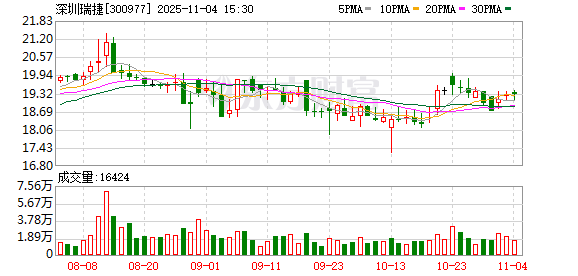
深圳瑞捷:关于取得金融机构股票回购专项贷款承诺函的公告
Zheng Quan Ri Bao· 2025-11-04 14:13
Core Points - Shenzhen Ruijie announced that it has obtained a commitment letter from China Construction Bank Shenzhen Branch to support the company's share repurchase financing [2] Summary by Categories - **Loan Details** - Lending Bank: China Construction Bank Shenzhen Branch [2] - Committed Loan Amount: Up to RMB 15.3 million [2] - Loan Term: Up to 3 years [2] - Loan Purpose: Specifically for the repurchase of company shares [2]
上市公司前三季度“成绩单”出炉!
Jin Rong Shi Bao· 2025-11-04 11:35
Core Insights - The overall performance of listed companies in China has shown continuous improvement in the first three quarters of 2025, with significant growth in both revenue and net profit [2][3] Group 1: Overall Performance - Total revenue for listed companies reached 53.46 trillion yuan, with a net profit of 4.70 trillion yuan, representing year-on-year growth of 1.36% and 5.50% respectively [2] - In the third quarter alone, revenue and net profit increased by 3.82% and 11.45% year-on-year, and by 2.40% and 14.12% quarter-on-quarter, indicating a solid upward trend [2] - Approximately 4183 companies reported profits, with nearly 80% of the market achieving positive earnings [2] Group 2: Industry Performance - The semiconductor and hardware equipment sectors experienced the fastest revenue growth at 20.9% and 16.8% respectively, while several other industries, including non-bank financials and automotive, saw growth rates above 7% [3] - In terms of net profit growth, the steel, software services, and semiconductor industries led with increases of 402.0%, 121.6%, and 46.6% respectively [3] Group 3: Major Companies - China National Petroleum Corporation topped the revenue list with 2.17 trillion yuan, followed closely by Sinopec at 2.11 trillion yuan and China State Construction at 1.56 trillion yuan [3] - Excluding financial and oil companies, China Mobile led with a net profit of 1154 billion yuan, followed by Kweichow Moutai with 646 billion yuan [3] Group 4: High-Quality Development - The role of technology innovation has become more prominent, with significant revenue and profit growth reported by companies in the ChiNext, STAR Market, and Beijing Stock Exchange [4] - The total market capitalization reached 107.32 trillion yuan, with the electronics sector leading, accounting for 12.42% of the total market [4] Group 5: R&D Investment - Listed companies collectively invested 1.16 trillion yuan in R&D, marking a year-on-year increase of 3.88%, with 168 companies investing over 1 billion yuan [6] - The overall R&D intensity across the market was 2.16%, with the ChiNext and STAR Market showing higher intensities of 4.54% and 11.22% respectively [6] Group 6: Shareholder Returns - A total of 1033 companies announced cash dividend plans, with a total cash dividend amounting to 734.9 billion yuan, an increase from the previous year [7] - The market has seen a total of 1525 share repurchase plans announced, with completed repurchases amounting to 92.3 billion yuan [7]




金工定期报告20251104:预期高股息组合跟踪
Soochow Securities· 2025-11-04 09:34
- The "Expected High Dividend Portfolio" model is constructed using a two-stage process: first, calculating the dividend yield based on annual report profit distribution data, and second, predicting and calculating the dividend yield using historical dividend data and fundamental indicators. Additionally, two short-term factors, the reversal factor and the profitability factor, are used to assist in stock selection. The portfolio is optimized within the CSI 300 constituents, holding 30 stocks per period and rebalancing monthly[3][8][13] - The stock selection process for the "Expected High Dividend Portfolio" involves: (1) excluding suspended and limit-up stocks from the CSI 300 constituents, (2) removing the top 20% of stocks with the highest short-term momentum (21-day cumulative returns), (3) excluding stocks with declining profitability (quarterly net profit growth rate < 0), and (4) ranking the remaining stocks by expected dividend yield and selecting the top 30 stocks to construct an equally weighted portfolio[9][13] - The backtesting results of the "Expected High Dividend Portfolio" from February 2, 2009, to August 31, 2017, show a cumulative return of 358.90% relative to the CSI 300 Total Return Index, with a cumulative excess return of 107.44%. The annualized excess return is 8.87%, the maximum rolling one-year drawdown of excess return is 12.26%, and the monthly excess win rate is 60.19%[11] - In October 2025, the "Expected High Dividend Portfolio" achieved an average return of 5.47%, outperforming the CSI 300 Index by 5.93% and the CSI Dividend Index by 2.50% during the same period[3][14][19]



