
BANK OF CHINA(601988)

Search documents
大连文体旅产业“烟火升腾”!“金融+体育”深度融合释放乘数效应
Xin Lang Cai Jing· 2025-12-10 13:56
Core Viewpoint - The opening of the first football-themed branch of SPD Bank in Dalian signifies the deep integration of finance and sports, promoting high-quality development of the sports economy and the integration of culture, sports, and tourism in the city [3][30]. Group 1: Financial Support for Sports - SPD Bank's Dalian branch aims to break traditional banking service boundaries by creating a unique service system that integrates financial services, fan experiences, and industry support [6][32]. - The strategic partnership between SPD Bank and Dalian Yingbo Football Club will provide comprehensive financial services, including credit, fund management, and payroll services, while enhancing fan engagement through digital platforms [6][32]. - Postal Savings Bank of Dalian is also collaborating with Dalian Yingbo Football Club to offer personalized financial services and themed credit cards, enhancing the "finance + football" ecosystem [8][35]. Group 2: Youth Development in Football - The "You Are On Stage" public football training camp, organized by Ping An Life and Dalian Football Association, aims to provide a professional growth platform for young football talents while integrating financial services into the training system [9][36]. Group 3: Promoting Sports Events - Dalian International Walking Festival and Dalian Marathon are key sports events that showcase the city's charm and spirit, with significant participation from the financial sector enhancing their impact [11][39]. - Financial institutions like Ping An Life and Huaxia Bank have been actively involved in supporting these events, providing services and resources to ensure a positive experience for participants [11][39]. Group 4: International Event Support - Dalian is becoming a significant venue for international sports events, with financial institutions like Bank of China providing comprehensive financial support for events such as the International Football World Cup [13][40]. - The successful hosting of international events relies on a robust safety and insurance framework, with companies like MetLife providing tailored insurance solutions for participants and staff [14][41]. Group 5: Integration of Sports and Tourism - Dalian is leveraging sports events to drive the integration of tourism, culture, and consumption, promoting the "Follow the Event to Tour Dalian" brand [16][43]. - Financial institutions are innovating products to support tourism-related businesses, such as "宿易贷" and "餐易贷," which provide significant funding to enhance the tourism economy [18][44]. Group 6: Future Prospects - Dalian has been recognized as a national pilot city for sports consumption, with tourism revenue reaching 99.15 billion yuan in the first half of 2025, a 300.72% increase from 2022 [20][47]. - The financial sector is expected to continue deepening its integration with the sports industry, contributing to the city's economic growth and the development of a vibrant sports economy [20][47].





五年新坐标|多措并举 助力打造科技创新 “硬实力”
Zhong Guo Xin Wen Wang· 2025-12-10 13:53
Core Insights - The article emphasizes the commitment of the Bank of China to enhance financial support for technological innovation during the 14th Five-Year Plan period, aiming to foster new momentum and advantages in the economy [1] Group 1: Financial Support for Technology Innovation - As of September 2025, the Bank of China's technology loan balance reached 4.7 trillion yuan, with 166,000 credit accounts established, and a cumulative supply of comprehensive services exceeding 830 billion yuan [1] - The establishment of a multi-level organizational system for technology finance, including a central technology finance center and 317 specialized outlets, aims to respond quickly to market demands [2] Group 2: Focus on Emerging Industries - The Bank of China has launched an action plan to support the development of the artificial intelligence industry chain, collaborating with over 2,300 core enterprises in this sector and providing a credit balance of approximately 410 billion yuan [2] - The introduction of the "bond-loan linkage" model and the "Zhongyin Sci-Tech Computing Loan" service in major innovation hubs like Beijing, Shanghai, and Shenzhen has facilitated connections with 773 supply-demand enterprises in the computing sector [2] Group 3: Product and Service Innovation - The Bank of China has innovated financial products to meet the diverse needs of technology enterprises, achieving multiple market firsts, including the launch of a stock repurchase loan policy and the issuance of 200 billion yuan in technology innovation bonds [3] - The "Innovation Credit Loan" has been developed to assess enterprise credit levels and growth potential, enhancing the credit service experience for small and micro technology enterprises [3] Group 4: Building a Financial Ecosystem - The "Zhongyin Sci-Tech Ecological Partner Program" aims to create a collaborative platform for technology innovation, injecting "patient capital" into the primary market for technology [4] - The establishment of 16 AIC equity investment funds, with a total subscription of 11.76 billion yuan, has facilitated investments in sectors such as commercial aerospace and artificial intelligence [4] - The Bank of China plans to continue enhancing its financial services for technology innovation, utilizing various financial tools to support major national technology tasks and small and medium-sized technology enterprises [4]

工行、农行、中行、建行、交行、汇丰中国、花旗中国等率先落地!
Jin Rong Shi Bao· 2025-12-10 13:41
Core Viewpoint - The implementation of the "Shanghai Free Trade Zone Free Trade Account Function Upgrade Implementation Measures (Trial)" on December 5 aims to enhance the cross-border trade and investment liberalization and facilitation levels in the Shanghai Free Trade Zone [1] Group 1: Bank Participation - Major Chinese banks including Industrial and Commercial Bank of China, Agricultural Bank of China, Bank of China, China Construction Bank, and Bank of Communications, along with foreign banks like HSBC China and Citibank China, successfully completed business operations on the same day the trial measures were implemented [1] - Industrial and Commercial Bank of China processed its first cross-border RMB loan for an advanced manufacturing enterprise using the upgraded free trade account, facilitating cross-border fund flow [2] - Agricultural Bank of China completed two upgraded free trade account transactions for a leading semiconductor manufacturing enterprise, significantly improving fund transfer efficiency by allowing transactions based solely on payment instructions [3] Group 2: Business Operations - Bank of China assisted five enterprises in directly processing various transactions under the upgraded free trade account, covering industries such as semiconductor, petrochemical, and automotive [4] - China Construction Bank enabled multiple key enterprises to upgrade their free trade account functions, enhancing cross-border payment efficiency and supporting global operations [5] - Bank of Communications focused on selecting multinational corporate groups for the trial, ensuring compliance and assessing the overall operational capabilities of the enterprises involved [6] Group 3: Foreign Bank Initiatives - HSBC China opened an upgraded free trade account for a multinational enterprise in the Shanghai Free Trade Zone, emphasizing the multiplier effect of the new policy on cross-border trade and investment [8] - Citibank China established upgraded free trade accounts for four corporate clients, highlighting its commitment to supporting China's financial market opening [8]




探寻利率方向(4):从M2看2026年债市流动性
GF SECURITIES· 2025-12-10 11:48
Investment Rating - The report assigns a "Buy" rating for the banking sector, indicating an expectation that stock prices will outperform the market by more than 10% over the next 12 months [40]. Core Insights - The growth of M2 is primarily driven by government and corporate leverage, with government leverage's contribution increasing from 23.9% in 2015 to 45.5% in 2025, while corporate leverage is expected to contribute 63.6% to M2 growth in 2025 [5][14]. - The report highlights a divergence between the social financing (社融) and M2 growth rates, indicating a liquidity accumulation in the financial system when the demand for financing from the real economy is insufficient, which can lead to a decline in bond yields [5][19]. - The expected social financing-M2 differential for 2026 is projected to be 0.56%, with a quarter-on-quarter increase of 33 basis points [32]. Summary by Sections M2 and Liquidity Analysis - M2 includes cash, personal deposits, corporate deposits, non-bank deposits, and deposits from non-deposit financial institutions. The main contributors to M2 growth are government and corporate leverage [5][13]. - The report discusses the relationship between the social financing-M2 differential and bond market performance, noting a shift in correlation since the second half of 2022 [5][19]. Social Financing Projections - For 2026, the report forecasts a total of 16.3 trillion yuan in new loans under the social financing framework, with a growth rate of 8.11% [32][34]. - The report anticipates that the net issuance of government bonds will reach 14.8 trillion yuan in 2026, with a focus on maintaining a proactive fiscal policy [34]. M2 Growth Forecast - The M2 growth rate for 2026 is projected at 7.55%, influenced by factors such as net fiscal deposits, the strengthening of the equity market, and cross-border capital flows [32][36].


中行、建行相继公告!资本补充工作迎来关键进展
Xin Lang Cai Jing· 2025-12-10 10:55
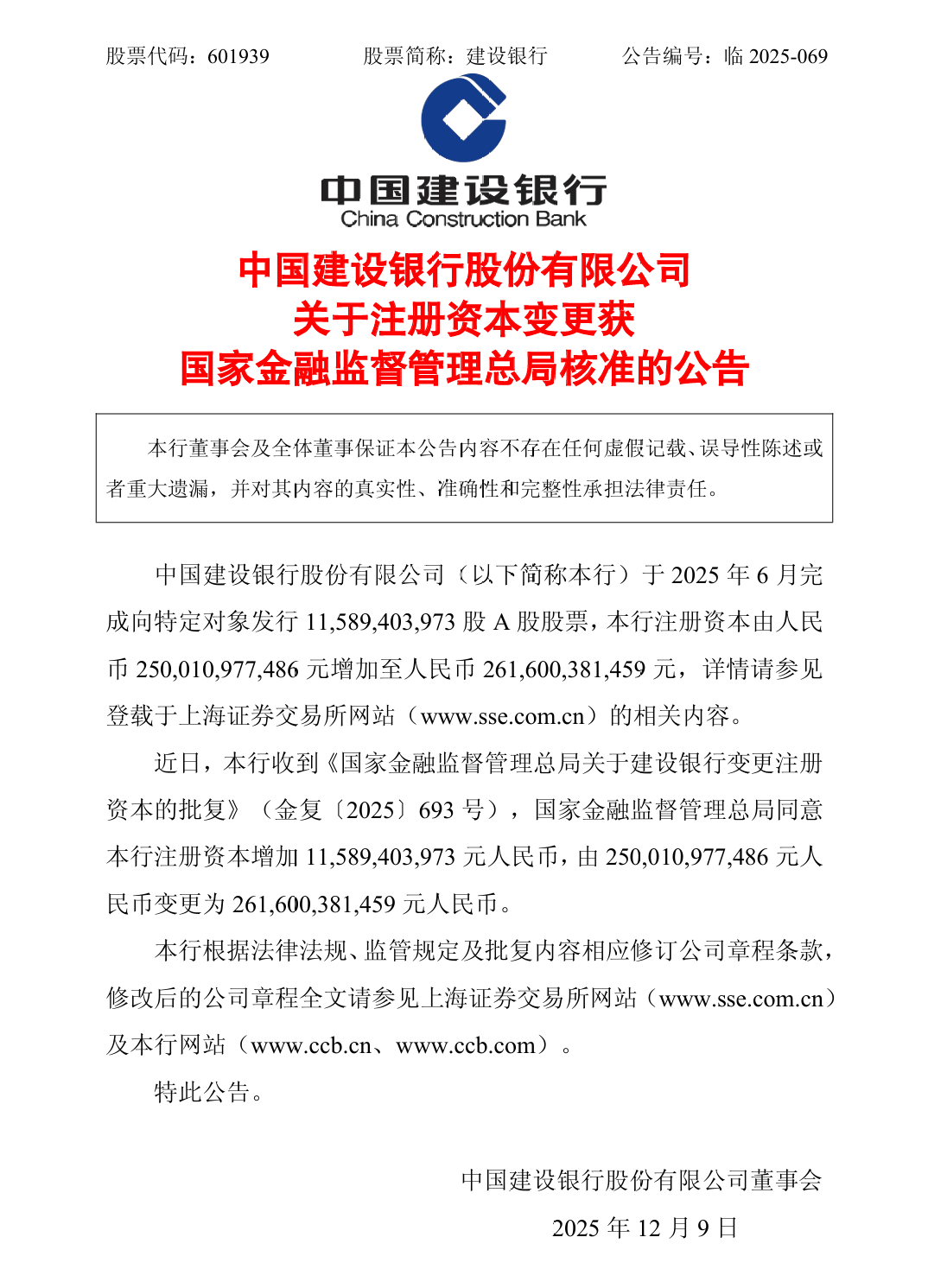
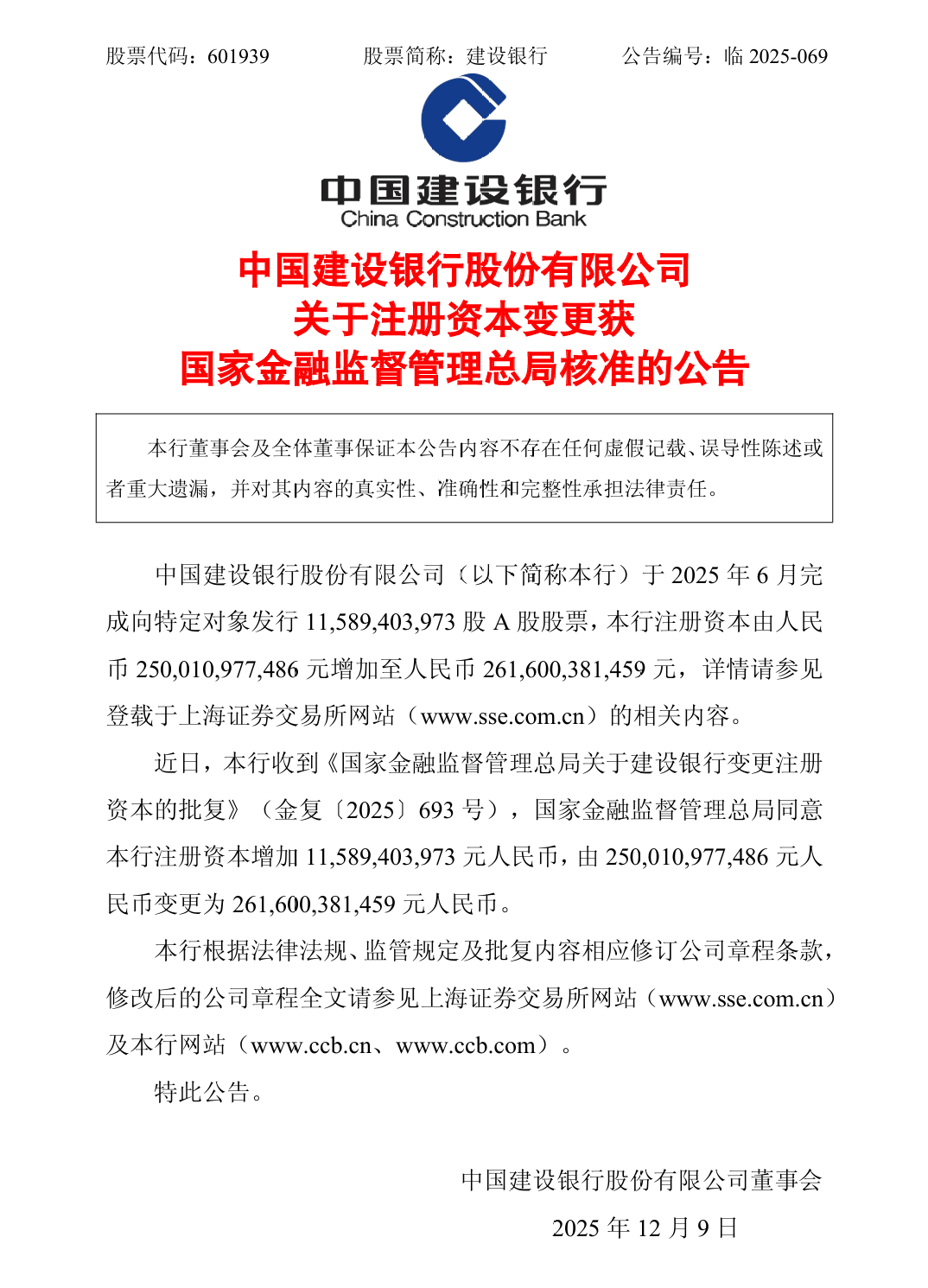
Core Viewpoint - The recent announcements from major state-owned banks regarding capital replenishment reflect a broader trend of capital enhancement among these institutions, with China Construction Bank (CCB) completing a significant issuance of A-shares to increase its registered capital [1][7]. Group 1: Capital Increase Details - China Construction Bank announced on December 9 that it completed the issuance of approximately 11.589 billion A-shares, raising its registered capital from RMB 2500.11 billion to RMB 2616.00 billion [1][4][7]. - The issuance was approved by the National Financial Regulatory Administration, allowing CCB to increase its registered capital by RMB 115.89 billion [4][7]. Group 2: Context of Capital Replenishment - The capital increase is part of a collective effort by major state-owned banks to enhance their capital bases, as highlighted in the government's work report which proposed issuing special government bonds worth RMB 500 billion to support these banks [7][15]. - In March, four major banks, including CCB, announced plans to issue A-shares to raise a total of RMB 4.1 trillion, with CCB aiming to raise up to RMB 1650 billion [7][15]. Group 3: Implications for Capital Adequacy - The capital increase is expected to directly improve the core Tier 1 capital adequacy ratio of CCB and other banks, which is crucial for risk management and supporting the real economy [7][16]. - While the increase in share capital may dilute earnings per share in the short term, it is anticipated to enhance the banks' competitive edge and long-term return expectations for investors [8][16].
中行、建行相继公告!
Jin Rong Shi Bao· 2025-12-10 10:41
近日,国有大行资本补充工作陆续迎来关键进展。 12月9日,建设银行(601939)发布公告称,该行于2025年6月完成向特定对象发行约115.89亿股A股股票,该行注册资本由人民币2500.11亿元增加至人 民币2616.00亿元。 公告显示,近日该行收到国家金融监督管理总局行政批复,同意该行注册资本增加115.89亿元人民币,由2500.11亿元增加至人民币2616.00亿元。 股票代码:601939 公告编号:临 2025-069 山国 长 前 : China Construction Bank 中国建设银行股份有限公司 关于注册资本变更获 国家金融监督管理总局核准的公告 本行董事会及全体董事保证本公告内容不存在任何虚假记载、误导性陈述或 者重大遗漏,并对其内容的真实性、准确性和完整性承担法律责任。 中国建设银行股份有限公司(以下简称本行)于2025年6月完 成向特定对象发行 11.589.403.973 股 A 股股票,本行注册资本由人民 币 250.010.977.486 元增加至人民币 261.600.381.459 元,详情请参见 登载于上海证券交易所网站(www.sse.com.cn)的相关内容 ...
银行行业2026年年度策略报告-20251210
Ping An Securities· 2025-12-10 10:38
Group 1 - The banking industry in 2026 will face a mixed external environment with strong macroeconomic resilience but insufficient effective demand, leading to continued moderate monetary policy and challenges in asset allocation due to a low interest rate environment [4][10] - The "14th Five-Year Plan" emphasizes the construction of a financial powerhouse, urging banks to leverage their resource endowments and deepen their strategic initiatives over the next five years [4][10][22] - The overall financial performance of listed banks is expected to improve in 2026, driven by the recovery of net interest income and non-interest income, with a projected net profit growth of 2.4% year-on-year [4][27] Group 2 - The net interest margin is expected to narrow by 6 basis points in 2026, with net interest income growth projected to rise to 4% compared to 0.3% in 2025 [4][27] - Non-interest income is anticipated to continue improving due to the recovery of wealth management opportunities and the fading impact of fee reductions from previous years [4][27] - The overall asset quality of the banking sector is expected to remain stable, with a focus on monitoring risks in the retail sector [4][27] Group 3 - The investment strategy emphasizes high dividend yields as a protective measure, with the banking sector's average dividend yield at 3.94%, providing a significant premium over ten-year government bonds [4][27] - Specific banks such as Chengdu Bank, Jiangsu Bank, and Shanghai Bank are highlighted for their strong regional advantages and potential for continued dividend growth [4][27][34] - The report suggests that the active capital market will provide a potential boost to quality retail banks, enhancing their recovery prospects [4][27]




银行股“红包雨”将至!上市银行超2600亿元分红要来了
2 1 Shi Ji Jing Ji Bao Dao· 2025-12-10 04:38
12月8日,工商银行与农业银行同步发布2025年中期分红派息实施公告显示,两家国有大行将在12月15 日完成现金红利发放,合计向A股股东派发约762亿元现金股息。 此前,中国银行、建设银行已率先发布中期分红实施方案。其中,中国银行每股派发现金红利0.1094 元,A股派发现金红利261.02亿元。建设银行每股派发现金红利0.1858元,A股派发现金股息约39.36亿 元。 (文章来源:21世纪经济报道) 银行又要撒"红包"了。 21世纪经济报道记者梳理,截至目前,今年共有32家上市银行宣布(拟)实施中期分红(或三季度分 红),数量较2024年多8家,其中9家银行为首次计划实施;目前已有26家银行宣布具体的利润分配方 案,平均分红率为24.9%,合计分红金额2645.66亿元,较去年增长2.55%。 四大行中期分红即将落地。 ...
中国金融市场的整体实力 和影响力不断增强
Jin Rong Shi Bao· 2025-12-10 02:05
Core Viewpoint - The Financial Stability Board (FSB) has released the 2025 Global Systemically Important Banks (G-SIB) list, highlighting the increasing significance of Chinese banks in the global financial system [1][2]. Group 1: G-SIB List Overview - Five Chinese banks, including Industrial and Commercial Bank of China (ICBC), Agricultural Bank of China, Bank of China, China Construction Bank, and Bank of Communications, are included in the G-SIB list for 2025, consistent with 2024 [1]. - ICBC has moved into the third group for the first time, while Agricultural Bank, Bank of China, and China Construction Bank remain in the second group, and Bank of Communications stays in the first group [1]. - The G-SIB list consists of five groups, with no banks in the highest fifth group, only JPMorgan in the fourth group, and a total of 29 banks listed, unchanged from 2024 [1][2]. Group 2: Performance Metrics - The total scores for the Chinese banks have increased compared to the previous year, with ICBC up by 33 points, Agricultural Bank by 15 points, Bank of China by 32 points, China Construction Bank by 10 points, and Bank of Communications by 9 points [2]. - The increase in scores indicates that factors beyond size are now more significant in determining the rankings of these banks [2]. Group 3: Implications and Requirements - The adjustments in the G-SIB list reflect the evolving business activities of banks, emphasizing quality over size, aligning with the goals of building a stronger financial nation [2]. - Banks on the G-SIB list face higher capital regulatory requirements, including additional capital and Total Loss-Absorbing Capacity (TLAC) requirements, with varying standards from 1% to 3.5% across the groups [2]. - ICBC, having moved up a group, will now encounter higher capital buffer requirements, which signifies both recognition of its strength and a challenge for future development [3].
声扬集团(08163)股东将股票由大华继显(香港)转入中国银行(香港) 转仓市值565.40万港元

Zhi Tong Cai Jing· 2025-12-10 00:39
声扬集团此前发布2025年中期业绩,收入951.6万港元,同比增加17.41%;股东应占溢利215.4万港元, 上年同期股东应占亏损1532.4万港元,同比扭亏为盈;每股基本盈利0.35港仙。 智通财经APP获悉,香港联交所最新资料显示,12月9日,声扬集团(08163)股东将股票由大华继显(香 港)转入中国银行(香港),转仓市值565.40万港元,占比5.76%。 ...