
BANK OF CHINA(601988)

Search documents
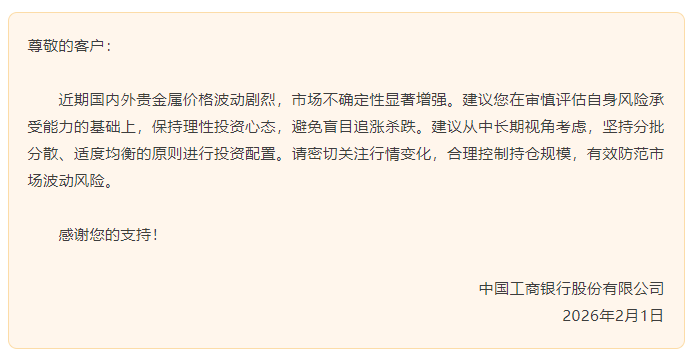
突发史诗级暴跌!工行、农行、中行、建行、交行等五大行,紧急出手!
Zhong Guo Ji Jin Bao· 2026-02-01 07:41
Core Viewpoint - Several major state-owned banks in China have issued risk warnings and adjusted their gold investment businesses due to significant fluctuations in gold prices [1] Group 1: Bank Adjustments and Risk Warnings - Industrial and Commercial Bank of China (ICBC) has adjusted its gold accumulation business and issued a risk warning, advising investors to assess their risk tolerance and maintain a rational investment mindset [2][3] - ICBC has raised the minimum investment amount for gold accumulation from 1,000 yuan to 1,100 yuan starting January 8 [5] - China Construction Bank (CCB) has increased the minimum investment amount for its gold accumulation business to 1,500 yuan effective February 2, while also advising clients to enhance their risk awareness [6][8] - Bank of Communications (BoCom) has set restrictions on gold wallet transactions based on clients' risk assessment results, allowing only those with higher risk tolerance to engage in all business activities [8][9] - Agricultural Bank of China (ABC) requires clients to complete a risk assessment before engaging in gold accumulation services, emphasizing the need for rational investment based on financial status [10] - Bank of China (BoC) has highlighted the uncertainties in the precious metals market and urged clients to manage their gold holdings carefully to mitigate potential losses [11]






最高立减88元!惠州四大银行联手惠泊车推出春日停车大优惠
Nan Fang Du Shi Bao· 2026-02-01 03:49
Core Viewpoint - The collaboration between Huizhou Jiaotou Huiboche and four major banks aims to provide significant parking discounts to residents, enhancing their travel experience and promoting convenient parking solutions [1][14]. Group 1: Discount Details - The promotional activities include discounts of up to 88 yuan, with various banks offering different benefits to their cardholders [1][10]. - Industrial and Commercial Bank of China (ICBC) offers random discounts of 1 to 3 yuan for credit card users on parking fees over 5 yuan, valid until July 31, 2026 [4]. - Bank of China provides a "3 yuan off 2 yuan" discount for debit card users until April 30, 2026, with additional random discounts available for subsequent payments [5]. - Guangfa Bank has the broadest coverage and longest duration, offering discounts of up to 88 yuan for credit and debit card users on parking fees over 5 yuan, valid until December 31, 2026 [10]. Group 2: Objectives and Future Plans - The initiative is designed to meet the public's demand for economical and convenient travel options while encouraging standardized parking practices [14]. - The company plans to continue exploring more public-friendly services to enhance parking resource efficiency and create a smarter, more user-friendly parking environment [14].


固收专题研究:怎么把握10年二级资本债投资机会?
Guolian Minsheng Securities· 2026-02-01 02:25
1. Report Industry Investment Rating No information provided in the content. 2. Core View of the Report The report delves into the investment opportunities of 10 - year secondary capital bonds. It analyzes the development history of commercial bank secondary capital bonds, the issuance and trading condition of 10 - year secondary capital bonds, the main investors, and provides investment strategies from both allocation and trading perspectives [4][7][49]. 3. Summary According to the Directory 10 - year Commercial Bank Secondary Capital Bond Decryption - **Development History of Commercial Bank Secondary Capital Bonds**: The development of China's commercial bank secondary capital bonds can be divided into four stages. From 2004 - 2012, it was the "old - style sub - debt" stage; from 2013 - 2019, "new - style secondary capital bonds" emerged; from 2020 - 2023, the market's risk perception deepened; from 2024 to the present, the market entered a new innovation cycle [4][8][9]. - **The "Past and Present" of 10 - year Secondary Capital Bonds**: The first 10 + 5 - year secondary capital bond was issued by Agricultural Bank of China in March 2019. Since 2019, only state - owned large - scale banks and state - owned joint - stock banks have issued 10Y secondary capital bonds. The state - owned large - scale banks are the main issuers, with Agricultural Bank of China having the largest issuance volume. In terms of the stock, the secondary capital bonds with a remaining term of 3 - 5 years have the largest stock, followed by those with a remaining term of 7 - 10 years [18][22][24]. - **Secondary Transaction Situation of 10 - year Secondary Capital Bonds**: From January 1, 2025, to January 13, 2026, the secondary capital bonds with a term of 3 - 5 years were the most actively traded, followed by those with a term of 1 - 3 years. The 7 - 10 - year secondary capital bonds ranked fourth in terms of trading volume. The 9 - 10 - year secondary capital bonds had the largest trading volume among long - term bonds, and the 10 - year secondary capital bonds issued by Agricultural Bank of China had the best liquidity [30][32][33]. - **Who is Buying 10 - year Secondary Capital Bonds**: Insurance institutions are the main buyers of 10Y secondary capital bonds, with a net increase of about 1.6 billion yuan in 7 - 10Y secondary capital bonds in the past year. However, due to accounting treatment issues, insurance funds are more cautious in asset allocation. The increase in trading volume in the past month may be due to insurance companies' net purchases. In addition, securities companies, insurance companies, and fund products are the top three buyers in the past month, but the net purchase scale of securities companies is negative, indicating a stronger trading nature [36][42][43]. Investment Strategies for 10 - year Secondary Capital Bonds - **From the Perspective of Allocation**: The report uses interest rate spread and variety premium as key indicators to measure the relative value of 10Y secondary capital bonds. In terms of interest rate spread, when the funds are loose and the interest rate spread is high, the yield of 10Y secondary capital bonds may decline. In terms of variety premium, the trend of 10Y secondary capital bonds is highly consistent with that of ultra - long local bonds, with a "volatility amplification" effect in some periods [50][52][54]. - **From the Perspective of Trading**: The report reviews the term spread, the order of yield peaks of 10Y secondary capital bonds and other varieties, and the spread indicators between secondary capital bonds and urban investment bonds. Since 2025, the term spread between 10Y and 5Y secondary capital bonds has moved in the same direction as the 10Y secondary capital bond. In the interest rate upward cycle since 2023, 10Y secondary capital bonds have risen and fallen in the same direction as other varieties; in the downward cycle, almost all varieties reach the stage low at the same time. When the spread between 10Y secondary capital bonds and 10Y urban investment bonds turns negative, the yield of 10Y secondary capital bonds often has room to decline [59][66][76]. - **Summary of Trading Strategies**: The report provides a basic framework for investment decisions by reviewing historical experiences from the perspectives of allocation and trading, and summarizing the core judgment indicators and rules for the interest rate to reach the stage peak and bottom [81][82][83].
二级资本债周度数据跟踪-20260131
Soochow Securities· 2026-01-31 11:00
证券研究报告·固定收益·固收点评 固收点评 20260131 二级资本债周度数据跟踪 (20260126-20260130) [Table_Tag] [Table_Summary] 观点 ◼ 一级市场发行情况: 本周(20260126-20260130)银行间市场及交易所市场无新发行二级资本 债。 ◼ 二级市场成交情况: 本周(20260126-20260130)二级资本债周成交量合计约 2994 亿元,较 上周减少 348 亿元,成交量前三个券分别为 25 中行二级资本债 02BC (179.10 亿元)、25 农行二级资本债 04A(BC)(147.41 亿元)和 25 中行二级资本债 03A(BC)(110.91 亿元)。 分发行主体地域来看,成交量前三为广东省、山东省和山西省,分别约 为 2331 亿元、216 亿元和 140 亿元。 从到期收益率角度来看,截至 1 月 23 日,5Y 二级资本债中评级 AAA-、 AA+、AA 级到期收益率较上周涨跌幅分别为:-1.62BP、-0.15BP、- 1.15BP;7Y 二级资本债中评级 AAA-、AA+、AA 级到期收益率较上周 涨跌幅分别为:3.09B ...
票据业务违规,内部制度不完善,中国银行股份有限公司吐鲁番市分行被罚20万元
Xin Lang Cai Jing· 2026-01-31 10:14
Core Viewpoint - The Turpan branch of Bank of China has been fined for inadequate management of its bill business, with a penalty amounting to 200,000 yuan [1]. Group 1 - The Turpan Financial Regulatory Bureau has issued an administrative penalty against the Bank of China Turpan branch [1]. - The penalty was imposed due to violations related to the management of bill business [1]. - The fine amount is set at 200,000 yuan [1].
财经老王丨与中国合作为什么是必选项?
Yang Shi Xin Wen Ke Hu Duan· 2026-01-31 08:07
Group 1 - The UK is sending a high-profile delegation of companies to China, indicating a strong interest in exploring business opportunities in the Chinese market [1] - The Chinese market is recognized for its scale and growth potential, prompting UK businesses to establish partnerships with Chinese companies [5] - The stability and predictability of the Chinese economy are crucial for global economic transformation, with China positioned as a key player [7] Group 2 - Confidence in China's economic growth aligns with the goals of the 14th Five-Year Plan, suggesting a positive outlook for future growth [9] - Companies like PwC and AstraZeneca are committed to increasing investments in China, particularly in technology and pharmaceuticals [10][12] - The sentiment among UK businesses is that collaboration with Chinese firms is essential for achieving greater success in the global market [10][12]


中国银行业协会发布催收新规 严设“红线”打击金融黑灰产
Zhong Guo Jing Ying Bao· 2026-01-31 04:00
Core Viewpoint - The China Banking Association (CBA) has officially released the "Guidelines for the Collection of Personal Consumer Loans by Financial Institutions (Trial)" to standardize credit card and personal consumer loan collection practices, protect the legal rights of debtors, and promote healthy industry development [1]. Summary by Sections Section 1: Definition of Collection Behavior - The guidelines provide clear definitions for various collection behaviors within the industry [1]. Section 2: Establishment of Collection Behavior Norms - The guidelines comprehensively address key issues such as collection timing, frequency, and the acquisition of contact information, emphasizing clarity and enforceability while setting prohibitive red lines [1]. Section 3: Strengthening External Agency Governance - The guidelines specify requirements for member units regarding the management of external collection agencies, establishing a constraint mechanism [1]. Section 4: Enhancing Internal Control Management - Financial institutions are required to improve their internal management capabilities to achieve a combination of governance and management [1]. Section 5: Promoting Industry Self-Regulation - The CBA encourages self-collection, technological innovation, and the governance of black and gray market activities, while promoting the establishment of a shared information system for illegal activities by external collection agencies [1]. Next Steps - The CBA will enhance tracking and guidance to ensure the effective implementation of the guidelines, aiming for continuous progress in promoting high-quality industry development [1].
多家银行召开经营管理工作会议为2026年工作“划重点”
Zheng Quan Ri Bao· 2026-01-30 22:49
Core Viewpoint - Multiple banks in China are holding meetings to summarize their 2025 operations and plan for 2026, focusing on high-quality development and aligning with national strategies [1][2]. Group 1: Policy Banks - Policy banks are crucial for implementing national development strategies, with the China Export-Import Bank emphasizing political responsibility and enhancing core competitiveness in overseas operations [1]. - State-owned banks are committed to high-quality development, integrating this focus into all operational processes to support national policies and contribute to the "14th Five-Year Plan" [1]. Group 2: Major Commercial Banks - Major banks are prioritizing their core responsibilities, with the Agricultural Bank of China focusing on supporting rural revitalization and urban-rural integration [2]. - The Bank of China aims to enhance global capabilities in product services, marketing, and compliance, while the China Construction Bank is shifting its focus to support modern industrial systems and high-level opening-up [2]. - Banks like ICBC and Agricultural Bank emphasize the integration of investments in both physical and human capital, while the China Construction Bank is committed to sustainable development and regional coordination [2]. Group 3: Joint-Stock Banks - Joint-stock banks are focusing on leveraging their unique advantages to improve operational efficiency, with Everbright Bank aiming for steady revenue growth and enhanced customer value [3]. - Ping An Bank is focusing on seizing strategic opportunities and integrating technology as a core driver for development [3]. - Risk management remains a priority, with banks emphasizing the importance of a robust asset safety framework and the role of technology in risk prevention and management [3].
并购贷款新规落地“满月” 参股型模式成创新焦点
Zhong Guo Jing Ying Bao· 2026-01-30 18:53
Core Insights - The implementation of the new regulations on merger loans has led to increased demand for acquisition financing, particularly in the technology and green sectors [1][2] - The introduction of "equity acquisition loans" has become a focal point for market innovation, prompting banks to explore new opportunities while facing heightened risk management requirements [1][6] Group 1: Market Dynamics - The new regulations have revitalized the merger loan business, with major banks like Industrial and Commercial Bank of China (ICBC) quickly launching compliant acquisition loan products across various provinces [2] - The demand for merger loans is driven by the need for consolidation among state-owned enterprises and large investment firms, as well as the increasing management needs of quality listed companies [2][3] - Competition among banks for high-quality projects has intensified, with multiple banks often participating in the approval process for the same project [3] Group 2: Regulatory Impact - The new regulations set tiered standards for conducting merger loans, with higher thresholds for equity acquisition loans, which may limit access for smaller banks [4] - Major banks have the advantage of robust capital and risk management capabilities, allowing them to quickly implement new loan products, while smaller banks tend to focus on local businesses and conservative lending practices [4] Group 3: Loan Structure and Risk - The new regulations allow for equity acquisition loans, which require a minimum stake of 20% in the target company, thus lowering barriers while ensuring strategic alignment [6] - The maximum loan-to-value ratio for equity acquisition loans is set at 60%, compared to 70% for control-type loans, reflecting a cautious regulatory approach to mitigate risks [6][7] - Banks face unique risks with equity acquisition loans, including potential information asymmetry and limited decision-making power, necessitating stricter risk assessment and management protocols [7][8] Group 4: Risk Management Strategies - Banks are advised to enhance their risk management frameworks, focusing on thorough due diligence, compliance monitoring, and ongoing evaluation of target companies post-acquisition [8] - A specialized management team with expertise in merger financing is recommended to ensure effective implementation of risk control measures across all stages of the loan process [8]
中国银行业协会规范个人消费类贷款催收行为
Yang Shi Wang· 2026-01-30 17:38
Core Viewpoint - The China Banking Association has established the "Guidelines for the Collection of Personal Consumption Loans by Financial Institutions (Trial)" to standardize the collection practices of member units and external collection agencies, promoting healthy industry development [1] Group 1: Definition and Regulation of Collection Practices - The guidelines define various collection behaviors within the industry, providing clear definitions for different types of collection activities [1] - A collection behavior standard has been established, addressing public concerns regarding collection timing, frequency, and contact information acquisition, emphasizing clarity and enforceability while setting prohibitive red lines [1] Group 2: Management of External Collection Agencies - The guidelines strengthen the governance of external collection agencies, specifying the requirements for member units in managing these agencies and establishing a constraint mechanism [1] Group 3: Internal Control Management - There is an emphasis on enhancing internal management capabilities within institutions, aiming for a combination of governance and management in collection practices [1] Group 4: Self-Regulation and Industry Development - The association encourages self-regulation to promote healthy industry development, advocating for self-collection, technological innovation, and strengthening the governance of illegal and gray market activities [1] - The guidelines promote the establishment of a shared information system for illegal activities of external collection agencies and encourage joint efforts to combat debt evasion [1]