
Sugon(603019)

Search documents
海光信息上半年归母净利润同比增长超40%;嵘泰股份拟收购中山澳多51%股权|公告精选
Mei Ri Jing Ji Xin Wen· 2025-08-05 13:03
每经记者|范芊芊 每经编辑|董兴生 并购重组 嵘泰股份:拟以2.88亿元收购中山澳多51%股权 嵘泰股份公告称,公司拟使用自有资金2.88亿元收购中山市澳多电子科技有限公司(以下简称"中山澳 多")51%股权,交易完成后,中山澳多将成为公司的控股子公司。本次交易构成关联交易,不构成重 大资产重组。交易价格以专业独立的第三方资产评估机构的评估价值为定价依据,并经双方协商一致确 定。 钧崴电子:全资子公司拟以26亿日元收购Flat Electronics Co.,Ltd.100%股权 海光信息:上半年归母净利润12.01亿元,同比增长41% 海光信息公告称,2025年上半年营业收入54.64亿元,同比增长45.21%;归母净利润12.01亿元,同比增 长40.78%。 东睦股份:上半年归母净利润为2.61亿元,同比增长37.61% 东睦股份公告称,上半年营业收入为29.30亿元,同比增长24.51%;归母净利润为2.61亿元,同比增长 37.61%。 中科曙光:上半年归母净利润同比增长29.89% 中科曙光发布业绩快报,上半年营业总收入为58.54亿元,同比增长2.49%;归属于上市公司股东的净利 润为7.31亿 ...



A股公告精选 | 算力龙头中科曙光、海光信息中报业绩出炉
智通财经网· 2025-08-05 12:23
Group 1: Company Announcements - China Shipbuilding Special Gas has received supplier certification from Japan's GIGAPHOTON for its photolithography gas products, enhancing its competitiveness in the electronic specialty gas market [1] - Tiantan Biological's subsidiary Chengdu Rongsheng Pharmaceutical has completed clinical trials for its recombinant human coagulation factor VIII injection for patients under 12 years old, showing good safety and efficacy [2] - Yibai Pharmaceutical has been ordered to suspend the production and sale of its children's cough syrup due to regulatory non-compliance, with minimal impact expected on its overall revenue [3] - Muyuan Foods reported a 10.41% year-on-year decline in sales revenue for July, totaling 11.639 billion yuan, with a sales volume of 6.355 million pigs [4] - Anker Detection announced a change in its controlling shareholder to Xirui Technology, with stock resuming trading on August 6, 2025 [5] Group 2: Financial Performance - Haiguang Information reported a 40.78% year-on-year increase in net profit for the first half of 2025, reaching 1.201 billion yuan, with total revenue of 5.464 billion yuan [5] - Zhongke Shuguang achieved a net profit of 731 million yuan in the first half of 2025, reflecting a 29.89% increase year-on-year, with total revenue of 5.854 billion yuan [7] Group 3: Shareholder Actions - Chenshin Pharmaceutical's major shareholder plans to reduce its stake by up to 3% through market transactions [8] - Changlian Co. announced that its shareholder Jiarong Investment intends to reduce its holdings by up to 2.96% [9] - Aored plans to have its shareholder Kongshun reduce its stake by up to 3% [10] - Chipengwei's controlling shareholder plans to reduce its stake by up to 2% [11] - Guangge Technology's shareholders plan to reduce their holdings by up to 4.04% [12]
8月5日晚间公告 | 海光信息、中科曙光公告业绩;中船特气光刻气获日本客户认证
Xuan Gu Bao· 2025-08-05 12:15
Suspension and Resumption of Trading - Anke Detection: Xirui Technology plans to acquire 14.72 million shares, leading to the resumption of trading [1] - Shangwei New Materials: The company may apply for continuous suspension of trading again if its stock price continues to rise [1] Investment Cooperation and Operational Status - China Shipbuilding Special Gas: The photolithography gas product has received qualified supplier certification from Japan's GIGAPHOTON [2] - Zhongyan Chemical: Plans to increase investment in Zhongyan (Inner Mongolia) Alkali Industry by 8 billion yuan [2] - Haon Automotive Electric: Plans to raise no more than 1.105 billion yuan through a private placement for the expansion of its Shenzhen production line, construction of the Huizhou production line, and upgrading of the R&D center [2] - Tianfu Cultural Tourism: The company signed a cooperation framework agreement for film and cultural tourism integration with various cultural and tourism organizations [2] Performance Changes - Haiguang Information: Net profit for the first half of 2025 is expected to be 1.201 billion yuan, a year-on-year increase of 40.78% [3] - Zhongke Shuguang: Net profit for the first half of 2025 is expected to be 731 million yuan, a year-on-year increase of 29.89% [4] - Niuwei Co., Ltd.: Half-year net profit for 2025 is expected to be 637 million yuan, a year-on-year increase of 30.47%, driven by improved market demand and product structure [4]
中科曙光发布半年报业绩快报,2025年上半年净利同比增长29.89%
Bei Jing Shang Bao· 2025-08-05 12:12
财务数据显示,2025年1-6月,中科曙光实现营业总收入58.54亿元,同比增长2.49%;归属于上市公司 股东的净利润7.31亿元,同比增长29.89%;归属于上市公司股东的扣除非经常性损益的净利润5.85亿 元,同比增长59.66%。基本每股收益0.501元,同比增长29.79%。 业绩增长主要得益于公司持续优化产品结构,为客户提供多样化、高质量的解决方案,不断提升运营效 率,同时参股子公司利润增长推动投资收益增加。 北京商报讯(记者 陶凤 实习记者 王天逸)8月5日,曙光信息产业股份有限公司发布2025年半年度业绩 快报。快报显示,公司上半年经营业绩稳步增长,盈利能力持续提升。 ...
中科曙光H1总营收为58.54亿元,净利润同比增长29.89%
Ju Chao Zi Xun· 2025-08-05 10:29
Core Insights - The company reported a total revenue of 5.854 billion yuan for the first half of 2025, representing a year-on-year increase of 2.49% [2] - The net profit attributable to shareholders reached 731 million yuan, showing a significant growth of 29.89% compared to the same period last year [2] - The net profit excluding non-recurring gains and losses was 585 million yuan, which is a remarkable increase of 59.66% year-on-year [2] Performance Drivers - The growth in performance is primarily attributed to the continuous optimization of product structure and the provision of diverse, high-quality solutions to customers [2] - The company has been enhancing operational efficiency, which has contributed to sustained business performance growth [2] - Increased investment income from the profits of associated subsidiaries has also played a role in the overall performance improvement [2] Company Overview - Founded in 2006 and headquartered in Tianjin, the company is a leading player in the high-end computer, storage, and data center products sector in China [2] - The company focuses on digital infrastructure construction and intelligent computing business, continuously optimizing product structures and solutions to enhance operational efficiency [2] Strategic Partnerships - In July, the company signed a cooperation development framework agreement with Zhongke Xingtu to jointly promote technological innovation and application in advanced computing within the space sector [2]

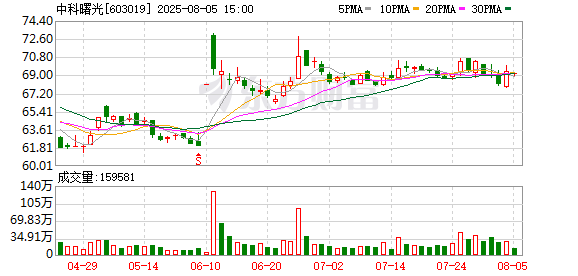
中科曙光:2025年半年度净利润约7.31亿元,同比增加29.89%
Mei Ri Jing Ji Xin Wen· 2025-08-05 09:41
(文章来源:每日经济新闻) 中科曙光(SH 603019,收盘价:69.23元)8月5日晚间发布2025年半年度业绩快报,营业收入约58.54 亿元,同比增加2.49%;归属于上市公司股东的净利润约7.31亿元,同比增加29.89%;基本每股收益 0.501元,同比增加29.79%。 ...
中科曙光(603019) - 2025 Q2 - 季度业绩
2025-08-05 09:30
Sugon Information Industry Co., Ltd. 2025 Semi-Annual Performance Express Report This report outlines Sugon Information Industry Co., Ltd.'s preliminary H1 2025 financial performance, key operational insights, and associated risks[index=1&type=section&id=%E6%9B%99%E5%85%89%E4%BF%A1%E6%81%AF%E4%BA%A7%E4%B8%9A%E8%82%A1%E4%BB%BD%E6%9C%89%E9%99%90%E5%85%AC%E5%8F%B8%202025%20%E5%B9%B4%E5%8D%8A%E5%B9%B4%E5%BA%A6%E4%B8%9A%E7%BB%A9%E5%BF%AB%E6%8A%A5) [Key Financial Data and Indicators](index=1&type=section&id=%E4%B8%80%E3%80%812025%E5%B9%B4%E5%8D%8A%E5%B9%B4%E5%BA%A6%E4%B8%BB%E8%A6%81%E8%B4%A2%E5%8A%A1%E6%95%B0%E6%8D%AE%E5%92%8C%E6%8C%87%E6%A0%87) The company's key financial data for H1 2025 show a 2.49% revenue increase and significant profit growth Key Financial Data for H1 2025 | Item | Current Period (Yuan) | Prior Period (Yuan) | Change (%) | | :--- | :--- | :--- | :--- | | **Total Operating Revenue** | 5,854,101,128.03 | 5,712,059,095.80 | 2.49 | | **Operating Profit** | 818,630,773.70 | 745,760,001.13 | 9.77 | | **Total Profit** | 812,390,102.05 | 745,662,923.68 | 8.95 | | **Net Profit Attributable to Shareholders of Listed Company** | 731,477,515.37 | 563,158,665.42 | 29.89 | | **Net Profit After Non-Recurring Items** | 584,907,717.35 | 366,345,850.84 | 59.66 | | **Basic Earnings Per Share** | 0.501 | 0.386 | 29.79 | Key Financial Position at Period End | Item | End of Current Period (Yuan) | Beginning of Current Period (Yuan) | Change (%) | | :--- | :--- | :--- | :--- | | **Total Assets** | 36,638,814,996.87 | 36,617,491,563.87 | 0.06 | | **Owners' Equity Attributable to Shareholders of Listed Company** | 20,824,691,637.16 | 20,402,094,556.36 | 2.07 | [Explanation of Operating Performance and Financial Position](index=2&type=section&id=%E4%BA%8C%E3%80%81%E7%BB%8F%E8%90%A5%E4%B8%9A%E7%BB%A9%E5%92%8C%E8%B4%A2%E5%8A%A1%E7%8A%B6%E5%86%B5%E6%83%85%E5%86%B5%E8%AF%B4%E6%98%8E) The company's net profit growth is primarily due to product structure optimization, operational efficiency, and increased investment income - The company attributes its performance growth to several factors[5](index=5&type=chunk) - Continuous optimization of product structure - Providing diverse and high-quality solutions to customers - Continuous improvement in operational efficiency - Increased investment income driven by profit growth from associate companies [Risk Warning](index=2&type=section&id=%E4%B8%89%E3%80%81%E9%A3%8E%E9%99%A9%E6%8F%90%E7%A4%BA) This section cautions investors that preliminary, unaudited financial data may vary from the final semi-annual report by up to **20%** - The financial data presented in this report are preliminary and unaudited by an accounting firm, potentially differing from the final semi-annual report data, with an estimated variance not exceeding **20%**[6](index=6&type=chunk)
中科曙光:上半年净利7.31亿元,同比增29.89%
Ge Long Hui A P P· 2025-08-05 09:21
格隆汇8月5日丨中科曙光(603019.SH)公告称,中科曙光发布2025年半年度业绩快报,营业总收入为 58.54亿元,同比增长2.49%。归属于上市公司股东的净利润为7.31亿元,同比增长29.89%。归属于上市 公司股东的扣除非经常性损益的净利润5.85亿元,比上年同期增长比率为59.66%。主要得益于公司优化 产品结构、提升运营效率以及参股子公司利润增长推动投资收益增加。 ...
中科曙光(603019.SH)上半年归母净利润7.31亿元 同比增长29.89%
智通财经网· 2025-08-05 09:19
业绩增长主要为公司通过持续优化产品结构、为客户提供多样化、高质量的解决方案,不断提升运营效 率,保持经营业绩增长及参股子公司利润增长推动投资收益增加。 智通财经APP讯,中科曙光(603019.SH)披露2025年半年度业绩快报,报告期内实现营业总收入58.54亿 元,同比增长2.49%;归属于上市公司股东净利润7.31亿元,同比增长29.89%。 ...
中科曙光(603019.SH):上半年净利润7.31亿元 同比增长29.89%
Ge Long Hui A P P· 2025-08-05 09:13
Core Viewpoint - Zhongke Shuguang (603019.SH) reported a total operating revenue of 5.854 billion yuan for the first half of the year, reflecting a year-on-year growth of 2.49% and a net profit attributable to shareholders of 731 million yuan, which represents a growth rate of 29.89% compared to the same period last year [1] Financial Performance - Total operating revenue reached 5.854 billion yuan, marking a year-on-year increase of 2.49% [1] - Net profit attributable to shareholders was 731 million yuan, showing a year-on-year growth rate of 29.89% [1] - Net profit excluding non-recurring gains and losses amounted to 585 million yuan, with a significant year-on-year growth rate of 59.66% [1] Operational Efficiency - The company achieved growth in operating performance through continuous optimization of product structure and provision of diverse, high-quality solutions to clients [1] - Improvement in operational efficiency contributed to the overall growth in business performance [1] - Increased investment income was driven by the profit growth of associated subsidiaries [1]