Sugon(603019)

Search documents
中科曙光:2025年上半年净利润7.31亿元,同比增长29.89%
Xin Lang Cai Jing· 2025-08-05 09:13
Core Insights - The company reported a total operating revenue of 5.854 billion yuan for the first half of 2025, representing a year-on-year increase of 2.49% [1] - The net profit for the same period was 731 million yuan, showing a significant year-on-year growth of 29.89% [1] - The company achieved these results by continuously optimizing its product structure and providing diverse, high-quality solutions to customers, which enhanced operational efficiency and sustained business performance growth [1]

中科曙光业绩快报:上半年归母净利润7.31亿元 同比增长29.89%
Zheng Quan Shi Bao Wang· 2025-08-05 09:13
人民财讯8月5日电,中科曙光(603019)8月5日晚间发布2025年半年度业绩快报,公司上半年实现营业 总收入58.54亿元,同比增长2.49%;归母净利润7.31亿元,同比增长29.89%;基本每股收益0.5元。 ...
对话曙光存储何振:中国AI的最大瓶颈,可能不全在GPU身上
Jing Ji Guan Cha Wang· 2025-08-05 09:01
Core Insights - The collaboration between Zhongke Shuguang and China Mobile aims to address the inefficiencies in data storage and computing power allocation in the "East Data West Computing" initiative [1][2] - The current investment ratio in computing power versus storage in China is approximately 40:1, compared to around 10:1 in foreign markets, indicating a significant imbalance [1][2] - Shuguang Storage has developed a unified scheduling platform to enhance data flow and management across different data centers, addressing key challenges in data visibility, organization, and utilization [3][4][5] Group 1: Industry Challenges - The primary bottleneck in AI infrastructure is not computing power but rather the foundational data layer, which is often fragmented and incompatible across different systems [3][4] - Data centers face issues such as lack of visibility into data assets, inefficient data flow, and high latency in accessing stored data, particularly in the context of the "East Data West Computing" strategy [4][5] - The rapid growth of AI applications has increased the performance requirements for data storage systems, necessitating advancements in IOPS and bandwidth capabilities [6][12] Group 2: Technological Advancements - Shuguang Storage has transitioned from being a follower to a solution provider in the storage technology space, leveraging over 21 years of R&D to establish a competitive edge [2][10] - The company has achieved global recognition for its centralized storage products, ranking first in the SPC-1 international benchmark for storage performance [2][10] - The development of a unified storage scheduling platform is seen as essential for facilitating data flow across heterogeneous and geographically dispersed data centers [7][8] Group 3: Strategic Collaborations - The partnership with China Mobile was initiated to address specific business needs and to support the national strategy of optimizing resource utilization in the West [7][8] - Shuguang Storage's extensive self-research capabilities position it as a key player in solving complex data flow challenges, which many other vendors struggle to address [8][9] Group 4: Future Outlook - The entry barriers for AI applications are expected to lower with advancements in technology, but new challenges related to privacy and data security will emerge [12][13] - Enhancing GPU resource utilization is critical for reducing AI operational costs, with Shuguang Storage's innovations in data transfer efficiency playing a pivotal role [13][14] - The company's focus on "storage-computing synergy" aims to optimize the interaction between storage systems and GPU resources, significantly improving processing speeds and efficiency [14]

连续两日“吸金”,同标的规模最大的计算机ETF(159998)获实时净申购超700万份,GPT-5发布或将进入倒计时
2 1 Shi Ji Jing Ji Bao Dao· 2025-08-05 03:10
8月5日,A股三大指数盘中走势分化,人工智能、AI算力等概念震荡走弱。热门ETF中,计算机ETF (159998)截至发稿下跌0.85%,成交额超2800万元,溢折率0.05%,盘中频现溢价交易。 据证券日报,数据显示,7月份,共有657家私募证券基金管理人参与A股调研活动,合计调研次数达 1763次,覆盖28个申万一级行业中的358家上市公司。从行业分布来看,7月份,有6个行业获得私募机 构的调研次数均不低于100次。其中,计算机行业以260次的调研频次高居榜首,涉及的上市公司数量达 到36家 中信证券表示,展望2025年H2,建议把握新一轮创新落地周期。AI主线创新继续,带动产业链上下游 落地提速,景气创新方向频出,驱动行业加速成长。综合梳理两大投资方向:1)AI产业链:重点布 局"AI主线",看好AI应用及算力板块机遇;2)景气创新:建议关注信创、金融科技创新、特种IT等结 构性创新机遇。 (本文机构观点来自持牌证券机构,不构成任何投资建议,亦不代表平台观点,请投资人独立判断和决 策。) Wind实时申购赎回信息显示,计算机ETF(159998)获实时净申购达720万份。 计算机ETF(159998)跟 ...




中证云计算50指数上涨0.63%,前十大权重包含浪潮信息等
Jin Rong Jie· 2025-08-04 13:11
Group 1 - The core viewpoint of the news is the performance of the China Securities Cloud Computing 50 Index, which has shown significant growth over various time frames, indicating a strong upward trend in the cloud computing sector [1] - The China Securities Cloud Computing 50 Index increased by 0.63% to 2522.77 points, with a trading volume of 55.338 billion yuan [1] - Over the past month, the index has risen by 15.53%, by 27.33% over the last three months, and by 30.99% year-to-date [1] Group 2 - The index comprises 50 listed companies involved in providing Infrastructure as a Service (IaaS), Platform as a Service (PaaS), Software as a Service (SaaS), and hardware for cloud computing [1] - The top ten weighted companies in the index are: Zhongji Xuchuang (14.25%), Xinyi Sheng (14.08%), Zhongke Shuguang (7.8%), Kingsoft Office (5.55%), Inspur Information (4.29%), Hengsheng Electronics (4.06%), Unisplendour (3.78%), Runhe Software (3.24%), Yonyou Network (2.52%), and Tuo Wei Information (2.48%) [1] - The industry composition of the index shows that Information Technology accounts for 54.03%, Communication Services for 44.14%, and Industry for 1.82% [1] Group 3 - The index samples are adjusted every six months, with adjustments implemented on the next trading day following the second Friday of June and December [2] - Weight factors are adjusted in accordance with the sample adjustments, which are fixed until the next scheduled adjustment unless a special situation arises [2] - Companies that are delisted or undergo mergers, acquisitions, or splits are handled according to the calculation and maintenance guidelines [2] Group 4 - Public funds tracking the Cloud Computing 50 Index include the Xinhua China Securities Cloud Computing 50 ETF [3]


国内AI模型持续推进性能提升,AI小宽基人工智能ETF(515980)有望受益
Sou Hu Cai Jing· 2025-08-04 03:57
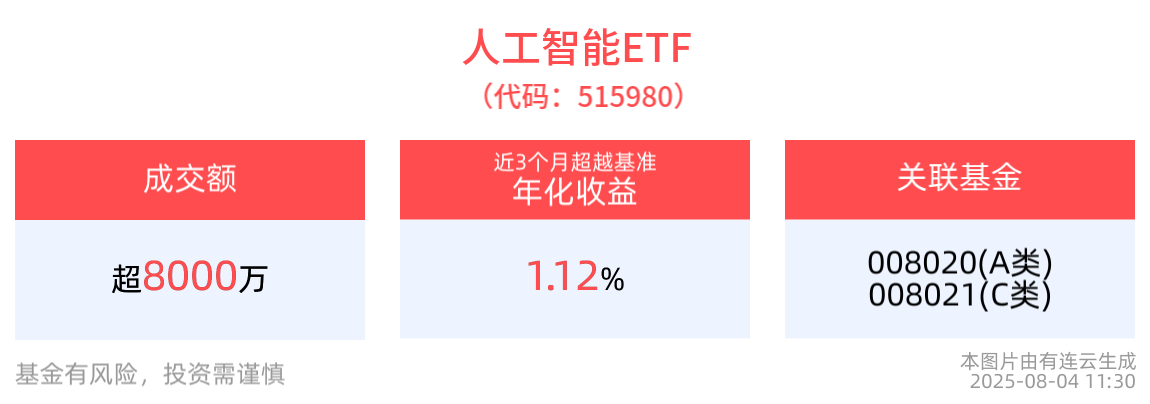
Group 1: Liquidity and Scale of AI ETF - The AI ETF has a turnover rate of 2.52% with a half-day trading volume of 81.81 million yuan, and an average daily trading volume of 269 million yuan over the past week as of August 1 [2] - The latest scale of the AI ETF reached 3.261 billion yuan, with leveraged funds continuing to invest, showing a financing buy-in amount of 19.96 million yuan and a financing balance of 88.20 million yuan [2] - The AI ETF has seen a net value increase of 53.17% over the past year, ranking 260 out of 2944 index equity funds, placing it in the top 8.83% [2] Group 2: Performance Metrics - Since its inception, the AI ETF has recorded a highest monthly return of 30.38%, with the longest consecutive monthly gains being 3 months and the longest cumulative gain reaching 43.97%, averaging a monthly return of 6.94% during rising months [2] - The AI ETF closely tracks the CSI Artificial Intelligence Industry Index, which selects 50 representative listed companies based on their AI business proportion, growth level, and market capitalization [2] Group 3: Key Holdings and Market Trends - As of July 31, 2025, the top ten weighted stocks in the CSI Artificial Intelligence Industry Index account for 61.26% of the index, with notable companies including Xinyi Sheng, Cambricon, and iFlytek [3] - The anticipated release of GPT-5 by OpenAI, expected in early August, will include three versions, enhancing capabilities in understanding and processing complex information [3] - The ongoing performance growth of AI-driven overseas tech companies and the acceleration of AI application monetization in China highlight the investment value in the domestic AI chain [3] Group 4: Investment Strategy and Focus Areas - The Huafu AI ETF (515980) is unique in its quarterly rebalancing and exclusive tracking of the AI industry index, balancing computing power and applications at 50% each [5] - The index includes sectors with strong commercialization potential in AI applications such as autonomous driving, robotics, and smart wearables, each holding a 5% weight [6] - Investors can also consider the Huafu AI ETF linked funds (Class A 008020, Class C 008021) to gain exposure to high-purity AI business stocks while avoiding speculative trading [7]



浙江大学发布类脑计算机“悟空”,同标的规模最大的计算机ETF(159998)盘中溢价,机构:预计国内AI 应用商业化进度有望提速
2 1 Shi Ji Jing Ji Bao Dao· 2025-08-04 02:29
Group 1 - The A-share market experienced a collective decline on August 4, with the Computer ETF (159998) dropping by 0.21% and maintaining a slight premium trading status [1] - As of August 1, the Computer ETF had a circulating share count of 3.809 billion and a circulating scale of 3.549 billion yuan, leading among similar products [1] - The Computer ETF tracks the CSI Computer Theme Index, which includes stocks from companies involved in information technology services, application software, system software, and computer hardware [1] Group 2 - Zhejiang University unveiled a new generation of neuromorphic brain-like computer named "Darwin Monkey," which is the first in the world to exceed 2 billion neurons based on specialized neuromorphic chips [2] - The "Darwin Monkey" supports over 2 billion pulse neurons and more than 100 billion synapses, with power consumption around 2000 watts in typical operating conditions [2] - North American tech giants are experiencing sustained high growth driven by AI, with increased capital expenditure on AI infrastructure, while domestic policies are expected to accelerate the commercialization of AI applications [2] Group 3 - China has leading capabilities in the open-source AI large model sector, with products like DeepSeek, Alibaba Tongyi Qianwen, and others forming a solid technological foundation for the "AI+" initiative [3] - Recommendations include focusing on the accelerated commercialization of AI products, particularly in AI terminals, AI agents, and potential killer AI applications [3] - The demand for AI computing power is expected to surge due to the scaling of AI applications, highlighting opportunities in intelligent computing center construction, liquid cooling servers, optical communication, and copper connections [3]
中科曙光在上海新设子公司
Qi Cha Cha· 2025-08-02 00:35
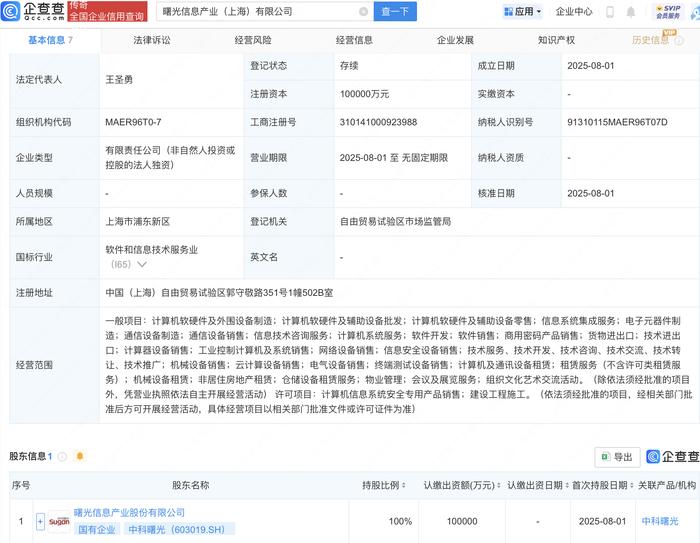
Core Insights - Shuguang Information Industry (Shanghai) Co., Ltd. has been established with a registered capital of 1 billion yuan, focusing on various sales including machinery, cloud computing, and electrical equipment [1][2]. Company Information - The company is wholly owned by Zhongke Shuguang (603019) [1]. - The legal representative is Wang Shengyong, and the company is registered in the Shanghai Free Trade Zone [2]. - The business scope includes general projects such as computer hardware and software sales, information system integration services, and various equipment sales [2]. Financial Details - The registered capital of the company is 1 billion yuan (100 million) [1][2]. - The company is classified as a limited liability company with no fixed business duration [2]. Operational Scope - The operational range includes sales of mechanical equipment, cloud computing devices, electrical equipment, and terminal testing equipment [1][2]. - The company is also involved in technology services, development, consulting, and various leasing services [2].
曙光信息产业(上海)有限公司成立,注册资本100000万人民币
Sou Hu Cai Jing· 2025-08-01 17:32
经营范围含计算机软硬件及外围设备制造;计算机软硬件及辅助设备批发;计算机软硬件及辅助设备零 售;信息系统集成服务;电子元器件制造;通信设备制造;通信设备销售;信息技术咨询服务;计算机 系统服务;软件开发;软件销售;商用密码产品销售;货物进出口;技术进出口;计算器设备销售;工 业控制计算机及系统销售;网络设备销售;信息安全设备销售;技术服务、技术开发、技术咨询、技术 交流、技术转让、技术推广;机械设备销售;云计算设备销售;电气设备销售;终端测试设备销售;计 算机及通讯设备租赁;租赁服务(不含许可类租赁服务);机械设备租赁;非居住房地产租赁;仓储设 备租赁服务;物业管理;会议及展览服务;组织文化艺术交流活动。(除依法须经批准的项目外,凭营 业执照依法自主开展经营活动)许可项目:计算机信息系统安全专用产品销售;建设工程施工。(依法 须经批准的项目,经相关部门批准后方可开展经营活动,具体经营项目以相关部门批准文件或许可证件 为准) 企业名称曙光信息产业(上海)有限公司法定代表人王圣勇注册资本100000万人民币国标行业制造业> 计算机、通信和其他电子设备制造业>电子器件制造地址中国(上海)自由贸易试验区郭守敬路351 ...
中证数字经济主题指数下跌0.66%,前十大权重包含中芯国际等
Jin Rong Jie· 2025-08-01 14:20
Group 1 - The core index of the digital economy, the CSI Digital Economy Theme Index, has shown a slight decline of 0.66% recently, closing at 1192.06 points with a trading volume of 79.724 billion yuan [1] - Over the past month, the CSI Digital Economy Theme Index has increased by 2.75%, while it has risen by 2.83% over the last three months and 2.80% year-to-date [1] - The index comprises companies involved in digital economy infrastructure and high digitalization application fields, reflecting the overall performance of listed companies in the digital economy sector [1] Group 2 - The top ten weighted companies in the CSI Digital Economy Theme Index include Dongfang Wealth (10.35%), SMIC (6.26%), Cambricon (5.13%), Northern Huachuang (5.09%), Haiguang Information (4.57%), Huichuan Technology (4.27%), iFlytek (4.01%), Hikvision (3.84%), OmniVision Technologies (3.63%), and Zhongke Shuguang (3.55%) [1] - The market capitalization distribution of the index shows that the Shanghai Stock Exchange accounts for 50.61%, while the Shenzhen Stock Exchange accounts for 49.39% [1] Group 3 - In terms of industry composition, the CSI Digital Economy Theme Index has a significant allocation to information technology at 78.11%, followed by finance at 10.35%, industry at 5.89%, communication services at 3.84%, and consumer discretionary at 1.81% [2] - The index samples are adjusted biannually, with adjustments occurring on the next trading day after the second Friday of June and December each year [2] - Public funds tracking the digital economy include Pengyang CSI Digital Economy Theme Link A, Pengyang CSI Digital Economy Theme Link C, Huaan CSI Digital Economy Theme Link A, Huaan CSI Digital Economy Theme Link C, Huaan CSI Digital Economy Theme ETF, and Pengyang CSI Digital Economy Theme ETF [2]