
QIANHE(603027)

Search documents
广发证券:供需重构 餐供行业拐点渐显
Zhi Tong Cai Jing· 2026-01-16 07:25
Core Viewpoint - The restaurant supply industry is undergoing a structural transformation, shifting from "passive supporters" to "active drivers" as companies adapt to a more cautious capital expenditure environment and a less aggressive price competition landscape [1][2]. Supply Side - The peak of capital expenditure has passed, revealing opportunities for structural adjustment within the restaurant supply industry. The industry continues to grow driven by the expansion of the restaurant sector, increased chain rates, and high growth in food delivery services. However, the past few years of downturn in the downstream restaurant sector and supply surplus have accelerated industry consolidation. Leading companies are moving away from past extensive capacity expansion and distribution strategies towards efficient service for large clients and refined operations for smaller clients, focusing on quality growth through product innovation and customization [2]. Demand Side - Historical analysis shows that when the Consumer Price Index (CPI) transitions from negative to positive or enters an upward phase, market expectations for consumer recovery often lead to capital flowing into cyclical sectors like the restaurant supply chain. The CPI is expected to turn positive in October 2025, indicating a mild recovery in consumer demand, which creates a favorable macro environment for the restaurant supply sector. The performance of leading companies has shown improvement since Q3 2025, suggesting that while the industry has not entered a high-growth phase, it has passed its worst stage and is currently stabilizing, with potential for both performance and valuation recovery [3]. Valuation - The restaurant supply sector's valuation has fallen to historically low levels, and the sector remains underweight, providing a high margin of safety and emotional recovery potential. Key segments include: 1. Frozen baking: The industry is expected to maintain rapid growth with a CAGR of 22.1% from 2020 to 2025. Leading company Lihigh Foods (300973) is benefiting from new product launches and channel expansion, with significant growth potential in its frozen baking business and cream business due to domestic substitution acceleration [4]. 2. Frozen food: The price competition has significantly weakened, with leading company Anjui establishing a clear advantage over competitors in management, channels, and capacity. The company is expected to enjoy dual benefits from industry growth and market share increase due to a rich pipeline of new products in 2025 [4]. 3. Compound seasoning: The current penetration rate in China is only 25.4%, compared to over 50% in mature markets like Europe, the U.S., and Japan, indicating substantial growth potential. The long-term development of leading companies in Western-style compound seasoning, such as Baoli Foods (603170) and Chinese-style compound seasoning companies like Tianwei Foods (603317) and Richen Co. (603755) is promising [4]. Investment Recommendations - The sector is currently in a phase of low valuation and institutional holdings, with demand stabilizing and improving policy conditions. Capital expenditures have significantly decreased, and the competitive landscape is shifting from price wars to a more rational framework. Leading companies are actively pursuing new products and channels (membership supermarkets/new retail), mergers and acquisitions, and R&D initiatives, providing high certainty and elasticity. It is recommended to focus on large-cap stocks for allocation and small-cap stocks for elasticity, with particular attention to the performance improvements of Anjui Foods (603345), Lihigh Foods (300973), and Qianhe Flavor (603027), as well as the growth elasticity from new channels and category expansions of Tianwei Foods (603317), Guoquan (02517), and Qianwei Yangchu (001215) [5].





中金:2025年线下渠道表现整体承压 零食、饮料健康化趋势显著
Zhi Tong Cai Jing· 2026-01-14 07:41
Core Insights - The overall sales performance of offline channels in the food and beverage sector is under pressure for the period of January to December 2025, with notable differentiation in the soft drink industry across various segments [1] - Functional beverages and ready-to-drink juices are maintaining high single-digit growth, while the snack food category shows strong growth in konjac products and healthy snacks [1] Beverage Sector - Beer sales are under pressure with a year-on-year decline of 6.7% in sales for January to December 2025, although average prices continue to rise [2] - Ready-to-drink cocktails have seen a cumulative year-on-year sales decline of 9.9%, while the market share of the brand Rio remains stable [2] - The soft drink industry shows varied performance across segments, with functional beverages experiencing a year-on-year sales increase of 9.3% and ready-to-drink juices seeing an average price increase of 7.8% [2] Dairy Products - The demand for dairy products continues to face pressure, although there is a quarter-on-quarter improvement in Q4 2025 [2] - Leading dairy companies are performing relatively well in the low-temperature yogurt segment, which is positively impacting overall yogurt performance compared to the broader dairy market [2] Condiments and Snacks - Basic condiments prioritize price, with leading brands continuing to capture market share [3] - The performance of spicy snack foods shows significant differentiation, with konjac products and certain specialty items providing crucial support [3] - Healthy snacks are experiencing notable growth, while the nut and dried fruit category is under pressure due to the timing of the Spring Festival affecting December sales [3] - Sweet snacks are generally underperforming, with widespread year-on-year declines [3] Frozen Foods - Hot pot ingredients are showing a trend of volume growth with stable prices, while competition remains fierce in the frozen dumpling and tangyuan markets [3] - By December 2025, the frozen food sector enters a peak stocking phase, with hot pot ingredients, frozen prepared foods, and frozen snacks achieving year-on-year growth, while frozen dumplings and tangyuan continue to face pressure [3] Recommendations - Recommended stocks in the A-share market include Anjuke Food, Yanjinpuzi, New Dairy, Ximai Food, Yanjing Beer, Dongpeng Beverage, Yili Group, Qianhe Flavor, and Haitian Flavor [4] - Recommended stocks in the H-share market include Weilong, Gu Ming, Master Kong, Uni-President China, Nongfu Spring, China Resources Beer, Mengniu Dairy, and Qingdao Beer [4]





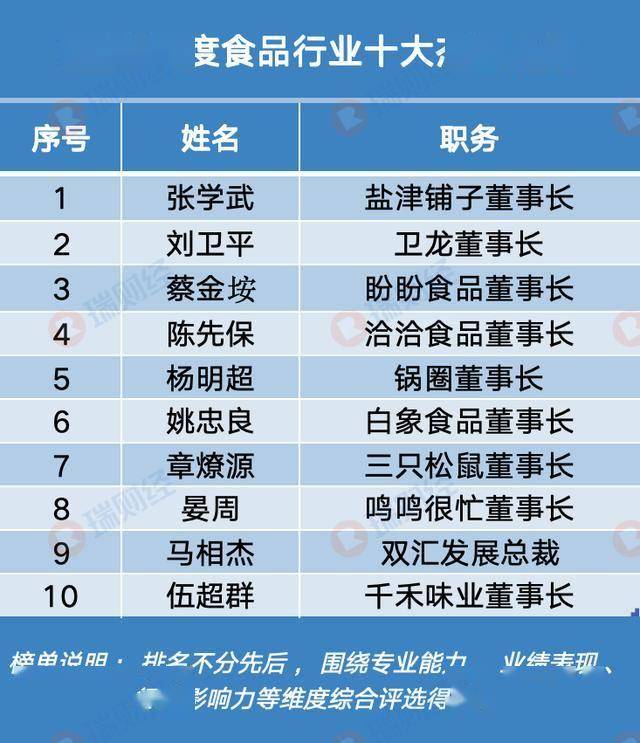
千禾味业董事长伍超群入选“2025年度食品行业十大杰出人物”
Sou Hu Cai Jing· 2026-01-13 09:45
Core Viewpoint - The "2025 Annual Top Ten Outstanding Figures in the Food Industry" list was announced by Rui Finance, highlighting key leaders in the sector, with Wu Chaoqun, Chairman of Qianhe Flavor Industry, being recognized for his contributions [2]. Group 1: Recognition and Achievements - Wu Chaoqun was selected for the "2025 Annual Top Ten Outstanding Figures in the Food Industry" list based on his professional capabilities, performance, and industry influence [2]. - Wu Chaoqun, born in May 1969, holds a Master's degree in Business Administration and founded Hengtai Industrial in January 1996, serving in various leadership roles [2]. Group 2: Industry Innovations - Wu Chaoqun is recognized as a pioneer in the "zero additives" segment of the seasoning industry, focusing on product packaging renewal and optimizing label information presentation [3]. - The company is strategically expanding its oyster sauce category to create a "second growth curve" for its product line [3].



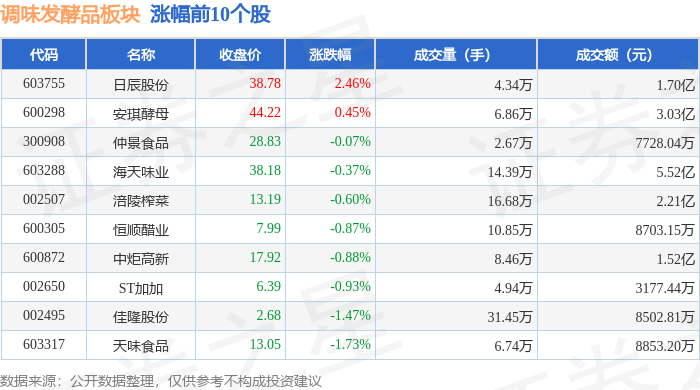
调味发酵品板块1月13日跌0.65%,朱老六领跌,主力资金净流出2.57亿元
Zheng Xing Xing Ye Ri Bao· 2026-01-13 09:00
Market Overview - The seasoning and fermentation sector experienced a decline of 0.65% on January 13, with Zhu Laoliu leading the drop [1] - The Shanghai Composite Index closed at 4138.76, down 0.64%, while the Shenzhen Component Index closed at 14169.4, down 1.37% [1] Stock Performance - Notable stock performances include: - Richen Co., Ltd. (603755) closed at 38.78, up 2.46% with a trading volume of 43,400 shares and a transaction value of 170 million yuan [1] - Angel Yeast Co., Ltd. (600298) closed at 44.22, up 0.45% with a trading volume of 68,600 shares and a transaction value of 303 million yuan [1] - Zhu Laoliu (920726) closed at 22.45, down 4.47% with a trading volume of 99,900 shares and a transaction value of 236 million yuan [2] Capital Flow - The seasoning and fermentation sector saw a net outflow of 257 million yuan from main funds, while retail investors contributed a net inflow of 215 million yuan [2] - The capital flow for individual stocks shows: - Hai Tian Flavoring (603288) had a main fund net inflow of 22.56 million yuan, but a net outflow from retail investors of 13.91 million yuan [3] - Angel Yeast (600298) experienced a main fund net inflow of 10.74 million yuan, with a net outflow from retail investors of 16.68 million yuan [3]





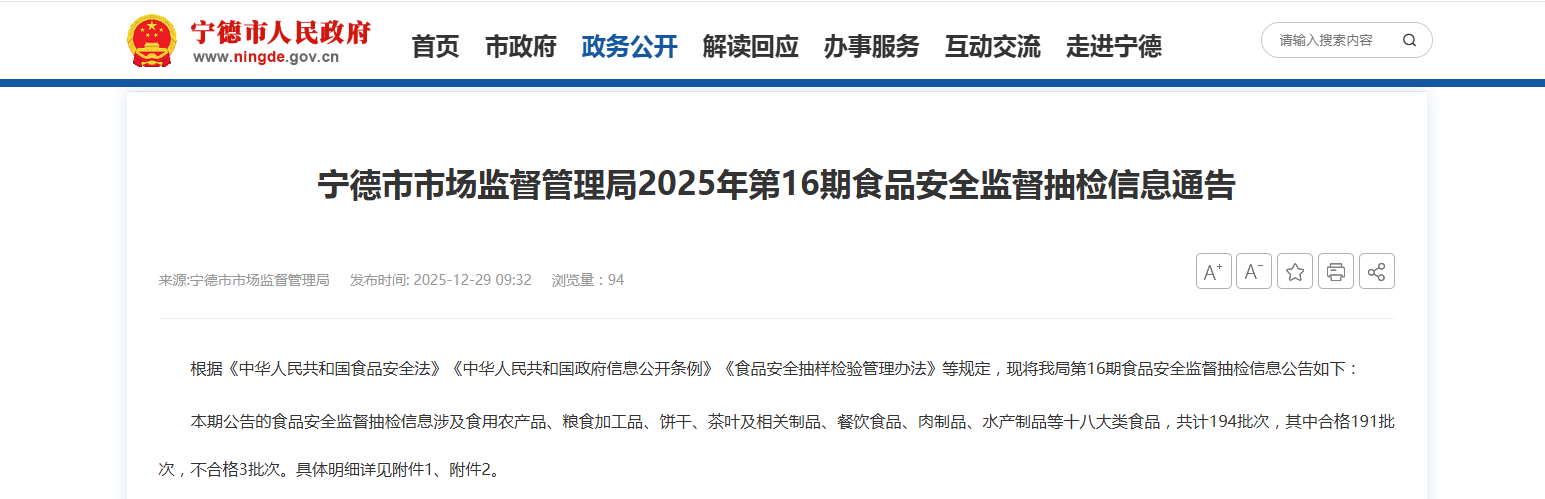
福建省宁德市市场监督管理局2025年第16期食品安全监督抽检信息通告
Zhong Guo Zhi Liang Xin Wen Wang· 2026-01-13 08:01
Core Viewpoint - The announcement details the results of the 16th food safety supervision sampling inspection, indicating that out of 194 batches tested, 191 were qualified and 3 were unqualified, with actions taken against the non-compliant products [2]. Group 1: Inspection Results - The inspection covered 18 categories of food products, including edible agricultural products, grain processing products, biscuits, tea, catering food, meat products, and aquatic products [2]. - A total of 194 batches were tested, with 191 passing and 3 failing the safety standards [2]. Group 2: Actions Taken - The Ningde Market Supervision Administration has mandated local market supervision departments to investigate and handle the non-compliant products, ensuring producers fulfill their legal responsibilities, including stopping sales, recalling products, and making public announcements [2]. - Consumers are advised to report any unqualified food products listed in the announcement by calling the complaint hotline 12315 [2].


千禾味业食品股份有限公司第五届董事会第九次会议决议公告
Shang Hai Zheng Quan Bao· 2026-01-12 18:14
证券代码:603027 证券简称:千禾味业 公告编号:临2026-001 千禾味业食品股份有限公司 第五届董事会第九次会议决议公告 本公司董事会及全体董事保证本公告内容不存在任何虚假记载、误导性陈述或者重大遗漏,并对其内容 的真实性、准确性和完整性承担个别及连带责任。 一、董事会会议召开情况 经审议,董事会同意公司制定的《董事、高级管理人员薪酬管理制度》。本议案已经公司第五届董事会 薪酬与考核委员会审议通过,尚需提交公司股东会审议。 表决结果:同意9票,反对0票,弃权0票,议案获得通过。 具体内容详见公司同日披露于上海证券交易所网站(www.sse.com.cn)的公告。 千禾味业食品股份有限公司(以下简称"公司")第五届董事会第九次会议通知于2026年1月6日以书面、 电子邮件、电话形式通知了全体董事,会议于2026年1月12日在公司会议室以现场结合通讯方式召开。 本次会议应参加表决董事9名,实际参加表决董事9名。会议由公司董事长伍超群先生主持,公司高级管 理人员列席了本次会议。本次会议的召集和召开符合《公司法》等有关法律、行政法规、部门规章、规 范性文件和《公司章程》的相关规定,会议形成的决议合法、有效。 ...
食品饮料行业周度更新:如何把握春节旺季备货行情?-20260112
Changjiang Securities· 2026-01-12 14:10
Investment Rating - The industry investment rating is "Positive" and is maintained [8] Core Viewpoints - The liquor sector is currently experiencing a phase of "supply optimization and weak demand recovery," with inventory destocking ongoing in Q4. Short-term price recovery is expected due to controlled supply from Moutai, with attention on Spring Festival sales and inventory movement [2][5] - The demand for mass-market products is expected to show marginal improvement, with January anticipated to see a strong start due to delayed Spring Festival stocking [2][5] - The report recommends focusing on products with strong seasonal effects and high performance realization, particularly in sectors like leisure snacks, restaurant supply chains, condiments, soft drinks, and dairy products [4][26] Summary by Sections Spring Festival Stocking Strategy - The Spring Festival stocking strategy should focus on products with strong seasonal effects and high performance realization. The timing of the Spring Festival can impact the performance of listed companies, especially in years when it falls later in the calendar [4][15] - Products with clear gifting scenarios and positive market sentiment in specific segments are prioritized for opportunity selection. The continuation of the post-Spring Festival market will depend on actual sales and positive Q1 performance feedback [4][26] CPI Trends - The food CPI has been strengthening since December, surpassing service and overall CPI. This trend is supported by supply clearing in certain items and seasonal demand recovery, which together bolster price improvements [32][34] - The CPI-PPI differential remains positive, supporting the continued improvement in profitability for food manufacturing companies [37] Market Performance Review - Since the beginning of 2026, the food and beverage index has increased by 2.21%, lagging behind the CSI 300, which rose by 2.79%. The performance of the liquor sector has remained stable, while the dairy sector has seen declines [6][40] - Soft drinks and leisure snacks have led the market in terms of growth related to Spring Festival stocking, while dairy and meat products have experienced declines [6][40] Industry Dynamics - The industry is increasingly focused on value deepening and structural optimization. Companies are prioritizing supply-demand balance, healthy pricing systems, and profit structure improvements rather than merely pursuing sales growth [7][46] - Food safety and supply chain resilience remain foundational to brand trust, highlighted by recent global recalls and supply chain disruptions [7][46]

千禾味业:第五届董事会第九次会议决议
Zheng Quan Ri Bao Wang· 2026-01-12 13:10
证券日报网讯1月12日,千禾味业(603027)发布公告称,公司第五届董事会第九次会议审议通过《关 于投资设立全资子公司的议案》《关于制定 <董事 高级管理人员薪酬管理制度="高级管理人员薪酬管 理制度"> 的议案》。 ...
2025年零售圈十大食品产业事件发布
Tai Mei Ti A P P· 2026-01-12 11:01
Core Insights - The retail food industry in 2025 is undergoing significant changes, influenced by various events that reshape consumer behavior and company strategies [1] - Key themes include a shift from traditional sales and marketing to a focus on consumer needs, product safety, and quality verification [22] Group 1: Company Changes - The leadership of "spicy strip" giant Wei Long has returned to the founding Liu family, marking a shift back to family control after a period of professional management [2] - Qianhe Flavor Industry faced a crisis due to a product safety incident involving its "zero additives" claim, leading to a decline in brand trust and financial performance [3][4] - Wahaha is embroiled in a family inheritance dispute, revealing internal conflicts and impacting its operational stability [5][6] Group 2: Mergers and Acquisitions - Nestlé has fully acquired Xu Fu Ji, ending a 14-year partnership and integrating the brand into its global operations [7][8] - Kraft Heinz announced plans to split into two independent companies, focusing on sauces and North American grocery products, to enhance operational clarity and market focus [11][12] Group 3: Market Trends - The retail landscape is shifting towards direct consumer engagement, with companies like Xiangpiaopiao exploring offline tea beverage experiences to build stronger consumer relationships [20][21] - The industry is witnessing a trend towards modernization in governance, with companies adapting to more agile and market-responsive structures [22]

千禾味业(603027) - 千禾味业食品股份有限公司董事、高级管理人员薪酬管理制度
2026-01-12 09:30
千禾味业食品股份有限公司 董事、高级管理人员薪酬管理制度 第一章 总则 第一条 为进一步完善千禾味业食品股份有限公司(以下简称"公司")治 理结构,提高公司的管理水平,强化公司董事、高级管理人员薪酬的管理,建立 和完善有效的激励与约束机制,充分调动董事、高级管理人员的工作积极性和创 造性,根据《中华人民共和国公司法》《上市公司治理准则》等有关法律法规、 规范性文件和《千禾味业食品股份有限公司章程》(以下简称"《公司章程》"), 结合公司实际情况,制定本制度。 第二条 本制度所称的董事、高级管理人员是指由股东会、董事会或其他有 权机构批准任命的下列人员: (一)公司董事会的全体成员,包含独立董事和非独立董事; (二)总裁、副总裁、董事会秘书、财务负责人。 第三条 公司董事和高级管理人员薪酬管理遵循以下原则: (一)公开、公正、透明的原则; (四)与公司实际经营情况及经营目标相结合的原则; (五)激励与约束并重的原则。 第二章 薪酬管理机构 第四条 公司股东会负责审议有关董事的薪酬事项;公司董事会负责审议有 关高级管理人员的薪酬事项。 第五条 公司董事会下设薪酬与考核委员会,负责制定董事、高级管理人员 的薪酬方案 ...