YINGJIA DISTILLERY(603198)

Search documents
白酒行业更新报告:白酒筑底,政策、批价双重催化
GUOTAI HAITONG SECURITIES· 2026-01-30 02:01
Investment Rating - The report assigns an "Accumulate" rating for the liquor industry [4]. Core Insights - The liquor industry has entered a deep adjustment period, but recent positive changes in the real estate and domestic demand sectors, along with the market-oriented transformation of Moutai, are stimulating incremental demand and driving up prices, leading to a valuation recovery [2]. - The report recommends stocks with price elasticity such as Guizhou Moutai, Wuliangye, and Luzhou Laojiao, as well as those expected to clear inventory like Yingjia Gongjiu, Gujing Gongjiu, Shanxi Fenjiu, Jianshiyuan, Zhenjiu Lidu, Shede Jiuye, and Jinhui Jiu [4]. Summary by Sections Market Environment - The real estate sector is showing signs of recovery, and policies are becoming more favorable. The liquor industry is a typical cyclical sector, with market pricing influenced by both internal demand and real estate conditions. The government has prioritized boosting domestic demand as a key task for the 14th Five-Year Plan, with plans to develop a strategy for expanding domestic demand from 2026 to 2030 [4]. - The real estate market is gradually bottoming out after years of adjustment, with recent government actions aimed at stabilizing market expectations and improving conditions [4]. Moutai's Market Transformation - Moutai's market-oriented reform has sparked incremental demand, with significant attention on liquor sales during the Spring Festival. Moutai has introduced various products on its iMoutai platform, leading to a surge in online purchases and stable price performance [4]. - As of January 29, Moutai's price has increased by over 1,600 RMB, with transaction prices exceeding 1,700 RMB, indicating successful price-volume strategies [4]. Industry Outlook - The liquor industry is believed to be at the bottom of its cycle, with liquidity improvements and expectations likely to catalyze stock prices. The report anticipates that if prices stabilize, the pressure on stock prices will lessen, and further positive signals from policies could enhance stock performance [4]. - The report includes earnings forecasts for key liquor companies, indicating a compound annual growth rate (CAGR) of 5% for Moutai from 2024 to 2026, with a price-to-earnings (PE) ratio projected to decrease from 21 to 19 [5].




1月30日每日研选丨白酒“回马枪”,是反弹还是反转?
Shang Hai Zheng Quan Bao· 2026-01-29 23:53
Core Viewpoint - The recent surge in the liquor sector, particularly on January 29, indicates a potential turning point for the industry, driven by multiple factors including short-term market signals, low valuations, and macroeconomic easing expectations [1][2]. Group 1: Market Performance - On January 29, the liquor sector saw a significant rally, with the Shenwan liquor index rising over 5%, reflecting strong performance from multiple stocks [1]. - The high-end liquor prices have established a "price bottom," with Moutai's bottle price stabilizing around 1560 yuan and Wuliangye's price also showing stability [1]. Group 2: Valuation and Dividend Appeal - The liquor sector's valuation is at a historical low of 4.1%, suggesting a high safety margin and potential for rebound [2]. - The sector's dividend yield is approximately 3.64%, with Wuliangye leading at over 5%, making it attractive for risk-averse investors [2]. Group 3: Macroeconomic Factors - Expectations of macroeconomic easing, particularly regarding potential quantitative easing (QE) by the Federal Reserve, could open up monetary policy space in China, potentially driving consumption upgrades and benefiting the liquor sector [2]. Group 4: Future Outlook - The liquor industry may be on the verge of recovery after a deep adjustment, with expectations of improved sales and financial performance in the latter half of 2026 [2]. - High-end liquor companies like Moutai and Wuliangye are actively reforming marketing strategies and expanding consumer bases, positioning themselves for future growth [2]. Group 5: Investment Opportunities - Investors are advised to focus on high-end liquor leaders with strong brand certainty, such as Moutai and Wuliangye, as well as regional companies likely to benefit from local consumption trends [3]. - Monitoring post-Spring Festival inventory reduction and price stability will be crucial for assessing the industry's bottoming out [3].


罕见!600亿,大面积涨停!
凤凰网财经· 2026-01-29 13:23
Group 1 - The core viewpoint of the article highlights a significant rebound in the liquor sector, particularly in the stock prices of major brands like Kweichow Moutai, which surged by 8.6% with a trading volume exceeding 26 billion yuan [1][3] - The white liquor market has seen a notable increase in the prices of Feitian Moutai, with the original box (53 degrees/500ml) for 2026 rising by 55 yuan and the loose bottle increasing by 20 yuan compared to January 26 [1][3][6] - A report from Huashan Securities indicates that the consumer sector has experienced a rare decline over the past five years, leading to a shift in market consensus and a potential limited downside for leading consumer companies post-2026 [1][2][6] Group 2 - The article discusses the anticipated implementation of policies aimed at boosting domestic demand, with the National Development and Reform Commission and the Ministry of Finance set to roll out large-scale equipment updates and consumption replacement policies in early 2026 [2][7] - Analysts suggest that the focus on domestic demand will be crucial for economic recovery, with expectations that policies will support both physical and service consumption [2][8] - The article notes that the consumer sector, including durable goods and daily retail, has shown positive growth, indicating a potential recovery in domestic demand [7][8]



果然财经|“老登”回来了?白酒股掀起涨停潮
Qi Lu Wan Bao· 2026-01-29 12:28
Core Viewpoint - The white liquor sector has experienced a significant rebound, with major stocks seeing substantial gains, indicating a potential recovery in consumer sentiment and market confidence [1]. Group 1: Market Performance - On January 29, the white liquor and consumer stocks surged, with Kweichow Moutai rising by 8.6% and achieving a trading volume exceeding 26 billion yuan [1]. - Nearly 20 stocks, including Jinzhidao Liquor, Huangtai Liquor, Yingjia Gongjiu, and Jinhui Liquor, reached their daily price limits [1]. - The total trading volume for the white liquor sector surpassed 60 billion yuan throughout the day [1].

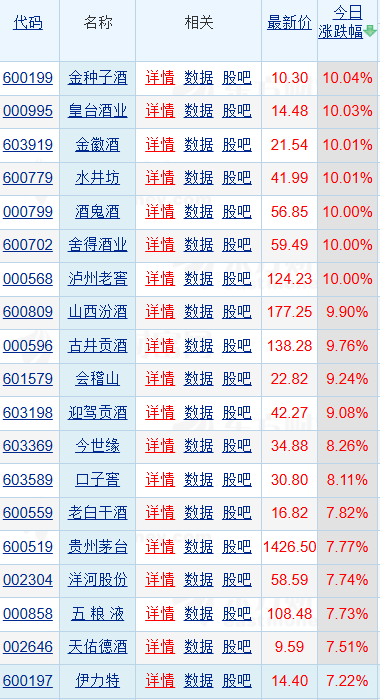
今日白酒板块表现强势,皇台酒业、酒鬼酒、金徽酒、水井坊、泸州老窖、金种子酒领涨,板块整理
Jin Rong Jie· 2026-01-29 10:46
Core Viewpoint - The liquor sector, particularly the baijiu (Chinese liquor) segment, is experiencing a significant surge, with multiple stocks hitting their daily limit up due to consumer recovery expectations. Company Summaries - **Huangtai Liquor (000995.SZ)**: Latest stock price is 14.48 CNY with a daily increase of +10.03%. It is a regional liquor company in Gansu with a historical brand presence [1]. - **Jiu Gui Liquor (000799.SZ)**: Latest stock price is 56.85 CNY with a daily increase of +10.00%. It is known for its unique flavor profile and is a pioneer in the fragrant liquor category [2]. - **Jin Hui Liquor (603919.SH)**: Latest stock price is 21.54 CNY with a daily increase of +10.01%. It is a leading liquor company in Northwest China with two major brands [3]. - **Shui Jing Fang (600779.SH)**: Latest stock price is 41.99 CNY with a daily increase of +10.01%. It is a well-known high-end liquor brand in China [4]. - **Luzhou Laojiao (000568.SZ)**: Latest stock price is 124.23 CNY with a daily increase of +10.00%. It is recognized as the originator of the strong aroma liquor category [5]. - **Jin Zhong Zi Liquor (600199.SH)**: Latest stock price is 10.30 CNY with a daily increase of +10.04%. It focuses on promoting new fragrant liquor products in Anhui [6]. - **Shede Liquor (600702.SS)**: Latest stock price is 59.49 CNY with a daily increase of +10.00%. It is one of the "Six Flowers of Sichuan Liquor" and adheres to an old liquor strategy [7][8]. - **Gu Qing Gong Liquor (000596.SZ)**: Latest stock price is 138.58 CNY with a daily increase of +10.00%. It is one of China's eight famous liquors and a leader in Huizhou liquor [9]. - **Shanxi Fen Liquor (600809.SH)**: Latest stock price is 177.42 CNY with a daily increase of +10.00%. It is a leading clear aroma liquor brand with rapid national expansion [10]. - **Wuliangye (000858.SZ)**: Latest stock price is 110.77 CNY with a daily increase of +10.00%. It is a well-known brand representing high-end strong aroma liquor [11]. - **Jin Si Yuan (603369.SH)**: Latest stock price is 35.44 CNY with a daily increase of +9.99%. It is a quality liquor company in Jiangsu known for its unique product [12]. - **Lao Bai Gan Liquor (600559.SH)**: Latest stock price is 17.16 CNY with a daily increase of +10.00%. It is a leading liquor company in Hebei implementing a multi-flavor and multi-brand strategy [13]. - **Kou Zi Jiao (603589.SH)**: Latest stock price is 31.34 CNY with a daily increase of +10.00%. It is a core Huizhou liquor company emphasizing traditional brewing techniques [14]. - **Ying Jia Gong Liquor (603198.SH)**: Latest stock price is 42.63 CNY with a daily increase of +10.10%. It is a major representative of Huizhou liquor focusing on ecological brewing [15]. - **Tian You De Liquor (002646.SZ)**: Latest stock price is 9.81 CNY with a daily increase of +9.98%. It represents Qingke liquor with unique regional advantages [16].


白酒板块罕见大涨!
Zheng Quan Ri Bao Wang· 2026-01-29 10:29
Core Viewpoint - The A-share liquor sector experienced a significant surge, with the liquor ETF rising by 10.08% and the China Securities Liquor Index increasing by 9.79% on January 29, driven by macroeconomic expectations and seasonal factors related to the upcoming Spring Festival [1][2]. Group 1: Market Performance - 20 liquor companies saw stock price increases, with 18 reaching the daily limit, including notable gains from Kweichow Moutai (8.61% increase) and others like Jinzhongzi Liquor and Huangtai Liquor, both around 10% [1][2]. - The wholesale price of Feitian Moutai has been rising, surpassing 1600 yuan, indicating a market recovery signal as the product remains sold out on official platforms [3]. Group 2: Expert Insights - Experts attribute the price increase to a combination of Moutai's proactive price control and seasonal demand, suggesting that the liquor sector is a target for capital investment due to its cyclical nature [4]. - The overall industry is under pressure, with several companies forecasting significant declines in net profit, indicating a challenging competitive landscape and increased inventory issues [4]. Group 3: Future Outlook - Analysts suggest that the proactive inventory adjustments by liquor manufacturers and the stabilization of high-end liquor prices could lead to a healthier market development [5]. - The upcoming Spring Festival is expected to boost demand, with the liquor sector seen as a value opportunity for investors, despite the need for cautious optimism regarding long-term trends [5].



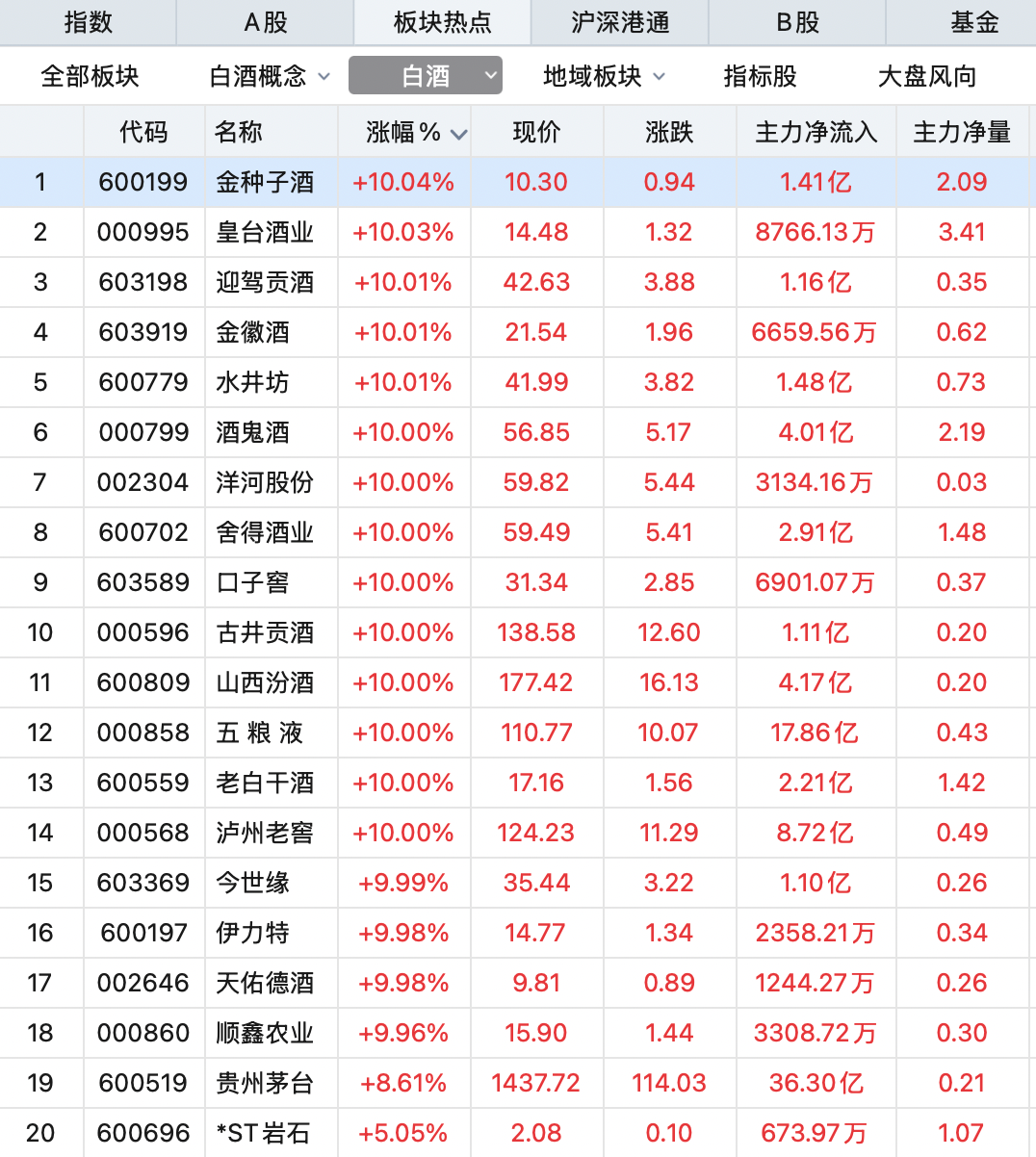
白酒板块1月29日涨9.16%,金种子酒领涨,主力资金净流入83.24亿元
Zheng Xing Xing Ye Ri Bao· 2026-01-29 09:03
Group 1 - The liquor sector experienced a significant increase of 9.16% on January 29, with Jinzhongzi Liquor leading the gains [1] - The Shanghai Composite Index closed at 4157.98, up 0.16%, while the Shenzhen Component Index closed at 14300.08, down 0.3% [1] - Key stocks in the liquor sector showed substantial price increases, with Jinzhongzi Liquor rising by 10.04% to a closing price of 10.30 [1] Group 2 - The main capital inflow into the liquor sector was 8.324 billion yuan, while retail investors saw a net outflow of 2.849 billion yuan [1] - Major stocks such as Moutai and Wuliangye had mixed capital flows, with Moutai experiencing a net outflow of 33.37 million yuan from main funds [2] - Wuliangye saw a net inflow of 1.703 billion yuan from main funds, representing 16.29% of its total capital flow [2]
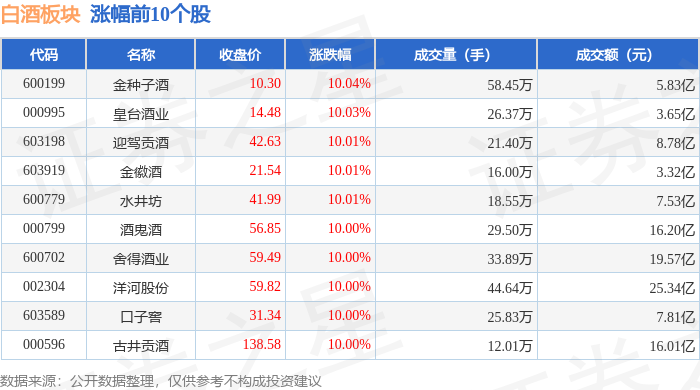
“老登股”大反攻!白酒板块全线飘红,泸州老窖等18股封板
2 1 Shi Ji Jing Ji Bao Dao· 2026-01-29 08:49
Market Performance - On January 29, A-shares showed mixed performance with the Shanghai Composite Index experiencing narrow fluctuations, the SSE 50 Index rising over 1%, while the ChiNext Index peaked and then retreated, and the Sci-Tech 50 Index fell over 3% [1] Sector Analysis - The liquor sector saw a significant surge in the afternoon, with all constituent stocks in the sector closing in the green. Notable stocks such as Jinzhongzi Liquor, Huangtai Liquor, Yingjia Gongjiu, Jinhui Liquor, Shui Jing Fang, Jiu Gui Jiu, She De Jiuye, and Luzhou Laojiao all hit the daily limit, while Shunxin Agriculture, Kweichow Moutai, and Gujing Gongjiu B rose over 5% [1] Price Movements - The price of Feitian Moutai has been continuously rising ahead of the festival, with the wholesale price of a full box surpassing 1600 yuan. As of January 29, the price for a single bottle of 2026 original box Moutai increased by 20 yuan to 1610 yuan, recovering above 1600 yuan, while the price for loose bottles remained at 1570 yuan. Previously, the wholesale price of Moutai had stabilized around 1550 yuan [1] Sales Insights - The "i Moutai" platform indicated that the price of 1499 yuan for the regular Moutai has been sold out for 29 consecutive days after multiple sell-outs [1]
沪指收涨0.16%!白酒板块掀涨停潮,两市成交额3.23万亿元
Bei Jing Shang Bao· 2026-01-29 07:41
Core Viewpoint - The A-share market exhibited mixed performance on January 29, with the Shanghai Composite Index slightly up by 0.16%, while the Shenzhen Component and ChiNext indices declined by 0.3% and 0.57% respectively [1] Market Performance - The Shanghai Composite Index closed at 4157.98 points, while the Shenzhen Component and ChiNext indices closed at 14300.08 points and 3304.51 points respectively [1] - A total of 1803 stocks in the A-share market gained, with 86 stocks hitting the daily limit up, while 3566 stocks declined, including 35 stocks hitting the daily limit down [1] Sector Performance - The liquor sector saw significant gains in the afternoon, with stocks such as Wuliangye (000858), Jinzhidao (600199), Huangtai Distillery (000995), and Yingjia Gongjiu (603198) reaching their daily limit up [1] - Kweichow Moutai (600519) experienced a substantial price increase, reaching 1400 CNY per share during trading and ultimately closing up by 8.61% at 1437.72 CNY per share [1] - Other sectors that performed well included precious metals and mining, while high-bandwidth memory, MLCC, and SMIC-related sectors faced declines [1] Trading Volume - The total trading volume for the Shanghai Stock Exchange was approximately 14857.95 billion CNY, while the Shenzhen Stock Exchange recorded about 17442.13 billion CNY, leading to a combined trading volume of around 3.23 trillion CNY [1]
白酒狂欢!泸州老窖等8股涨停,贵州茅台涨近8%飞天批价突破1600元,券商看好底部配置机会
Jin Rong Jie· 2026-01-29 06:23
Group 1 - The core logic behind the current market speculation on the liquor sector is the positive expectations for sales during the upcoming Spring Festival and the highlighted value of industry bottom configurations [2][4] - As the Spring Festival approaches, traditional consumption scenarios for liquor are recovering, and institutional research reports are optimistic about the industry's recovery trend, leading to capital inflows into undervalued liquor stocks [2][4] - Various local regions have introduced supportive policies, reinforcing market confidence in the long-term development of the liquor industry [2][4] Group 2 - Some Moutai distributors have sold out their quotas for January and February, driven by pre-holiday stocking and Moutai's volume control strategy, which may lead to price increases [3] - The price of Moutai has seen a rise, with the original box price increasing by 20 yuan to 1610 yuan per bottle, while the price for loose bottles remains around 1570 yuan [3] - Citic Securities reports that the liquor industry is set to enter a marketing phase for the Spring Festival, focusing on market cultivation and consumer education to promote sales [4] Group 3 - High-end liquor brands are expected to benefit from the recovery of consumption scenarios such as business banquets and gift-giving during the Spring Festival, leading to a rebound in wholesale prices and sales [5] - Regional liquor companies are leveraging local market advantages and adjusting channel strategies to break through in a competitive environment, with some launching affordable products to meet consumer demand [5] - Service providers in liquor production areas are likely to see growth opportunities as regions promote digital transformation and cultural integration, enhancing production efficiency and brand value [5]