
Shandong Huifa Foodstuff (603536)

Search documents
食品加工板块10月14日涨0.04%,盖世食品领涨,主力资金净流出1.25亿元
Zheng Xing Xing Ye Ri Bao· 2025-10-14 08:39
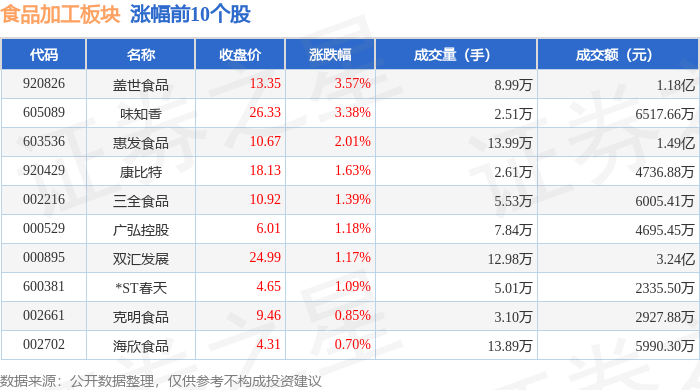
Market Overview - On October 14, the food processing sector rose by 0.04% compared to the previous trading day, with Gai Shi Food leading the gains [1] - The Shanghai Composite Index closed at 3865.23, down 0.62%, while the Shenzhen Component Index closed at 12895.11, down 2.54% [1] Stock Performance - Gai Shi Food (code: 920826) closed at 13.35, up 3.57% with a trading volume of 89,900 shares and a turnover of 118 million yuan [1] - Wei Zhi Xiang (code: 605089) closed at 26.33, up 3.38% with a trading volume of 25,100 shares and a turnover of 65.18 million yuan [1] - Hui Fa Food (code: 603536) closed at 10.67, up 2.01% with a trading volume of 139,900 shares and a turnover of 149 million yuan [1] - Other notable performers include Kang Bi Te (code: 920429) up 1.63% and Shuanghui Development (code: 000895) up 1.17% [1] Capital Flow - The food processing sector experienced a net outflow of 125 million yuan from institutional investors, while retail investors saw a net inflow of 140 million yuan [2] - The overall capital flow indicates a mixed sentiment, with institutional investors pulling back while retail investors are more active [2] Individual Stock Capital Flow - ST Chuntian (code: 600381) had a net inflow of 3.86 million yuan from institutional investors, while it faced a net outflow of 3.76 million yuan from speculative funds [3] - Hui Fa Food (code: 603536) saw a net inflow of 2.40 million yuan from institutional investors, but a net outflow of 2.55 million yuan from retail investors [3] - Shuanghui Development (code: 000895) had a net inflow of 1.87 million yuan from institutional investors, with a significant outflow of 38.42 million yuan from speculative funds [3]


从齐鲁灶台到国际餐桌 惠发食品亮相“好品山东”2025(马来西亚)农业贸易博览会
Zhong Guo Zhi Liang Xin Wen Wang· 2025-10-13 03:38
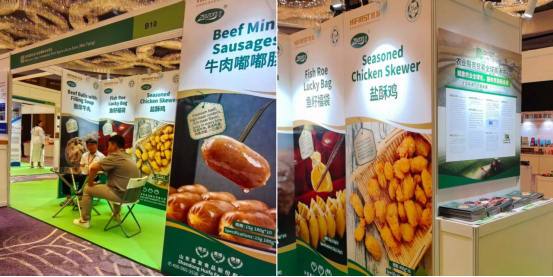
Core Insights - The "Good Products Shandong" 2025 Agricultural Trade Expo was held in Kuala Lumpur, Malaysia, with Shandong Huifa Food Co., Ltd. representing Shandong [1] Group 1: Company Overview - Huifa Food showcased multiple product lines tailored to local market consumption habits, attracting numerous inquiries from customers [3] - The company is focused on building an integrated online and offline health food industry chain and supply chain platform, emphasizing a full-chain layout of "R&D production + supply chain services + overseas expansion" [3] - Huifa Food aims to provide comprehensive support for specialty food exports, relying on standardized control and integration of resources across the entire industry chain [3] Group 2: Market Strategy - The expo allowed Huifa Food to present its innovative achievements and high-quality products in the food sector while gaining insights into local consumer preferences and market trends [3] - The company plans to continuously optimize its product structure, enhance brand building, and accelerate the international distribution of quality food products [3] - Huifa Food is committed to injecting new momentum into the integration of "Good Products Shandong" into the global industrial chain [3]
食品加工板块10月10日涨0.81%,光明肉业领涨,主力资金净流出426.1万元
Zheng Xing Xing Ye Ri Bao· 2025-10-10 08:46
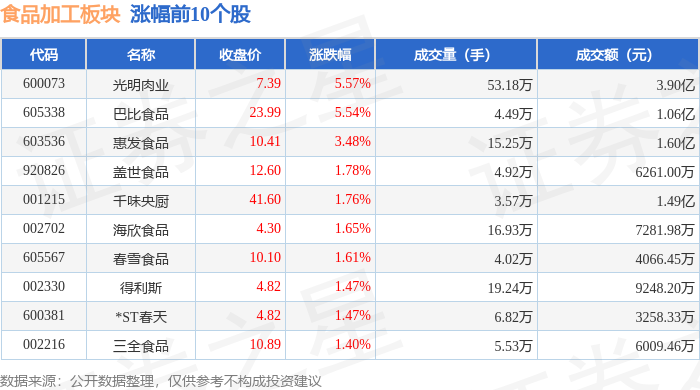
Core Insights - The food processing sector experienced a rise of 0.81% on October 10, with Bright Meat Industry leading the gains [1] - The Shanghai Composite Index closed at 3897.03, down 0.94%, while the Shenzhen Component Index closed at 13355.42, down 2.7% [1] Food Processing Sector Performance - Bright Meat Industry (600073) closed at 7.39, up 5.57% with a trading volume of 531,800 shares and a transaction value of 390 million [1] - Other notable performers included: - Baba Food (605338) at 23.99, up 5.54% [1] - Huifa Food (603536) at 10.41, up 3.48% [1] - Gai Shi Food (920826) at 12.60, up 1.78% [1] - Qianwei Central Kitchen (001215) at 41.60, up 1.76% [1] Capital Flow Analysis - The food processing sector saw a net outflow of 4.261 million from institutional investors, while retail investors had a net inflow of 11.6 million [2] - Key stocks with significant capital flow included: - Bright Meat Industry with a net inflow of 43.4 million from institutional investors [3] - Anji Food (603345) with a net inflow of 12.8 million from institutional investors [3] - Tang Chen Bei Jian (300146) with a net inflow of 12.3 million from institutional investors [3]


惠发食品“河州味道”惊艳亮相2025马来西亚MIHAS展会
Zhong Guo Zhi Liang Xin Wen Wang· 2025-09-28 13:55
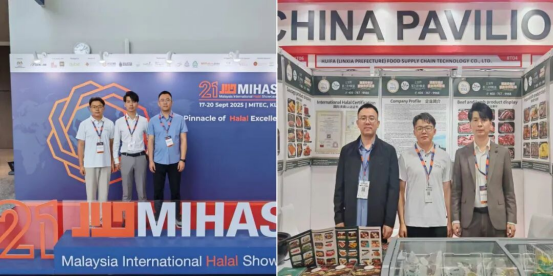
Core Insights - The 2025 Malaysia MIHAS exhibition successfully showcased the "Hezhou Flavor" brand by Shandong Huifa Food Co., Ltd., highlighting the innovation and market potential of Chinese food brands on an international stage [1][3]. Group 1: Exhibition Participation - The company participated in the exhibition with the theme "Let the World Love Hezhou Flavor," utilizing MIHAS as a global trade platform for market insights, customer engagement, and partner expansion [3]. - The company's booth received over 400 professional visitors and industry buyers from Southeast Asia, the Middle East, and Europe, establishing preliminary cooperation intentions with 18 high-quality potential clients, including international distributors and chain restaurants [3][5]. Group 2: Market Exploration - The exhibition served as a deep exploration of international markets, allowing the team to understand consumer preferences, trade policies, and industry trends in Southeast Asia, confirming the feasibility and development path for brand expansion [5]. - The company plans to systematically advance supply chain internationalization, product localization, and cross-cultural brand communication, steadily pushing forward its global strategic layout [5].
惠发食品(603536) - 惠发食品关于控股股东部分股份解除质押并继续质押的公告
2025-09-25 09:00
证券代码:603536 证券简称:惠发食品 公告编号:临 2025-032 山东惠发食品股份有限公司 关于控股股东部分股份解除质押并继续质押的公告 本公司董事会及全体董事保证本公告内容不存在任何虚假记载、误导性陈述或者重 大遗漏,并对其内容的真实性、准确性和完整性承担法律责任。 ●山东惠发食品股份有限公司(以下简称"公司"或"本公司")控股股东山东惠 发投资有限公司(以下简称"惠发投资")持有本公司股份 69,507,573 股,占公司总股 本的 28.41%。本次股份解除质押并继续质押后,惠发投资累计质押公司股份数量为 35,000,000 股,占其持股数量的 50.35%,占公司总股本的 14.31%。 3、股东累计质押股份情况 截至本公告披露日,控股股东惠发投资及其一致行动人惠增玉、惠希平累计质押股 ●惠发投资及其一致行动人惠增玉、惠希平合计持有公司股份 136,687,507 股,占 公司总股本的 55.87%。本次股份解除质押并继续质押后,惠发投资及其一致行动人累 计质押公司股份数量为 35,000,000 股,占其合计持股数量的 25.61%,占公司总股本的 14.31%。 一、本次股份解除质押情 ...
惠发食品:本次股份解除质押并继续质押后,惠发投资累计质押公司股份数量为3500万股
Mei Ri Jing Ji Xin Wen· 2025-09-25 08:56
Group 1 - The controlling shareholder of Huifa Food, Shandong Huifa Investment Co., Ltd., holds approximately 69.51 million shares, accounting for 28.41% of the total share capital [1] - After the release and subsequent pledge of shares, Huifa Investment has a total of 35 million shares pledged, which represents 50.35% of its holdings and 14.31% of the company's total share capital [1] - Huifa Investment and its concerted parties, Huizengyu and Huixiping, collectively hold about 137 million shares, making up 55.87% of the total share capital [1]
36氪精选:罗永浩大战贾国龙,预制菜闷声发大财
日经中文网· 2025-09-20 00:33
Core Viewpoint - The recent surge in stock prices of pre-prepared food companies in A-shares is attributed to the upcoming national food safety standards for pre-prepared dishes, which will provide a unified identity and safety baseline for the industry [12][13]. Industry Overview - The pre-prepared food industry in China has a history dating back to the 1990s, with significant developments occurring between 2000 and 2005 when many current leading companies were established [13]. - Regulatory frameworks for pre-prepared foods have only begun to take shape in recent years, with standards being introduced by various governmental bodies [13][14]. Market Dynamics - The stock prices of companies such as Deli Foods, Longda Food, and Huifa Foods have seen increases of over 5%, with Deli Foods hitting a 10.10% rise [7][11]. - The rise in stock prices is linked to the public's renewed interest in the pre-prepared food debate, sparked by recent comments from industry figures [12]. Consumer Perception - There is a disconnect between the regulatory definition of pre-prepared foods and consumer understanding, leading to concerns about food safety and transparency [14]. - Consumers express frustration over the lack of knowledge regarding the preparation of their meals, reflecting a deeper societal issue of time constraints and the desire for authentic dining experiences [14][17]. Operational Trends - The adoption of pre-prepared foods is becoming widespread among restaurants, as they are more cost-effective than hiring chefs and allow for a diverse menu without extensive culinary skills [16]. - The rise of central kitchens and cold chain logistics post-2008 has facilitated the expansion of pre-prepared foods, standardizing offerings across various dining establishments [16].



惠发食品跌2.02%,成交额4728.27万元,主力资金净流出104.38万元
Xin Lang Cai Jing· 2025-09-19 02:27
Core Viewpoint - Huhua Food's stock price has experienced a decline of 12.76% year-to-date, with a recent drop of 2.02% on September 19, 2023, indicating potential challenges in the market [1][2]. Company Overview - Huhua Food, established on February 2, 2005, and listed on June 13, 2017, is located in Zhucheng, Shandong Province. The company specializes in the research, production, and sales of frozen food products, including prepared dishes, meatballs, sausages, fried products, and skewers [2]. - The company's revenue composition includes: Supply Chain 34.76%, Meatballs 20.18%, Fried Products 15.20%, Chinese Dishes 9.46%, Sausages 8.43%, Skewers 6.26%, Other 3.27%, Materials and Others 1.77%, and Catering 0.66% [2]. Financial Performance - As of June 30, 2023, Huhua Food reported a total of 25,700 shareholders, a decrease of 0.61% from the previous period, with an average of 9,346 circulating shares per shareholder, an increase of 0.61% [3]. - For the first half of 2023, the company achieved a revenue of 735 million yuan, a year-on-year decrease of 17.75%, and a net profit attributable to shareholders of -29.99 million yuan, a decline of 82.54% year-on-year [3]. Stock Market Activity - Huhua Food's stock has seen a trading volume of 47.28 million yuan with a turnover rate of 1.91% as of September 19, 2023. The stock price was reported at 10.19 yuan per share [1]. - The stock has appeared on the "Dragon and Tiger List" once this year, with the most recent occurrence on March 5, 2023, where it recorded a net purchase of 2.65 million yuan [2].
再度被关注的预制菜,市场空间有多大
Di Yi Cai Jing· 2025-09-18 03:04
Core Viewpoint - The reliance of the restaurant industry on pre-prepared dishes is decreasing, as evidenced by the shift towards fresher, made-to-order food options among leading restaurant chains like Jiumaojiu Group's Taier Sour Fish [1] Group 1: Market Trends - The pre-prepared dish concept sector saw initial strength, with stocks like Delisi and Huifa Foods hitting the limit up, but later experienced a decline of 1.51% on September 17 [2] - Analysts suggest that the long-term trend for pre-prepared dishes remains positive due to increasing restaurant chain standardization, rising labor costs, and faster consumer lifestyles, indicating growth potential in both B2B and B2C markets [2][3] - The demand for pre-prepared products such as cleaned vegetables and processed seafood is rising among chain restaurants, driven by considerations of cost, supply chain stability, and safety [2][3] Group 2: Industry Dynamics - The increasing chain restaurant ratio, currently around 30%, is expected to drive growth in pre-prepared dishes, creating a mutually beneficial cycle between industry concentration and supply chain strength [3] - Unlike the cooling B2C market, B2B sectors like cleaned vegetables and seafood processing continue to expand their market share [4] - The pre-prepared dish industry is still in its early to mid-development stage, with a fragmented competitive landscape and a focus on B2B efficiency and standardization [4] Group 3: Investment Landscape - Several provinces have previously launched supportive policies for the pre-prepared dish industry, focusing on local agricultural products, but many face challenges in attracting investment [6] - Investment in the pre-prepared dish sector has seen a decline since 2022, with a notable drop in financing activity in 2023 and 2024 [7]
惠发食品跌2.04%,成交额6097.37万元,主力资金净流出194.73万元
Xin Lang Cai Jing· 2025-09-18 02:19
Group 1 - The core viewpoint of the news is that Huifa Food has experienced a decline in stock price and financial performance, with significant net outflows of capital and a decrease in revenue and profit [1][2]. - As of September 18, Huifa Food's stock price was 10.59 yuan per share, with a market capitalization of 2.591 billion yuan, and a year-to-date stock price decline of 9.33% [1]. - The company has seen a net capital outflow of 194.73 thousand yuan, with large orders showing a buy-sell imbalance [1]. Group 2 - Huifa Food, established on February 2, 2005, specializes in the research, production, and sales of frozen food products, including various types of pre-prepared dishes [2]. - The company's revenue composition includes 34.76% from supply chain, 20.18% from ball products, and 15.20% from fried products, among others [2]. - For the first half of 2025, Huifa Food reported a revenue of 735 million yuan, a year-on-year decrease of 17.75%, and a net profit loss of 29.9936 million yuan, down 82.54% year-on-year [2]. Group 3 - Since its A-share listing, Huifa Food has distributed a total of 73.8826 million yuan in dividends, with 4.8928 million yuan distributed in the last three years [3].