哑铃配置策略

Search documents
公募REITs2026年投资展望:攻守之道与价值掘金
Guoxin Securities· 2025-12-30 01:29
Group 1: Report's Investment Rating - Not provided in the document Group 2: Core Viewpoints - China's public REITs have shifted from pilot projects to normal development, with a steady expansion in issuance scale and continuous enrichment of asset types in recent years. In 2025, the issuance scale declined slightly, but new "first - order" projects broadened the REITs asset landscape [13]. - Since 2021, the subscription multiples of China's public REITs have shown significant fluctuations, driven by product scarcity, market sentiment, and expected returns of asset types. The secondary - market performance of REITs is between the CSI 300 and the CSI Aggregate Bond Index, with low correlation to other assets, suitable for balancing portfolio volatility [19][27]. - The holders of the current public REITs' floating shares are highly concentrated, dominated by institutional investors. Brokerage proprietary trading is the main force, followed by insurance funds and industrial capital. Different types of REITs show significant sectoral differentiation in their holder structures [2][28]. Group 3: Summary by Directory Market Review: From Valuation Fluctuation to Value Return Market Characteristics and Driving Factors - The issuance scale of public REITs in 2025 decreased compared to the previous high, but new asset types emerged. The subscription multiples fluctuated significantly from 2021 - 2025, and the secondary - market performance of REITs can be divided into six stages, with different reasons for each stage's performance [13][19][21]. - As of December 19, 2025, the CSI REITs Total Return Index had a year - to - date increase of +3.2%, significantly underperforming the CSI 300 and the CSI Convertible Bond Index, only better than the CSI Aggregate Bond Index. The main reasons include the shift of funds, the narrowing of the primary - secondary market spread, and the weak fundamentals of underlying assets [22]. Institutional Allocation Preference Differences - Brokerage proprietary trading, insurance funds, and industrial capital are the main holders of public REITs' floating shares, accounting for over 84%. Brokerage proprietary trading prefers assets with high liquidity and valuation elasticity, while insurance funds focus on assets with stable long - term cash flows. Individual and mutual fund investors' participation is limited [2][28][30]. - The number of REITs products allocated by public fund FOFs has been increasing, but the growth rate has slowed down. From the first to the third quarter of 2025, the allocation strategy of FOFs changed from diversified layout to concentrated addition of high - attention products [31][36]. Fundamental Analysis: Differentiated Performance of Asset Types - **Industrial Parks**: In 2025, the rental rate and rent level of industrial park REITs showed the characteristics of "intensified differentiation and supply - demand game". High - quality science and technology parks and core - location assets showed resilience, while some traditional industrial parks faced pressure [42]. - **Warehousing and Logistics**: In 2025, the operating income of warehousing and logistics REITs mostly showed a fluctuating downward trend. The rental rate was differentiated, with core assets showing strong anti - risk ability, and the rent level generally declined [46]. - **Consumption**: In 2025, consumption REITs showed significant differentiation. The rental rate remained stable at a high level, while the rent level was differentiated. Core - area and high - quality - operation commercial assets had strong anti - risk ability [51]. - **Affordable Housing**: The affordable housing REIT market showed strong operational resilience, with most REITs maintaining a high rental rate and stable rent level, indicating strong anti - risk ability of the housing sector [54]. - **Transportation**: The core driving logic of the transportation sector is the recovery of travel demand and the improvement of asset operation efficiency. The traffic volume and toll revenue showed significant differentiation among different REITs [57]. - **Ecological and Environmental Protection**: The two listed ecological and environmental protection REITs showed good performance in the third quarter of 2025, with an increase in waste treatment volume and sewage treatment volume [61]. - **Energy**: In 2025, except for Huaxia TBEA New Energy REIT, the revenue of other energy REITs declined significantly. The photovoltaic field performed well, while the wind power field was generally sluggish [63]. - **Municipal Utilities**: The heating area and charging area of Guotai Haitong Jinan Energy Heating REIT remained basically stable in 2025, but the heat - stop rate and charging rate decreased significantly in the third quarter [67]. - **Water Conservancy**: The operating income of YinHua Shaoxing Raw Water Water Conservancy REIT increased significantly in the third quarter of 2025, mainly due to the increase in the supply of raw water [69]. - **New Infrastructure**: The two new infrastructure REITs disclosed their operating income for the first time in the third quarter of 2025, and their trusteeship service fee collection rates were 100%, laying a good foundation for subsequent operations [71]. Investment Recommendations: Structural Opportunities under Policy Dividends and Asset Differentiation Primary Market: Select Projects in a Differentiated Market - Since this year, the enthusiasm for new REIT subscriptions has declined, and some REITs have broken their issue prices after listing. The return on new subscriptions has decreased due to the weak secondary - market performance and the narrowing of the primary - secondary market spread. Different asset types have shown differentiated performance, and it is recommended to focus on high - quality projects and be cautious about long - term strategic allocations [3][75]. Secondary Market: A Dumbbell Strategy for Offense and Defense - In asset allocation, public REITs can meet the investment needs of "idle funds + long - term holding". Appropriate allocation of REITs in the investment portfolio can improve the Sharpe ratio, but the allocation ratio should be moderate [77][78]. - In the future, there will be short - term local unlocking disturbances, with a peak in the first half of 2026. It is recommended to follow the "policy dividend + high - quality assets" principle, adopt a dumbbell strategy. On one hand, explore the stable dividend value of affordable housing and municipal environmental protection assets; on the other hand, lay out new infrastructure sectors such as data centers and clean energy. Also, seize the incremental opportunities brought by expansion [3][82].
ETF盘中资讯|机构:岁末年初银行有较高胜率,规模最大银行ETF(512800)红盘蓄力,标的股息率较无风险利率超额逾3%
Jin Rong Jie· 2025-12-25 03:16
Group 1 - The banking sector showed a slight recovery with most individual stocks rising, including a more than 2% increase in Ruifeng Bank and notable gains in Everbright Bank, CITIC Bank, and Shanghai Bank [1] - The largest bank ETF (512800) saw a price increase of 0.24%, surpassing the 5-day moving average [1] Group 2 - Institutions suggest focusing on structural opportunities for the year-end market, expecting a dual drive of "policy expectation and profit recovery verification," recommending a "barbell allocation strategy" for technology and high-dividend sectors [3] - High dividend stocks are anticipated to have a higher success rate at year-end due to investor preferences for profit realization and demand for dividends from insurance funds [3] - The banking sector has returned to a high cost-performance range after previous corrections, with a price-to-book ratio (PB) of only 0.7, placing it in the lower 41.29% percentile over the past decade, and a dividend yield of 4.95%, exceeding the 10-year government bond yield by over 3 percentage points [3] Group 3 - Pacific Securities indicates that the current low valuation of the banking sector and clear performance improvement trends suggest a high probability of a price increase [5] - Founder Securities expresses optimism about the recovery of the banking sector's fundamentals and the positive resonance with the funding environment, predicting improved revenue and profit for listed banks by 2026 [5] - The bank ETF (512800) and its linked funds are efficient investment tools tracking the overall banking sector, with the latest scale exceeding 13 billion and an average daily trading volume of over 800 million, making it the largest and most liquid among A-share bank ETFs [5]

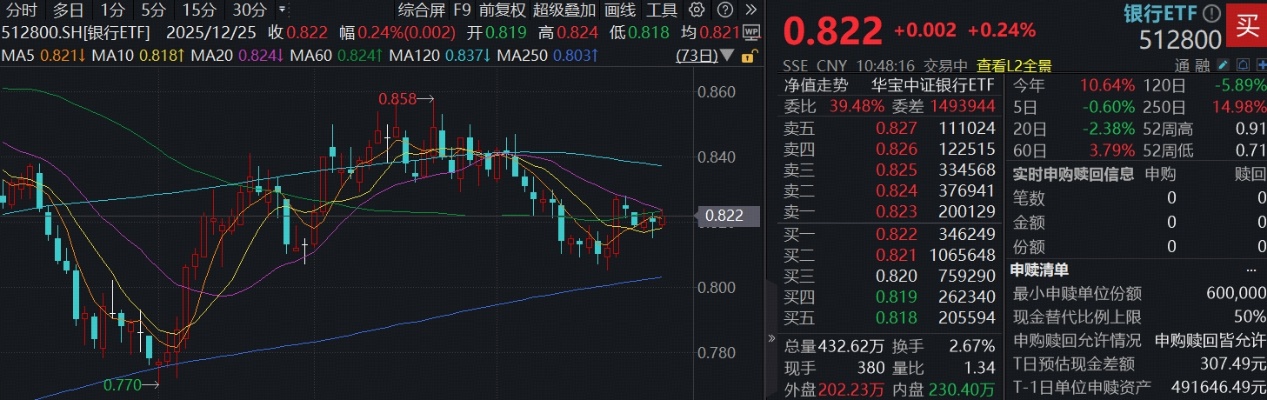
机构:岁末年初银行有较高胜率,规模最大银行ETF(512800)红盘蓄力,标的股息率较无风险利率超额逾3%
Xin Lang Cai Jing· 2025-12-25 03:02
Group 1 - The banking sector showed a slight recovery on December 25, with most individual stocks rising, including a more than 2% increase in Ruifeng Bank and notable gains in Everbright Bank, CITIC Bank, and Shanghai Bank [1][8] - The largest bank ETF (512800) in the market saw an increase of 0.24%, surpassing the 5-day moving average [1][8] - Institutions expect the market to focus on structural opportunities, driven by "policy expectations and profit recovery," suggesting a "barbell allocation strategy" for technology and high-dividend sectors [3][10] Group 2 - The banking sector has returned to a high cost-performance range after previous adjustments, with a price-to-book ratio (PB) of only 0.7, placing it in the lowest 41.29% percentile over the past decade [3][10] - The index's dividend yield reached 4.95%, exceeding the risk-free rate represented by the 10-year government bond yield of 1.84% by over 3 percentage points [3][10] - Pacific Securities noted that the current low valuation of the banking sector and clear trends of performance improvement suggest a high probability of a price rally [5][12] Group 3 - The bank ETF (512800) and its linked funds are efficient investment tools that passively track the CSI Bank Index, which includes 42 listed banks in A-shares [13] - The latest scale of the bank ETF exceeds 13 billion, with an average daily trading volume of over 800 million, making it the largest and most liquid among the 10 bank ETFs in A-shares [13]
最新规模突破新高!红利低波ETF泰康(560150)近10日“吸金”近3300万元,稳定分红的高息股备受市场关注
Xin Lang Cai Jing· 2025-08-11 05:53
Group 1 - The core viewpoint of the news highlights the performance and growth of the Dividend Low Volatility ETF Taikang (560150), which has seen significant inflows and a rise in its scale to 917 million yuan, marking a new high since its inception [1][2] - The Dividend Low Volatility ETF Taikang closely tracks the CSI Dividend Low Volatility Index, which selects 50 securities based on liquidity, continuous dividends, moderate dividend payout ratios, positive growth in earnings per share, and low volatility [2] - The ETF has experienced a substantial increase in shares, with a growth of 28 million shares in the past two weeks, and has attracted a total of 32.97 million yuan in inflows over the last ten trading days [1] Group 2 - The current market environment has led to a shift in investment strategies, with a focus on a "barbell strategy" that combines high-dividend defensive assets with high-growth sectors, reflecting a unique resilience in the market [1] - There is a noted divergence in market performance, with the banking sector reaching new highs while cyclical sectors like coal have adjusted, indicating a shift in the market's demand for high-dividend assets towards sustainability of earnings [2]
高股息和成长两手抓哑铃配置策略获资金青睐
Shang Hai Zheng Quan Bao· 2025-08-10 13:40
Group 1 - The "barbell allocation strategy" is gaining popularity among funds, focusing on both high-dividend defensive assets and high-growth sectors, showcasing resilience in the current market environment [2][3] - Over the past decade, the A-share market has experienced multiple barbell allocation trends, characterized by a focus on high dividends and low volatility on one end, and high growth on the other, adapting to economic cycles and industry trends [2] - In 2024, the barbell strategy is showing a new feature of "contraction at both ends," with the banking sector outperforming as a defensive anchor and a shift towards smaller tech stocks in the growth segment [2] Group 2 - In Q2 of this year, actively managed equity funds have also adopted a barbell structure, with a shift towards theme-based growth and large-cap value stocks [3] - The barbell allocation strategy remains favored by many institutions, recommending a mix of low-valuation, high-dividend blue-chip stocks for stability and high-growth sectors like AI and robotics for capturing structural opportunities [3] - Four investment opportunities are highlighted: stable cash flow and high-dividend sectors like telecommunications and finance, AI commercialization in the internet sector, growth in the biopharmaceutical industry, and potential recovery in the real estate chain [4]

宁波银行中报超预期,哑铃配置策略中上红低波投资机会凸显
Xin Lang Cai Jing· 2025-07-25 01:22
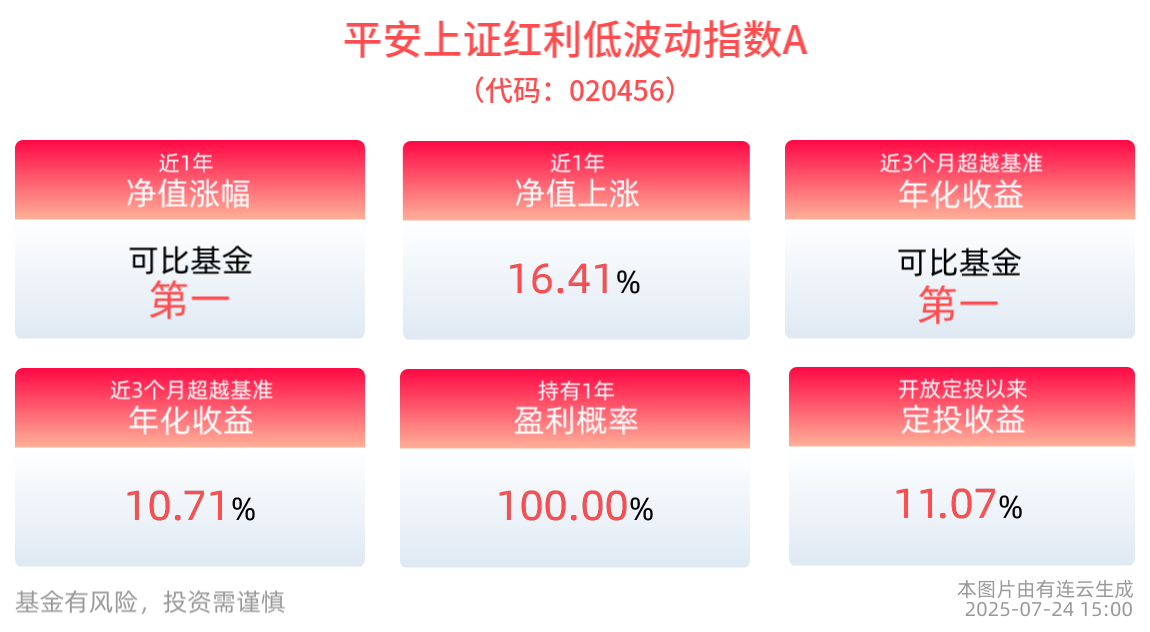
Core Viewpoint - Ningbo Bank's mid-year report shows a revenue growth rate of 7.9% and a profit growth rate of 8.2%, both improving by over 2% compared to Q1 2025, indicating a stable and positive overall performance [3] Financial Performance - Revenue and profit growth rates have improved quarter-on-quarter, with core Tier 1 capital also showing a quarter-on-quarter improvement [3] - The non-performing loan ratio remains stable, reflecting a solid financial position [3] - The bank has reversed the downward trend in provisions and the phenomenon of profit growth lagging behind revenue growth [3] Fund Performance - As of July 24, 2025, the Ping An SSE Dividend Low Volatility Index A Fund has seen a net inflow of 4.618 billion yuan over three of the last five trading days, averaging a daily net inflow of 924 million yuan [3] - The fund's financing net purchases reached 1.13 billion yuan in the past week, with a latest financing balance of 78.049 billion yuan [3] - The fund's trading congestion level is at 20.98%, lower than 79.02% historically, indicating less trading activity [3] Historical Returns - The Ping An SSE Dividend Low Volatility Index A Fund has a maximum monthly return of 11.16% since inception and an average monthly return of 3.98% [4] - The fund has a one-year Sharpe ratio of 1.15, ranking it in the top half among comparable funds [4] - The maximum drawdown for the fund this year is 5.35%, with a relative benchmark drawdown of 0.44% [4] Fund Management - The fund was established on April 23, 2024, and aims to minimize tracking deviation and error against its benchmark [5] - The current fund managers, Qian Jing and Bai Guiyao, have achieved a return of 14.96% since the fund's inception [5] - The fund's top ten holdings include companies like COSCO Shipping, Chengdu Bank, and Industrial Bank, accounting for a total of 17.41% of the fund [5][7]

西部利得港股通新机遇混合A:2025年第二季度利润53.96万元 净值增长率3.14%
Sou Hu Cai Jing· 2025-07-18 05:16
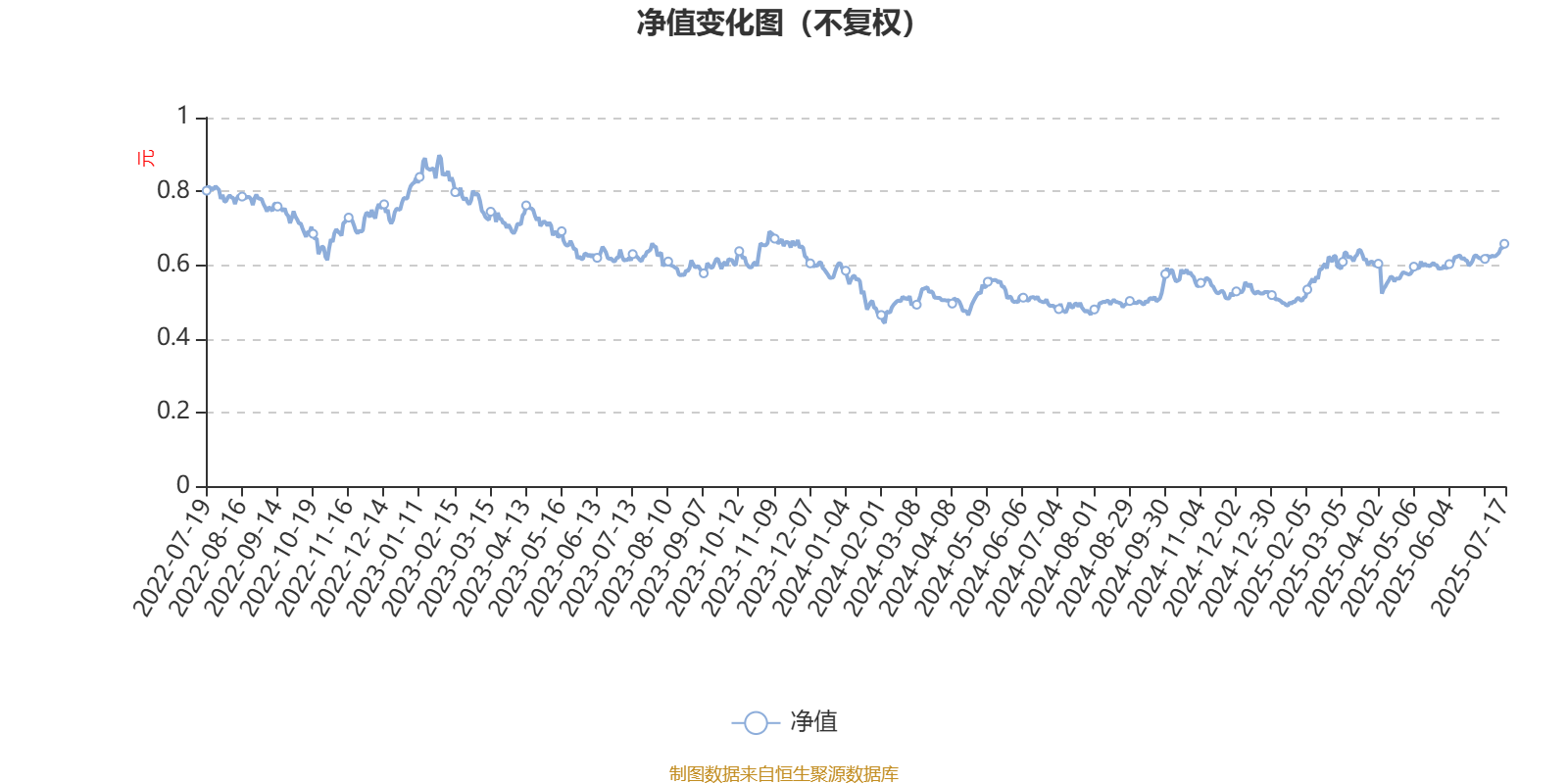
Core Viewpoint - The AI Fund Western Li De Hong Kong Stock Connect New Opportunities Mixed A (008861) reported a profit of 53.96 thousand yuan for Q2 2025, with a weighted average profit per fund share of 0.0189 yuan, and a net asset value growth rate of 3.14% during the period [2]. Fund Performance - As of July 17, the fund's unit net value was 0.658 yuan [2]. - The fund's scale reached 17.6493 million yuan as of the end of Q2 2025 [13]. - The fund's performance over various periods includes: - 3-month net value growth rate: 16.63%, ranking 129 out of 880 comparable funds [2]. - 6-month net value growth rate: 31.25%, ranking 22 out of 880 comparable funds [2]. - 1-year net value growth rate: 32.92%, ranking 124 out of 880 comparable funds [2]. - 3-year net value growth rate: -17.98%, ranking 575 out of 870 comparable funds [2]. Investment Strategy - The fund manager indicated a strategy of gradually realizing gains from technology, new energy vehicles, and consumer companies with reasonable valuations, while increasing positions in innovative pharmaceuticals with favorable policies and potential catalysts [2]. - The fund adopted a barbell strategy in the absence of a clear market direction, enhancing allocation to stable high-dividend assets [2]. Risk Metrics - The fund's 3-year Sharpe ratio was -0.0515, ranking 533 out of 874 comparable funds [7]. - The maximum drawdown over the past three years was 50.65%, ranking 97 out of 864 comparable funds, with the largest single-quarter drawdown occurring in Q1 2022 at 28.84% [9]. Portfolio Composition - The average stock position over the past three years was 81.24%, slightly above the comparable average of 80.33% [12]. - The fund's top ten holdings as of Q2 2025 included Tencent Holdings, Hong Kong Exchanges and Clearing, Alibaba-W, Kingdee International, China Mobile, HSBC Holdings, Xpeng Inc.-W, 3SBio, AIA Group, and BeiGene [16].



这类ETF领涨!有成分股连续涨停
Zhong Guo Zheng Quan Bao - Zhong Zheng Wang· 2025-07-07 12:43
Group 1: ETF Market Performance - Approximately 10% of over 1200 ETFs in the market saw gains, with power-related ETFs leading the charge, accounting for 8 out of the top 10 gainers [1] - The Power ETF (159611) topped the market with a 2.02% increase, and all 55 component stocks rose, including Huayin Power and YN Energy, which hit the daily limit [1] - As of July 4, the overall net inflow of funds into ETFs was about 1.36 billion yuan, with significant outflows from broad-based ETFs exceeding 6 billion yuan in the past week [1] Group 2: Sector-Specific ETF Trends - Innovation drug-related ETFs experienced a pullback, with 9 out of the top 10 decliners being in this category, some dropping over 2% [3] - The Huatai Baichuan Innovation Drug ETF (517120) fell by 2.21% after a previous week of over 5% gains, indicating volatility in this sector [4] - Funds favored Hong Kong technology-focused ETFs, with significant net inflows, particularly the Hong Kong Internet ETF (159792), which saw over 2 billion yuan in net inflow in the past week [6][7] Group 3: New ETF Launches - On July 7, 17 new ETFs were launched, including the first batch of 10 Sci-Tech Bond ETFs, which saw strong initial sales [11] - The Sci-Tech Bond ETFs are designed for institutional investors seeking exposure to technology innovation assets and for individual investors looking for stable returns [11]



超百只主动权益基金净值创新高
Zhong Guo Zheng Quan Bao· 2025-06-26 21:25
Core Viewpoint - A significant number of active equity funds are experiencing a performance turnaround, with over 180 funds reaching new historical net asset value highs as of June 25, driven by market uptrends and favorable external factors [1][2]. Group 1: Performance of Active Equity Funds - Over 180 active equity funds have achieved historical net asset value highs, with more than half of these funds established for over a year, and some for nearly 14 years [1][2]. - The fund with the highest increase is Jin Yuan Shun An Yuan Qi, which has risen over 450% since its inception in November 2017, primarily investing in small-cap stocks [2][3]. - Other notable funds include Guangfa Multi-Factor and Dacheng Jingheng, with increases of over 340% and nearly 300% respectively, focusing on quantitative investment strategies [2][3]. Group 2: Market Trends and Investment Strategies - Approximately 80% of active equity funds have seen positive performance this year, with around 1,100 funds increasing by over 10%, particularly those focused on Hong Kong stocks, pharmaceuticals, and technology [3][4]. - The highest-performing fund this year is Huatai-PB Hong Kong Advantage Selection, which has increased by over 90%, primarily investing in the Hong Kong pharmaceutical sector [4]. - Three main investment directions have gained consensus among institutions: innovative pharmaceuticals, technology, and dividend stocks, with a preference for a "barbell" strategy that balances aggressive and defensive investments [4][5]. Group 3: Future Outlook and Recommendations - Fund managers suggest focusing on high-potential international pharmaceutical companies and stable dividend assets, especially in a declining interest rate environment [5][6]. - The AI sector is highlighted as a key area for investment, with significant growth in AI applications and user engagement noted [6][7]. - Overall, there is optimism for the A-share market, with recommendations to prioritize stable dividend returns and sectors with strong industrial and policy catalysts [7].
午后突发!A股能否再度上攻?
天天基金网· 2025-06-26 12:03
Core Viewpoint - The A-share market experienced a pullback after a strong performance, with over 3,600 stocks declining, raising questions about future market direction and asset allocation strategies [2][5]. Market Performance - A-shares saw a significant drop after reaching new highs, with a total trading volume of 1.58 trillion yuan, while sectors like military, tourism, and banking showed resilience [4][5]. - The Hong Kong stock market also faced volatility, with Cathay Securities International's stock fluctuating from a 90% increase to a 4% decrease [6][9]. Influencing Factors - Geopolitical tensions, particularly concerning Iran, and the triggering of the weak-side convertibility guarantee for the Hong Kong dollar contributed to market caution [9][10]. - Analysts believe that the impact of the Hong Kong dollar's situation on the market is relatively limited, as the fundamentals of the Chinese economy remain strong [11]. Future Outlook - Analysts expect a potential upward trend in the A-share market, driven by the resilience of the domestic economy and the undervaluation of Chinese assets, which may attract foreign investment [5][11]. - The upcoming earnings reports in July are anticipated to be a critical point for market performance, with a focus on sectors that show signs of recovery [11]. Investment Strategies - Two main investment themes are highlighted: 1. Financial sectors like banks and insurance, which offer stability and high dividends, are seen as attractive for short-term and long-term investments [15]. 2. Sectors with strong growth potential, such as rare earths, precious metals, and machinery, are also recommended for investment [15]. - A "barbell strategy" is suggested for navigating market volatility, combining stable dividend stocks with sectors poised for recovery [16]. Conclusion - The current market environment is characterized as a "slow bull" phase, where investors are encouraged to remain patient and strategically allocate assets to capitalize on future opportunities [16][18].