Cambricon(688256)

Search documents
30家A股分拆上市,机构早已布局完毕!
Sou Hu Cai Jing· 2025-12-07 00:13
Group 1 - The core viewpoint of the article highlights the trend of companies in the A-share market pursuing spin-off listings, with 30 companies currently in line for this process, indicating a significant shift towards independent financing for subsidiaries [2][5] - Spin-offs allow parent companies to focus on their core business while providing subsidiaries with independent financing channels, which has attracted institutional investors who are quick to capitalize on policy changes [2][5] - The article emphasizes the information asymmetry in the market, where institutional investors have the advantage of early access to signals and trends, leaving retail investors at a disadvantage [2][3] Group 2 - The biggest risk in a bull market is not a downturn but missing out on opportunities, as many investors become overly cautious after experiencing bear markets [3][5] - Market consensus plays a crucial role in bull markets, where the value of assets is often driven by the collective agreement among institutional investors [5][6] - Understanding institutional behavior is essential for retail investors, as true market intentions are often hidden behind superficial trading patterns [6][8] Group 3 - The article provides examples of specific stocks, such as Cambrian and Tibet Tianlu, to illustrate how institutional activity can signal potential price movements and the importance of monitoring these trends [8][10] - Quantitative data can help retail investors visualize capital flows, providing insights that traditional technical analysis may miss [11][13] - The relationship between spin-off announcements and institutional accumulation of shares is highlighted, suggesting that retail investors can benefit from observing these patterns [13][14] Group 4 - Recommendations for retail investors include focusing on who is buying rather than what to buy, establishing a personal observation system, and maintaining patience and emotional control in investment decisions [14]





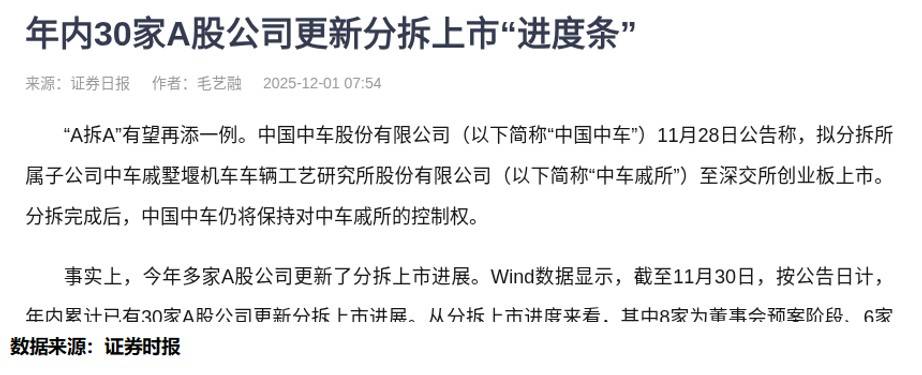
喜娜AI速递:今日财经热点要闻回顾|2025年12月6日
Xin Lang Cai Jing· 2025-12-06 11:19
Group 1: Netflix and Warner Bros Acquisition - Netflix announced the acquisition of Warner Bros. Discovery's film studio and streaming business for $82.7 billion, with a transaction price of $27.75 per share in cash and stock, expected to close in Q3 2026 [2][7] - The acquisition is anticipated to enhance Netflix's studio capabilities and expand production and investment, signaling a significant transformation in the entertainment industry [2][7] Group 2: Chinese Securities Industry - The chairman of the China Securities Regulatory Commission emphasized the need for securities firms to shift from scale-driven profit expansion to a function-first approach, focusing on serving the real economy and investors [2][7] - Concerns were raised regarding individual stock risks in December, including high valuation stocks, lock-up expirations, and shareholder reduction plans, which could impact stock prices [2][7] Group 3: GPU Industry and IPOs - The IPO process for the "Four Little Dragons" of domestic GPUs, including Moer Technology, Muxi Co., Suiruan Technology, and Birun Technology, is accelerating, with significant movements in financing and stock performance [3][8] - Over 30 A-share companies that are invested in "Zhiyu + Suiruan + Birun" have seen an average increase of over 45% this year, indicating strong institutional interest [3][8] Group 4: Currency and Economic Impact - The Chinese yuan has been rapidly appreciating, with expectations of breaking the 7.0 mark against the US dollar due to factors like Fed rate cut expectations and year-end corporate demand [3][8] - A potential decline in Chinese tourists to Japan could result in an economic loss of approximately ¥101.16 billion for Japan, impacting its GDP by 0.36% [3][9] Group 5: Rare Earth Exports - China has relaxed export restrictions on rare earth permanent magnets, leading to a positive response in related stocks and an increase in export efficiency [4][9] Group 6: Silver Market - Silver prices have been rising, with ETF holdings increasing significantly, indicating strong investor demand, and analysts predict prices could reach $62 per ounce in the next three months [4][9] Group 7: Semiconductor Company Developments - Cambrian Technologies issued a statement refuting false information circulating about its products and clients, while its third-quarter report showed significant growth driven by cloud product sales [5][10] - Multiple institutions have raised their price targets for Cambrian Technologies, indicating positive market sentiment [5][10] Group 8: Currency Swap Agreement - The People's Bank of China and the Monetary Authority of Macao expanded their currency swap agreement from 30 billion RMB/34 billion MOP to 50 billion RMB/57 billion MOP, aimed at enhancing financial stability and promoting RMB internationalization [5][10]




明年芯片产能提升3倍?寒武纪,紧急辟谣!
Sou Hu Cai Jing· 2025-12-05 15:40
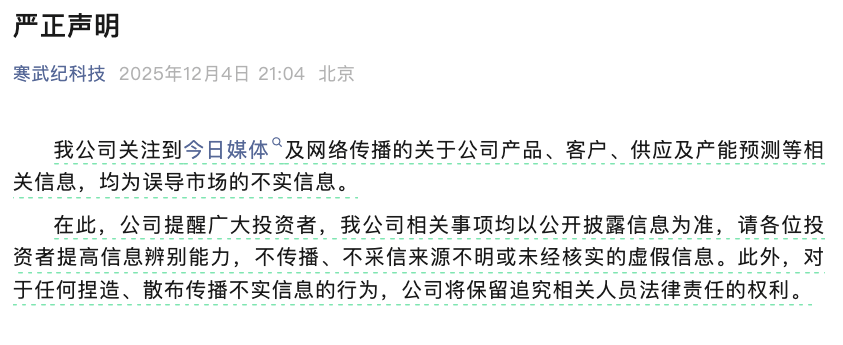
12月4日晚间,寒武纪发布严正声明称,公司关注到今日媒体及网络传播的关于公司产品、客户、供应及产能预测等相 关信息,均为误导市场的不实信息。 消息面上,当天早些时候,有外媒援引知情人士的话报道称, 寒武纪 计划明年将人工智能(AI)芯片产量提升逾三 倍,对标 华为 抢占市场份额,并填补因 英伟达 被迫退出而产生的市场空缺。 该报道还称, 寒武纪 计划在2026年交付50万个AI加速器,其中包括多达30万个其最先进的思元590和690晶片。据悉, 公司将主要通过 中芯国际 最新的7纳米"N+2"工艺生产晶片。 公开资料显示,中科寒武纪科技股份有限公司成立于2016年,,专注于人工智能芯片产品的研发与技术创新,致力于打 造人工智能领域的核心处理器芯片。2020年7月,公司在上交所科创板上市, 随着人工智能算力需求持续增长, 寒武纪 的 营收 和 净利润 也出现了爆发式增长。今年第三季度, 寒武纪 实现 营收 为17.27亿元,连续三个季度 营收 规模超过10亿元,同比增长1332.52%; 净利润 为5.67亿元,连续四个季度实现盈利。 寒武纪提醒广大投资者,公司相关事项均以公开披露信息为准,请各位投资者提高信息 ...
百度昆仑芯拟赴港上市 2024年营收超寒武纪、摩尔线程
Ju Chao Zi Xun· 2025-12-05 15:30
Core Viewpoint - Baidu's AI chip subsidiary, Kunlun Chip, has initiated preparations for an IPO in Hong Kong, aiming to submit its A1 form by Q1 2026 and complete the listing by early 2027, which has positively impacted Baidu's stock price [1][3]. Group 1: IPO Plans and Market Reaction - Kunlun Chip plans to submit its A1 form to the Hong Kong Stock Exchange by Q1 2026, with a target listing date in early 2027 [1]. - Following the news, Baidu's stock price rose nearly 8% during the day, closing at 121.6 HKD, with a market capitalization of approximately 334.4 billion HKD [1]. Group 2: Financial Performance and Projections - Kunlun Chip is projected to achieve revenues of approximately 2 billion CNY in 2024, with a net loss of 200 million CNY, surpassing the performance of previously listed companies in the same sector [3]. - Revenue is expected to increase to 3.5 billion CNY in 2025, with external orders accounting for over half of total revenue, indicating a potential path to breakeven [3]. Group 3: Product Development and Market Strategy - Kunlun Chip has successfully produced the P800 chip, which won a large-scale procurement order from China Mobile, targeting cloud inference and AI computing scenarios [3]. - The company plans to launch the M100 product in 2026, focusing on cost-effectiveness for large-scale inference, and the M300 in early 2027, aimed at training and inference for trillion-parameter multimodal models [3]. Group 4: Company Background and Ownership Structure - Kunlun Chip originated from Baidu's "Intelligent Chip and Architecture Department," with research starting in 2011 and achieving independent financing in 2021 [4]. - As of the latest funding round, Kunlun Chip's post-money valuation is approximately 21 billion CNY, with Baidu retaining about 59.45% ownership and new state-owned investors increasing external shareholder participation to over 40% [4].

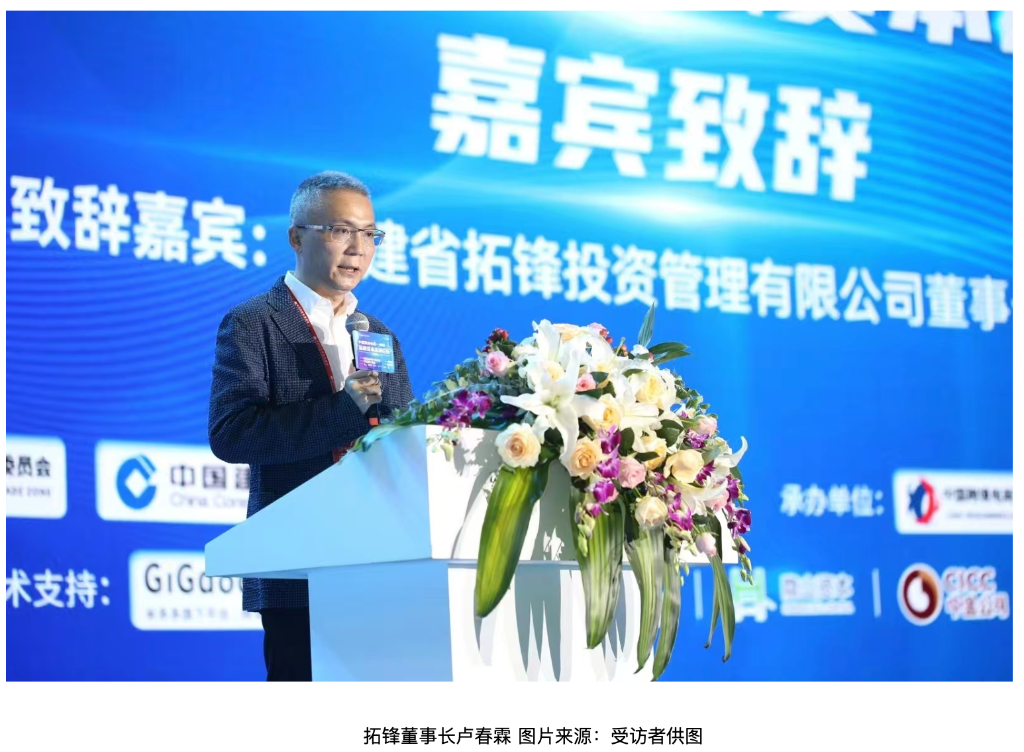
投资摩尔线程浮盈7倍,他为何敢下重注?拓锋董事长卢春霖:跟踪调研6个月,重点考察三方面
Mei Ri Jing Ji Xin Wen· 2025-12-05 13:49
Core Insights - The article highlights the significant investment success of Tuofeng Private Equity Fund Management Co., led by Lu Chunlin, particularly in the semiconductor sector, with a focus on companies like Moore Threads and Cambrian [1][5][19] - The investment strategy emphasizes long-term value creation and ecosystem integration rather than short-term financial returns [15][18] Investment Strategy - Tuofeng's investment in Moore Threads has yielded over 700% returns, showcasing the potential of domestic GPU companies in China [1][15] - The firm has established strategic partnerships with institutions like the Chinese Academy of Sciences to access cutting-edge technology and projects [6][8] - Lu Chunlin's approach involves a deep understanding of the semiconductor industry, focusing on various segments from chip design to hardware and AI applications [17][18] Market Context - The article discusses the changing landscape of China's capital market, particularly the shift from traditional financial metrics to a focus on technological innovation and ecosystem collaboration [5][15] - The semiconductor industry is viewed as a critical area for investment, with opportunities arising from the need to build a domestic supply chain and reduce reliance on foreign technology [19] Company Profiles - Moore Threads is highlighted as a key player in the GPU market, with a strong team and innovative technology that positions it well for future growth [10][12] - Other investments by Tuofeng include companies like Mu Xi Integrated Circuit and Qingwei Intelligent Technology, indicating a diversified approach within the semiconductor sector [16][18] Future Outlook - Lu Chunlin believes that the next 5 to 10 years will be a golden period for investment in the semiconductor supply chain, as China aims to establish its own ecosystem [19]
Chiplet概念板块领跌,下跌1.24%
Di Yi Cai Jing· 2025-12-05 13:35
Group 1 - The Chiplet sector experienced a decline of 1.24% [1] - Companies such as Saiwei Electronics fell by 3.14% [1] - Huahai Chengke decreased by 2.27% [1] - Runxin Technology dropped by 2.04% [1] - Cambricon saw a decline of over 2% [1]


【股市20251205】
债券笔记· 2025-12-05 12:54
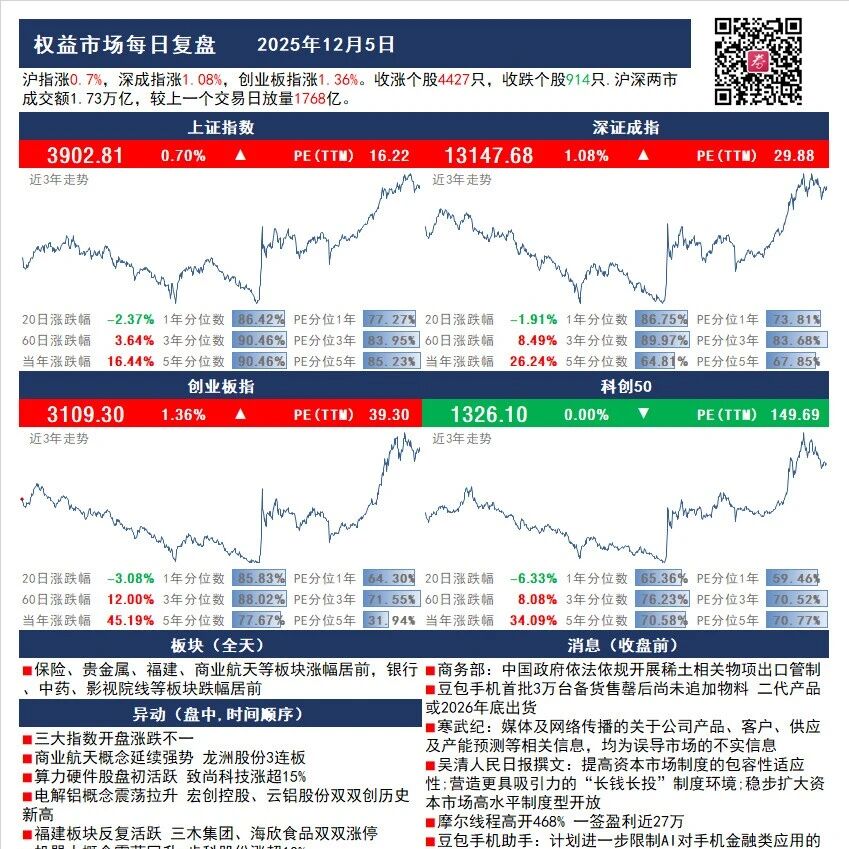
Market Overview - The Shanghai Composite Index rose by 0.7% to 3902.81, while the Shenzhen Component Index increased by 1.08% to 13147.68, and the ChiNext Index gained 1.36% to 3109.30 [1][2] - A total of 4427 stocks closed higher, while 914 stocks closed lower, indicating a positive market sentiment [1][3] - The trading volume in the Shanghai and Shenzhen markets reached 1.73 trillion, an increase of 176.8 billion compared to the previous trading day [1] Performance Metrics - The 20-day performance for the Shanghai Composite Index showed a decline of 2.37%, while the Shenzhen Component Index experienced a decrease of 1.91% [2] - The annual performance for the Shanghai Composite Index is up by 16.44%, and the Shenzhen Component Index has increased by 26.24% [2] - The ChiNext Index has seen a significant annual increase of 45.19% [2] Sector Performance - Sectors such as insurance, precious metals, and commercial aerospace showed strong gains, while traditional sectors like Chinese medicine and film exhibition faced declines [2] - The electric aluminum concept stocks experienced volatility, with companies like Hongchuang Holdings and Yun Aluminum reaching historical highs [2] - The robotics sector saw a rebound, with companies like Boke Technology rising over 10% [2] Notable Stock Movements - The stock of Moer Thread opened high with a 468% increase, leading to significant profits for investors [2] - Companies in the Fujian sector, such as Sanmu Group and Haixin Food, reached their daily limit [2] - The AI glasses concept saw a surge, with Doctor's Glasses rising over 10% [2] Market Sentiment - The overall market sentiment is improving, with a board sealing rate close to 80% [2] - The National Development and Reform Commission has allocated 35.5 billion for investment projects, indicating government support for economic growth [2]




寒武纪(688256) - 2025年第二次临时股东会会议资料
2025-12-05 09:45
中科寒武纪科技股份有限公司 2025 年第二次临时股东会会议资料 证券代码:688256 证券简称:寒武纪 中科寒武纪科技股份有限公司 2025 年第二次临时股东会会议资料 2025 年 12 月 | 2025 | 年第二次临时股东会会议须知 3 | | --- | --- | | 2025 | 年第二次临时股东会会议议程 6 | | 2025 | 年第二次临时股东会会议议案 8 | | | 议案一:关于使用公积金弥补亏损的议案 8 | 中科寒武纪科技股份有限公司 2025 年第二次临时股东会会议资料 2025 年第二次临时股东会会议须知 一、股东会设会务组,负责会议的组织工作,协调处理相关事宜。 二、为确认出席会议的股东或其代理人的出席资格,会议工作人员将对出席 会议者的身份进行必要的核对工作,请被核对者给予配合。出席会议的股东或其 代理人须在会议召开前 30 分钟到会议现场办理签到手续,并请按股东会登记方 法等有关规定出示有效身份证明文件或法人单位证明、授权委托书等。在会议主 持人宣布现场出席会议的股东和代理人人数及所持有表决权的股份总数之前,会 议登记应当终止。现场参会登记终止后出席的股东或其代理人,不 ...
百元股数量达153只,一日增加4只
Zheng Quan Shi Bao Wang· 2025-12-05 09:35
高价股一览 以最新收盘价计算,A股平均股价为13.69元,其中股价超过100元的有153只,相比上一个交易日增加4 只。 百元股作为判定市场热度的信号之一,历来受到投资者关注。证券时报·数据宝统计显示,截至12月5日 收盘,沪指报收3902.81点,上涨0.70%,A股平均股价为13.69元,个股股价分布看,股价超过100元的 有153只,股价在50元至100元的有421只,股价在30元至50元的有755只。 股价超百元个股中,收盘价最高的是贵州茅台,今日报收1430.01元,上涨0.42%,其次是寒武纪、C摩 尔等,最新收盘价分别为1355.00元、600.50元。 市场表现方面,收盘股价超百元股中,今日平均上涨4.20%,跑赢沪指3.50个百分点。今日上涨的有95 只,涨停的有中坚科技、长光华芯等,下跌的有56只,跌幅居前的有中科蓝讯、菲菱科思等。 追溯发现,最新百元股近一个月平均上涨1.80%,其间沪指下跌1.45%,涨幅居前的有长光华芯、天普 股份、常友科技等,涨幅分别为89.78%、54.98%、47.77%,今年以来平均涨幅为116.51%,强于沪指 100.07%,累计涨幅居前的有上纬新材、天普 ...

科创板平均股价40.31元,67股股价超百元
Zheng Quan Shi Bao Wang· 2025-12-05 09:07
以最新收盘价计算,科创板平均股价为40.31元,其中股价超100元的有67只,股价最高的是寒武纪-U。 证券时报·数据宝统计显示,科创板股今日上涨的有484只,下跌的有106只,以收盘价为基准测算,科 创板平均股价为40.31元,其中,收盘价超过100元的有67只,股价在50元至100元之间的有135只,股价 在30元至50元的有150只。 科创板股中,收盘价最高的是寒武纪-U,今日报收1355.00元,下跌1.02%,其次是C摩尔-U、源杰科技 等,最新收盘价分别为600.50元、598.90元。 科创板百元股中,今日平均上涨7.32%,具体来看,今日上涨的有33只,涨幅居前的有C摩尔-U、长光 华芯、步科股份等。下跌的有32只,跌幅居前的有中科蓝讯、东芯股份、影石创新等。 资金流向方面,科创板百元股今日主力资金合计净流入27.32亿元,净流入资金居前的有C摩尔-U、长光 华芯、国盾量子等,净流入资金分别为{6};净流出资金居前的有寒武纪-U、东芯股份、海光信息等, 净流出资金分别为44824.31万元、35631.58万元、21828.33万元。 融资融券方面,百元股最新(12月4日)融资余额合计926. ...