INNOCARE(688428)

Search documents
诺诚健华新型BCL2抑制剂Mesutoclax联合奥布替尼一线治疗CLL/SLL的注册性III期临床试验完成患者入组
Xin Lang Cai Jing· 2026-02-26 02:31
2月26日,诺诚健华宣布,公司自主研发的新型BCL2抑制剂mesutoclax(ICP-248) 联合BTK抑制剂奥 布替尼一线治疗慢性淋巴细胞白血病/小淋巴细胞淋巴瘤(CLL/SLL)的注册性III期临床试验已经完成 患者入组。 ...

跟着大资金选股!公募调仓科创板,猛攻电子、医药
市值风云· 2026-02-14 10:09
Core Viewpoint - The article discusses the current funding logic in the market, highlighting the significant movements of public funds in the technology sector, particularly in the semiconductor and biopharmaceutical industries, as they adjust their portfolios based on performance and valuation metrics [3][8]. Group 1: Public Fund Movements - Public funds have shown a notable shift in their holdings, particularly in the STAR Market, with the STAR 50 Index rising by 12.1% this year [3][4]. - The total market capitalization of STAR Market companies reached 10.4 trillion yuan, with the technology sector dominating, accounting for 62.1% of the total market cap [5][6]. - The semiconductor industry remains the core focus for fund allocation, with 12 companies in the sector having a market capitalization exceeding 10 billion yuan [9][11]. Group 2: Semiconductor Sector Insights - The market's pricing anchor for the semiconductor sector has shifted from "valuation expansion" to "performance realization," emphasizing the importance of actual earnings [13][14]. - Key drivers for future growth in the semiconductor sector include strong order backlogs, profit growth through acquisitions and expansions, and sustained price increases in advanced processes [13][14]. - Public funds have significantly increased their holdings in semiconductor materials, chip design, and equipment, with companies like ShenGong Co. seeing an 11% increase in fund holdings [15][21]. Group 3: Biopharmaceutical Sector Insights - The biopharmaceutical sector is a critical area for public funds, with major holdings in companies like BeiGene and United Imaging Healthcare, although the sector has faced a reduction in holdings for several key companies [24][26]. - The article notes that innovative drug companies are currently under pressure, with significant reductions in holdings observed in companies like BaiLi TianHeng and RongChang Biopharma [26][28]. - Despite the challenges, companies with strong earnings potential and innovative drug pipelines are still attracting interest from public funds, indicating a selective investment approach [35][40].





诺诚健华2026年临床研发与商业化关键节点梳理
Jing Ji Guan Cha Wang· 2026-02-14 02:54
经济观察网基于最新公开信息,诺诚健华-U(688428)在2026年有以下值得关注的事件进展,主要涉及临 床研发、合作推进和产品商业化等方面。 临床研发进展 ICP-488(高选择性TYK2抑制剂):2026年2月2日,公司宣布其治疗银屑病的III期临床试验已完成患者入 组,共入组383例患者,标志该药取得关键临床节点。 Soficitinib(TYK2抑制剂):2026年年初,治疗中重度特应性皮炎的III期注册临床试验已完成患者入组; 该药治疗白癜风、结节性痒疹等适应症的临床试验也在加速推进。 奥布替尼(BTK抑制剂): 可持续盈利基础:公司2025年首次实现扭亏为盈(营收约23.7亿元,归母净利润约6.3亿元),管理层表示 将从2025年起进入可持续盈利阶段,重点通过全球化布局和管线多元化巩固业绩。 以上内容基于公开资料整理,不构成投资建议。 治疗特发性血小板减少性紫癜(ITP)的III期临床研究已完成,预计2026年上半年提交新药上市申请 (NDA)。 治疗系统性红斑狼疮(SLE)的IIb期研究已达到主要终点,III期注册临床试验即将启动。 BCL2抑制剂(Mesutoclax/ICP-248):目前正 ...
大健康风向标〡跨越千亿美元门槛:中国分子站在全球化起点
Jing Ji Guan Cha Wang· 2026-02-13 07:06
Core Viewpoint - The keyword for the stock market in 2025 is expected to be "innovative drugs," with significant stock price increases driven by the potential of in-development innovative drugs and BD (business development) transactions rather than traditional revenue from already marketed drugs [1] Group 1: BD Transactions - In 2025, China's innovative drug BD transaction total exceeded $100 billion, with notable orders reaching $10 billion, and upfront payments from multinational pharmaceutical companies reaching a new high of $1.25 billion [1] - Landmark transactions include a $13 billion collaboration between Qihuang Dejian and Biohaven/AimedBio in January, marking a milestone for China's ADC technology [2] - In May, 3SBio's deal with Pfizer exceeded $6 billion, setting a record for upfront payments in China at $1.25 billion, highlighting the value of both first-in-class and fast-follow drugs [2] - In July, a $12 billion strategic partnership between Hengrui Medicine and GlaxoSmithKline showcased the depth of early-stage pipelines in leading Chinese pharmaceutical companies [2] - In October, Innovent Biologics and Takeda's collaboration worth $11.4 billion included a cost-sharing model for global R&D, enhancing operational capabilities for future international ventures [2] Group 2: Milestone Payments and Emerging Fields - Several past BD transactions reached milestone payments in 2025, including a $300 million payment to China National Pharmaceutical's subsidiary from Merck and a $250 million payment to Bairui Tianheng from Bristol-Myers Squibb [3] - The focus of BD transactions is shifting from oncology to other therapeutic areas, with autoimmune diseases, metabolism, and central nervous system disorders emerging as new hot fields [3] - Notable deals include the global rights licensing of BTK inhibitor Orelabrutinib for multiple sclerosis by Nocera Biopharma, with a potential total transaction value exceeding $2 billion [3] - The metabolic field is gaining traction, driven by global weight loss trends, with several companies entering into licensing agreements for GLP-1 targeted drugs [3] Group 3: Independent Clinical Trials and Regulatory Approvals - Numerous innovative drug companies in China are advancing their own overseas clinical trials, achieving significant progress [4] - In early 2025, Dize Pharmaceutical's lung cancer targeted drug received priority review from the FDA and was approved in July, becoming the first globally innovative drug independently developed in China to gain approval in the U.S. [4] - Other advancements include breakthrough therapy designations for CS0159 by Kexi Kedi and a Phase III trial approval for a recombinant human albumin injection by Heyuan Biopharma [4] - These developments indicate that the Chinese innovative drug industry is becoming a significant force in global innovation, transitioning from fast-following to original innovation and integrating deeply into the global value chain [4]



InnoCare Announces First Patient Dosed in the Phase II/III Clinical Trial of Novel TYK2 Inhibitor Soficitinib for Chronic Spontaneous Urticaria in China
Globenewswire· 2026-02-13 02:21
Core Viewpoint - InnoCare Pharma has initiated the Phase II/III clinical trial for its TYK2 inhibitor soficitinib, targeting chronic spontaneous urticaria (CSU), while also advancing trials for other autoimmune conditions [1][2]. Group 1: Clinical Trials and Development - The first patient has been dosed in the Phase II/III clinical trial of soficitinib for CSU [1]. - Patient enrollment is complete for the Phase III trial of soficitinib for moderate to severe atopic dermatitis and the Phase II trial for vitiligo [2]. - Clinical trials for soficitinib are also underway for psoriasis and nodular prurigo [2]. Group 2: Mechanism and Indications - Soficitinib is a selective TYK2 inhibitor aimed at treating T-cell related autoimmune disorders, with a focus on dermatological applications [3]. - The drug works by blocking signaling pathways related to cytokines that cause mast cell activation and inflammation, thereby alleviating symptoms of CSU [4]. Group 3: Market Potential and Patient Demographics - CSU affects approximately 50 million patients globally, with the treatment market projected to reach $3 billion by 2029 [6]. - The condition is characterized by recurrent wheals and itching, often lasting two to five years, necessitating long-term treatment strategies [5]. Group 4: Company Overview - InnoCare is a biopharmaceutical company focused on developing first-in-class and best-in-class drugs for cancer and autoimmune diseases, with operations in multiple cities in China and the United States [6].

2026年中国SHP2抑制剂行业政策、产业链、市场规模预测、竞争格局、代表企业及发展趋势研判:成为国内外多家药企争相布局的焦点,发展迅速[图]
Chan Ye Xin Xi Wang· 2026-02-12 01:21
Core Viewpoint - SHP2 inhibitors are emerging as a significant target for cancer treatment, with rapid development in the industry, particularly in China, which is becoming a notable player in the global market [1][6][9]. Industry Overview - SHP2, a protein tyrosine phosphatase, plays a crucial role in regulating various cellular functions, including growth, differentiation, and oncogenic transformation [2][6]. - The global market for SHP2 inhibitors is projected to start existing from 2027, reaching approximately $329 million by 2029, and is expected to grow to $4.821 billion by 2033 [1][7][9]. Market Size - The Chinese SHP2 inhibitor market is anticipated to grow to $206 million by 2029 and reach $784 million by 2033 [9][10]. Industry Chain - The SHP2 inhibitor industry chain includes upstream components such as protein reagents, specific antibodies, small molecule building blocks, testing kits, and experimental models; midstream involves drug research and production; downstream consists of large oncology specialty hospitals and comprehensive hospital oncology departments [11][12]. Development Environment - Recent policies in China have been implemented to encourage the pharmaceutical industry, particularly in the development and production of innovative drugs, including cancer therapies, by shortening clinical application and approval times [13][14]. Competitive Landscape - Major companies in the SHP2 inhibitor space include Innovent Biologics, CanSino Biologics, Junshi Biosciences, and others, with significant progress in developing SHP2 inhibitors, although no drugs have yet been approved for commercialization [15][16]. - Notable companies include: - **QinHao Pharmaceutical**: Focused on developing innovative candidates targeting the RAS signaling pathway, with its lead candidate GH21 in Phase II clinical trials [15][16]. - **Nuocheng Jianhua**: Known for its BTK inhibitor, it is also developing a new SHP2 inhibitor, ICP-189, in collaboration with ArriVent Biopharma [16][17]. Future Outlook - The SHP2 inhibitor sector is one of the hottest areas in pharmaceutical research, with significant advancements in the development of allosteric inhibitors and ongoing clinical trials showing promising results [17][18].


样本数量达580只 市值覆盖率超90% 科创综指打开观察新质生产力“新窗口”
Shang Hai Zheng Quan Bao· 2026-02-10 18:09
Group 1 - The Sci-Tech Innovation Board Composite Index (Sci-Tech Index) has been operating smoothly for one year since its official release on January 20, 2025, and has become a key tool for investors to observe and share the dividends of China's new productive forces [2] - As of February 10, 2025, the Sci-Tech Index covers 580 samples with a market capitalization coverage exceeding 90%, and the weight of constituent stocks with a total market value above 10 billion yuan has increased by 15.1% since its release [2] - The index has gained recognition among investors, with a total of 49 fund managers launching 81 index funds related to the Sci-Tech Index, achieving a combined scale of 25.8 billion yuan as of February 9, 2025 [4] Group 2 - The Sci-Tech Board has gathered over 600 companies, with the latest addition being the listing of Yuhang Power on February 10, 2025, marking it as the 603rd listed company [5] - The total R&D investment of Sci-Tech Board companies reached 132.864 billion yuan in the first three quarters of 2025, which is 2.7 times the net profit of the board, with a median R&D investment ratio of 12.5% of operating income, significantly higher than other A-share sectors [5] - As of February 9, 2025, 391 companies on the Sci-Tech Board have disclosed their expected performance for 2025, with over 60% of them reporting a year-on-year increase in net profit [6] Group 3 - The integrated circuit and biopharmaceutical industries are experiencing a recovery in prosperity, with 87 companies in the integrated circuit sector expected to see a combined net profit increase of approximately 9.949 billion yuan due to demand from emerging applications like artificial intelligence [7] - In the innovative drug sector, 26 companies are projected to increase their net profit by 1.449 billion yuan in 2025, with 18 companies reporting a total revenue of 24.157 billion yuan, reflecting a year-on-year growth of 34.9% [7]


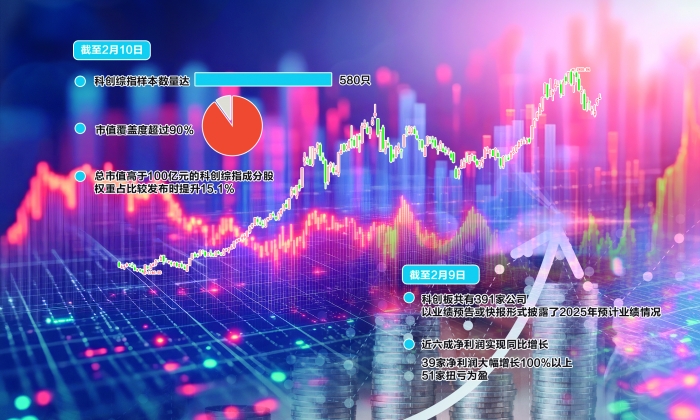
科创板迎第603家上市公司 科创综指成新质生产力观测“新坐标”
Xin Hua Cai Jing· 2026-02-10 14:32
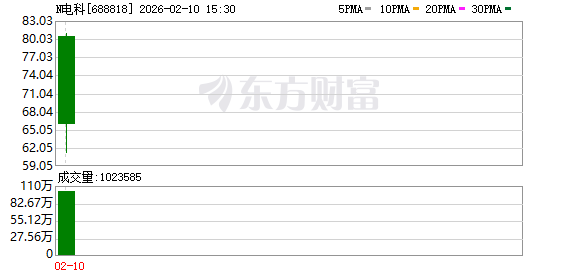
Core Insights - The Science and Technology Innovation Board (STAR Market) has welcomed a new company, Electric Science and Technology Blue Sky, bringing the total number of listed companies to 603, highlighting its role as a hub for "hard technology" enterprises in China [2] - The STAR Market Composite Index has gained significant attention, with a sample size of 580 stocks and a market capitalization coverage exceeding 90%, indicating a notable growth effect [2][3] - Nearly 60% of STAR Market companies have reported a year-on-year increase in net profit, with 39 companies experiencing a substantial growth of over 100% [3] STAR Market Overview - The STAR Market is characterized by a development pattern of "chain leader guidance and upstream-downstream collaboration," particularly in strategic emerging industries such as new-generation information technology, biomedicine, and high-end equipment manufacturing [2] - The STAR Market Composite Index has become one of the four core broad-based indices in A-shares, providing a vital tool for domestic and international investors to observe and share in the dividends of China's new productive forces [2] Performance and Growth - As of February 9, 2026, 391 companies on the STAR Market have disclosed their expected performance for 2025, with over 60% of them showing a year-on-year increase in net profit [3] - The total R&D investment of STAR Market companies reached 132.864 billion yuan in the first three quarters of 2025, which is 2.7 times the net profit of the sector, with a median R&D investment ratio of 12.5% of operating income, significantly higher than other A-share sectors [3] Reform and Development - The STAR Market has undergone three rounds of systematic reforms aimed at enhancing the inclusiveness and adaptability of the capital market, supporting various types of companies, including unprofitable and special equity structure enterprises [4] - Since the introduction of the "STAR Market Eight Articles," over 170 new merger and acquisition transactions have been recorded, totaling more than 90 billion yuan, with a transaction completion rate of nearly 70% [5] Index and Product Ecosystem - The STAR Market Composite Index has shown a steady upward trend since its launch, with an increase of approximately 63% as of February 10, 2026 [6] - A complete product chain has been established, including ETFs, linked funds, and enhanced products, with 49 fund managers launching a total of 81 STAR Market Composite Index funds, achieving a combined scale of 25.8 billion yuan [6]


ETF复盘资讯|创新药反弹还看港股!520880放量摸高近4%!字节Seedance2.0爆火出圈,科创AI、科创芯片连续上攻
Sou Hu Cai Jing· 2026-02-10 12:19
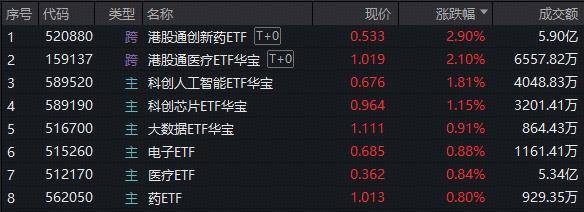
Market Overview - A-shares experienced narrow fluctuations, with the Sci-Tech Innovation Board showing strong performance, particularly in AI applications and computing chips [1] - The Hong Kong stock market saw a significant rebound in the pharmaceutical sector, with the Hong Kong Innovation Drug ETF (520880) reaching a peak increase of 3.86% and closing up 2.9% [3][5] ETF Performance - The Hong Kong Innovation Drug ETF (520880) recorded a trading volume of 5.9 billion, while the Hong Kong Medical ETF (159137) rose by 2.1%, marking its sixth consecutive day of gains [2][3] - The Sci-Tech Artificial Intelligence ETF (589520) increased by 1.81%, with a peak rise of over 2.4% during the trading session [8] Industry Insights - The Chinese innovative drug sector is experiencing a dual breakthrough in internationalization and commercialization, with over 70% of innovative drug companies reporting positive revenue growth [6][7] - Significant collaborations in the innovative drug space include a strategic partnership between Innovent Biologics and Eli Lilly, valued at up to $8.85 billion, and a $18.5 billion collaboration between CSPC Pharmaceutical and AstraZeneca [6] AI and Technology Developments - ByteDance's recent launches, including the Seedance 2.0 video generation model and Seedream 5.0 image generation model, have generated significant interest in the AI sector [11] - The Sci-Tech Artificial Intelligence ETF (589520) has a substantial exposure to ByteDance, with a weight of 29.42% in its index [11][13] Semiconductor and Chip Industry - The semiconductor equipment industry is experiencing an upward trend, with projected sales growth of 26% in 2026, reaching $791.7 billion [17] - The Sci-Tech Chip ETF (589190) is positioned to benefit from the ongoing "super cycle" in the semiconductor industry, with a focus on domestic production and expansion [15][17] Investment Strategy - Analysts suggest that the current market conditions present a favorable opportunity for investment in innovative drugs and AI sectors, with a recommendation to focus on ETFs that track these industries [7][19] - The Sci-Tech Chip ETF has shown a strong annualized return of 17.93%, outperforming other semiconductor indices [19][20]


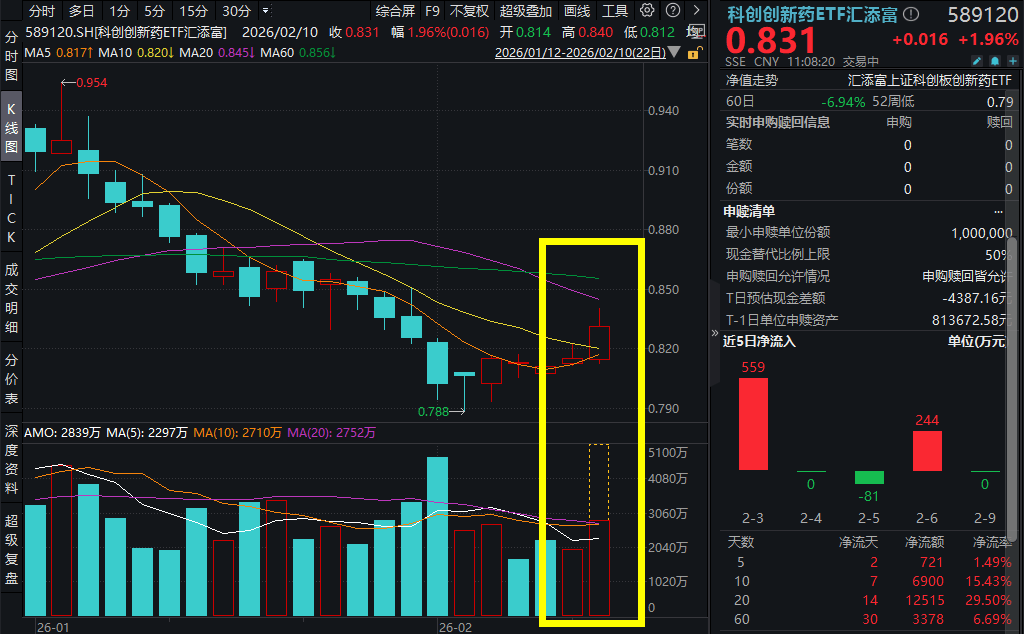
国内首款VAV1分子胶降解剂进入临床,诺诚健华涨超2%!科创创新药ETF汇添富(589120)爆量涨2%,冲击两连阳!重磅BD来袭,关注科创创新药主线
Sou Hu Cai Jing· 2026-02-10 04:05
Core Viewpoint - The A-share market is experiencing a strong upward trend, particularly in the innovative drug sector, with significant gains in the ChiNext Innovative Drug ETF [1][3]. Group 1: Market Performance - As of 11:08 on February 10, the ChiNext Innovative Drug ETF (589120) surged by 2%, marking a potential two-day consecutive rise [1]. - Major component stocks of the ETF, such as Rongchang Biopharma and Baili Tianheng, saw increases exceeding 5%, while others like Baijie Shenzhou rose over 4% [3]. Group 2: Key Component Stocks - The top ten component stocks of the ChiNext Innovative Drug ETF include: - J-Z**KD with a 4.04% increase and an estimated weight of 10.43% - Baili Tianheng with a 5.10% increase and an estimated weight of 7.89% - Rongchang Biopharma with a 5.51% increase and an estimated weight of 6.35% [4]. Group 3: Industry Developments - Innovent Biologics announced the approval of its ICP-538, a VAV1 molecular glue degrader, for clinical research, marking it as the first of its kind in China and the second globally [4]. - Baili Tianheng's recent shareholder meeting approved significant resolutions, including the issuance of debt financing tools and extending the validity of H-share issuance [5]. Group 4: Strategic Collaborations - Innovent Biologics entered a strategic partnership with Eli Lilly to advance the global development of innovative drugs in oncology and immunology, receiving an upfront payment of $350 million and potential milestone payments totaling up to $8.5 billion [5]. Group 5: Industry Growth and Trends - The Chinese innovative drug sector is transitioning from "pipeline expectations" to "performance realization," with over 70% of companies projected to achieve revenue growth by 2025 [8]. - The total value of License-out transactions for Chinese innovative drugs skyrocketed from $2.562 billion in 2017 to an estimated $140.274 billion by 2025, indicating a significant increase in global recognition [6]. Group 6: Investment Opportunities - Three key investment themes for 2026 in the innovative drug sector include: 1. Accelerated BD (Business Development) overseas, focusing on ADC, dual antibodies, and GLP-1RA [9]. 2. Policy support for innovative drug development, enhancing commercialization opportunities [9]. 3. Monitoring critical clinical data and commercialization milestones for new drugs [10].