
VeriSilicon(688521)

Search documents
计算机行业深度:国产ASIC:PD分离和超节点—ASIC系列研究之四
Shenwan Hongyuan Securities· 2025-09-29 01:54
Core Insights - The report highlights the significant advantages of ASIC over GPU in terms of cost-effectiveness and energy efficiency, marking a turning point for ASIC development [5][15] - The increasing penetration of AI is driving a surge in inference demand, expanding the market space for ASICs, with projections indicating the global AI ASIC market could reach $125 billion by 2028 [6][15] - The report emphasizes the importance of ASIC design service providers, noting that companies like Broadcom and Marvell hold significant market shares and are crucial for the successful deployment of ASIC technology [6][15] Summary by Sections Computer Industry Deep Dive - ASICs are specialized chips tightly coupled with downstream applications, focusing on specific needs like text and video inference, while GPUs are general-purpose [5][15] - ASICs demonstrate superior energy efficiency, with Google's TPU v5 showing 1.46 times the efficiency of NVIDIA's H200, and Amazon's Trainium2 reducing training costs by 40% compared to GPU solutions [5][15] - The demand for inference capabilities is expected to grow significantly, driven by applications like ChatGPT, which reached 700 million weekly active users by July 2025 [6][15] Market Trends - The report forecasts that the AI ASIC market will see substantial growth, with Broadcom estimating a serviceable market for large clients of $60-90 billion by 2027 [6][15] - Domestic cloud providers are increasingly investing in self-developed ASICs, with companies like Baidu and Alibaba making significant advancements in their chip development [15][16] - The report identifies two core trends in the development of domestic ASICs: PD separation and super nodes, which enhance performance and adaptability to diverse industry needs [15][16] Investment Recommendations - The report suggests focusing on companies with strong self-developed technology platforms in the small nucleic acid drug sector, highlighting firms like Rebio and Hengrui Medicine as potential investment opportunities [17] - It also recommends monitoring the performance of companies involved in the aluminum electronic materials sector, particularly Xinjiang Zhonghe, which is expected to benefit from its integrated supply chain and new alumina projects [18][20] - The report indicates that the data center industry, particularly companies like GDS Holdings, is poised for growth due to increasing demand for AI infrastructure and cloud services [21][23]




龚虹嘉“押中”千亿芯原股份
Huan Qiu Lao Hu Cai Jing· 2025-09-28 13:01
Core Viewpoint - Chip Origin Co., Ltd. has entered the "trillion" market value club, with a total market value reaching 994 billion yuan and a cumulative increase of over 660% since the "924" market rally [1][3] Company Performance - As of September 26, Chip Origin's stock price was 189.11 yuan, with a total market value of 994.2 billion yuan, reflecting a strong performance that has significantly benefited its investors [3] - The company has been experiencing losses, with net profits of -318.1 million yuan and -643.4 million yuan for 2023 and 2024 respectively, showing a year-on-year decrease of 2493.19% and 102.29% [8] - In the first half of 2025, the company achieved revenue of 974 million yuan, a slight increase of 4.49%, but still recorded a net loss of 358 million yuan, a year-on-year decrease of 17.58% [8] Shareholder Insights - The third-largest shareholder, Fucai Holdings, owned by Gong Hongjia, has seen its investment grow significantly since entering the company around 2018, with a current holding value of approximately 6.516 billion yuan [1][4][5] - Fucai Holdings has participated in multiple rounds of financing, contributing a total of 15.617 million USD and 32.441 million yuan to the company [5] Business Model - Chip Origin operates differently from traditional chip companies, focusing on providing customized chip services and semiconductor IP licensing without owning its own branded chip products [7][8] - The company is positioned as a "tool provider" for chip development, which has led to a unique market perception [8] Market Expectations - There are high expectations for Chip Origin's chip customization segment, with forecasts predicting revenue growth in the chip volume business to reach 1 billion yuan, 4 billion yuan, and 6 billion yuan from 2025 to 2027 [9] - The global demand for ASIC customization is expected to grow rapidly, with projections indicating a market size of 94 billion USD by 2028, driven by advancements in AI chip development [10] Order Backlog - As of the second quarter of 2025, Chip Origin had a total order backlog of 3.025 billion yuan, with nearly 90% attributed to chip customization orders [11] - The company signed new orders worth 1.205 billion yuan between July 1 and September 11, 2025, marking an 85.88% increase compared to the same period last year [11] Leadership and Expansion - The founder, Dai Weimin, has a strong academic and entrepreneurial background, having previously held a tenured professor position before founding Chip Origin [13][14] - The company is pursuing expansion through acquisitions, including a recent announcement to acquire a 97.007% stake in Chip Technology, a local RISC-V CPU IP provider, to enhance its capabilities in AI ASIC design [16]

摩尔线程上市!国产算力双雄共振!华为海思迎超级风口,算力国产替代的浪潮已不可阻挡!
Xin Lang Cai Jing· 2025-09-28 12:28
Core Insights - The article highlights the significant growth and opportunities within the semiconductor industry, particularly focusing on companies that are integral to the Huawei HiSilicon ecosystem, which is experiencing a surge in demand for advanced chips and related technologies. Group 1: Key Companies and Their Roles - Longi Technology (600584) is a global leader in packaging and testing, uniquely handling the 4nm Chiplet packaging for Huawei's Kirin X90 chip, which enhances chip performance by three times. The new automotive-grade chip factory is expected to contribute 5 billion yuan in annual revenue, solidifying its dominance in advanced packaging [1]. - Tuo Wei Information (002261) is a major player in the AI server market with over 30% market share, deeply involved in Huawei's AI innovation centers across key sectors. The company has server orders booked until Q1 2026, indicating strong revenue visibility [2]. - Shenzhen Huaqiang (000062) serves as a key distributor for Huawei's entire product line, with a 120% year-on-year increase in sales of the Ascend 910B chip. The company is positioned to benefit from the explosive growth in Huawei's chip shipments [3]. - Chipone Technology (688521) provides essential IP cores for Huawei's Kirin and Ascend AI chips, contributing an estimated 1.5 billion yuan to revenue in 2025, which is over 30% of its total revenue [4]. - Tongfu Microelectronics (002156) is a primary packaging and testing provider for Ascend chips, with a projected 50% growth in AI packaging orders by 2025, benefiting from the mass production of Huawei's Chiplet architecture [5]. Group 2: Emerging Technologies and Market Trends - Runhe Software (300339) is a dual ecosystem partner for HarmonyOS and HiSilicon, with over 40% market share in smart terminal OS adaptation. The company is leveraging its collaboration with Huawei to enhance its product offerings in smart home and vehicle networking [6]. - Zhongke Chuangda (300496) is a core player in automotive-grade solutions, providing algorithm optimization for Huawei's AI chips, with a 61.54% market share in global in-car infotainment systems [7]. - North Huachuang (002371) is a leading equipment supplier for semiconductor manufacturing, providing critical etching and ALD equipment, with 35% of its products compatible with 5nm technology [8]. - Huazheng New Materials (603186) has developed a breakthrough material that replaces traditional substrates, achieving a 45% annual growth in semiconductor materials revenue [9]. - Liyuan Information (300184) has been a long-time agent for Huawei's chips, with a projected net profit increase of 43%-65% in Q1 2025, benefiting from the growing demand in IoT and industrial control sectors [10]. Group 3: Strategic Collaborations and Future Prospects - Skyworth Digital (000810) is a pioneer in implementing Huawei's StarFlash technology, significantly reducing latency in smart home devices, with a projected 200% growth in related orders by 2025 [11]. - Megmeet (002881) is a benchmark partner for Huawei's 5G modules, with a 217% increase in revenue from the new energy vehicle sector, indicating strong growth potential in the 5G and vehicle networking markets [12]. - Guangdian Yuntong (002152) is a leader in financial technology solutions based on Huawei's Ascend chips, with a revenue visibility of 1 billion yuan for 2025, focusing on digital transformation in finance [13]. - Jing Sai Technology is a core supplier of crystal oscillators for Huawei's 5G base station chips, with a 15% revenue contribution from the new energy vehicle sector [14]. - Feirongda (300602) specializes in thermal management solutions for Huawei's chips, with a projected 120% growth in automotive business revenue in 2024 [15].




国产 ASIC:PD 分离和超节点:ASIC 系列研究之四
Shenwan Hongyuan Securities· 2025-09-26 13:28
Investment Rating - The report indicates a positive investment outlook for the ASIC industry, highlighting significant growth potential driven by increasing demand for AI applications and specialized chip designs [2]. Core Insights - The report emphasizes the distinct business models of ASIC and GPU, noting that ASICs are specialized chips tightly coupled with specific downstream applications, while GPUs are general-purpose chips [3][10]. - ASICs demonstrate superior cost-effectiveness and efficiency, with notable examples such as Google's TPU v5 achieving 1.46 times the energy efficiency of NVIDIA's H200, and Amazon's Trainium2 reducing training costs by 40% compared to GPU solutions [3][15]. - The report forecasts that the global AI ASIC market could reach $125 billion by 2028, with significant contributions from major players like Broadcom and Marvell [30]. Summary by Sections 1. AI Model Inference Driving ASIC Demand - The global AI chip market is projected to reach $500 billion by 2028-2030, with AI infrastructure spending expected to hit $3-4 trillion by 2030 [8]. - ASICs are recognized for their strong specialization, offering cost and efficiency advantages over GPUs, particularly in AI applications [9][14]. 2. High Complexity of ASIC Design and Value of Service Providers - ASIC design involves complex processes requiring specialized service providers, with Broadcom and Marvell being the leading companies in this space [41][42]. - The report highlights the importance of design service providers in optimizing performance and reducing time-to-market for ASIC products [55][60]. 3. Domestic Developments: Not Just Following Trends - Domestic cloud giants like Alibaba and Baidu have made significant strides in ASIC self-research, establishing independent ecosystems rather than merely following international trends [4][30]. - The report identifies key domestic design service providers such as Chipone, Aojie Technology, and Zhaoxin, which are well-positioned to benefit from the growing demand for ASICs [41]. 4. Key Trends in Domestic ASIC Development - The report identifies PD separation and supernode architectures as two core trends in domestic ASIC development, with companies like Huawei and Haiguang leading the way [4][30]. - These trends reflect a shift towards more flexible and efficient chip designs that cater to diverse industry needs [4]. 5. Valuation of Key Companies - The report includes a valuation table for key companies in the ASIC sector, indicating strong growth prospects and market positioning for firms like Broadcom and Marvell [5].



ASIC系列研究之四:国产ASIC:PD分离和超节点
Shenwan Hongyuan Securities· 2025-09-26 12:46
Investment Rating - The report maintains a positive outlook on the ASIC industry, indicating a favorable investment rating for the sector [2]. Core Insights - The report highlights the significant cost-effectiveness and efficiency advantages of ASICs over GPUs, particularly in the context of AI model inference, with Google's TPU v5 demonstrating an energy efficiency ratio 1.46 times that of NVIDIA's H200 [3][19]. - The increasing penetration of AI applications is driving a surge in inference demand, expanding the market for ASICs, with projections indicating the global AI ASIC market could reach $125 billion by 2028 [3][32]. - The report emphasizes the complexity of ASIC design, underscoring the critical role of design service providers like Broadcom and Marvell, which are expected to benefit from the growing demand for custom ASIC solutions [4][44]. Summary by Sections 1. Demand Driven by Large Model Inference - The global AI chip market is projected to reach $500 billion by 2028-2030, with significant growth in AI infrastructure spending anticipated [13]. - ASICs are specialized chips that offer strong cost and efficiency advantages, particularly in specific applications like text and video inference [14][19]. - The report notes that the demand for ASICs is expected to rise sharply due to the increasing consumption of tokens in AI applications, exemplified by the rapid growth of ChatGPT's user engagement [25][31]. 2. High Complexity of ASIC Design and Value of Service Providers - ASIC design involves a complex supply chain, with cloud vendors often relying on specialized design service providers for chip architecture and optimization [41][44]. - Broadcom's ASIC revenue is projected to exceed $12 billion in 2024, driven by the success of its TPU designs for Google and other clients [60]. - The report identifies the importance of a complete IP system and design experience as key factors for service providers to secure new orders in the ASIC market [63]. 3. Domestic Developments: Not Just Following Trends - Leading Chinese cloud providers like Alibaba and Baidu are making significant strides in self-developed ASICs, indicating a robust domestic ecosystem [3][4]. - The report highlights the emergence of domestic design service providers such as Chipone and Aowei Technology, which are positioned to capitalize on the growing demand for ASICs [3][4]. - The trends of PD separation and supernodes are identified as critical developments in the domestic ASIC landscape, with companies like Huawei and Haiguang leading the way [4][44]. 4. Key Trends in Domestic ASIC Development - PD separation involves using different chips for prefill and decode tasks, enhancing efficiency in specific applications [4]. - Supernodes are being developed to create unified computing systems through high-bandwidth interconnections, with early implementations seen in domestic companies [4][44].



科创芯片ETF(588200)开盘跌1.00%,重仓股中芯国际跌1.04%,海光信息跌1.83%
Xin Lang Cai Jing· 2025-09-26 03:34
Core Viewpoint - The Sci-Tech Chip ETF (588200) opened with a decline of 1.00%, indicating a downward trend in the semiconductor sector [1] Group 1: ETF Performance - The Sci-Tech Chip ETF (588200) opened at 2.470 yuan, reflecting a decrease of 1.00% [1] - Since its establishment on September 30, 2022, the ETF has achieved a return of 150.11% [1] - The ETF's return over the past month is reported at 18.87% [1] Group 2: Major Holdings Performance - Key holdings in the ETF include: - SMIC (中芯国际) down 1.04% [1] - Haiguang Information (海光信息) down 1.83% [1] - Cambricon (寒武纪) down 1.56% [1] - Lattice Technology (澜起科技) down 0.73% [1] - Zhongwei Company (中微公司) down 1.04% [1] - Chipone (芯原股份) down 2.70% [1] - Hu Silicon Industry (沪硅产业) down 1.66% [1] - Hengxuan Technology (恒玄科技) down 0.35% [1] - Sitaiwei (思特威) down 0.86% [1] - Huahai Qingke (华海清科) down 0.10% [1] Group 3: Management Information - The ETF is managed by Harvest Fund Management Co., Ltd. [1] - The fund manager is Tian Guangyuan [1]

芯原股份股价跌5.18%,国联基金旗下1只基金重仓,持有3300股浮亏损失3.46万元
Xin Lang Cai Jing· 2025-09-26 02:33
Group 1 - The core point of the news is that Chip Origin Technology Co., Ltd. experienced a 5.18% drop in stock price, closing at 192.00 CNY per share, with a trading volume of 1.55 billion CNY and a turnover rate of 1.58%, resulting in a total market capitalization of 100.937 billion CNY [1] - Chip Origin Technology, established on August 21, 2001, and listed on August 18, 2020, is based in the China (Shanghai) Pilot Free Trade Zone and specializes in providing platform-based, comprehensive, and one-stop chip customization services and semiconductor IP licensing services [1] - The company's main business revenue composition includes: 41.85% from chip volume business, 28.81% from intellectual property licensing fees, 23.83% from chip design business, 5.21% from royalties, and 0.29% from other sources [1] Group 2 - From the perspective of major fund holdings, only one fund under Guolian Fund holds shares in Chip Origin Technology, specifically the Guolian CSI 500 ETF (515550), which held 3,300 shares in the second quarter, accounting for 0.44% of the fund's net value, ranking as the eighth largest holding [2] - The Guolian CSI 500 ETF (515550) was established on November 15, 2019, with a latest scale of 72.7548 million CNY, achieving a year-to-date return of 28.98%, ranking 1885 out of 4220 in its category, and a one-year return of 55.37%, ranking 1621 out of 3824 [2] Group 3 - The fund managers of Guolian CSI 500 ETF (515550) are Chen Xinyu and Du Chao, with Chen having a tenure of 6 years and 59 days, managing a total fund size of 1.216 billion CNY, achieving a best return of 63% and a worst return of -19.21% during his tenure [3] - Du Chao has a tenure of 1 year and 343 days, managing a total fund size of 2.467 billion CNY, with a best return of 56.95% and a worst return of -14.54% during his tenure [3]
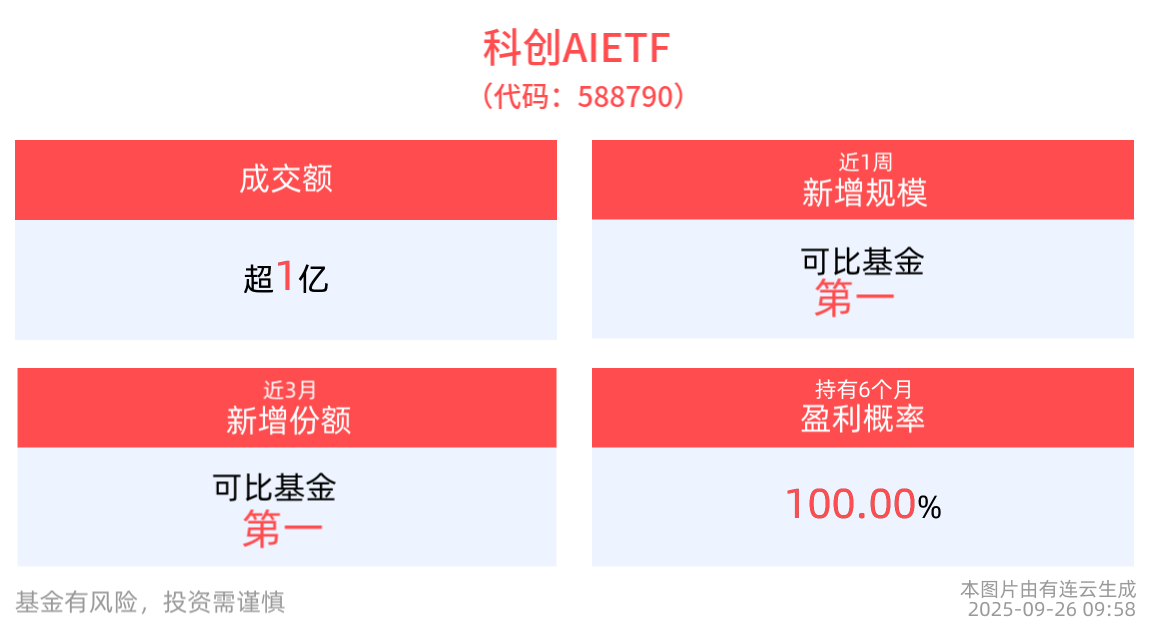
以AI重构供应链,京东发布大模型落地成果,科创AIETF(588790)回调超1%
Xin Lang Cai Jing· 2025-09-26 02:22
Core Insights - The overall AI penetration rate in China remains relatively low, indicating significant growth potential for the industry as policies are implemented and model capabilities continue to evolve [5] - The current market focus is on AI-related hardware, with a lack of explosive products and clear business models in the downstream applications, leading to insufficient visibility in company performance [5] - The Sci-Tech Innovation AI ETF (588790) has shown significant growth in both scale and shares, reflecting strong investor interest in the AI sector [6][6] Event Updates - JD.com has entered the "mass production phase" of AI applications, launching three major AI products and showcasing four application scenarios at its global technology conference [4] - China has added three U.S. companies to its export control list and another three to its unreliable entity list, indicating ongoing regulatory tensions [4] ETF Performance - The Sci-Tech Innovation AI ETF has seen a recent decline of 1.72%, with a weekly increase of 4.19% as of September 25, 2025 [3] - The ETF has a turnover rate of 2.43% and a transaction volume of 171 million yuan, ranking first among comparable funds in terms of average monthly trading volume [3] Industry Developments - Over 70% of China's energy state-owned enterprises have integrated Alibaba's AI technology, covering a wide range of sectors including electricity, oil, and coal [4] - Intel showcased its next-generation Xeon processors at the 2025 Cloud Summit, utilizing new manufacturing processes and advanced packaging technologies to enhance performance and efficiency [4] Market Composition - The top ten weighted stocks in the Sci-Tech Innovation AI Index account for 71.66% of the index, with companies like Cambricon and Lanke Technology leading the list [7] - The ETF closely tracks the Sci-Tech Innovation AI Index, which includes 30 large-cap companies providing essential resources and technology for the AI industry [6]


半导体甩掉了渣男外号
Datayes· 2025-09-24 12:24
Market Performance - A-shares have achieved remarkable results over the past year, with the Shanghai Composite Index up over 40%, the Shenzhen Component Index up over 65%, the ChiNext Index up over 108%, and the STAR Market 50 Index up 126.5% [1] - The market showed a positive trend today, with the Shanghai Composite Index rising 0.83%, the Shenzhen Component Index rising 1.80%, and the ChiNext Index rising 2.28% [16] Semiconductor Industry - In August, China's semiconductor production equipment (SPE) imports reached $2.6 billion, a year-on-year increase of 12%, but a month-on-month decrease of 22% [5][7] - Year-to-date, SPE imports have totaled $21.2 billion, reflecting a 3% year-on-year growth, with a 1 percentage point improvement in growth rate compared to the first seven months [5] - The strong growth in import demand is primarily driven by lithography equipment, which saw a year-on-year increase of 55% [6] - Shanghai's import demand remains robust, with a year-on-year increase of 132%, indicating ongoing expansion in 28nm and below logic chip production capacity [6] Corporate Developments - Alibaba's stock surged by 9%, with positive statements from executives regarding token usage and a significant investment plan of RMB 380 billion over the next three years [13] - Alibaba announced a collaboration with NVIDIA on Physical AI, covering various aspects including data processing and model training [13] Digital Consumption - The Ministry of Commerce and other departments issued guidelines to promote digital consumption, focusing on smart connected vehicles and the development of new consumer brands [20] Building Materials - Six departments issued a work plan for the building materials industry, emphasizing strict control over cement and glass production capacity [21] Gaming Industry - The National Press and Publication Administration approved 11 imported games in September, including "Cosmic Robot" [22] Financial Sector - The number of securities analysts has exceeded 6,100, marking a new high [23] - The Ministry of Finance and other departments released policies to support service exports, including 13 specific measures [23] Stock Market Trends - The electronic industry saw the largest net inflow of funds today, with Northbound funds totaling 28.6 billion yuan [26] - The market is experiencing a surge in interest in semiconductor-related stocks, with multiple companies in the sector showing strong performance [16][17]



科创50ETF指数(588040)涨超1.7%,半导体设备领涨市场
Xin Lang Cai Jing· 2025-09-24 02:59
Group 1 - The Shanghai Stock Exchange Sci-Tech Innovation Board 50 Index (000688) has seen a strong increase of 1.74%, with notable gains from component stocks such as Shengmei Shanghai (688082) up 9.99%, Huahai Qingshi (688120) up 7.10%, and Hehui Optoelectronics (688538) up 7.04% [1] - The Sci-Tech 50 ETF Index (588040) also rose by 1.74%, with the latest price reported at 1.46 yuan [1] - Semiconductor equipment is leading the market, with Shengmei Shanghai reaching a new high following the announcement of its first KrF process front-end coating and developing equipment, Ultra Lith KrF, which was delivered to a major logic wafer factory in China on September 8, 2025 [1] Group 2 - The Sci-Tech 50 ETF Index closely tracks the performance of the Sci-Tech Innovation Board 50 Index, which consists of 50 securities with large market capitalization and good liquidity, reflecting the overall performance of representative sci-tech enterprises [2] - As of August 29, 2025, the top ten weighted stocks in the Sci-Tech Innovation Board 50 Index include Cambricon (688256), SMIC (688981), Haiguang Information (688041), and others, collectively accounting for 60.25% of the index [2] - The Sci-Tech 50 ETF Index is complemented by other products such as the Sci-Tech 50 Enhanced ETF (588460) and various connection funds [2]


