
SMIC(688981)

Search documents
电子行业周报:I应用爆点频出,算力链重回主线
Guoxin Securities· 2026-02-04 02:50
证券研究报告 | 2026年02月02日 2026年02月03日 2026年02月04日 电子行业周报 优于大市 AI 应用爆点频出,算力链重回主线 AI 应用爆点频出,海外算力链重回主线。过去一周上证下跌 0.44%,电子下 跌 2.51%,子行业中半导体下跌 0.90%,电子化学品下跌 5.87%。同期恒生科 技、费城半导体、台湾资讯科技下跌 1.38%、上涨 0.51%、上涨 0.55%。过去 一周,由 Clawdbot 所引致的对于"AI 智能体正加速场景落地"的预期成为 市场热点,同时,国内互联网大厂陆续启动"红包大战"争抢大模型流量入 口。在此背景下,算力资源不单单成为军备竞赛的着力点,更是在各类 AI 应用试水过程中逐步成为"卖方型市场",成为 AI 应用的核心预算约束, 算力链有望在强业绩支撑下重回科技投资主线,继续推荐:澜起科技、胜宏 科技、工业富联、蓝特光学、德明利、华勤技术、翱捷科技、芯原股份、寒 武纪、中芯国际、晶丰明源等。 海外原厂业绩保持强劲,建议关注存储产业链相关公司。存储周期持续上行, 原厂业绩保持强劲:AI 驱动企业级 SSD 量价齐升,闪迪 2QFY26 营收环比增 长 3 ...


国内外AI年报分析展望




2026-02-04 02:27
Summary of the Conference Call on AI Annual Report Analysis Industry Overview - The conference focused on the analysis and outlook of AI annual reports, particularly in the TMT (Technology, Media, and Telecommunications) sector, with a specific emphasis on domestic and international AI companies [1][2][4]. Key Points and Arguments General Market Sentiment - The period from October 31 to March is characterized as a performance vacuum, where the focus is on thematic investments rather than immediate earnings results [2][3]. - The spring market is expected to see a resurgence, with significant activity anticipated around March [3][4]. North American Companies - North American companies, particularly those involved in AI and cloud computing, have reported earnings that exceeded expectations, indicating strong capital expenditure in AI [4][6]. - Companies like Microsoft and Meta have shown robust spending on AI infrastructure, reflecting a positive outlook for the sector [4][6]. - Despite some domestic companies underperforming, their stock prices have rebounded, suggesting that market sentiment is more focused on thematic trends rather than immediate earnings [5][6]. Domestic AI Companies - Domestic AI companies are experiencing a supply-demand imbalance, with strong demand for AI-related products and services, despite some companies reporting earnings below expectations [6][7]. - The industry is characterized by a shortage of materials and components, which is driving prices up and creating a favorable environment for growth [6][7][10]. Future Growth Projections - There is a consensus that the growth trajectory for AI companies will continue to be strong, with expectations for significant growth in 2026 and beyond [8][9]. - Many companies are currently undervalued, trading at price-to-earnings (P/E) ratios between 15x to 20x, which presents a potential investment opportunity [8][9]. Specific Company Insights - Companies like Wan, Tianfu Communication, and others are highlighted for their potential despite recent earnings misses, as the overall industry outlook remains positive [4][6][7]. - The demand for GPUs and AI chips is expected to remain high, with domestic companies like Cambrian facing challenges but still showing potential for recovery [9][10]. Application and Innovation - The conference emphasized the importance of AI applications, particularly in gaming and media, with companies like Tencent and ByteDance leading the charge [14][15]. - The emergence of AI-driven applications is seen as a significant growth area, with expectations for increased investment and innovation in this space [14][15]. Regulatory and Market Concerns - There are concerns regarding potential regulatory impacts on the gaming industry, but these are largely viewed as unfounded and not likely to affect the overall market significantly [15][16]. - The market is currently experiencing volatility, but analysts suggest that this presents buying opportunities for fundamentally strong companies [21][22]. Additional Important Insights - The conference highlighted the importance of monitoring capital expenditure trends among major tech companies, as this will influence the demand for AI infrastructure and services [36][37]. - The potential for new technologies, such as diamond-based cooling materials for semiconductors, was discussed as a future growth area [24][25]. - Analysts recommend focusing on companies with strong fundamentals and growth potential, particularly in the AI and semiconductor sectors, as the market continues to evolve [22][23][39].
电子行业周报:AI 应用爆点频出,算力链重回主线-20260204
Guoxin Securities· 2026-02-04 01:56
Investment Rating - The report maintains an "Outperform" rating for the electronic industry [1][11]. Core Insights - AI applications are rapidly emerging, with the computing power chain returning to the main investment focus. The market is witnessing a "seller's market" for computing resources, driven by the increasing demand for AI applications [1]. - The storage cycle is on an upward trend, with strong performance from overseas manufacturers. Companies like SanDisk and Samsung have reported significant revenue growth, driven by AI demand [2]. - Texas Instruments (TI) anticipates a median revenue increase in Q1 2026, supported by a continuous rise in order volume, particularly in the industrial and data center markets [3]. - Apple reported record quarterly performance, with revenues exceeding market expectations, particularly in the iPhone segment, which saw a 23% year-over-year increase [4]. - Global wafer expansion is entering an upward cycle, with ASML and LAM Research exceeding expectations in their quarterly performances, indicating a strong demand driven by AI [5]. Summary by Sections Electronic Industry Overview - The electronic industry experienced a decline of 2.51% in the past week, with semiconductors down 0.90% and electronic chemicals down 5.87% [12]. Semiconductor Sector - Companies such as Zhongxin International, Aojie Technology, and Demingli are recommended for investment due to their strong performance and growth potential in the semiconductor sector [11]. Storage Industry - The storage cycle is strengthening, with companies like Demingli and Jiangbolong showing significant revenue growth, driven by AI and data center demands [2]. Consumer Electronics - Apple’s revenue reached $143.76 billion in Q4 2025, with a 16% year-over-year increase, driven by strong iPhone sales and services [4]. Equipment and Materials - ASML and LAM Research reported strong quarterly results, indicating a robust demand for advanced logic and storage equipment, suggesting a positive outlook for the equipment sector [5].
中芯国际2月3日获融资买入7.66亿元,融资余额132.10亿元
Xin Lang Cai Jing· 2026-02-04 01:24
来源:新浪证券-红岸工作室 融券方面,中芯国际2月3日融券偿还1.92万股,融券卖出1.50万股,按当日收盘价计算,卖出金额 173.79万元;融券余量15.61万股,融券余额1811.27万元,低于近一年20%分位水平,处于低位。 资料显示,中芯国际集成电路制造有限公司位于上海市浦东新区张江路18号,香港中环康乐广场8号交易 广场1期29楼,成立日期2000年4月3日,上市日期2020年7月16日,公司主营业务涉及提供0.35微米至14 纳米多种技术节点、不同工艺平台的集成电路晶圆代工及配套服务。主营业务收入构成为:集成电路晶 圆代工93.83%,其他6.17%。 截至9月30日,中芯国际股东户数33.62万,较上期增加33.27%;人均流通股6134股,较上期减少 25.41%。2025年1月-9月,中芯国际实现营业收入495.10亿元,同比增长18.22%;归母净利润38.18亿 元,同比增长41.09%。 机构持仓方面,截止2025年9月30日,中芯国际十大流通股东中,易方达上证科创板50ETF(588080) 位居第五大流通股东,持股5730.50万股,相比上期减少1650.36万股。华夏上证科创板 ...
创元科技:公司尚未接到海力士和中芯国际的半导体洁净室订单
Zheng Quan Ri Bao Wang· 2026-02-03 13:45
证券日报网讯 2月3日,创元科技(000551)在互动平台回答投资者提问时表示,公司全资子公司江苏 苏净是国内洁净环保领域技术创新、装备制造和工程整体解决方案的综合供应商,江苏苏净下属江苏苏 净工程江苏有限公司是从事洁净室等空气净化系统工程的高新技术企业,拥有超高等级洁净环境集成核 心技术,可为电子信息、医疗卫生、新能源、生物制药等行业客户提供综合的空气净化系统解决方案。 目前,尚未接到海力士和中芯国际的半导体洁净室订单。 ...

资金动向 | 北水大幅加仓腾讯,连续7日抛售中芯国际
Ge Long Hui A P P· 2026-02-03 10:35
2月3日,南下资金净买入港股9.52亿港元。 其中,净买入腾讯控股19.55亿、南方恒生科技6.69亿、中国移动4.07亿、小米集团-W 3.29亿、华虹半导体2.56亿、喜相逢集团1.57亿;净卖出盈富基金37.63 亿、中芯国际15.77亿、阿里巴巴-W 11.98亿、快手-W 3.67亿、美团-W 2.4亿、长飞光纤光缆1.72亿。 | | 沪股通 | | | | | --- | --- | --- | --- | --- | | 名称 | 涨跌幅 | 净买入额(亿) | 成交额 | 名称 | | 腾讯控股 | -2.9% | 22.02 | 106.98亿 | 腾讯控股 | | 阿里巴巴-W | -1.4% | -5.87 | 63.97 Z | 阿里巴巴-W | | 中芯国际 | -2.4% | -8.06 | 38.32 Z | 中芯国际 | | 窓高長金 | 0.2% | -25.58 | 27.14亿 | 快手-W | | 长飞光纤光缆 | 12.2% | -1.44 | 18.24亿 | 監富長金 | | 钧达股份 | 23.9% | -0.33 | 17.92 Z | 长飞光纤光缆 | | ...

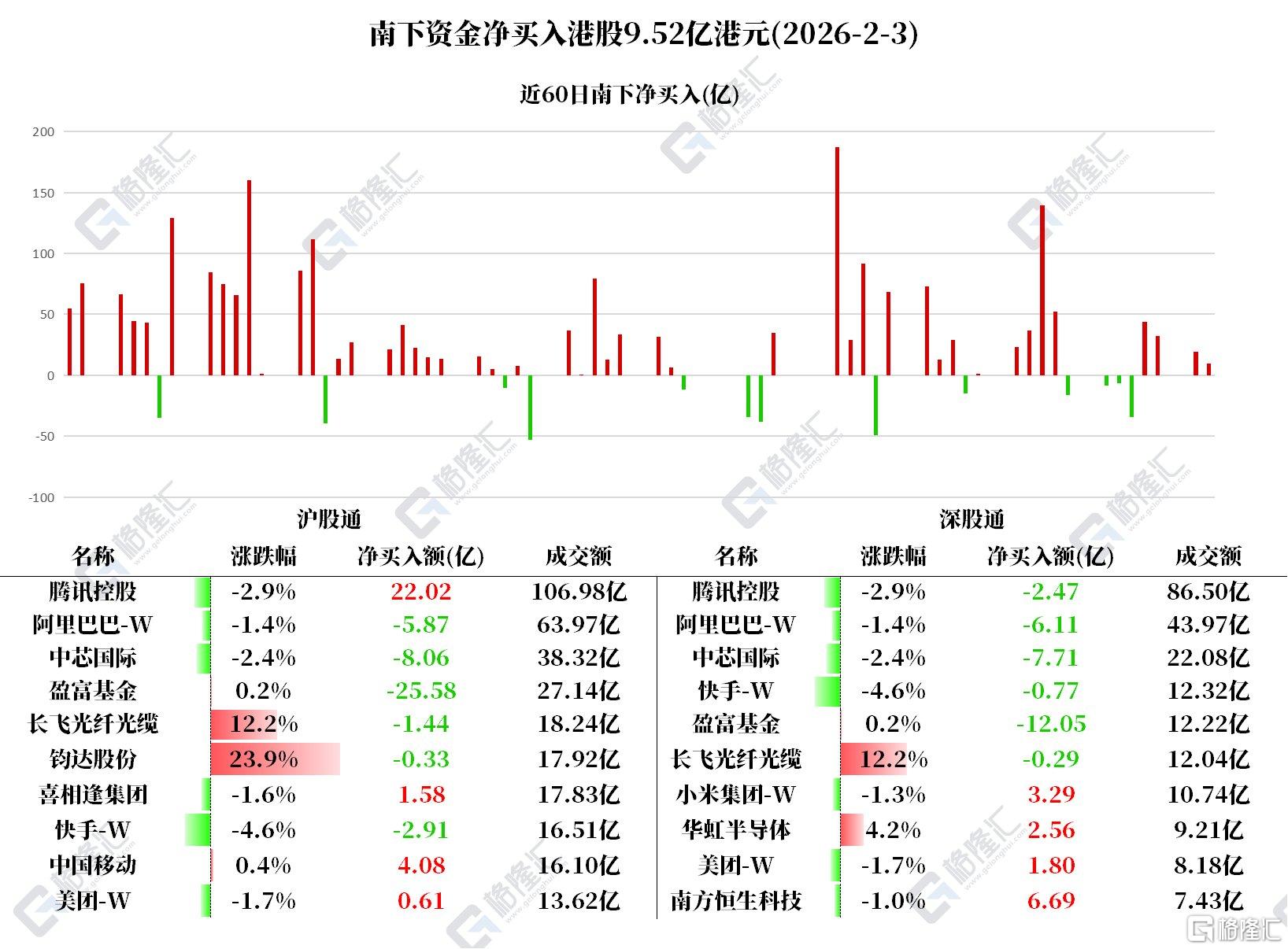
南向资金追踪|净买入超9亿港元 大举加仓腾讯减持中芯国际和阿里
Xin Lang Cai Jing· 2026-02-03 10:32
智通财经2月3日讯(编辑 冯轶)据Wind数据显示,南向资金今日成交约1264亿港元,较前一日缩量约119亿;约占今日恒指成交总额的37.72%,占比继续低 于四成,且降至短线低点。 港股今日短线企稳,南向资金净流入约9.52亿港元。其中,沪港股通净流入约17.33亿港元,而深港股通净流出约7.81亿港元。 不过,盈富基金(02800.HK)作为场内最大规模的ETF遭净卖出37.62亿港元,显示仍有部分资金继续流出。 个股方面,交易所数据显示,今日南向资金 大幅净买入:腾讯控股(0700.HK)19.55亿港元;中国移动(00941.HK)4.08亿港元;美团-W(03690.HK)2.41亿港元。 大幅净流出:中芯国际(00981.HK)15.77亿港元;阿里巴巴-W(09988.HK)11.99亿港元;快手-W(01024.HK)3.68亿港元;长飞光纤光缆 (06869.HK)1.72亿港元。 投资要点 腾讯控股今日跌2.92%,资金前5日加仓663万股,短线继续流入。 中国移动今日涨0.38%,资金前5日减持4164万股,短线仍以流出为主。 美团-W今日跌1.74%,资金前5日减持655万股,短线仍以 ...




南向资金丨盈富基金逆势遭净卖出37.63亿港元
Xin Lang Cai Jing· 2026-02-03 09:50
(本文来自第一财经) 南向资金净买入9.52亿港元,腾讯控股、南方恒生科技、中国移动净买入额位列前三,分别获净买入 19.55亿港元、6.69亿港元、4.08亿港元。净卖出方面,盈富基金、中芯国际、阿里巴巴-W分别遭净卖 出37.63亿港元、15.77亿港元、11.98亿港元。 来源:第一财经 ...
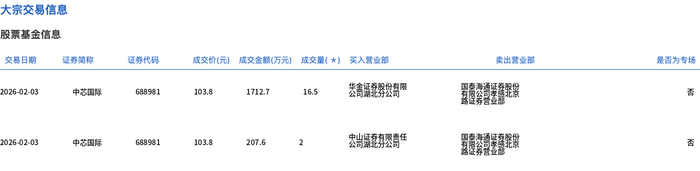
中芯国际今日大宗交易折价成交18.5万股,成交额1920.3万元
Xin Lang Cai Jing· 2026-02-03 09:39
2月3日,中芯国际大宗交易成交18.5万股,成交额1920.3万元,占当日总成交额的0.29%,成交价103.8 元,较市场收盘价116.03元折价10.54%。 | 交易日期 | 证券简称 | 证券代码 | 成交价(元) 成交金额(万元) 成交量(*) 买入营业部 | | | | 类出营业部 | 是否为专场 | | --- | --- | --- | --- | --- | --- | --- | --- | --- | | 2026-02-03 | 中芯国际 | 1868889 | 103.8 ાં રે | 1712.7 | 委高温馨投资有限 | 203 11866 | | Ka | | 2026-02-03 | 中芯国际 | 688981 | 103.8 7 | 207.6 | 去制量免费图筒任 | 是有些的不是在线 | | Ka | ...
创元科技(000551.SZ):目前尚未接到海力士和中芯国际的半导体洁净室订单
Ge Long Hui A P P· 2026-02-03 08:20
格隆汇2月3日丨创元科技(000551.SZ)在投资者互动平台表示,公司全资子公司江苏苏净是国内洁净环 保领域技术创新、装备制造和工程整体解决方案的综合供应商,江苏苏净下属江苏苏净工程江苏有限公 司是从事洁净室等空气净化系统工程的高新技术企业,拥有超高等级洁净环境集成核心技术,可为电子 信息、医疗卫生、新能源、生物制药等行业客户提供综合的空气净化系统解决方案。 目前,尚未接到 海力士和中芯国际的半导体洁净室订单。 ...