
PAB(000001)

Search documents
国泰海通|固收:浮盈被动“兑现”,缺负债明显缓解——固收角度拆解银行一季报
国泰海通证券研究· 2025-05-16 12:04
Core Viewpoint - The accumulation of OCI floating profits in banks has largely been consumed, primarily due to passive consumption from a weak bond market rather than active selling by banks [1][2][3] Group 1: OCI Floating Profit Consumption - Most banks have consumed over half of their OCI floating profit accumulation, with some banks even turning to floating losses; large banks have a relatively smaller consumption ratio, around one-third [1] - Among the six major banks, only one has consumed about half of its floating profit accumulation, while the others have consumed approximately one-third [1] - Out of 33 listed banks with available data, 25 have consumed more than half of their floating profit accumulation, with 7 turning to floating losses [1][2] Group 2: Impact on Revenue - The low performance of bond market investments has significantly dragged down the revenue performance of listed banks, with non-interest income negatively impacting revenue growth by 3.81 percentage points for joint-stock banks and 6.42 percentage points for city commercial banks [1] - For rural commercial banks, the contribution from non-interest income dropped from 7.30 percentage points to 4.52 percentage points [1] Group 3: Net Interest Margin Pressure - The pressure on net interest margins (NIM) is primarily observed in large banks, with a notable narrowing in Q1 due to a "lack of liabilities" leading to a shift towards interbank certificates of deposit [3] - In Q1, the average NIM for large banks narrowed by 0.10 percentage points to a low of 1.39%, significantly weaker than seasonal trends [3] - The recovery trend for NIM is not stable, as interbank deposits saw a seasonal decline in March, although there was a notable rebound in April due to a more relaxed funding environment [3]



平安银行北京分行助力首批科技创新债券成功发行 书写“科技金融”大文章
Bei Jing Shang Bao· 2025-05-16 08:32
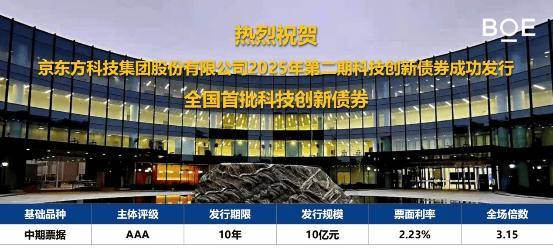
Group 1 - The People's Bank of China and the China Securities Regulatory Commission jointly announced measures to support the issuance of technology innovation bonds, with Ping An Bank's Beijing branch leading the underwriting of BOE Technology Group's 1 billion yuan (approximately 0.15 billion USD) bond project [1] - The bond has a 10-year term and a coupon rate of 2.23%, with a strong market response resulting in 3.15 times oversubscription [1] - The funds raised will be specifically used for technological upgrades in the semiconductor display sector, reinforcing BOE's position as a global leader [1] Group 2 - BOE Technology Group, established in April 1993, is a leading IoT innovation enterprise with a business structure centered on semiconductor displays and a strong global market presence [2] - The company is expected to see a 108.97% year-on-year increase in net profit attributable to shareholders in 2024, indicating strong cash flow and risk resilience [2] - The raised funds will focus on "hard technology" to support high-generation production line construction and core technology breakthroughs, accelerating the domestic substitution process [2]


平安银行承销首批科技创新债券,为债券市场“科技板”贡献力量
Sou Hu Cai Jing· 2025-05-16 06:15
Core Viewpoint - The successful issuance of the 10 billion yuan MTN002 project by BOE Technology Group, led by Ping An Bank, highlights the bank's commitment to supporting the real economy and promoting technology finance [1][4]. Group 1: Issuance Details - The MTN002 project was issued with a scale of 10 billion yuan, a term of 10 years, and a coupon rate of 2.23%, receiving an oversubscription of 3.15 times from market investors [1]. - The funds raised will be specifically used for technological upgrades in the semiconductor display field, reinforcing BOE's position as a global leader [1][3]. Group 2: Regulatory and Market Context - The People's Bank of China and the China Securities Regulatory Commission jointly announced measures to support the issuance of technology innovation bonds, aiming to inject long-term capital into technology enterprises [3]. - Ping An Bank actively participated in the first batch of projects under this initiative, enhancing the efficiency of bond issuance through the "green channel" provided by the trading association [3][4]. Group 3: Company Profile and Financial Performance - BOE Technology Group, established in April 1993, is a leading IoT innovation enterprise with a core focus on semiconductor displays, maintaining the highest global shipment volume of its core products [3]. - The company is projected to achieve a net profit growth of 108.97% year-on-year in 2024, indicating strong cash flow and risk resilience [3]. Group 4: Future Outlook - Ping An Bank aims to continue focusing on national strategic areas, promoting the flow of long-term capital into the forefront of technological innovation, thereby contributing to the cultivation of new productive forces and achieving high-level technological self-reliance [4].
1.7折起!信用卡现金分期利率低过消费贷,你会用吗?
Xin Lang Cai Jing· 2025-05-15 15:14
Core Viewpoint - Several banks have adjusted consumer loan interest rates, ceasing discounts below 3%, while simultaneously offering promotional rates for credit card cash installment services, indicating a shift in strategy towards more refined customer management in credit card operations [1][5]. Group 1: Credit Card Cash Installment Promotions - Banks like China Merchants Bank and Bank of Communications are offering significant discounts on cash installment rates, with annualized rates as low as 2.76% and 5.49% for specific terms [2][3]. - Credit card cash installment services allow banks to provide cash credit directly to customers' designated accounts, with flexible repayment options and generally do not occupy credit card limits [3][4]. Group 2: Market Trends and Regulatory Environment - The People's Bank of China has emphasized the need for financial institutions to support consumer loans, which may lead to increased competition in the retail loan market [5][6]. - The credit card market is transitioning from a phase of broad expansion to one of meticulous management, with a decline in the issuance of new cards due to market saturation and stricter regulations [6][7]. Group 3: Industry Challenges and Future Outlook - The proportion of credit card loans in retail lending has decreased from 13.09% in 2022 to 12.54% in 2024, while personal business and consumer loans have seen an increase [6][7]. - Industry experts suggest that the focus should shift towards retaining valuable customers and leveraging technology and risk management to ensure sustainable growth in the credit card sector [7].


银行配置策略报告系列一:四维度再看当下银行配置机会-20250515
Huachuang Securities· 2025-05-15 06:11
Core Insights - The report maintains a positive outlook on bank sector investments, emphasizing the stability and dividend attributes of bank stocks, with an average dividend yield exceeding 4.3% [6][16] - The banking sector is expected to benefit from structural changes in the economy, leading to improved return on equity (ROE) and overall performance [7][10] Dimension One: Stability and Dividend Attributes of Bank Stocks - The core revenue growth of banks showed marginal improvement in Q1 2025, with a projected stable annual performance despite a slowdown in revenue and profit growth [10][11] - The average dividend payout ratio for listed banks increased to 26.1%, with an average dividend yield of over 4.3%, indicating strong dividend sustainability [16] - Major banks have received capital injections, enhancing asset quality and stabilizing market expectations, with non-performing loan ratios remaining steady at 1.16% [10][11] Dimension Two: Public Fund Reform and Increased Bank Allocations - The recent public fund reforms are expected to increase allocations to the banking sector, with potential incremental capital of approximately 222.7 billion yuan if funds align with industry benchmarks [10][12] Dimension Three: Influx of Long-term Capital - The acceleration of long-term capital inflows, particularly from insurance funds, is anticipated to provide additional support to bank stocks, with 14 cases of insurance fund acquisitions in 2025 [10][12] Dimension Four: Structural Economic Transformation and ROE Improvement - The banking sector's ROE is projected to stabilize between 8-9%, with potential for upward movement if economic conditions improve and structural transformations accelerate [7][10] Investment Recommendations - Emphasis on bank sector allocation, particularly focusing on state-owned banks and quality regional banks with strong provisioning coverage [7][10] - The report suggests a diversified investment strategy, highlighting the importance of dividend strategies and the potential for valuation improvements in selected banks [7][10]



4月社融符合预期,中证银行ETF(512730)涨近1%冲击8连涨
Xin Lang Cai Jing· 2025-05-15 02:00
Core Viewpoint - The banking sector is experiencing upward momentum, with several banks showing significant stock price increases, while the overall market is shifting focus towards quality bank stocks due to recent financial data and regulatory changes [1][2]. Group 1: Market Performance - Hangzhou Bank, Chongqing Bank, Agricultural Bank, and others have seen stock price increases, with Hangzhou Bank up by 1.96% as of May 15, 2025 [1]. - The China Securities Bank ETF has risen by 0.85%, marking an 8-day consecutive increase, with a latest price of 1.67 yuan [1]. - The China Securities Bank ETF has accumulated a 4.88% increase over the past week [1]. Group 2: Financial Data - In April 2025, new social financing (社融) increased by 1.16 trillion yuan, a year-on-year increase of 1.22 trillion yuan, with a stock social financing growth rate of 8.7%, up by 0.3 percentage points month-on-month [1]. - New RMB loans amounted to 0.28 trillion yuan, a year-on-year decrease of 0.45 trillion yuan [1]. - M1 growth rate is at 1.5%, down by 0.1 percentage points month-on-month, while M2 growth rate is at 8.0%, up by 1 percentage point month-on-month [1]. Group 3: Regulatory Changes and Investment Strategy - The China Securities Regulatory Commission has issued a plan to promote high-quality development of public funds, encouraging a shift from focusing on scale to focusing on returns [1]. - Longjiang Securities suggests that the market will start to pay attention to undervalued quality bank stocks, particularly in the context of active fund reallocation [1]. - The banking sector's PB and PE valuations remain among the lowest across industries, indicating significant undervaluation [2]. Group 4: Key Bank Stocks - As of April 30, 2025, the top ten weighted stocks in the China Securities Bank Index account for 65.11% of the index, including major banks like China Merchants Bank, Industrial and Commercial Bank, and Agricultural Bank [2].




中信证券:银行基本面预期稳定 可把握两条主线
智通财经网· 2025-05-14 00:55
Core Viewpoint - The report from CITIC Securities indicates that since 2025, the banking sector is stabilizing its asset-liability configuration while actively growing loans and deposits, with a convergence in interbank asset-liability expansion. Although the industry's net interest margin continues to decline, the reduction in funding costs is helping to narrow the margin of decline. The outlook suggests that managing funding costs will be a key focus for banks in the upcoming quarters [1][5][6]. Asset and Liability Management - On the asset side, credit and investment are experiencing high growth, while interbank asset growth is significantly converging. In Q1 2025, the total assets of 42 listed banks increased by 3.9% quarter-on-quarter, consistent with the level in Q1 2024. Both loan and investment asset scales are maintaining high growth, while interbank assets are on a downward trend [2]. - On the liability side, deposit growth is positive, and interbank liability expansion is converging. In Q1 2025, the total liabilities of 42 listed banks increased by 4.2% quarter-on-quarter, slightly higher than the asset expansion rate. The structure shows positive growth in deposits, with a convergence in interbank liabilities [2]. Loan and Deposit Structure - In 2024, the structure of loans and deposits among listed banks shows that the proportion of corporate loans is increasing while retail loans are decreasing. By the end of 2024, the proportion of corporate loans, particularly in government-related sectors, increased to 28.8%, up by 0.6 percentage points from the previous year. Conversely, the proportion of mortgage loans decreased to 18.8%, down by 1.67 percentage points [3]. - On the deposit side, the proportion of retail deposits is increasing, with a continued trend towards term deposits. By the end of 2024, the proportion of retail term deposits rose to 34.7%, an increase of 3.56 percentage points from the previous year, while the proportion of corporate demand deposits decreased to 21.4%, down by 1.94 percentage points [3]. Interest Margin Pricing - The industry’s net interest margin continues to decline. According to data from the National Financial Regulatory Administration, the net interest margin for commercial banks was 1.52% in Q4 2024, a slight decrease of 1 basis point from Q3 2024. In Q1 2025, the net interest margin for 25 banks that disclosed this information decreased by 7 basis points compared to the entire year of 2024 [4]. - The analysis indicates that the asset yield continues to decline while funding costs are significantly reduced. The yield on interest-earning assets was 3.18% in Q4 2024 and 3.04% in Q1 2025, down by 9 and 14 basis points respectively. The cost of interest-bearing liabilities was 1.83% in Q4 2024 and 1.72% in Q1 2025, down by 7 and 12 basis points respectively, benefiting from improved cost management and the gradual effect of deposit rate reductions [4]. - Although net interest margins for listed banks are generally declining, the rate of decline in Q1 2025 shows a narrowing trend. The average net interest margin for 25 banks decreased by 13 basis points year-on-year, which is better than the decline of 22 basis points in Q1 2024 and 18 basis points for the entire year of 2024 [4]. Future Outlook - The reduction in funding costs remains a crucial direction for managing bank interest margins in the upcoming quarters. Since 2024, factors such as rate reductions and regulatory improvements have significantly impacted the decline in funding costs, with many banks taking the opportunity to strengthen their funding pricing management [5]. - With the completion of concentrated repricing at the beginning of the year, it is expected that interest margins will stabilize further. The pace and extent of future policy interest rate and LPR adjustments will be critical for stabilizing bank interest margins [6].


银行行业今日净流入资金7.22亿元,工商银行等7股净流入资金超5000万元
Zheng Quan Shi Bao Wang· 2025-05-13 09:10
资金面上看,两市主力资金全天净流出357.13亿元,今日有8个行业主力资金净流入,银行行业主力资 金净流入规模居首,该行业今日上涨1.52%,全天净流入资金7.22亿元,其次是交通运输行业,日涨幅 为0.72%,净流入资金为6.03亿元。 主力资金净流出的行业有23个,国防军工行业主力资金净流出规模居首,全天净流出资金86.44亿元, 其次是电子行业,净流出资金为61.34亿元,净流出资金较多的还有计算机、机械设备、汽车等行业。 银行行业今日上涨1.52%,全天主力资金净流入7.22亿元,该行业所属的个股共42只,今日上涨的有42 只;。以资金流向数据进行统计,该行业资金净流入的个股有22只,其中,净流入资金超5000万元的有 7只,净流入资金居首的是工商银行,今日净流入资金3.11亿元,紧随其后的是农业银行、平安银行, 净流入资金分别为1.85亿元、1.36亿元。银行行业资金净流出个股中,资金净流出超3000万元的有5只, 净流出资金居前的有兴业银行、招商银行、浙商银行,净流出资金分别为1.21亿元、4964.98万元、 4080.15万元。(数据宝) 银行行业资金流向排名 沪指5月13日上涨0.17%,申 ...


银行信用卡业务拐点已至
Jin Rong Shi Bao· 2025-05-13 03:11
Group 1 - The core viewpoint is that commercial banks are actively closing credit card centers in various locations due to a shift from growth to a competitive market focused on existing customers [1][3][4] - As of April 30, 2024, nearly 30 banks have closed their credit card centers, with notable closures by Bank of Communications and Minsheng Bank [1][2] - The People's Bank of China reported a decline in the total number of credit cards and loans, with a total of 727 million cards by the end of 2024, a year-on-year decrease of 5.14% [1] Group 2 - The performance of credit card businesses in 2024 reflects a slowdown, with significant declines in card issuance, active card numbers, and consumer spending [2][3] - For instance, Postal Savings Bank reported a credit card consumption amount of 993.1 billion yuan, down approximately 12% year-on-year [2] - The shift in credit card business strategy is characterized by a move from centralized management to localized operations, aiming to provide comprehensive financial services tailored to local customers [3][4] Group 3 - The increasing pressure of non-performing loans in the credit card sector has prompted banks to focus on cost reduction and efficiency improvement [4][5] - Experts suggest that banks should adjust their credit card business strategies to offer differentiated products and services, targeting specific customer segments [4][5] - There is a call for banks to develop early warning models for risk management and enhance the disposal of non-performing credit card assets [5]


关于平安鑫瑞混合型证券投资基金在蚂蚁(杭州)基金销售有限公司渠道恢复大额申购、定期定额投资及转换转入业务的公告
Shang Hai Zheng Quan Bao· 2025-05-12 19:48
公告送出日期:2025年5月13日 一、公告基本信息 ■ 二、其他需要提示的事项 根据法律法规和基金合同的相关规定,平安基金管理有限公司(以下简称"本公司")决定从2025年5月 14日起,取消平安鑫瑞混合型证券投资基金(以下简称"本基金")在蚂蚁(杭州)基金销售有限公司 (以下简称"蚂蚁基金")的大额申购、定期定额投资和转换转入业务的限额,恢复办理本基金的正常申 购、定期定额投资和转换转入业务。 如有疑问,可拨打平安基金管理有限公司客户服务电话:400-800-4800进行咨询,或登陆公司网站 fund.pingan.com获得相关信息。 风险提示:本公司承诺以诚实信用、勤勉尽责的原则管理和运用基金资产,但不保证基金一定盈利,也 不保证最低收益。敬请投资者注意投资风险。投资者投资于上述基金前应认真阅读基金的基金合同、更 新的招募说明书及相关公告。 特此公告。 平安基金管理有限公司 2025年5月13日 平安基金管理有限公司 关于新增平安银行股份有限公司 为旗下基金销售机构的公告 为更好地满足广大投资者的理财需求,根据平安基金管理有限公司(以下简称"本公司")与平安银行股 份有限公司(以下简称"平安银行")签 ...