
SZAP(000061)

Search documents
【环球财经】芝加哥农产品期价13日涨跌不一
Xin Hua Cai Jing· 2025-10-13 22:49
Group 1 - The core viewpoint of the articles highlights the mixed performance of corn, wheat, and soybean prices in the Chicago futures market, with corn and wheat experiencing declines while soybean prices saw a slight increase [1][2] - On October 13, the most active December corn contract closed at $4.11 per bushel, down 2.25 cents (0.54%) from the previous trading day, while the December wheat contract fell to $4.97 per bushel, down 1.75 cents (0.35%). In contrast, the November soybean contract rose by 1 cent (0.1%) to $10.08 per bushel [1] - The impressive corn yield in the northern and western Midwest of the U.S. is noted, with December corn futures attempting to hold the support level of $4.105 per bushel, and the next downside target set at $4.05 [1] Group 2 - China continues to seek Brazilian soybeans, reportedly purchasing 2-4 cargo ships of Brazilian soybeans, with estimates indicating that the sowing area in Brazil has reached 14-15% of the planned area [1] - The forecast for U.S. soybean planting area is expected to increase to 87-88 million acres by 2026 due to rising fertilizer costs and crop rotation willingness, while corn planting area may decrease to 92-93 million acres, and wheat planting area is projected to drop by 1-2 million acres to 45-46 million acres [1] - The global grain market is currently characterized by three major themes: record global wheat export supply, significant U.S. corn production with insufficient Midwest inventory, and the impact of U.S.-China trade relations on agricultural markets [2]

ICE农产品期货主力合约收盘多数下跌,原糖期货跌3.29%
Mei Ri Jing Ji Xin Wen· 2025-10-13 22:07
Core Insights - The Intercontinental Exchange (ICE) agricultural futures saw a majority decline in closing prices on October 13, with raw sugar futures dropping by 3.29% to 15.57 cents per pound [1] - Cotton futures decreased by 0.47% to 63.54 cents per pound [1] - Cocoa futures fell by 0.21% to $5,836.00 per ton [1] - Coffee futures experienced an increase of 2.80%, closing at 383.50 cents per pound [1] Summary by Category - **Raw Sugar**: Futures declined by 3.29%, closing at 15.57 cents per pound [1] - **Cotton**: Futures decreased by 0.47%, closing at 63.54 cents per pound [1] - **Cocoa**: Futures fell by 0.21%, closing at $5,836.00 per ton [1] - **Coffee**: Futures rose by 2.80%, closing at 383.50 cents per pound [1]
CBOT农产品期货主力合约收盘多数下跌,玉米期货跌0.61%
Mei Ri Jing Ji Xin Wen· 2025-10-13 22:07
每经AI快讯,当地时间10月13日,芝加哥期货交易所(CBOT)农产品期货主力合约收盘多数下跌,大 豆期货涨0.15%报1008.25美分/蒲式耳,玉米期货跌0.61%报410.50美分/蒲式耳,小麦期货跌0.35%报 496.75美分/蒲式耳。 (文章来源:每日经济新闻) ...
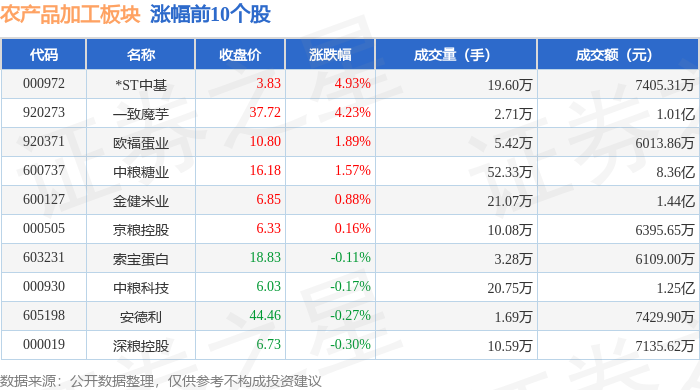
农产品加工板块10月13日跌0.19%,ST朗源领跌,主力资金净流出1178.04万元
Zheng Xing Xing Ye Ri Bao· 2025-10-13 12:38
从资金流向上来看,当日农产品加工板块主力资金净流出1178.04万元,游资资金净流入3503.85万元,散 户资金净流出2325.81万元。农产品加工板块个股资金流向见下表: 证券之星消息,10月13日农产品加工板块较上一交易日下跌0.19%,ST朗源领跌。当日上证指数报收于 3889.5,下跌0.19%。深证成指报收于13231.47,下跌0.93%。农产品加工板块个股涨跌见下表: | 代码 | 名称 | 收盘价 | 涨跌幅 | 成交量(手) | 成交额(元) | | --- | --- | --- | --- | --- | --- | | 000972 | *ST中基 | 3.83 | 4.93% | 19.60万 | 7405.31万 | | 920273 | 一致魔宇 | 37.72 | 4.23% | 2.71万 | 1.01亿 | | 920371 | 欧福省业 | 10.80 | 1.89% | 5.42万 | 6013.86万 | | 600737 | 中粮糖业 | 16.18 | 1.57% | 52.33万 | 8.36亿 | | 600127 | 金健米业 | 6.85 | 0.88% ...


欧盟将降低或取消对多种乌克兰农产品的关税
Xin Lang Cai Jing· 2025-10-13 12:04
Core Points - The European Council approved a resolution to lower or eliminate tariffs on Ukrainian agricultural products such as dairy, fresh fruits and vegetables, and meat [1] - This decision is based on a preliminary agreement reached on June 30, 2025, regarding the review of the EU-Ukraine Deep and Comprehensive Free Trade Area (DCFTA) [1] - The resolution aims to establish a long-term reciprocal trade framework between the EU and Ukraine [1] Summary by Categories Trade Policy - The resolution allows for gradual compliance of Ukrainian market access with EU standards on animal welfare, pesticides, and veterinary medicines [1] - Sensitive products like sugar, poultry, and wheat will have limited gradual opening, while non-sensitive products like milk may consider full opening [1] - A safeguard mechanism will be implemented to address market fluctuations [1] Future Actions - The EU-Ukraine Joint Committee will convene to formalize this decision through a trade division meeting [1]
从种养殖到市场消费,山东推动食用农产品全链条信息化追溯
Qi Lu Wan Bao Wang· 2025-10-13 11:23
Core Viewpoint - The Shandong Provincial Government has issued measures to strengthen the full-chain supervision of food safety, outlining 26 specific actions to ensure the safety of food from production to consumption [1][2][3] Group 1: Regulatory Measures - The measures clarify responsibilities in food safety regulation and establish a comprehensive supervision mechanism from "farm to table" [1] - Key actions include enhancing the prevention of heavy metal pollution in agricultural land, implementing risk classification management for edible agricultural products, and strengthening quality control at the source of meat products [1][2] Group 2: Specific Actions - The measures include a full coverage management list for heavy metal pollution in agricultural land and ongoing inspections of enterprises and mining areas related to heavy metals [1] - A risk classification system for edible agricultural products will be developed, focusing on high-risk varieties and production methods, with increased inspection frequency during critical periods [1][2] - Quality management standards for pig slaughtering will be fully implemented, and centralized slaughtering for cattle and sheep will be accelerated [1][2] Group 3: Market and Information Management - The measures emphasize strict management of production area certifications and the proper issuance of quality inspection certificates for meat products [2] - There will be a push for electronic certification systems for edible agricultural products, enhancing traceability and data sharing across departments [2][3] - A collaborative mechanism for food safety traceability will be established, ensuring information sharing and feedback on non-compliant products [3]
全国农产品批发市场猪肉平均价格为18.47元/公斤,比上周六下降1.6%
Sou Hu Cai Jing· 2025-10-13 07:40
Core Insights - The "Agricultural Products Wholesale Price Index" reached 118.70 on October 13, reflecting an increase of 0.28 points compared to the previous Saturday [1] - The "Vegetable Basket" product wholesale price index was recorded at 119.61, which is an increase of 0.33 points from the previous Saturday [1] - The average wholesale price of pork across national agricultural markets was 18.47 yuan per kilogram, showing a decrease of 1.6% compared to the previous Saturday [1]
农产品批发价格:猪肉降1.6%,牛肉升0.5%
Sou Hu Cai Jing· 2025-10-13 07:23
Core Insights - The average price of pork in China's wholesale agricultural market decreased by 1.6% as of October 13, with the price at 18.47 yuan per kilogram [1] - The "Agricultural Products Wholesale Price 200 Index" rose by 0.28 points, reaching 118.70, indicating a slight increase in overall agricultural product prices [1] - The "Vegetable Basket" product wholesale price index increased by 0.33 points to 119.61, reflecting a general upward trend in certain agricultural products [1] Price Changes - Pork: 18.47 yuan/kg, down 1.6% from the previous week [1] - Beef: 66.34 yuan/kg, up 0.5% [1] - Mutton: 62.06 yuan/kg, up 0.2% [1] - Eggs: 7.76 yuan/kg, down 1.4% [1] - Broiler chicken: 17.55 yuan/kg, down 0.6% [1]
甘肃:聚焦高标准农田建设做实监督 护航粮食和重要农产品稳产保供
Zhong Yang Ji Wei Guo Jia Jian Wei Wang Zhan· 2025-10-13 00:17
Core Viewpoint - The construction of high-standard farmland is crucial for ensuring national food security and the supply capacity of important agricultural products, with a focus on addressing management issues and enhancing oversight [3][4][13]. Group 1: High-Standard Farmland Construction - High-standard farmland construction is a key measure to implement the strategy of "storing grain in the land and technology," which is essential for national food security [3]. - The construction involves significant investment and requires a collaborative approach among various departments to ensure effective management and oversight [5][13]. - The provincial government is actively addressing issues such as unreasonable project planning, non-compliance in bidding and acceptance, and inadequate post-construction management [4][6]. Group 2: Oversight and Accountability - The provincial disciplinary inspection and supervision agencies are intensifying efforts to rectify prominent issues in high-standard farmland construction, focusing on the entire management process from planning to post-construction [4][6]. - A total of 2,336 issues have been rectified, with 49 cases filed and 28 individuals receiving disciplinary actions this year [6]. - The establishment of a comprehensive supervision system is emphasized, involving various stakeholders including local communities and project management teams [10][11]. Group 3: Management and Utilization - Effective management is critical for maximizing the benefits of high-standard farmland, with a focus on clear responsibilities and ongoing supervision [7][8]. - The integration of smart agricultural practices is being explored to enhance operational efficiency and resource management [9]. - The approach includes regular monitoring and community involvement to ensure the sustainability and productivity of the farmland [8][10]. Group 4: Long-term Governance - Continuous supervision is necessary to ensure both immediate benefits and long-term governance in high-standard farmland projects [10][11]. - The provincial government is working on refining policies and regulations to address potential risks and improve the management framework [11][15]. - The focus is on preventing corruption and ensuring that resources are used effectively for the benefit of local communities [14][15].
黄金价格创历史新高 能化及部分农产品承压
2 1 Shi Ji Jing Ji Bao Dao· 2025-10-12 23:45
Group 1: Commodity Market Overview - In the first week after the National Day holiday, domestic commodity futures showed mixed performance, with precious metals, black metals, and base metals leading gains, while energy chemicals and some agricultural products saw significant declines [1] - From October 9 to 12, the energy chemical sector experienced declines, with fuel oil down 3.00% and crude oil down 3.71%. In contrast, the black metal sector saw iron ore up 1.86%, coking coal up 3.11%, and coke up 2.68% [1] Group 2: Gold Market Dynamics - International gold prices surged during the holiday, with COMEX gold futures breaking the $4000 per ounce mark, reaching a historical high of $4067.8 per ounce due to factors such as the U.S. government shutdown and expectations of Federal Reserve rate cuts [2] - Global gold supply remains tight, with a projected 1.5% year-on-year decline in gold mine production by Q3 2025, primarily due to decreasing ore grades in major producing countries like South Africa and Australia [2] - Investment demand for gold increased, with the largest gold ETF seeing a weekly inflow of 12.3 tons, the largest single-week inflow of 2024 [2] Group 3: Palm Oil Market Developments - The palm oil market experienced explosive growth post-holiday, with BMD palm oil futures rising 2.87% during the holiday and continuing to rise on October 8 [4] - Indonesia's plan to implement a B50 biodiesel program in the second half of 2026 is expected to significantly increase domestic palm oil demand, reducing exportable supply and tightening global palm oil availability [4] Group 4: U.S. Government Shutdown Impact - The U.S. government shutdown has led to the suspension of some public services and delayed economic data releases, increasing uncertainty in the market and affecting investment decisions [6] - The shutdown has compounded concerns regarding the U.S. dollar's credibility and sovereign debt, contributing to rising prices for precious metals and other commodities [6] Group 5: Chemical Industry Policy Developments - A new growth stabilization plan for the petrochemical industry has been issued by seven departments, focusing on addressing structural contradictions such as excess low-end capacity and insufficient high-end supply [7] - The plan emphasizes controlling new capacity, encouraging existing producers to undertake energy-saving and carbon-reduction modifications, and supporting the development of high-end chemical products [7]