
SZAP(000061)

Search documents
六年来五次!拉尼娜又来了,全球农产品供应链将受冲击
Hua Er Jie Jian Wen· 2025-12-26 01:35
Group 1: Core Insights - The new La Niña phenomenon is forming, marking the fifth occurrence in six years, which is expected to disrupt global weather systems and pose significant risks to agriculture, energy markets, and supply chains [1] - Historical data indicates that global economic losses from La Niña events have ranged from $258 billion to $329 billion, highlighting the increasing impact of extreme weather on economic losses and decision-making in insurance, agriculture, and energy sectors [1] - The current La Niña is predicted to have a weaker intensity but is expected to last for several months, adding uncertainty to commodity price trends [1] Group 2: Regional Impacts - In Southeast Asia, recent floods in Vietnam and Thailand have resulted in over 500 deaths and economic losses exceeding $16 billion, with La Niña contributing to extreme rainfall patterns [2] - La Niña is associated with colder winters in North America and East Asia, which may increase heating fuel demand, particularly in regions like the Pacific Northwest and the Great Lakes [4] - Brazil, as the world's largest soybean exporter, is cautious about potential rainfall reductions in its southern planting areas due to La Niña, while China may face threats to winter wheat production from below-average temperatures [5] Group 3: Agricultural Market Uncertainty - The global agricultural market is on high alert, as La Niña is typically linked to decreased yields of corn, rice, and wheat [3] - In Southeast Asia, strong rainfall may disrupt palm oil harvesting and transportation, although increased moisture could benefit crop recovery in the following months [5] Group 4: Climate Change Context - The occurrence of five La Niña events in six years reflects a broader trend over the past 25 years, where La Niña has become more prevalent than El Niño, with ongoing research into the influence of climate change on this cycle [6] - Experts suggest that while La Niña is a natural phenomenon, its effects are being altered and amplified by global warming, leading to more extreme weather events [6] - The current La Niña is expected to peak in the coming weeks, but its impact on global weather patterns will likely persist for several months [6]

光大期货:12月26日农产品日报
Xin Lang Cai Jing· 2025-12-26 01:33
生猪: 周四,生猪主力2603合约震荡收十字星,生猪期价在长期均线支撑处企稳,期价呈现偏强表现。全国生 猪现货报价稳定为主,黑龙江市场生猪主流成交价格11.14元/公斤,较昨日价格持平;吉林市场主流成 交价格11.21元/公斤,较昨日价格持平;辽宁地区生猪出栏主流价格11.39元/公斤,较昨日价格下跌0.01 元/公斤;内蒙古市场主流成交价格为11.17元/公斤,较昨日价格下跌0.01元/公斤。现东北地区中大猪挺 价心理持续,价格暂无明显波动,今日中大猪价格低价11.2元/公斤,高价11.80元/公斤,标肥价差震荡 走扩。广东市场生猪出栏均价为11.98元/公斤 ,较昨日价格稳定,与赣桂湘均价价差0.78元/公斤, 规 热点栏目 自选股 数据中心 行情中心 资金流向 模拟交易 客户端 蛋白粕: 周四,CBOT大豆因节日休市,今日恢复交易。之前美豆小幅上涨,因空头获利平仓。市场谨慎看待中 国采购步伐。之前美国农业部周二发布的出口销售报告显示,截至12月11日,美豆单周净销售239.62万 吨,其中对中国净销售138.3万吨。国内方面,两粕震荡走高。豆粕现货成交环比减少,但依然高于上 周同期。成交集中在远期合约, ...


61个“辽字号”农产品进入全国名特优新名录
Liao Ning Ri Bao· 2025-12-26 01:19
Core Viewpoint - The Ministry of Agriculture and Rural Affairs has released the third batch of national high-quality agricultural products and specialty products for 2025, highlighting a significant increase in recognized products, which will enhance product quality and market competitiveness [1][2]. Group 1: National Recognition of Agricultural Products - A total of 790 high-quality agricultural products and 152 specialty products have been recognized, with 61 products from a specific province, including Wafangdian Huangyuanshuai apples and Liaoyang salted duck eggs [1]. - The province now has a total of 193 nationally recognized high-quality agricultural products and 15 specialty products [1]. Group 2: Impact on Agricultural Development - The certification of high-quality and specialty agricultural products is expected to improve product quality, promote standardized agricultural production, and enhance the effective supply of high-quality agricultural products [1]. - The focus is shifting from mere certification to strengthening brands and broadening promotion, aiming for a transformation from "good products" to "strong brands" and "successful sales" [2].
金银农产品集体暴走,2026牛市是“续航”还是“转向”?
Sou Hu Cai Jing· 2025-12-25 23:32
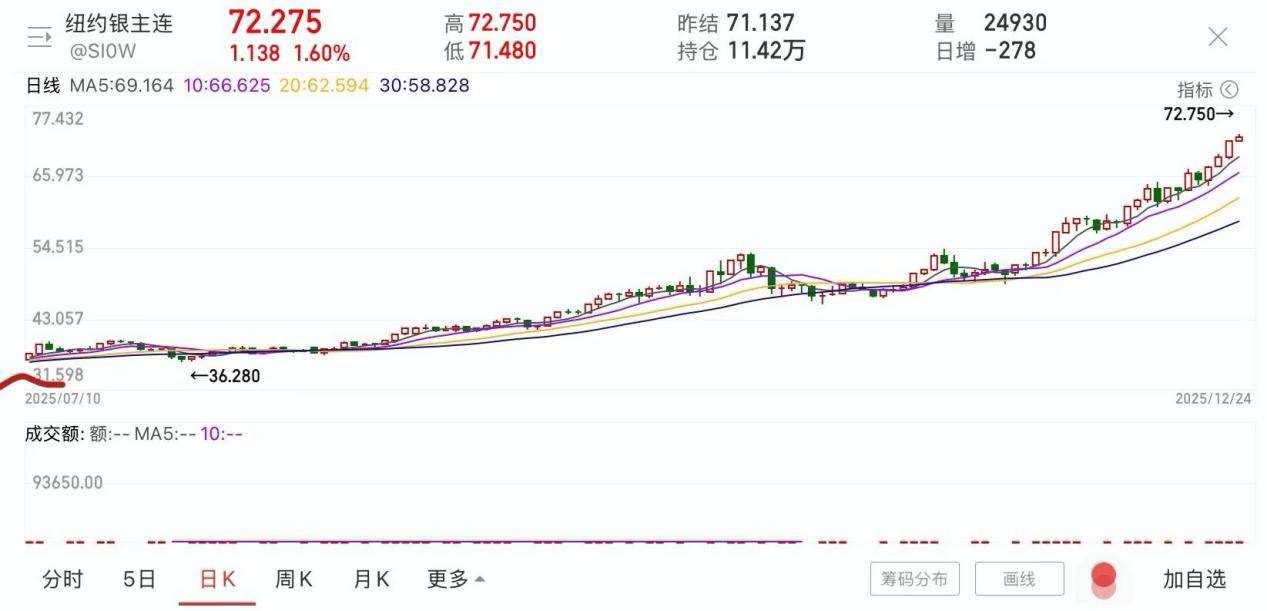
Group 1: Commodity Market Overview - By the end of 2025, the global commodity market is expected to experience a strong upward trend due to factors such as climate anomalies, escalating geopolitical conflicts, and mismatched supply-demand dynamics [1] - Precious metals are continuing their bull market, with COMEX gold futures surpassing $4550 per ounce and COMEX silver exceeding $72 per ounce, both poised for their strongest annual performance since 1979 [1] - Copper prices have reached a historical high of $11,952 per ton, while platinum prices are also rising due to three consecutive years of supply shortages [1] Group 2: Agricultural Products - Agricultural futures prices are showing mixed trends due to dynamic structural supply-demand contradictions, with corn prices continuing to rise while wheat, soybeans, soybean oil, and soybean meal have shown signs of recovery after a phase of decline [1] - Recent geopolitical tensions and extreme weather have contributed to a rebound in U.S. wheat prices, which have risen for five consecutive days as of December 24 [6] - The ongoing Russia-Ukraine conflict has raised concerns about grain and edible oil supply disruptions, particularly affecting the Black Sea region [7] Group 3: Precious Metals Performance - At the beginning of the year, international gold prices fluctuated between $2600 and $2700 per ounce, but have now surpassed $4550, marking an increase of over 60% for the year [3] - Silver has outperformed gold with a year-to-date price increase of approximately 140%, narrowing the gold-silver ratio from 85:1 at the beginning of the year to below 70 [3] - The rise in precious metal prices is driven by two main factors: increased expectations for Federal Reserve interest rate cuts and heightened geopolitical risks that boost market demand for safe-haven assets [4][5] Group 4: Future Market Outlook - Looking ahead to 2026, there are differing opinions on whether the commodity market will continue its bull run or shift direction, with some analysts predicting a decrease in macro volatility that could weaken gold's safe-haven demand [10] - Other analysts believe that the establishment of a Federal Reserve rate-cutting cycle and weakening dollar credit will support precious metals, with ongoing strong demand from central banks and industrial consumption [10] - In the agricultural sector, short-term support for U.S. soybean prices is expected from China's purchases, but uncertainties remain regarding the volume of these purchases and the overall favorable planting conditions in South America [10]
辩证看农产品出口成绩单(人民时评)
Ren Min Ri Bao· 2025-12-25 22:19
Core Insights - China, as the world's largest agricultural product importer, has reported impressive export figures, with nearly 600 billion yuan in agricultural exports over the first ten months of the year, covering 838 product categories and reaching 223 countries and regions [1] Group 1: Export Growth and Quality Improvement - The increase in export categories and the enhancement of product quality indicate that China's agricultural exports are moving beyond the "large quantity, low price" phase, demonstrating strong market competitiveness [1] - By aligning with international high standards and integrating into the global market, China's agricultural products are gaining higher recognition and added value [1] Group 2: Efficiency in Logistics and Customs - The introduction of innovative customs and logistics mechanisms, such as the "batch inspection" model in Huzhou and the "green channel time+" rapid release mode in Yunnan, has significantly improved efficiency in the export process [2] - Infrastructure connectivity and regulatory improvements have collectively enhanced the competitiveness of Chinese agricultural products [2] Group 3: Balancing Export and Food Security - High-quality agricultural exports do not conflict with food security; instead, they can support it by optimizing the use of domestic and international markets [2] - The export of specialty products like fruits and vegetables, which often utilize non-arable resources, contributes to a balanced agricultural structure [2] Group 4: Economic Benefits for Farmers - Agricultural exports can lead to higher premiums, incentivizing farmers and creating a positive cycle of industry development and rural revitalization [3] - Examples include the high prices of Nanfeng honey oranges in South Africa and the value-added processing of Yantai apples, which significantly increase farmers' incomes [3] Group 5: China's Role in Global Agricultural Trade - China has become the world's second-largest agricultural trading nation, with a balanced approach to imports and exports that supports food security [3] - The future of Chinese agriculture lies not only in domestic production but also in its ability to compete in global markets [3]
聚焦农产品电商 探索全链条协同机制
Xin Hua Ri Bao· 2025-12-25 21:13
尽管我国农产品电商起步较晚,但在国家相关政策与新兴技术的支撑下,发展迅猛。在2024中国农产品 电商高层研讨会上,农业农村部相关负责人表示,中国已成为世界第一大农产品电商国。《2024中国农 产品电商发展报告》显示,随着我国进入新的经济和消费周期,数字农产品电商也进入高质量发展时 期。近年来,我国农产品电商供应链也催生出直播电商、社区团购、生鲜电商、电商直采、社区支持农 业等各具特色的新业态。与传统农产品供应链相比,农产品电商供应链在结构模式、运营效率等方面优 势明显,呈现出供应链层级少、线上线下(300959)深度融合、信息透明度高、消费者参与度高、供应 链短链化等典型特征。 同时,以上特征对农产品电商的生产、配送和营销均产生重要影响,对农产品电商全链条协同管理提出 更具有挑战性的要求。首先,生产环节管控缺失,致农产品质量下降。电商实现农产品与消费者直接对 接,虽省去诸多中间环节,但因链条缩短、监管缺位,导致农产品面临质量难控、质量认证失效等挑 战,存在威胁农产品整体品质与安全的风险。其次,配送环节韧性欠佳,致配送时效降低。农产品供给 不确定性大、季节性波动明显、品质要求高,这些特点都增加了农产品电商供应链 ...
新疆乌什特色农产品展示展销 暨文化走亲和旅游推介专场活动启幕
Xin Lang Cai Jing· 2025-12-25 17:23
Core Viewpoint - The event "2025 Xinjiang Wushi Specialty Agricultural Products Exhibition and Cultural Promotion" aims to showcase and sell unique agricultural products from Wushi, Xinjiang, in Chuzhou, providing a cultural and culinary experience for local residents [1][2] Group 1: Event Overview - The event is organized by multiple local government bodies and is held at Chuzhou Wuyue Plaza for three days [1] - It features a variety of Wushi specialty agricultural products, including Akesu apples, red dates, paper-skin walnuts, and seabuckthorn, highlighting the region's natural gifts [1] Group 2: Culinary Experience - The event includes a dedicated area for beef and lamb, offering authentic Wushi grassland flavors, and a barbecue section featuring lamb skewers and ribs, enhancing the culinary experience for attendees [1] - The use of local Xinjiang spices in the food preparation aims to provide a genuine taste of the region [1] Group 3: Consumer Engagement and Promotions - The event offers multiple consumer incentives, including 50,000 yuan in vouchers, with discounts for purchases over 100 yuan [2] - Online promotions include live-streaming sales with products priced at 9.9 yuan, 19.9 yuan, and 29.9 yuan, allowing for shared discounts between online and offline shoppers [2] - A lottery and surprise blind box activities are available, encouraging higher spending with chances to win Wushi specialty gift boxes [2]
全链条发力 携手护粮安——2025年粮食和重要农产品稳产保供一线观察
Xin Lang Cai Jing· 2025-12-25 13:18
Core Insights - Food security is emphasized as a national priority, with significant efforts made to ensure stable production and supply of grain and important agricultural products by 2025 [1] Group 1: Agricultural Production - In 2025, China's grain production faced challenges from various natural disasters, yet the total grain output reached a historical high of 14,297.5 billion jin, marking a significant increase from the previous year [2][3] - The national average grain yield was reported at 399.1 kg per mu, an increase of 1.1% from the previous year, with corn planting area expanding to 67.4 million mu, up by 3.3 million mu [3] - The Ministry of Agriculture and Rural Affairs noted that grain production achieved a bumper harvest, ensuring basic self-sufficiency in grains and absolute safety in staple foods [3] Group 2: Storage and Processing Efficiency - Enhanced storage capabilities are crucial for food security, with advancements in technology such as intelligent control systems in grain storage facilities to maintain quality and freshness [6] - The implementation of efficient harvesting techniques has reduced grain loss, with machine harvesting loss rates in Shandong province decreasing to 0.78% [7] - In processing, measures to minimize grain loss have been adopted, such as using sealed transport vehicles and advanced milling equipment, resulting in a significant reduction in wheat breakage rates [7] Group 3: Consumption and Waste Reduction - Initiatives at the consumer level, such as offering smaller portion sizes in community dining facilities, aim to reduce food waste and promote a culture of conservation [9][10] - Community efforts to encourage food-saving practices, like "clean plate" campaigns, contribute to the overall goal of ensuring food security for the population [10]
农产品贸易巨头路易达孚称首席财务官“意外”去世,终年52岁
Xin Lang Cai Jing· 2025-12-25 08:53
农产品贸易巨头路易达孚12月24日发布声明称,首席财务官Patrick Treuer夜间"意外"去世,终年52岁。 Treuer于2014年加入公司,2019年出任首席财务官。路易达孚表示,将适时公布关于首席财务官继任人 选的安排。 ...
12月25日“农产品批发价格200指数”比昨天下降0.07个点
Zhong Guo Xin Wen Wang· 2025-12-25 07:39
Group 1 - The "Agricultural Product Wholesale Price 200 Index" decreased by 0.07 points to 130.26 on December 25 [1] - The "Vegetable Basket" product wholesale price index fell by 0.08 points to 133.16 [1] - The average price of pork in national wholesale markets was 17.44 yuan/kg, an increase of 0.5% from the previous day [1] - The average price of beef remained stable at 65.88 yuan/kg [1] - The average price of mutton decreased by 0.6% to 62.76 yuan/kg [1] - The average price of eggs dropped by 1.5% to 7.32 yuan/kg [1] - The average price of broiler chickens fell by 1.0% to 17.67 yuan/kg [1] - The average price of 28 monitored vegetables was 5.75 yuan/kg, down by 1.0% [1] - The average price of 6 monitored fruits was 7.75 yuan/kg, a decrease of 0.5% [1] Group 2 - Among 46 monitored fresh agricultural products, the top five price increases were for white catfish (4.1%), giant peak grapes (3.6%), large yellow croaker (2.2%), flower catfish (1.5%), and crucian carp (1.0%) [2] - The top five price decreases were for large yellow croaker (5.1%), pineapple (3.6%), Fuji apples (3.3%), cauliflower (3.3%), and green beans (2.7%) [2]