
TCL TECH.(000100)

Search documents
全球首条印刷OLED8.6代线开工!TCL华星295亿元押注,中尺寸“耐力赛”开启
Hua Xia Shi Bao· 2025-10-22 09:18
Core Viewpoint - TCL Huaxing has officially commenced construction of its OLED 8.6 generation line, becoming the fourth global player in this segment, with a total investment of approximately 29.5 billion yuan, expected to achieve mass production by 2027 [2][3]. Investment and Production - The T8 project is a joint investment between TCL Huaxing, the Guangzhou Municipal Government, and the Guangzhou Economic and Technological Development Zone Management Committee [2]. - The total investment of 29.5 billion yuan for the T8 project is significantly lower than that of competitors, such as BOE's 63 billion yuan and Visionox's 55 billion yuan for their respective OLED 8.6 generation lines [3][4]. Technology and Production Capacity - TCL Huaxing's T8 project is the world's first printed OLED 8.6 generation line, differing from competitors who use evaporation technology [3]. - The initial design capacity of the T8 project is 22,500 panels per month, which is lower than the 32,000 panels per month capacity of other OLED 8.6 generation lines [4]. - The company aims to achieve a 50% localization rate for equipment in the first phase of the T8 project, with expectations for further increases in subsequent phases [3]. Market Dynamics and Competition - The competition for mid-size displays is intensifying, with TCL Huaxing planning to expand its OLED market presence from niche professional fields to broader consumer electronics [5][6]. - The demand for AMOLED panels is projected to grow significantly, with an expected shipment of 1.01 billion panels in 2024, increasing to over 1.33 billion by 2030 [6]. - The entry of TCL Huaxing into the OLED market is seen as a challenge to South Korean companies, marking a shift in competitive dynamics within the industry [7]. Future Outlook - TCL Huaxing's first consumer OLED product is expected to enter mass production in the first half of next year, focusing on mid-size applications such as monitors, laptops, tablets, and automotive displays [5][6]. - The company anticipates that the growth of mid-size OLED demand will accelerate significantly starting in 2026, leading to increased competition and potential market consolidation [7].


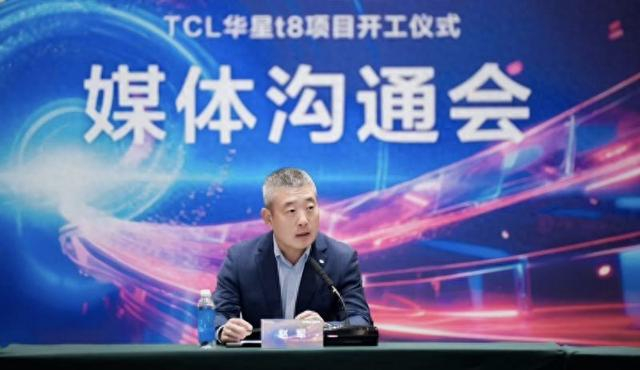
全球首条规模化量产的G8.6代印刷OELD产线正式开工
Nan Fang Ri Bao Wang Luo Ban· 2025-10-22 09:08
Core Insights - The TCL Huaxing T8 project, the world's first mass production G8.6 generation printed OLED production line, has commenced construction in Guangzhou with a total investment of approximately RMB 29.5 billion, expected to achieve an annual output value of RMB 12.1 billion upon reaching full production [1][2] - The T8 project features advantages of low energy consumption, low resource consumption, and high material utilization, with a design capacity of 22,500 sheets per month [1] - The project aims to accelerate the large-scale implementation of printed OLED technology in the global mid-to-high-end market, leveraging innovations such as industrial robots, AI models, and new materials [1][2] Industry Context - The G8.6 generation line and inkjet printing (IJPOLED) technology represent the forefront of global display technology, allowing precise printing of organic light-emitting materials onto OLED screens [2] - The project is seen as a critical breakthrough for China's new display industry, enabling a shift from following to leading in the high-generation AMOLED sector [2] - The Guangdong-Hong Kong-Macao Greater Bay Area is recognized as a key region for innovation in the electronic information industry, with a well-integrated industrial chain [2] Ecosystem Development - The T8 project will facilitate the establishment of a complete industrial chain ecosystem covering materials, equipment, panels, and terminals, with several leading global suppliers already committed to collaborating with TCL Huaxing [3]
总投资295亿元 TCL华星t8项目正式开工
Zhong Guo Jing Ji Wang· 2025-10-22 07:46
Core Viewpoint - The T8 project by TCL Huaxing marks the establishment of the world's first mass production G8.6 generation printed OLED production line, representing a significant technological breakthrough for Chinese display companies in the high-generation AMOLED field [2][4]. Group 1: Project Overview - The T8 project officially commenced construction in Guangzhou on October 21, with a total investment of approximately RMB 29.5 billion and a construction period of 24 months, aiming for mass production in the second half of 2027 [1]. - The project is designed to process about 22,500 glass substrates (2290mm×2620mm) per month, primarily targeting the mid-size market for displays, laptops, and tablets [1]. Group 2: Technological Advancements - The T8 project is expected to achieve a 50% localization rate for equipment in its first phase, with further increases anticipated in subsequent phases [2]. - The project aims to overcome bottlenecks in key materials and core equipment through collaboration with upstream and downstream enterprises, universities, and research institutions [2][3]. Group 3: Industry Impact - The T8 project will enhance the synergy between TCL Huaxing's existing production lines in Guangzhou, Shenzhen, and Huizhou, creating a robust ecosystem for printed OLED technology [3]. - The project is positioned to accelerate the establishment of a complete industrial chain ecosystem covering materials, equipment, panels, and terminals [3]. Group 4: Cost and Performance Benefits - The T8 project is expected to reduce overall costs by over 15% upon mass production, with significant improvements in material utilization and equipment costs [4]. - The printed OLED technology offers advantages such as high display performance, with the ability to cover applications from 5-inch mobile devices to 65-inch televisions, targeting high-value scenarios like medical and professional monitors [4]. Group 5: Investment Returns - The investment payback period for the T8 project is anticipated to be shorter than the typical 5-7 years for high-generation displays, due to the competitive edge of printed OLED technology [5].
TCL华星t8项目开工:推动印刷OLED技术在全球中高端市场规模化落地
Huan Qiu Wang· 2025-10-22 02:20
Core Insights - The TCL Huaxing T8 project has officially commenced, with a total investment of approximately 29.5 billion RMB [1][3] - The T8 project represents the world's first mass production line for G8.6 generation printed OLED technology, marking a significant technological advancement for Chinese display companies [3] - The project aims to enhance the entire OLED industry chain, from materials to terminal products, by fostering collaboration with leading global suppliers [3][4] Investment and Development - The T8 project is a collaboration between TCL Huaxing, the Guangzhou Municipal Government, and the Guangzhou Economic and Technological Development Zone Management Committee [1] - The project is expected to accelerate the establishment of a complete ecosystem for printed OLED technology, including upstream and downstream enterprises [3] - TCL Huaxing has invested in printed OLED technology for 12 years, achieving mass production and stable capacity at its G5.5 generation production line [4] Market Position and Future Prospects - The T8 project is designed to process approximately 22,500 glass substrates per month, facilitating the large-scale application of printed OLED technology in mid-sized displays [4] - The initial applications of printed OLED products will focus on monitors, laptops, and tablets, with plans to expand into higher value-added display applications in the future [4] - The project aims to meet the growing demand for a full range of printed OLED products, providing solutions that offer low blue light, stable wide color gamut, and uniformity across multiple screens [4]
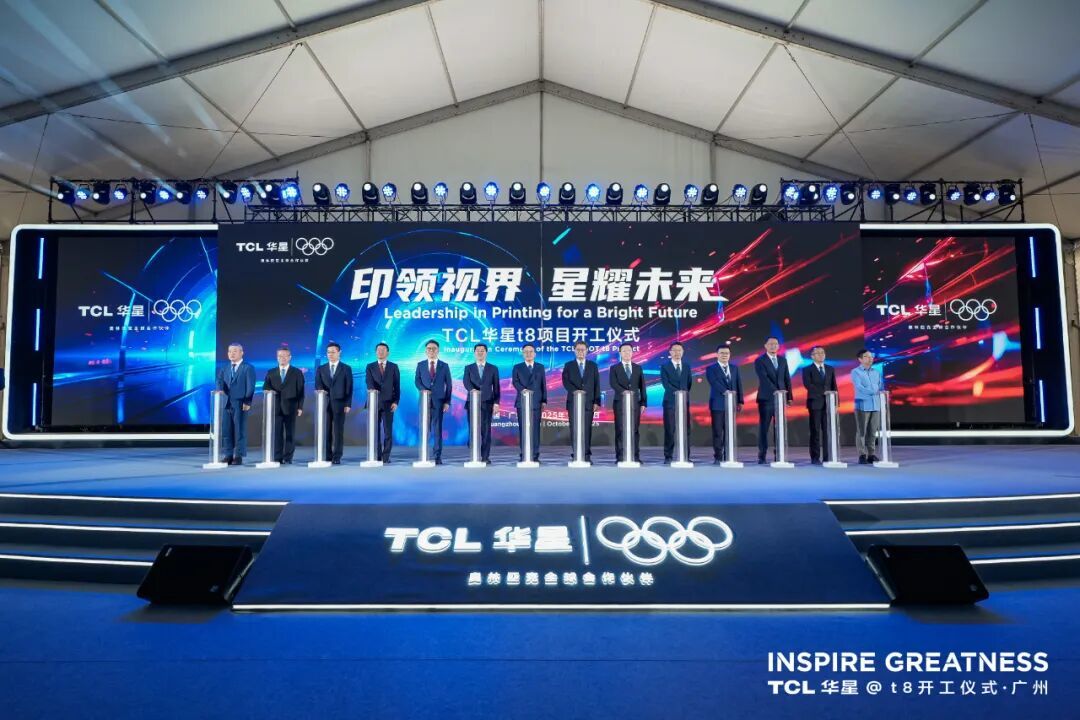
从“跟跑”迈向“领跑” “中国好屏”弯道超车
Guang Zhou Ri Bao· 2025-10-22 02:09
Core Insights - TCL Huaxing's T8 project marks the world's first mass production G8.6 generation printed OLED production line, showcasing China's potential to lead in high-generation AMOLED technology [1][4][6] - The project represents a significant investment of approximately 29.5 billion RMB and is part of the "Hundred Million Thousand Project" in Guangzhou [1][6] Technology Development - The T8 project utilizes G8.6 substrate specifications and inkjet printing (IJPOLED) technology, which is considered the most advanced and promising direction in the global display field [4] - This technology allows for precise printing of organic light-emitting materials onto OLED screens, leading to lower costs, higher material utilization, and superior color performance [4][5] Market Positioning - The T8 project is expected to enable China's OLED industry to transition from a follower to a leader in the global new display industry [4][6] - TCL Huaxing aims to meet the demand for large-scale production of printed OLED products, providing solutions with low blue light, stable wide color gamut, and uniformity across multiple screens [5] Industry Collaboration - The project will accelerate the establishment of a cluster of upstream and downstream enterprises in the printed OLED ecosystem, covering materials, equipment, panels, and terminals [7] - Several leading global material and equipment suppliers have expressed intent to collaborate with TCL Huaxing to enhance the printed OLED supply chain [7] Regional Development - The T8 project signifies a new level of cooperation between Guangzhou and TCL in the new display field, highlighting Guangzhou's role as a manufacturing hub [6] - The Guangzhou Development Zone and Huangpu District are actively promoting industrial projects, with TCL Huaxing's T8 project being a key initiative among others [7]
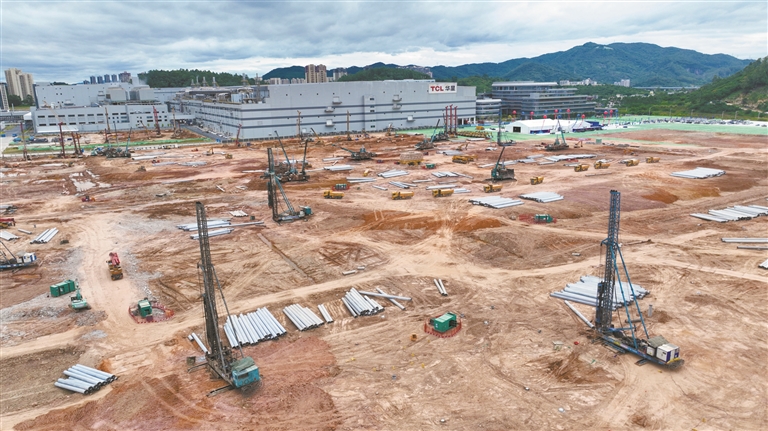
全球首条高世代印刷OLED生产线TCL华星t8项目正式开工
Guang Zhou Ri Bao· 2025-10-22 01:47
Core Viewpoint - The groundbreaking ceremony for TCL Huaxing's 8.6-generation printed OLED display panel production line project (referred to as "t8 project") took place in Guangzhou, marking a significant investment in the advanced display technology sector and contributing to the local economy [2][3]. Group 1: Project Overview - The t8 project represents the world's first high-generation printed OLED production line with a total investment of approximately 29.5 billion yuan [4]. - The monthly production capacity of the t8 project is set to reach 22,500 glass substrates, focusing on high-end display products such as flat panels, laptops, and monitors [4]. - The project will utilize TCL Huaxing's independently developed 8.6-generation substrate specifications and inkjet printing technology, aiming for lower costs, higher material utilization, and superior color performance in display products [4]. Group 2: Government and Industry Support - Guangzhou's municipal leaders expressed their congratulations on the project's commencement and acknowledged TCL's contributions to the city's economic and social development [3]. - The local government is committed to providing high-quality and efficient services to support the project's construction and the development of enterprises [3]. - The project is part of Guangzhou's strategic focus on developing 15 key industrial clusters, with ultra-high-definition and new display technologies being a priority area [3].
杉杉重整投资人离奇被换真相浮水:一切由遴选小组决定
2 1 Shi Ji Jing Ji Bao Dao· 2025-10-22 00:35
Core Viewpoint - The creditor meeting for the restructuring plan of Sunwoda Group has been overshadowed by the unexpected exit of a key investor, Saimaike Advanced Materials Co., Ltd, which has filed a lawsuit against the restructuring management and another investor, New Yangzi Trading, claiming exclusion from the investment process [1][3]. Group 1: Legal Proceedings - Saimaike has initiated legal action against the restructuring management and New Yangzi Trading, alleging that they were excluded from the restructuring investor qualification without consent, seeking to invalidate the investment agreement [1][3]. - The court is currently reviewing the case and has urged the leading investor, New Yangzi Trading, to negotiate with Saimaike to resolve the matter, indicating uncertainty regarding the establishment of the restructuring agreement [3]. Group 2: Restructuring Process - The restructuring management, Zhonglun Law Firm, clarified that during the second round of submissions, New Yangzi Trading designated a new investment entity, New Yangchuan Investment, while Saimaike remained involved in the submission process [1][2]. - The selection committee found the initial investment proposal unsatisfactory due to a lack of a controlling party and a lengthy payment cycle, leading to the eventual confirmation of New Yangzi Trading as the controlling party after optimizing the investment terms [2]. Group 3: Investor Dynamics - The restructuring agreement was signed without Saimaike's prior knowledge, raising concerns about the fairness and transparency of the process, which is supposed to adhere to principles of fairness and openness [4][5]. - Saimaike argues that its exclusion from the investment agreement not only harms its interests but also affects other potential investors, as the stock price of Sunwoda has significantly increased, creating potential for substantial profits for the remaining investors [4][5].

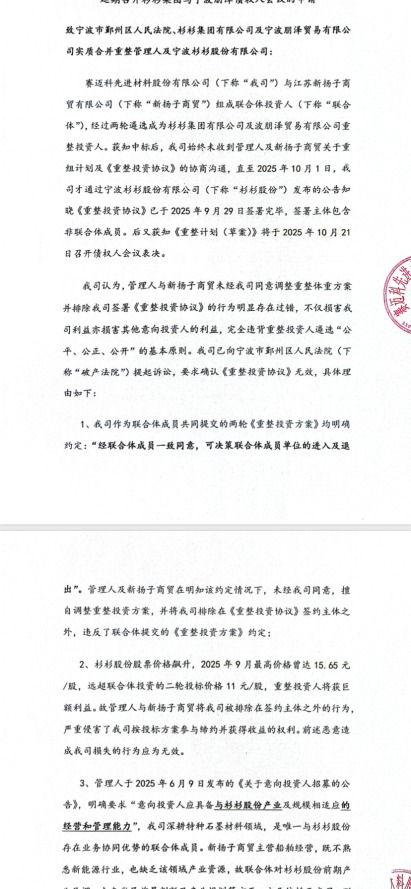
【早报】深夜急跌!黄金一度创12年来最大单日跌幅;特朗普称将于明年初访问中国,外交部回应
财联社· 2025-10-21 23:11
Industry News - The Ministry of Industry and Information Technology (MIIT) is soliciting opinions on the mandatory national standard revision plan for vehicle factory qualification certificates, which will include key information such as combined driving assistance systems and energy storage devices [7] - MIIT is also seeking feedback on the draft guidelines for the construction of a computing power standard system (2025 version), aiming to revise over 50 standards by 2027 across various aspects including computing facilities and applications [7] - The Guangdong Provincial Government has issued an action plan for the high-quality development of manufacturing empowered by artificial intelligence from 2025 to 2027, supporting the application of industrial intelligent computing power and the cultivation of industrial software and intelligent equipment [8] - The State Administration for Market Regulation has approved the release of six testing methods for illegal food additives, which can detect 43 non-food substances, including 28 antihypertensive drug components [8] Company News - Wens Foodstuff Group announced a net profit of 1.781 billion yuan for the third quarter, a year-on-year decrease of 65.02% [9] - Pop Mart International is expected to see a year-on-year revenue growth of 245% to 250% in the third quarter [9] - China Telecom reported a net profit of 30.8 billion yuan for the first three quarters, representing a year-on-year increase of 5% [10] - Wanchen Group announced a year-on-year net profit growth of 917% for the first three quarters [11] - Xinqianglian reported a staggering year-on-year net profit growth of 1940% for the first three quarters [12] - Huajian Group stated that there are no major asset restructuring or injection plans involving the company within the next 12 months [13] - New Yisheng announced that its controlling shareholder is transferring shares, reducing the holding ratio to 6.24% [13] - Xiechuang Data plans to procure servers worth up to 4 billion yuan from multiple suppliers to provide cloud computing services [13] - Guanghua Technology received a warning letter for disclosing undisclosed information during an online communication with brokers [13] - Zhuhai Free Trade Zone Group plans to transfer 100% equity of Gree Real Estate to Toujie Holdings, which is expected to constitute a major asset restructuring [13] - China Integrated Circuit Fund reduced its holdings in Zhongdian Port by 3.0197 million shares [13] - Shanshan Group and TCL Technology responded to a lawsuit from Semai Ke, stating that a third creditors' meeting was held as scheduled on the 21st [13]




TCL华星t8项目正式开工 加速构建印刷OLED生态
Zheng Quan Shi Bao· 2025-10-21 17:37
Core Insights - TCL Huaxing's T8 project marks the commencement of the world's first mass production G8.6 generation printed OLED production line, representing a significant technological leap for Chinese display companies from "catching up" to "leading" in the high-generation AMOLED sector [2][3] - The project has a total investment of approximately 29.5 billion yuan, co-funded by TCL Huaxing, the Guangzhou Municipal Government, and the Guangzhou Economic and Technological Development Zone Management Committee [2] - The T8 project aims to enhance the entire printed OLED ecosystem, facilitating the establishment of a comprehensive industrial chain covering materials, equipment, panels, and terminals [2] Company Developments - TCL Huaxing has invested 12 years in technological innovation in printed OLED, achieving mass production with the G5.5 generation production line (T12) starting in November 2024, which provides reliable experience for the T8 project [3] - The T8 project is designed to process approximately 22,500 glass substrates per month, accelerating the global market penetration of printed OLED technology in mid-to-high-end applications [3] - The project will prioritize applications in displays, laptops, and tablets, with plans to expand into more high-value display scenarios in the future [3] Industry Impact - The Guangdong-Hong Kong-Macao Greater Bay Area is recognized as a key region for innovation in the electronic information industry, with a complete industrial chain and deep integration of production, education, research, and application [2] - The collaboration with leading global material and equipment suppliers will enhance the construction of the printed OLED supporting system, further solidifying TCL Huaxing's position in the industry [2] - The T8 project is expected to provide competitive display solutions for companies like Lenovo, contributing to China's advancement in global display technology [3]
全球首条高世代印刷OLED生产线开工建设
Zheng Quan Ri Bao· 2025-10-21 16:38
Core Viewpoint - TCL Technology Group's subsidiary, TCL Huaxing, has commenced construction of the world's first high-generation printed OLED production line, the t8 project, which aims to enhance China's competitiveness in the display industry and reduce reliance on foreign technology [2][3]. Investment and Development - The t8 project has a total investment of approximately 29.5 billion yuan, co-funded by TCL Huaxing and local government entities [2]. - The project is expected to achieve a monthly processing capacity of about 22,500 glass substrates, targeting mid-size IT applications such as flat panels, laptops, and monitors [2]. Technological Advancements - The printed OLED technology features a unique RGB pixel arrangement, resulting in richer image details and smoother edges, which enhances overall display quality [3]. - Printed OLEDs have a material utilization rate exceeding 90%, significantly higher than the 30% rate of traditional evaporation techniques, leading to lower production costs and higher efficiency [3]. Market Potential - The t8 project is positioned to expand the application of printed OLED technology into mid-size displays, with plans to develop screens for monitors, laptops, and potentially automotive displays [4][5]. - Market research predicts that AMOLED panels in IT and automotive sectors will experience substantial growth, with compound annual growth rates of 38% for laptops, 26% for automotive displays, and 15% for desktop monitors by 2030 [5].