HYPC(000703)

Search documents
恒逸石化(000703) - 关于实施权益分派期间“恒逸转2”暂停转股的公告
2025-06-09 12:47
| 证券代码:000703 | 证券简称:恒逸石化 | 公告编号:2025-057 | | --- | --- | --- | | 债券代码:127067 | 债券简称:恒逸转 2 | | 恒逸石化股份有限公司 关于实施权益分派期间"恒逸转2"暂停转股的公告 本公司及董事会全体成员保证信息披露的内容真实、准确、完整,没有虚假 记载、误导性陈述或重大遗漏。 特别提示: "恒逸转2" 债券代码:127067 债券简称:恒逸转2 转股起止时间:2023年1月30日至2028年7月20日 特此公告。 恒逸石化股份有限公司董事会 2025年6月9日 1 附件: 《恒逸石化股份有限公司公开发行可转换公司债券募集说明书》中"转股 价格的调整方式及计算公式"条款的规定: 在本次发行之后,若公司发生派送股票股利、转增股本、增发新股(不包 括因本次发行的可转换公司债券转股而增加的股本)、配股以及派发现金股利 等情况,将按下述公式进行转股价格的调整(保留小数点后两位,最后一位四 舍五入): 派送股票股利或转增股本:P1=P0/(1+n); 增发新股或配股:P1=(P0+A×k)/(1+k); 暂停转股时间:2025年6月11日起 ...

恒逸石化(000703) - 关于实施权益分派期间“恒逸转债”暂停转股的公告
2025-06-09 12:47
| 证券代码:000703 | 证券简称:恒逸石化 | 公告编号:2025-056 | | --- | --- | --- | | 债券代码:127022 | 债券简称:恒逸转债 | | 恒逸石化股份有限公司 关于实施权益分派期间"恒逸转债"暂停转股的公告 本公司及董事会全体成员保证信息披露的内容真实、准确、完整,没有虚假 记载、误导性陈述或重大遗漏。 特别提示: "恒逸转债" 债券代码:127022 鉴于恒逸石化股份有限公司(以下简称"公司")将于近日实施公司2024年 度权益分派,根据公司"恒逸转债"之《恒逸石化股份有限公司公开发行可转换 公司债券募集说明书》中"转股价格的调整方式及计算公式"(详见附件)条款 的规定,自2025年6月11日起至本次权益分派股权登记日止,公司"恒逸转债" (债券代码:127022)将暂停转股,本次权益分派股权登记日后的第一个交易日 起恢复转股。在上述期间,公司可转换公司债券正常交易,敬请公司可转换公司 债券持有人注意。 特此公告。 恒逸石化股份有限公司董事会 2025年6月9日 1 附件: 债券简称:恒逸转债 转股起止时间:2021年4月22日至2026年10月15日 暂停 ...
重磅!2025年中国及31省市纺织行业政策汇总及解读(全)“纺织行业加速推进高端化”
Qian Zhan Wang· 2025-06-09 02:23
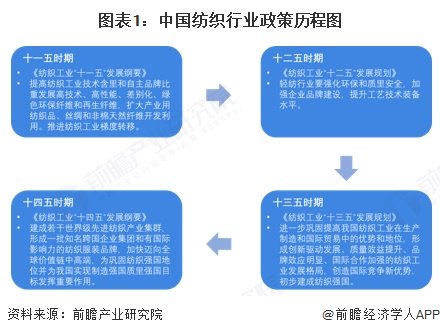
Core Viewpoint - The article discusses the evolution and current policies of China's textile industry, emphasizing the government's support for digital transformation, quality improvement, and sustainable development to enhance the industry's global competitiveness and achieve the goals of becoming a manufacturing and quality powerhouse [1][3]. Policy Evolution - During the "11th Five-Year Plan," the focus was on increasing the technological content and brand proportion in the textile industry, promoting high-tech and environmentally friendly fibers, and expanding the use of non-cotton natural fibers [1]. - The "12th Five-Year Plan" emphasized environmental protection, quality safety, and brand building within the light textile industry [1]. - The "13th Five-Year Plan" aimed to consolidate China's advantages in textile manufacturing and international trade, establishing the country as a textile powerhouse [1]. - The "14th Five-Year Plan" seeks to elevate the textile industry to a higher position in the global value chain, contributing to the goals of becoming a manufacturing and quality strong nation [1]. National Policy Summary and Interpretation - Recent national policies, such as the "Three-Year Action Plan for Digital Transformation of the Textile Industry (2022-2024)" and the "Implementation Plan for Quality Improvement and Upgrading of the Textile Industry (2023-2025)," provide a favorable macro environment and policy support for the industry's development [3][4]. - These policies aim to promote healthy and rapid development across various segments of the textile supply chain and enhance the industry's global competitiveness [3]. Key Policy Details - The "Implementation Plan" outlines goals for 2025, including: - R&D expenditure intensity of 1.3% for large-scale textile enterprises [8]. - 70% of large-scale textile enterprises achieving digital networking [8]. - Reduction in energy and water consumption per unit of industrial added value, along with continuous decreases in major pollutant emissions [8]. - Improvement in the quality and scale of recycled textile products, aiming to establish 20 globally recognized brands [8]. Key Tasks and Focus Areas - Accelerate innovation-driven development and enhance independent innovation capabilities by focusing on key technology breakthroughs and establishing industry innovation platforms [9]. - Promote high-end manufacturing in textiles and expand the application of functional chemical fibers across various sectors of the economy [9]. - Develop smart manufacturing and improve industry quality and efficiency through the adoption of digital technologies [9]. - Advance green and circular low-carbon development by promoting energy-saving and pollution-reducing technologies [9]. - Enhance the resilience of the supply system to meet and lead fashion consumption upgrades [9]. - Optimize regional industrial layouts and foster open cooperation within the textile industry [9]. Provincial Policy Summary - Various provinces have introduced policies to support the development of the textile industry, focusing on high-quality growth, digital transformation, and the promotion of environmentally friendly materials [12][14]. - For example, Guangdong aims to enhance the digital transformation of its textile industry by 2025, achieving over 60% integration of digital technologies [16].


大炼化周报:长丝价格承压,产销下滑-20250608
Soochow Securities· 2025-06-08 09:53
1. Report Industry Investment Rating No information about the industry investment rating is provided in the content. 2. Core View of the Report The report focuses on the weekly data of the large refining and chemical industry, including price, profit, inventory, and operating rate of different sectors such as polyester, refining, and chemicals, as well as the performance and profit forecasts of related listed companies [2][8]. 3. Summary According to Relevant Catalogs 3.1 Big Refining Weekly Data Briefing - **Price and Spread**: The domestic key large refining project spread this week was 2,675 yuan/ton, a week - on - week decrease of 48 yuan/ton (-2%); the foreign key large refining project spread was 1,063 yuan/ton, a week - on - week decrease of 23 yuan/ton (-2%). The average price of PX this week was 832.1 dollars/ton, a week - on - week decrease of 8.0 dollars/ton, and the spread to crude oil was 356.4 dollars/ton, a week - on - week decrease of 13.1 dollars/ton [2]. - **Polyester Plate**: The average prices of POY/FDY/DTY this week were 6,979/7,279/8,200 yuan/ton respectively, with week - on - week changes of -57/-21/+0 yuan/ton. Their weekly average profits were 96/30/44 yuan/ton, with week - on - week increases of +8/+31/+46 yuan/ton. The inventory was 16.5/21.6/28.4 days, with week - on - week increases of +2.7/+0.9/+1.1 days. The filament operating rate was 89.1%, a week - on - week decrease of 0.6 pct. The downstream loom operating rate was 61.3%, a week - on - week decrease of 1.1 pct [2]. - **Refining Plate**: Domestic refined oil prices: gasoline, diesel, and jet fuel prices rose this week. US refined oil prices: gasoline prices fell, while diesel and jet fuel prices rose [2]. - **Chemical Plate**: The PX operating rate was 84.6%, a week - on - week increase of 3.9 pct [2]. - **Related Listed Companies**: Private large refining and chemical & polyester filament companies include Hengli Petrochemical, Rongsheng Petrochemical, Orient Shenghong, Hengyi Petrochemical, Tongkun Co., Ltd., and Xin凤鸣 [2]. - **Stock Price and Profit Forecast**: The report provides the stock price changes of 6 private refining and chemical companies in different time periods and their profit forecasts from 2024A to 2027E [8]. 3.2 Big Refining Weekly Report 3.2.1 Big Refining Index and Project Spread Trend The report shows the changes in the Shanghai - Shenzhen 300, petroleum and petrochemical, and oil prices, as well as the weekly spreads of domestic and foreign large refining projects [14][16]. 3.2.2 Polyester Plate It presents various data such as the prices, spreads, operating rates, inventories, and production - sales ratios of PX, PTA, MEG, polyester filaments (POY, FDY, DTY), polyester staple fibers, and polyester bottle chips [10]. 3.2.3 Refining Plate The report details the prices, spreads, and changes of domestic, US, European, and Singapore refined oil products (gasoline, diesel, jet fuel) compared to crude oil [10]. 3.2.4 Chemical Plate It provides the prices, spreads, and changes of various chemical products such as pure benzene, styrene, acrylonitrile, polycarbonate, MMA, etc., compared to crude oil [10].


石油化工行业周报:关注OPEC增产进度,油价或延续震荡-20250604
Yong Xing Zheng Quan· 2025-06-04 09:03
Investment Rating - The report maintains an "Increase" rating for the oil and petrochemical industry [5] Core Viewpoints - International oil prices have shown a downward trend recently, with Brent crude settling at approximately $63.90 per barrel, down about 1.30% week-on-week, and down approximately 15.80% since the beginning of the year [19][21] - The North American active rig count has decreased week-on-week, with a notable year-on-year decline of 37 rigs, indicating a potential future increase in global drilling platform activity [31] - The refining sector shows promising recovery potential, with significant increases in price differentials for various products, suggesting improved profitability for refining companies [35] Market Performance - The CITIC oil and petrochemical sector rose approximately 0.37% during the week of May 26 to May 30, outperforming the Shanghai Composite Index by about 0.39 percentage points [16] - Key stocks that led the gains include Hengtong Co., Hongtian Co., and Compton, while stocks like Guangju Energy and Dongfang Shenghong saw declines [17][18] Investment Recommendations - The report identifies four main investment themes: 1. Focus on major energy state-owned enterprises like China National Petroleum and China National Offshore Oil Corporation, which are pushing for oil and gas exploration and green transformation [53] 2. Increased global upstream capital expenditure benefiting oil service companies such as CNOOC Services and Offshore Engineering [53] 3. Accelerated development of coal chemical projects and natural gas resources in Xinjiang, with a focus on companies like Baofeng Energy and New Natural Gas [53] 4. Refining companies planning new capacities and accelerating new material projects, recommending companies like Satellite Chemical and Hengli Petrochemical [53]



恒逸石化(000703) - 关于回购公司股份(第五期)事项的进展公告
2025-06-03 09:31
证券代码:000703 证券简称:恒逸石化 公告编号:2025-055 恒逸石化股份有限公司 关于回购公司股份(第五期)事项的进展公告 本公司及董事会全体成员保证信息披露的内容真实、准确、完整,没有虚假 记载、误导性陈述或重大遗漏。 一、回购股份基本情况 恒逸石化股份有限公司(以下简称"公司"或"恒逸石化")于 2024 年 10 月 22 日召开的第十二届董事会第十五次会议审议通过了《关于以集中竞价交易方式回 购公司股份方案(第五期)的议案》。同意公司使用自有资金及股票回购专项贷 款资金,以集中竞价交易方式回购公司股份,回购资金总额不低于人民币 12,500 万元,不超过人民币 25,000 万元;回购价格为不超过人民币 9.00 元/股;回购期 限为公司自董事会审议通过本回购方案之日起 12 个月内。具体内容详见公司在 巨潮资讯网上披露的《关于以集中竞价交易方式回购股份方案(第五期)暨取得 金融机构股票回购专项贷款的公告》(公告编号:2024-110)、《关于以集中竞 价交易方式回购股份(第五期)的回购报告书》(公告编号:2024-111)。 (1)自可能对本公司证券及其衍生品种交易价格产生重大影响的重大 ...
石化民企龙头ESG报告出炉,恒力石化排放最高、增幅最大 | ESG信披洞察
Xin Lang Cai Jing· 2025-05-31 08:23
Core Insights - The petrochemical industry is a cornerstone of modern economic development and a major carbon emitter, with China's petrochemical sector emitting 1.4 billion tons of carbon in 2022, accounting for 18% of industrial carbon emissions and 12% of national emissions [1] Group 1: Carbon Emissions Data - In 2024, the total greenhouse gas emissions for four major private petrochemical companies are as follows: - Dongfang Shenghong: 30.1 million tons CO2 equivalent [4] - Hengli Petrochemical: 53.92 million tons CO2 equivalent, a year-on-year increase of approximately 64% [4][5] - Hengyi Petrochemical: 7.94 million tons CO2 equivalent, a year-on-year decrease of 1.9% [5] - Rongsheng Petrochemical: 29.39 million tons CO2 equivalent, a year-on-year increase of 1.1% [5] Group 2: Emission Breakdown - Hengli Petrochemical's emissions include: - Scope 1: 47.2 million tons CO2 equivalent, up about 51% year-on-year [4] - Scope 2: 6.72 million tons CO2 equivalent, up over three times year-on-year [4] - Dongfang Shenghong's emissions include: - Scope 1: 15.81 million tons CO2 equivalent - Scope 2: 14.29 million tons CO2 equivalent [5] - Rongsheng Petrochemical's emissions include: - Scope 1: 26.41 million tons CO2 equivalent - Scope 2: 2.98 million tons CO2 equivalent [5] - Hengyi Petrochemical's emissions include: - Scope 1: 6.13 million tons CO2 equivalent - Scope 2: 1.81 million tons CO2 equivalent [4] Group 3: Environmental Investments - Dongfang Shenghong has the highest environmental investment at 1.84 billion yuan, followed by Hengyi Petrochemical at approximately 400 million yuan, Hengli Petrochemical at 375 million yuan, and Rongsheng Petrochemical at 270 million yuan [8] Group 4: Waste Management - The hazardous waste production for the companies is as follows: - Hengli Petrochemical: 148,000 tons - Dongfang Shenghong: 91,300 tons - Hengyi Petrochemical: 437 tons - Rongsheng Petrochemical: 337,000 tons [8] Group 5: Carbon Management Initiatives - Dongfang Shenghong is advancing CO2 resource utilization by capturing CO2 to reduce emissions and exploring new carbon-neutral development pathways [9] - Hengli Petrochemical has implemented systems to reduce CO2 emissions by approximately 3,435.72 tons annually through process optimizations [9] - Hengyi Petrochemical has initiated a renewable energy project in Brunei, with a planned capacity of 476 MWp [9] - Rongsheng Petrochemical has established a high-value CO2 utilization industry chain, reducing emissions by 103,000 tons annually [10]
【投资视角】启示2025:中国纺织行业投融资及兼并重组分析(附投融资事件、产业基金和兼并重组等)
Qian Zhan Wang· 2025-05-29 08:10
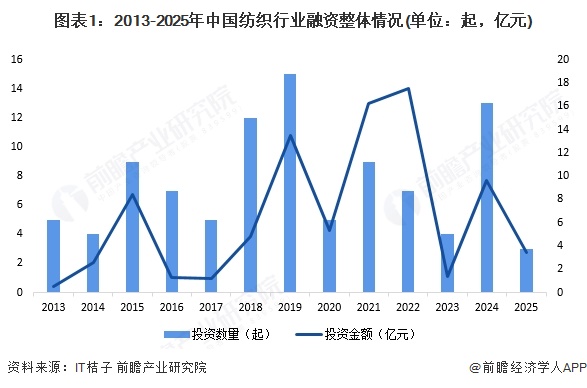
Group 1 - The textile industry in China has experienced fluctuations in investment and financing, with a peak in 2019 and a decline starting in 2020, leading to a total of 13 financing events and an investment amount of 9.65 billion yuan in 2024 [1][20] - Investment rounds in the textile industry are primarily early-stage, focusing on A-round, angel, and strategic investments, indicating a trend towards resource integration and industry chain extension [2] - The majority of financing events are concentrated in Guangdong and Zhejiang provinces, with 21 events each, due to their complete textile industry chain and mature market environment [5] Group 2 - The focus of investment in the textile industry is shifting towards new textile materials, reflecting a strategic direction in the sector [7] - The investment entities in the textile industry are predominantly capital organizations, accounting for 74%, with notable investors including Shenchuang Investment and SoftBank China Capital [11] - There are several textile-related private equity funds established, indicating a growing interest in the sector [14] Group 3 - Horizontal mergers and acquisitions among midstream textile companies have become mainstream as a strategy to expand scale amid intense competition [16][18] - Recent merger and acquisition activities include significant transactions, such as the acquisition of 100% of Longrun Materials by Jiulong Recycling [17] - The overall trend in the textile industry indicates a focus on consolidation through mergers and acquisitions to enhance competitiveness [20]

2025年全球纺织发展现状分析:2024年全球纺织行业产值达1.07万亿美元
Qian Zhan Wang· 2025-05-25 05:06
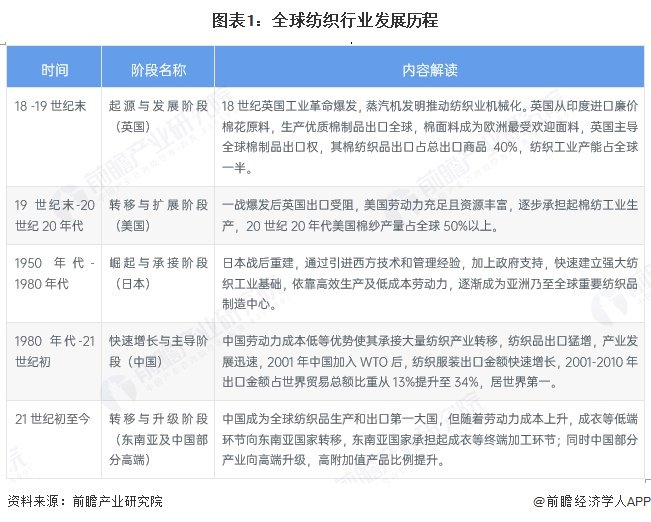
Core Insights - The global textile industry is experiencing a shift towards Southeast Asia, while parts of China's textile sector are upgrading to high-end production [1][4][5] Group 1: Historical Development - The textile industry originated during the 18th century with the British Industrial Revolution, where steam engines significantly increased production efficiency [2] - By the late 19th century, the U.S. began to take over cotton textile production due to labor and resource advantages, with U.S. cotton yarn production exceeding 50% of global output by the 1920s [2] - Japan established a strong textile industry post-World War II through Western technology and government support, becoming a key manufacturing center [2] - China emerged as the world's largest textile producer and exporter in the early 21st century, with textile and apparel exports rising from 13% to 34% of global trade from 2001 to 2010 [2] - Currently, as labor costs rise in China, low-end production is shifting to Southeast Asian countries, while China focuses on high-value products [2][4] Group 2: Market Size and Growth - The global textile industry market value is projected to reach $1.07 trillion in 2024, reflecting a year-on-year growth of approximately 2% [4][5] - The number of companies in the global textile market is estimated at 2.731 million, indicating a significant market presence [5] Group 3: Fiber Production - Global fiber production reached a record high of 124 million tons in 2023, up from 116 million tons in 2022, with polyester fibers accounting for 57% of total fiber production [7] Group 4: Market Structure - The global textile industry exhibits a low concentration level, characterized by a long-tail feature and fragmented competition, with over 3 million registered companies [10] - In the home textile sector, the top three companies hold only 2.31% market share, indicating a highly competitive environment [10] Group 5: Regional Contribution - East Asia dominates the global textile industry, accounting for $717.7 billion, or 66.89% of the total market value [12]
2025年中国纺织行业经营效益分析:行业盈利能力减弱,毛利率周期性波动显著
Qian Zhan Wang· 2025-05-21 07:12
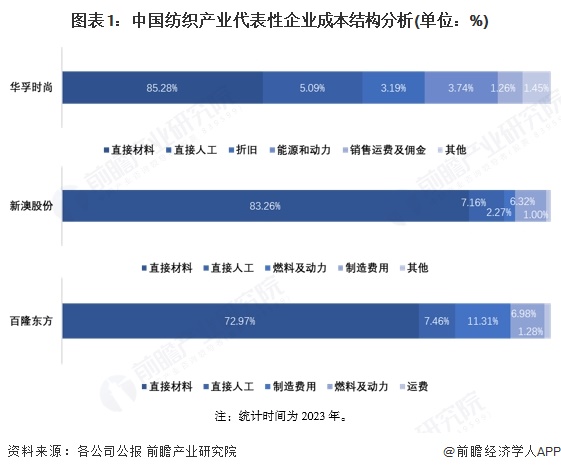
Group 1: Cost Structure Analysis - In the textile industry, direct material costs constitute the primary component of production costs, accounting for approximately 70%-85% of total costs, which significantly impacts pricing and profitability [1][4] - Fluctuations in raw material prices have a notable effect on cost control and profitability, leading companies to adopt strategies such as centralized purchasing, hedging, and advance stocking to mitigate risks [1] Group 2: Price Transmission Mechanism - The textile industry operates through a supply, manufacturing, and sales chain, where costs from the supply side, including raw materials and labor, are transmitted to the manufacturing side as production costs, which then influence consumer pricing through demand elasticity [4] Group 3: Value Distribution in the Textile Industry - Sales represent the most critical segment of the textile value chain, with downstream apparel and home textile brands holding significant bargaining power, while upstream suppliers have limited negotiation capabilities, resulting in intense price competition and low profitability for textile manufacturers [6] Group 4: Industry Operating Efficiency - From 2015 to 2023, the total profit of China's textile industry has shown a downward trend, indicating weakened profitability; however, in 2024, the total profit for textile enterprises (excluding apparel and chemical fiber) is projected to reach 86.87 billion yuan, reflecting a year-on-year increase of 3.5% after two consecutive years of decline [10] Group 5: Profitability of Textile Enterprises - The gross profit margin in the textile industry exhibits significant quarterly cyclicality, typically fluctuating between 10% and 12%, with November generally showing higher margins above 11%, while May and August tend to have lower margins due to seasonal production and sales factors [11]