
AVIC XAC(000768)

Search documents
军贸逻辑有望驱动板块重估,高端装备ETF(159638)上涨1.60%,成分股航天电子涨停
Sou Hu Cai Jing· 2025-08-04 02:55
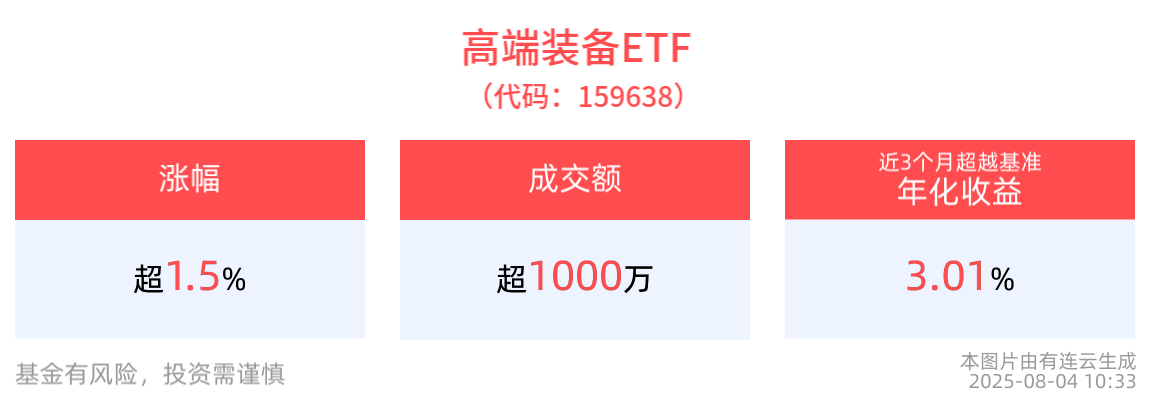
Group 1: High-end Equipment ETF Performance - The high-end equipment ETF has a turnover rate of 1.54% with a transaction volume of 18.92 million yuan as of August 1 [2] - The latest scale of the high-end equipment ETF reached 1.199 billion yuan, with leveraged funds continuing to invest, showing a financing buy-in amount of 2.1449 million yuan and a financing balance of 19.1817 million yuan [2] - Over the past year, the net value of the high-end equipment ETF has increased by 26.30%, with the highest monthly return since inception being 19.30% and the longest consecutive monthly increase lasting 3 months with a maximum increase of 21.15% [2] Group 2: Defense and Aerospace Industry Insights - The PE-TTM of the national defense and military industry is at 84.92, which is in the 77.27 percentile over the past decade, indicating a relatively high valuation level [2] - The aerospace equipment industry has a PE-TTM of 76.50, placing it in the 71.02 percentile historically, suggesting strong valuation levels [2] - Increased regional conflicts are enhancing national security demands, leading to a global rise in military spending, which is expected to expand the military trade market and drive sector revaluation [2] Group 3: Commercial Aerospace Industry Development - The commercial aerospace industry in China is in the early stages of growth, characterized by high enthusiasm and numerous startups, but with uneven development among companies [3] - Regulatory policies introduced aim to strengthen quality supervision throughout the entire lifecycle of commercial aerospace projects, promoting standardized development in the industry [3] - As of July 31, 2025, the top ten weighted stocks in the CSI High-end Equipment Sub-index account for 46.03% of the index, with key players including AVIC Shenyang Aircraft, Aero Engine Corporation of China, and others [3]


无人机蜂群+机器狗协同系统首次展示,国防ETF(512670)涨近1%
Xin Lang Cai Jing· 2025-08-04 01:50
Group 1 - The "drone swarm + robotic dog" collaborative system has been showcased, with Kesi Technology's control chip achieving millisecond-level response for hundreds of devices, and the procurement budget for a single system exceeding 50 million yuan [1] - As of August 4, 2025, the CSI Defense Index (399973) rose by 0.56%, with notable increases in constituent stocks such as Haige Communication (002465) up 3.11% and AVIC Aircraft (600038) up 2.29% [1] Group 2 - The current "14th Five-Year Plan" is nearing its conclusion, and the upcoming September 3 military parade is expected to catalyze a significant reshaping of the military industry sector, which has shown a strong upward trend recently [2] - The military industry is anticipated to enter a new phase of growth and value, moving away from previous cyclical fluctuations driven solely by events, supported by the strategic goal of building a world-class military by 2050 [2] Group 3 - The Defense ETF closely tracks the CSI Defense Index, which includes listed companies under the ten major military groups and those providing weaponry to the armed forces, reflecting the overall performance of defense industry stocks [3] - As of July 31, 2025, the top ten weighted stocks in the CSI Defense Index accounted for 43.88% of the index, with companies like AVIC Shenyang Aircraft (600760) and AVIC Engine (600893) among the leaders [3]


军工周报:福建舰入列进入最后攻坚时刻,关注海洋装备投资机会-20250803
NORTHEAST SECURITIES· 2025-08-03 10:14
Investment Rating - The report does not explicitly state an investment rating for the defense and military industry but highlights a positive outlook for long-term growth potential [4]. Core Insights - The defense and military industry is expected to experience a recovery in demand as the "14th Five-Year Plan" approaches its final year, with a clear directive for modernization by 2035 and a world-class military by 2050 [4]. - The report emphasizes the significant impact of AI technology on military equipment and decision-making, showcasing its transformative value in modern warfare, particularly highlighted by the ongoing Russia-Ukraine conflict [2][39]. - The report identifies specific investment opportunities in the military sector, particularly in AI applications, low-altitude economy developments, and the upcoming commissioning of the Fujian aircraft carrier [3][38]. Summary by Sections Market Review - The defense and military index rose by 0.08% last week, ranking 6th among 31 primary industries, while the overall market indices declined [2][13]. - The current PE (TTM) for the defense and military sector is 84.92, with sub-sectors showing varied valuations, such as aerospace equipment at 146.02 and ground armaments at 189.72 [2][21]. Key Recommendations - The report recommends focusing on companies involved in downstream manufacturing, military technology, underwater equipment, missile supply chains, titanium materials, electronic components, and laser weapons [4]. - Specific companies highlighted include Hongdu Aviation, AVIC Shenyang Aircraft, and Reicoh Laser among others [4]. Industry Dynamics - The report discusses the emergence of low-altitude economy opportunities, driven by recent policy initiatives and technological advancements in drone logistics and infrastructure [3][32][37]. - The military AI sector is identified as a core growth driver, with expectations for a surge in orders for AI-enabled equipment by 2025 [40].


中航西飞:截至2025年7月31日公司的股东人数是155584户
Zheng Quan Ri Bao Wang· 2025-08-01 12:13
证券日报网讯中航西飞(000768)8月1日在互动平台回答投资者提问时表示,截至2025年7月31日,公 司的股东人数是155584户。 ...
国产航母概念下跌1.45%,10股主力资金净流出超3000万元
Zheng Quan Shi Bao Wang· 2025-08-01 09:30
Group 1 - The domestic aircraft carrier concept index declined by 1.45%, ranking among the top declines in the concept sector as of the market close on August 1 [1] - Within the domestic aircraft carrier concept sector, major stocks such as Beifang Navigation, Guorui Technology, and Optoelectronics experienced significant declines, while a few stocks like Bowei Alloy, China Marine Defense, and Nanshan Holdings saw slight increases [1][2] - The domestic aircraft carrier concept sector experienced a net outflow of 674 million yuan from main funds, with 27 stocks seeing net outflows, and 10 stocks having outflows exceeding 30 million yuan [2] Group 2 - The top net outflow stocks in the domestic aircraft carrier concept included Beifang Navigation with a net outflow of 210 million yuan, followed by Hailanxin and China Shipbuilding with outflows of 117 million yuan and 79.72 million yuan respectively [2][3] - The stocks with the highest net inflows included Haige Communication, China Power, and Zhenxin Technology, with inflows of 90.39 million yuan, 33.53 million yuan, and 13.88 million yuan respectively [2][3] - The trading volume and turnover rates varied among the stocks, with Beifang Navigation showing a turnover rate of 7.92% and a decline of 7.05% [2][3]


把握航天航空投资机遇,航天ETF(159267)正式上市
2 1 Shi Ji Jing Ji Bao Dao· 2025-08-01 01:07
Core Viewpoint - The article highlights the growth potential and investment opportunities in the aerospace and defense industry, particularly focusing on the commercial space sector and the domestic aircraft manufacturing market, driven by favorable policies and technological advancements [7][8][9]. Group 1: Aerospace and Defense Industry Overview - The Huazhong National Aerospace Industry ETF closely tracks the National Aerospace Industry Index, which includes high-quality companies in aerospace equipment, military electronics, ground weaponry, and aerospace equipment, with a defense industry representation of 98.2% [2]. - Key companies in the National Aerospace Index include AVIC Shenyang Aircraft Corporation (weight 8.37%, market cap 182.41 billion), AVIC Xi'an Aircraft Industry Group (weight 5.36%, market cap 79.96 billion), and others [3]. Group 2: Historical Performance - Since 2020, the National Aerospace Index has achieved a cumulative return of 38.4%, with an annualized return of 6.4% and an annualized volatility of 33.4%, showing significant excess returns during market rebounds compared to the China Securities Military Industry Index [5]. Group 3: Catalysts for Growth - The commercial space sector is entering a new phase of scale and marketization, supported by recent regulatory frameworks from the National Space Administration aimed at enhancing quality supervision [7][8]. - The domestic aircraft market is seeing stable deliveries of the C919 aircraft, with China Commercial Aircraft Corporation predicting the delivery of 9,323 aircraft over the next 20 years, valued at approximately 1.4 trillion USD [9]. - The low-altitude economy is expanding rapidly, with a projected market size of 1.064 trillion RMB by 2026, reflecting a growth rate of 33.8% in 2023 [10]. Group 4: Policy and Regulatory Environment - Strengthened regulations and new policies from the Science and Technology Innovation Board are expected to enhance project quality and industry management, promoting long-term healthy development in the aerospace sector [11]. - The frequency of space launches has reached a new high, with 35 successful launches in the first half of the year, indicating a robust growth trajectory for the industry [11].


中证航空航天指数报10440.45点,前十大权重包含中航沈飞等
Jin Rong Jie· 2025-07-31 08:58
Core Viewpoint - The China Aerospace and Aviation Index (CS Aerospace, H30213) has shown significant growth, with a 2.97% increase over the past month, 19.87% over the past three months, and 9.41% year-to-date, reflecting the overall performance of listed companies in the aerospace sector [2]. Group 1: Index Performance - The CS Aerospace Index is composed of 50 listed companies in the aerospace sector, with a base date of December 31, 2004, set at 1000.0 points [2]. - The index has experienced a monthly increase of 2.97%, a quarterly increase of 19.87%, and a year-to-date increase of 9.41% [2]. Group 2: Index Composition - The top ten weighted companies in the CS Aerospace Index are: AVIC Shenyang Aircraft (9.77%), Guangqi Technology (8.54%), Aero Engine Corporation of China (7.8%), AVIC Optoelectronics (6.77%), AVIC Xi'an Aircraft (5.51%), AVIC Aircraft (4.24%), Aerospace Electronics (3.69%), AVIC Chengfei (3.45%), AVIC Gaoke (3.11%), and Huace Navigation (2.73%) [2]. - The index's holdings are primarily from the Shanghai Stock Exchange (52.90%) and the Shenzhen Stock Exchange (47.10%) [2]. Group 3: Industry Breakdown - The industry composition of the index shows that aerospace accounts for 78.74%, defense equipment for 15.81%, communication equipment for 2.73%, and software development for 2.72% [2]. Group 4: Sample Adjustment - The index samples are adjusted biannually, with adjustments occurring on the next trading day after the second Friday of June and December, with a sample adjustment ratio not exceeding 20% [3]. - Weight factors are adjusted in accordance with sample changes, and special circumstances may lead to temporary adjustments [3].

中证空天一体军工指数上涨1.32%,前十大权重包含中航成飞等
Jin Rong Jie· 2025-07-29 12:27
Core Viewpoint - The China Securities Index for Aerospace and Military Industry (空天军工指数) has shown significant growth, with a 1.32% increase on the day reported, and notable gains over the past month, three months, and year-to-date [1]. Group 1: Index Performance - The China Securities Aerospace and Military Industry Index rose by 1.32% to 2227.18 points, with a trading volume of 27.607 billion [1]. - Over the past month, the index has increased by 8.99%, by 19.70% over the last three months, and by 14.25% year-to-date [1]. Group 2: Index Composition - The index includes leading companies related to the aerospace and military strategy, covering sectors such as aircraft, power and control systems, early warning systems, weapon systems, C4ISR systems, military digitalization, and aerospace materials [1]. - The top ten weighted companies in the index are: AVIC Shenyang Aircraft (9.45%), Aero Engine Corporation of China (7.41%), AVIC Optoelectronics (6.42%), AVIC Xi'an Aircraft (5.33%), Philihua (4.5%), AVIC Aircraft (3.9%), Aerospace Electronics (3.56%), Haige Communications (3.43%), AVIC Chengfei (3.34%), and Western Superconducting (3.23%) [1]. Group 3: Market and Sector Breakdown - The index's holdings are primarily listed on the Shanghai Stock Exchange (56.17%) and Shenzhen Stock Exchange (43.83%) [2]. - The industry composition of the index includes: Industrial sector (71.88%), Materials (14.41%), Information Technology (7.72%), and Communication Services (5.99%) [2]. Group 4: Index Adjustment Mechanism - The index samples are adjusted biannually, with adjustments occurring on the next trading day after the second Friday of June and December [2]. - Weight factors are generally fixed until the next scheduled adjustment, with special circumstances allowing for temporary adjustments [2]. Group 5: Related Investment Funds - Public funds tracking the aerospace and military industry include: Penghua China Securities Aerospace and Military Industry C and Penghua China Securities Aerospace and Military Industry A [3].

行业双周报:湄公河联合巡逻收官,巴以冲突持续紧张-20250729
GUOTAI HAITONG SECURITIES· 2025-07-29 11:49
Investment Rating - The report rates the military industry as "Overweight" [5][12]. Core Viewpoints - The intensification of great power competition is a long-term trend, indicating a positive long-term outlook for the military industry. Increased defense spending is essential to ensure peace and security, especially as tensions around China may escalate [2][8]. Summary by Sections Investment Highlights - Key investment themes include: 1. General Assembly: AVIC Shenyang Aircraft Corporation, Aerospace South Lake, AVIC Xi'an Aircraft Industry [11]. 2. Components: AVIC Optoelectronics, Aerospace Electric, Guobang Electronics, Ruichuang Micro-Nano [11]. 3. Subsystems: AVIC Onboard, North Navigation [11]. 4. Materials and Processing: AVIC Heavy Machinery, Feilihua, Guangwei Composite, Huayin Technology, Bolite, Western Materials, Aviation Materials [11]. Market Review - The military industry index rose by 1.22% from July 20 to July 25, underperforming the broader market by 0.45 percentage points, ranking 24th out of 29 sectors [13][16]. - The Shanghai Composite Index increased by 1.67%, and the ChiNext Index rose by 2.76% during the same period [13][16]. Major News in the Military Industry - The 155th joint patrol operation in the Mekong River concluded successfully, highlighting international cooperation in regional security [9][24]. - The China Weapon Industry Group showcased new unmanned and anti-unmanned combat systems, emphasizing advancements in military technology [23]. - The successful first flight of the Xinzhou 60 civil rescue aircraft marks a significant step in enhancing China's emergency response capabilities [23]. International Military Situation - The report notes a complex international military landscape, with various nations calling for an end to the Gaza conflict and highlighting the importance of defense construction amid ongoing tensions [10][25]. - The U.S. has increased its military presence in the Pacific, deploying additional submarines in response to perceived threats from China [10][30].


航空航天ETF天弘(159241)实时净申购1000万份,双曲线一号遥十运载火箭发射成功,机构:民营液体火箭商业化运营有望实现“从零到一”突破
2 1 Shi Ji Jing Ji Bao Dao· 2025-07-29 06:02
Group 1 - The aerospace ETF Tianhong (159241) showed a slight increase of 0.25% with a trading volume exceeding 520 million yuan, indicating active market interest in the military industry sector [1] - The ETF has seen a net subscription of 10 million shares in real-time, with a net inflow of over 4.7 million yuan yesterday, reflecting strong investor confidence [1] - The current circulating scale of the aerospace ETF is 415 million yuan, with a total of 351 million shares, and a year-to-date share growth rate of 84.61%, the highest among similar products [1] Group 2 - The China Public Bidding Service Platform announced a tender for rocket launch services for 2025, with a total of 7 launches and 94 satellites, amounting to 1.336 billion yuan [2] - The tender is part of the second round of bidding for Shanghai Yuanxin Satellite Technology Co., indicating a significant acceleration in the construction of the Qianfan constellation [2] - Analysts suggest that the participation of multiple private rocket companies in the bidding could enhance network capacity and expedite satellite constellation development [2]