GF SECURITIES(000776)

Search documents
广发证券股价连续3天下跌累计跌幅6.42%,华泰柏瑞基金旗下1只基金持5028.11万股,浮亏损失7391.33万元
Xin Lang Ji Jin· 2026-02-03 07:14
Core Viewpoint - Guangfa Securities has experienced a decline in stock price, dropping 1.29% to 21.44 CNY per share, with a total market capitalization of 167.765 billion CNY and a cumulative drop of 6.42% over the past three days [1] Group 1: Company Overview - Guangfa Securities, established on January 21, 1994, and listed on June 11, 1997, is located in Guangzhou, Guangdong Province [1] - The company's main business segments include wealth management (40.08%), trading and institutional business (32.27%), investment management (24.97%), investment banking (2.14%), and others (0.54%) [1] Group 2: Shareholder Insights - Huatai-PB Fund's Huatai-PB CSI 300 ETF (510300) reduced its holdings by 2.4035 million shares in the third quarter, now holding 50.2811 million shares, representing 0.66% of circulating shares, with a floating loss of approximately 14.0787 million CNY today [2] - The fund has incurred a total floating loss of 73.9133 million CNY during the three-day decline [2] Group 3: Fund Performance - Huatai-PB Quantitative Leading Mixed A (460009) increased its holdings by 14,800 shares in the fourth quarter, now holding 180,200 shares, which accounts for 1.05% of the fund's net value, with a floating loss of about 50,500 CNY today [3] - The fund has achieved a year-to-date return of 6.04%, ranking 1755 out of 8874 in its category, and a one-year return of 45.12%, ranking 2036 out of 8124 [3]

广发证券:玉米种业处于去库存阶段 政策推动行业高质量发展
智通财经网· 2026-02-03 06:45
Group 1 - The seed industry is currently in a destocking phase, with overall inventory levels high, reaching over 12 billion yuan in Q3 2025, the highest since 2015 [1] - The area for seed production in 2025 is projected to be 3.85 million acres, a 10% decrease year-on-year, with production expected to be 1.527 billion kilograms, also down 10% [1] - The net profit for listed seed companies, excluding non-recurring gains, is expected to be close to -1 billion yuan in Q3 2025, indicating significant losses [1] Group 2 - The newly revised Plant Variety Protection Regulations in April 2025 aim to enhance variety rights protection and encourage breeding innovation, with a notable decrease in the number of corn varieties approved [2] - A total of 1,564 crop varieties were approved in the national review for 2025, remaining stable compared to 2024, but with a significant reduction in corn varieties [2] Group 3 - The number of high-quality, disease-resistant rice varieties has been steadily increasing, with 53 new varieties expected by 2025, showing significant improvements in yield and disease resistance [3] - New rice varieties from Longping High-Tech have demonstrated over 5% yield increase in trials, with improved disease resistance and quality [3] Group 4 - The Ministry of Agriculture's 2025 corn spring planting technical guidelines emphasize the importance of reasonable planting density, with some varieties suitable for densities of 6,500 to 7,000 plants per acre [4] - The average yield of newly approved corn varieties has surpassed 800 kilograms per acre, a 1.7% increase year-on-year, with 61 varieties in the Northwest ecological zone exceeding 1,000 kilograms per acre [4]
广发证券:AI记忆上游基础设施价值量、重要性提升 建议关注产业链核心受益标的
智通财经网· 2026-02-03 06:05
Core Insights - The report from GF Securities highlights the emergence of AI memory as a foundational capability that supports contextual continuity, personalization, and historical information reuse, which is expected to accelerate the deployment of AI applications like AI Agents [1] Group 1: AI Memory and Infrastructure - AI memory is transitioning from being viewed as a cost item to an asset item, leading to increased value and importance of related upstream infrastructure [1] - NVIDIA has launched the AI inference context storage platform ICMS, which addresses the growing demand for long-term context memory layers in multi-turn reasoning scenarios [1] Group 2: Performance and Economic Viability of ICMS - The ICMS platform demonstrates superior performance in SSD usage, with significantly lower unit costs compared to GPU memory and scalable capacity in TB and PB [2] - WEKA's performance evaluation of its enhanced memory grid (AMG) shows that ICMS can effectively handle long-term context while maintaining stable throughput, achieving up to 4 times higher throughput compared to other solutions as user pools grow [2] Group 3: Market Potential for Context Storage - The estimated storage requirements for context memory indicate that supporting 100,000 simultaneous users or agents with a large context model could require approximately 45PB of storage, assuming a retention factor of 15x [3]

广发证券:容量电价日臻完善 新型储能核心受益
智通财经网· 2026-02-03 03:31
Core Insights - The report from GF Securities highlights the improvement in the economics of new energy storage, the stability of thermal power profitability, and the quality enhancement of pumped storage [1][3]. Historical Context - The national capacity pricing policy was initially explored through pumped storage and coal power, followed by the expansion to natural gas and new energy storage due to electricity shortages [1]. - Various provinces are actively exploring diverse capacity mechanisms for new energy storage, with some regions implementing capacity compensation policies for independent storage starting in 2023, although the specifics vary [1]. Development Trends - The Chinese government is reinforcing the construction of capacity pricing mechanisms as part of the electricity market reform, with a new policy set to be released on January 30, 2026, to optimize the market mechanism and promote fair competition among various power sources [2]. - Several provinces have begun to implement localized policies, such as Inner Mongolia and Xinjiang providing compensation for storage discharge, while others like Hebei have not established clear standards for capacity compensation [2]. Impact Analysis - The implementation of the national capacity pricing policy is expected to lead to a gradual rollout of provincial policies, enhancing the certainty and economic viability of energy storage [3]. - The revenue model for coal power is shifting towards asset-based, with an anticipated marginal increase of 1.3 cents in thermal power capacity income, which will lower expected energy prices and facilitate market clearing [3]. - The new mechanisms for pumped storage are expected to ensure revenue for existing units while pressuring new units to control operational costs [3].
广发证券:新宠物主与宠均消费提升驱动行业持续增长 重视功能性食品的产品风口机会
智通财经网· 2026-02-03 02:57
Industry Overview - The pet consumption market in urban China is projected to reach approximately 312.6 billion yuan by 2025, representing a year-on-year growth of 4% compared to 2024. The growth rates for the cat and dog consumption markets are 5% and 3%, respectively. The main drivers of industry growth are new pet owners and increased per capita spending on pets [1][2]. Brand Landscape - Preference for domestic brands continues to rise, with intense competition among brands. The preference for domestic brands in cat and dog food is expected to reach 38% and 35% by 2025, up from 16% and 20% in 2022. The industry has experienced several growth phases, including the e-commerce boom in 2018 and the "cat economy" in 2020, with domestic brands becoming more sensitive to changes in categories and channels, thus enhancing their market share and influence [3]. Product Innovation - The competition in baked pet food is intensifying, and functional pet food may become a new growth area. Consumer preferences have shifted towards baked and freeze-dried foods, surpassing traditional puffed foods. The current trend indicates that functional pet foods, which include products designed for specific health benefits, are gaining traction. Key functional food categories include weight management, urinary health, gastrointestinal health, coat care, and senior pet nutrition [4]. Channel Transformation - There is a focus on new instant retail channels. The market share for major online platforms such as Tmall, JD.com, Douyin, and Pinduoduo is approximately 29%, 9%, 9%, and 10%, respectively. The combination of offline locations and online channels in O2O instant retail is currently experiencing high growth, with rapid growth rates across various product categories [5].
金融工程:大类资产及权益风格月报(2026年1月):宏观视角看好权益资产,小盘风格有望占优-20260203
GF SECURITIES· 2026-02-03 02:32
Quantitative Models and Construction Methods Macro Indicator Trend Model - **Model Name**: Macro Indicator Trend Model - **Construction Idea**: Establish the relationship between macro indicators and asset performance by analyzing the trend of macro indicators and their impact on monthly asset returns[17][18] - **Construction Process**: - Use monthly moving averages of macro indicators to classify them into upward or downward trends - Apply T-test to determine whether the distribution of monthly returns of assets differs significantly under upward and downward trends - Formula: $ t = \frac{\overline{R_1} - \overline{R_2}}{\sqrt{\frac{(n_1-1)S_1^2 + (n_2-1)S_2^2}{n_1+n_2-2}(\frac{1}{n_1} + \frac{1}{n_2})}} \sim t_{n_1+n_2-2} $ - $\overline{R_1}$ and $\overline{R_2}$: Average monthly returns under upward and downward trends - $S_1$ and $S_2$: Standard deviations of monthly returns under upward and downward trends - $n_1$ and $n_2$: Number of months under upward and downward trends[17][18] - **Evaluation**: Effectively identifies macro indicators with significant impacts on asset returns[17][18] Technical Perspective Model - **Model Name**: Technical Perspective Model - **Construction Idea**: Evaluate asset trends, valuation, and fund flows using historical data and specific calculation methods[22][23][25] - **Construction Process**: - **Trend**: Use closing prices or LLT indicators to calculate trend indicators. Assign +1 for upward trends and -1 for downward trends[22] - **Valuation**: Calculate equity risk premium (ERP) as the reciprocal of PE(TTM) minus the 10-year government bond yield. Define historical 5-year percentile as: $ (Current ERP - Historical 5-year ERP Minimum) / (Historical 5-year ERP Maximum - Historical 5-year ERP Minimum) $ Assign scores based on percentile levels: +2 for >90%, +1 for 70%-90%, 0 for 30%-70%, -1 for 10%-30%, -2 for <10%[23][25] - **Fund Flows**: Calculate monthly active net inflows for indices and assess marginal changes. Assign +1 for positive changes and -1 for negative changes[26] - **Evaluation**: Provides a comprehensive view of asset trends, valuation, and fund flows[22][23][25] Fixed Proportion + Macro Indicators + Technical Indicators Combination Model - **Model Name**: Fixed Proportion + Macro Indicators + Technical Indicators Combination Model - **Construction Idea**: Adjust asset weights based on macro and technical indicators while maintaining a fixed proportion baseline[36][40] - **Construction Process**: - Set baseline weights for equity, bonds, commodities, and currency assets - Adjust weights monthly based on macro and technical indicator signals[36][40] - **Evaluation**: Balances fixed proportion allocation with dynamic adjustments for improved performance[36][40] Controlled Volatility + Macro Indicators + Technical Indicators Combination Model - **Model Name**: Controlled Volatility + Macro Indicators + Technical Indicators Combination Model - **Construction Idea**: Limit annualized volatility to 6% while dynamically adjusting weights based on macro and technical indicators[46][50] - **Construction Process**: - Use risk parity as the baseline weight - Adjust weights monthly based on macro and technical indicator signals[46][50] - **Evaluation**: Reduces volatility while maintaining competitive returns[46][50] Equity Style Rotation Models - **Model Name**: Equity Style Rotation Models (Large/Small Cap and Growth/Value) - **Construction Idea**: Adjust weights between equity styles based on macro and technical indicators[57][58] - **Construction Process**: - Set baseline weights for large/small cap and growth/value styles - Adjust weights monthly based on macro and technical indicator signals[57][58] - **Evaluation**: Captures style rotation opportunities for enhanced returns[57][58] --- Model Backtesting Results Macro Indicator Trend Model - **Annualized Return**: Not explicitly provided - **Maximum Drawdown**: Not explicitly provided - **Annualized Volatility**: Not explicitly provided Technical Perspective Model - **Annualized Return**: Not explicitly provided - **Maximum Drawdown**: Not explicitly provided - **Annualized Volatility**: Not explicitly provided Fixed Proportion + Macro Indicators + Technical Indicators Combination Model - **Annualized Return**: 10.20%[40] - **Maximum Drawdown**: 9.27%[40] - **Annualized Volatility**: 6.14%[40] Controlled Volatility + Macro Indicators + Technical Indicators Combination Model - **Annualized Return**: 10.46%[50] - **Maximum Drawdown**: 7.37%[50] - **Annualized Volatility**: 5.54%[50] Large/Small Cap Rotation Model - **Annualized Return**: 14.30%[61] - **Maximum Drawdown**: 49.10%[61] - **Annualized Volatility**: 22.30%[61] Growth/Value Rotation Model - **Annualized Return**: 14.43%[68] - **Maximum Drawdown**: 45.18%[68] - **Annualized Volatility**: 21.57%[68]
2026年第三期中国铁路建设债券募集说明书摘要
Zhong Guo Zheng Quan Bao - Zhong Zheng Wang· 2026-02-02 22:56
Group 1 - The issuer of the bond is China National Railway Group Co., Ltd., and the total issuance scale is 10 billion yuan for the "2026 Third Phase China Railway Construction Bond" [4][29] - The bond is divided into two types: a 10-year bond with a scale of 5 billion yuan and a 30-year bond with a scale of 5 billion yuan, totaling 10 billion yuan [21][29] - The bonds will be issued at a fixed interest rate, with the 10-year bond's interest rate being the Shibor benchmark rate plus a basic spread ranging from -0.3% to 0.7%, and the 30-year bond's interest rate ranging from 0.1% to 1.1% [21][29] Group 2 - The main underwriter for this bond issuance is Guotai Junan Securities Co., Ltd., which is responsible for managing the underwriting team and coordinating the issuance process [5][31] - The bonds will be publicly issued to institutional investors through a bidding system on the Shenzhen Stock Exchange [22][31] - The bonds will be registered and held by the Shenzhen branch of the China Securities Depository and Clearing Corporation and the Central Government Bond Registration and Clearing Co., Ltd. [24][30] Group 3 - The bonds will have a maturity date of February 5, 2036, for the 10-year bond and February 5, 2056, for the 30-year bond [27] - The bonds will be issued at par value of 100 yuan, with a minimum subscription unit of 10 million yuan [24][29] - The bonds will be guaranteed by the Railway Construction Fund, providing an irrevocable joint liability guarantee [29]


广发证券:国内航司亏损收敛、扭亏兑现 淡季盈利压力下行业修复趋势仍在延续
智通财经网· 2026-02-02 08:21
Core Viewpoint - The overall performance forecast for Chinese airlines in 2025 indicates a trend of "significantly reduced losses, some airlines turning profitable, and accelerated profit differentiation" [2][3]. Group 1: Annual Performance Forecast - China Southern Airlines and Hainan Airlines have turned profitable, contributing significantly to the sector's profit recovery, while Air China and China Eastern Airlines remain in the loss zone, with China Eastern's losses narrowing [1][2]. - China Southern Airlines and Hainan Airlines are the core contributors to profit recovery, while Huaxia Airlines continues to show growth, reflecting the relative advantages of regional routes and operational flexibility [2][3]. Group 2: Quarterly Performance Insights - In Q4 2025, the industry remains under pressure with losses prevailing, but most airlines show significant year-on-year improvements, indicating a continued recovery trend despite seasonal profitability pressures [1][2]. Group 3: Future Outlook - Demand remains a key variable for ticket price recovery and profit improvement, with domestic passenger volume expected to grow moderately due to normalized consumer travel and enhanced leisure tourism [4]. - The supply constraints and cost pressures are likely to amplify profit elasticity, with slow aircraft deliveries maintaining capacity control and policies aimed at reducing disorderly competition stabilizing revenue quality [4]. Group 4: Recommended Stocks - The top picks include Hainan Airlines (600221.SH) and Huaxia Airlines (002928.SZ), with a focus on China National Aviation (601111.SH, 00753), Juneyao Airlines (603885.SH), and Spring Airlines (601021.SH) [5].



【广发金工】分红与股指期货基差月报:2026年1月底统计
广发金融工程研究· 2026-02-02 07:07
Summary of Key Points Core Viewpoint - The article provides an overview of the dividend progress of various stock indices and their components, highlighting the current status of dividend proposals, approvals, and implementations across different sectors. Group 1: Broad Index Dividend Progress - In the CSI 300 index, one company has passed the board proposal stage for dividends [1] - In the SSE 50 index, one company has also passed the board proposal stage for dividends [1] - In the CSI 500 index, one company has implemented dividends, totaling 1.30 billion [4] - In the CSI 1000 index, one company is at the shareholder proposal stage for dividends [1] Group 2: Industry Index Dividend Progress - In the pharmaceutical and biotechnology sector, one company has implemented dividends totaling 0.66 billion, and another has passed the shareholder meeting approval stage [2][6] - In the public utilities sector, one company has passed the shareholder meeting approval stage for dividends [2][6] - In the machinery and equipment sector, one company is at the shareholder proposal stage, and another is at the board proposal stage [2][6] - In the coal sector, one company has implemented dividends totaling 1.30 billion [2][6] - In the oil and petrochemical sector, one company has implemented dividends totaling 0.14 billion [2][6] Group 3: Stock Index Futures Basis - The annualized basis rates for the CSI 300 near-month, far-month, near-quarter, and far-quarter contracts are -0.25%, 0.04%, 0.44%, and 0.55% respectively [3] - The annualized basis rates for the SSE 50 near-month, far-month, near-quarter, and far-quarter contracts are -0.89%, -1.30%, -1.67%, and -1.57% respectively [3] - The annualized basis rates for the CSI 500 near-month, far-month, near-quarter, and far-quarter contracts are -4.14%, -2.29%, -0.53%, and 1.11% respectively [3] - The annualized basis rates for the CSI 1000 near-month, far-month, near-quarter, and far-quarter contracts are -1.56%, 1.25%, 4.20%, and 5.11% respectively [3]


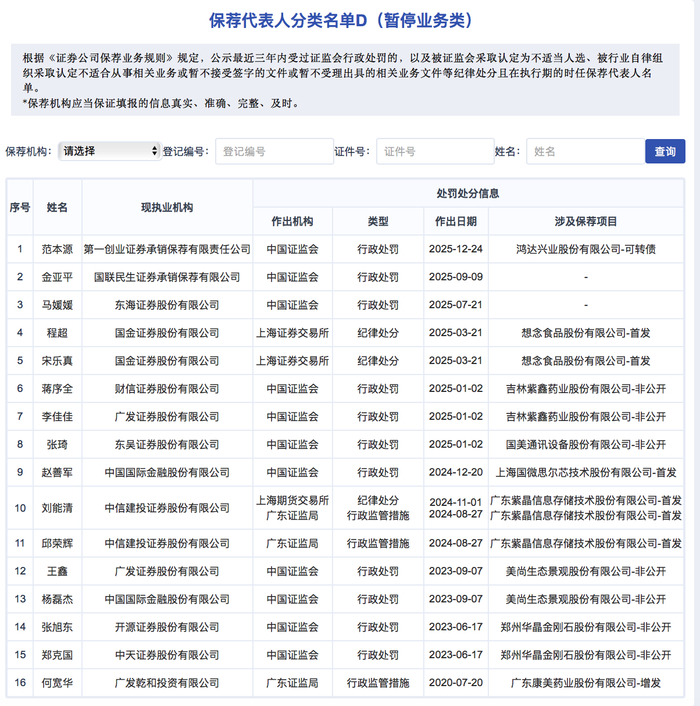
签字资格按下“暂停键”,11家券商的16名保代被评D类,新增三家
Xin Lang Cai Jing· 2026-02-02 06:00
Core Viewpoint - The China Securities Association has updated the classification list of sponsor representatives, with 16 individuals rated as D-class, temporarily losing their signing qualifications due to various violations [1][4]. Group 1: D-Class Representatives - A total of 16 D-class representatives are involved, with 11 brokerage firms represented, including notable firms like Guotai Junan Securities and CICC, each having two representatives on the list [5][8]. - Compared to the D-class list updated in June last year, 4 representatives have been removed, while 3 new representatives have been added from First Capital Securities, Guolian Minsheng Securities, and Dongwu Securities [1][5]. Group 2: Violations and Penalties - The violations of the D-class representatives include issues related to convertible bonds, IPOs, and private placements, with some facing significant fines [4][6]. - For instance, Fan Benyuan from First Capital Securities was penalized for failing to detect misuse of approximately 1.7 billion yuan in fundraising for a convertible bond project, resulting in a total penalty of about 16.98 million yuan [5][6]. - Jin Yaping from Guolian Minsheng Securities was noted for a unique case of severe penalties due to long-term stock trading violations, amounting to over 10 million yuan [5][6]. Group 3: Regulatory Mechanism - The D-class classification is part of a regulatory mechanism that has evolved since its inception, with the latest revisions in September 2024 introducing stricter criteria for classification based on recent administrative penalties [8][9]. - The classification aims to enforce accountability among sponsor representatives, ensuring that violations lead to significant repercussions, thereby enhancing the integrity of the IPO process [9][10]. - The current C-class list includes 281 representatives, with 86 added in 2025, indicating a dynamic adjustment in regulatory oversight [10].